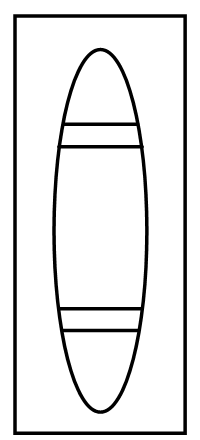
- AIris
- BPupil
- ✓Choroid
- DBlind spot
|
|
Column $I$
$($Position of the object$)$
|
|
Column $II$
$($Position of the image$)$
|
|
Column $III$
$($Type of Image$)$
|
|
$(a)$
|
Object beyond $2F$
|
$(i)$
|
At $2F$
|
$(p)$
|
Real, inverted, large
|
|
$(b)$
|
Object at $2F$
|
$(ii)$
|
Same side as the object
|
$(q)$
|
Virtual, erect, magnified
|
|
$(c)$
|
Object between $F$ and $2F$
|
$(iii)$
|
Beyond $2F$
|
$(r)$
|
Real, inverted, same size
|
|
$(d)$
|
Object within the focal length
|
$(iv)$
|
Between $F$ and $2F$
|
$(s)$
|
Real, inverted, diminished
|
|
$(a)-(ii)-(p);$
|
$(b)-(iii)-(q);$
|
$(c)-(iv)-(r);$
|
$(d)-(i)-(s)$
|
|
$(a)-(iv)-(s);$
|
$(b)-(i)-(r);$
|
$(c)-(iii)-(p);$
|
$(d)-(ii)-(q)$
|
|
$(a)-(iii)-(q);$
|
$(b)-(ii)-(s);$
|
$(c)-(ii)-(r);$
|
$(d)-(iii)-(p)$
|
|
$(a)-(i)-(r);$
|
$(b)-(iv)-(p);$
|
$(c)-(i)-(s);$
|
$(d)-(iv)-(q)$
|
|
$(a)-(iv)-(s);$
|
$(b)-(i)-(r);$
|
$(c)-(iii)-(p);$
|
$(d)-(ii)-(q)$
|


Whatever may be the position of object, a convex mirror always forms a virtual, erect and diminished image.
Object distance after shifting the object $= 4\ m + 0.5 \ m = 4.5\ m$ For a plane mirror;
Object distance = Image distance $= 4.5 \ m$
Distance between the object and its image $= 4.5 + 4.5 = 9\ m.$
The diameter of the eye ball is approximately $2.3\ cm.$
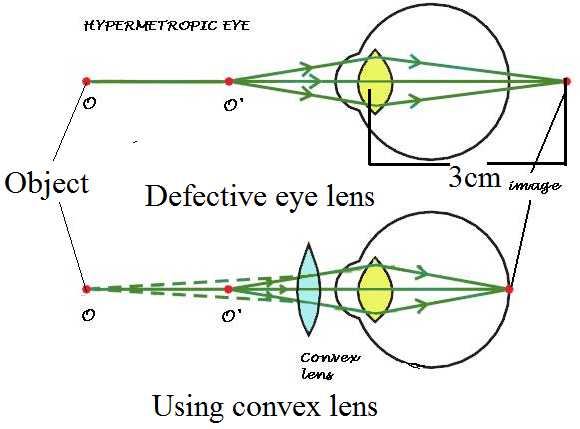
Images are formed on the retina of the normal eye, which is approximately $2.3\ cm$ behind the pupil.The formation of an image $3\ cm$ away from the pupil of the eye indicates that the light rays are focused behind the retina. For proper visibility, the light rays must focus on the retina.

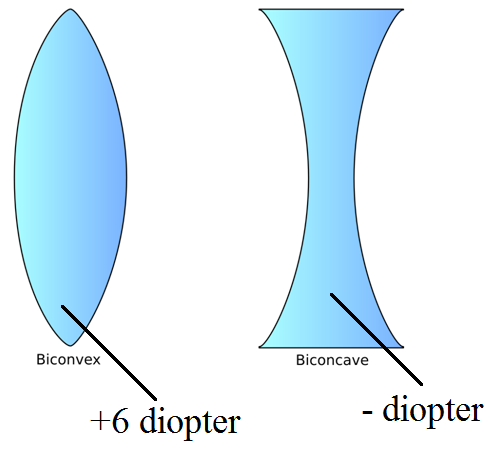
It can be concluded that Shyam is suffering from hypermetropia and a convex lens can be used to correct this defect.
A concave mirror is used by $E.N.T.$ doctors to get a magnified image of internal organs like ear, nose and throat.


$ T$ is a laterally symmetrical object and hence its image in a plane mirror would be the same as itself.