Question types

Materials : Metals and Non-Metals question types

461 questions across 8 question groups — pick any mix to generate a Science paper with step-by-step answer keys.

461
Questions
8
Question groups
5
Question types
Sample Questions

Materials : Metals and Non-Metals questions

One sample from each question group in this chapter. Select any group above to see the full set with answer keys.

Metals like zinc and aluminium react with sodium hydroxide to produce $...........$ gas.
  • A
    Hydrogen sulphide.
  • Hydrogen
  • C
    Oxygen
  • D
    Sulphur dioxide.

Answer: B.

View full solution
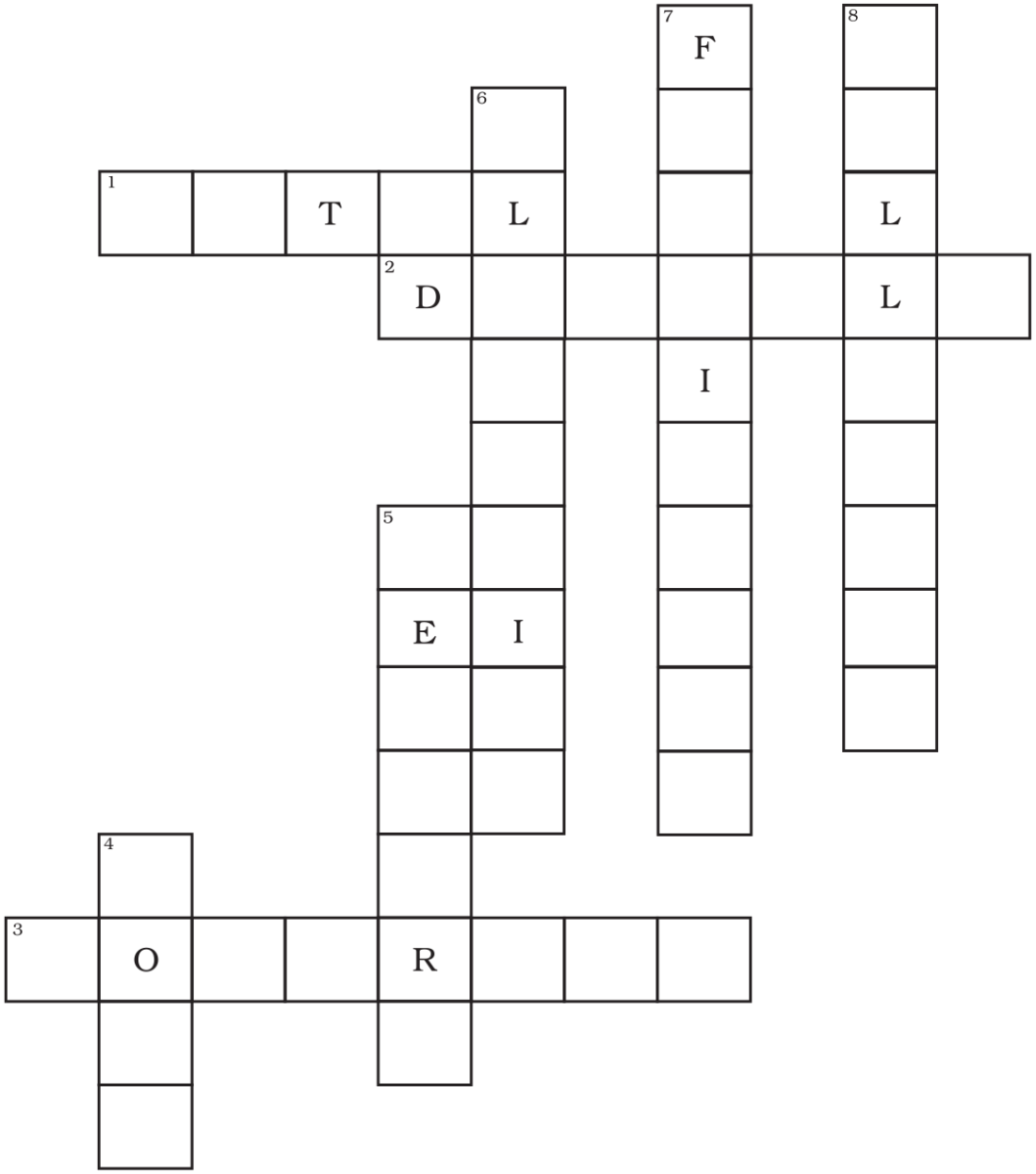
Complete the crossword given in Fig. with the help of the clues. Across:
$1.$ Which is generally hard, ductile, malleable and sonorous.
$2.$ A metal is called so it can be drawn into wires.
$3.$ Metal bells are used because of this property.
Down:
$4.$ A metal generally used for making jewellery.
$5.$ A metal which is liquid at room temperature.
$6.$ A metal which reacts with acid as well as base to form hydrogen gas.
$7.$ Substances used to enhance the growth of plants.
$8.$ Property by virtue of which metals can be beaten into thin sheets.
View full solution
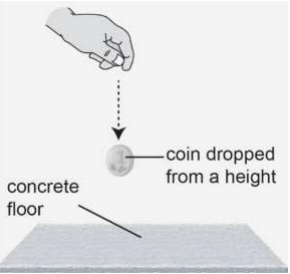
Mayank dropped four coins from the same height onto a concrete floor.
Image

The table below shows the type of sound that each coin produced after hitting the floor.
Coin Temperature of the ball when heated for a minute
Coin $1$ Ringing sound
Coin $2$ Damp sound
Coin $3$ Damp sound
Coin $4$ Ringing sound
$9.$ Which coins in Mayank’s activity are made of metal$?$
$A.$ Coin $1$ and Coin $2$
$B.$ Coin $2$ and Coin $3$
$C.$ Coin $3$ and Coin $4$
$D$. Coin $4$ and Coin $1$
$10.$ On which type of loor will Mayank’s activity produce the same results$?$
$A.$ Glass
$B.$ Sand
$C.$ Grass
$D.$ Carpet
View full solution
A scientist injected nitrogen dioxide gas in water.
He dropped a blue litmus paper in the water after the reaction was over.
The litmus paper turned red.
$7.$ What can be concluded from the experiment$?$
$A.$ A salt is produced by the reaction.
$B.$ An acid is produced by the reaction.
$C.$ Nitrogen gas is produced by the reaction.
$D.$ Hydrogen gas is produced by the reaction.
$8.$ The scientist heated the water after the reaction was over. Will there be any change in the colour of the litmus paper that turned red? Explain your answer.
View full solution
The equations below show four chemical reactions.
$(i)$ Copper sulphate $+$ Zinc $\rightarrow$ Zinc sulphate $+$ Copper
$(ii)$ Copper sulphate $+$ Iron $\rightarrow$ Iron sulphate $+$ Copper
$(iii)$ Iron sulphate $+$ Copper $\rightarrow$ no reaction
$(iv)$ Zincsulphate $+$ Copper $\rightarrow$ no reaction
$5.$ What can be concluded from the above reactions$?$
$A.$ Copper is less reactive than both zinc and iron
$B.$ Zinc is less reactive than iron but more reactive than copper
$C.$ Copper is less reactive than zinc but more reactive than iron
$D.$ Iron is less reactive than both zinc and copper
$6.$ Why is example $(i)$ regarded as a displacement reaction? Explain your answer. 
View full solution
Peter hammered four balls made of different materials.
He then heated each ball for a minute.
The table below shows what Peter observed.
Ball What happens to the ball when hammered? Temperature of the ball when heated for a minute
Ball $1$ Flattens $85\ ℃$
Ball $2$ Breaks $45\ ℃$
Ball $3$ Breaks $35\ ℃$
Ball $4$ Flattens $75\ ℃$
$3.$ What can be concluded from the table$?$
Circle ‘Yes’ or ‘No’ for each statement
Can this statement be concluded from the table$?$ Yes or No
Materials that break when hammered get heated quickly Yes/No
Materials that latten when hammered get heated quickly Yes/No
Materials that break when hammered get heated slowly Yes/No
$4.$ Two of the four balls are made of ceramic and wood respectively.
Which two balls are they likely to be$?$

 
View full solution
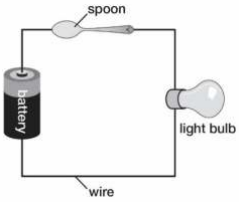
Sajid has four teaspoons made of different materials.
He used each spoon to close an electric circuit one by one.
Image

The table below shows if the light bulb glows for each spoon in the circuit.
Spoon in the circuit Does the light bulb glow?
Spoon $1$ No
Spoon $2$ No
Spoon $3$ Yes
Spoon $4$ Yes
$1.$ Which of these is supported by the results of Sajid’s activity$?$
$A.$ Spoon $1$ is made of metal and Spoon $2$ is made of non-metal
$B.$ Spoon $2$ is made of metal and Spoon $3$ is made of non-metal
$C.$ Spoon $3$ is made of metal and Spoon $4$ is made of non-metal
$D.$ Spoon $4$ is made of metal and Spoon $1$ is made of non-metal
$2.$ Will the results of the activity change if two batteries are used in the circuit in place of the single battery? Explain your answer.
View full solution

Generate a Materials : Metals and Non-Metals paper free

Pick question groups from the list above, set marks and difficulty, and export a branded PDF with step-by-step answer keys. First 3 chapters free — no signup.

Download App