Questions

questions in short. [3 marks ]

🎯

Test yourself on this topic

24 questions · timed · auto-graded

Question 13 Marks
List sources of noise pollution in your surroundings.
Answer
Some sources of noise pollution are as follows:
$i.$ Televisions and transistors running at high volumes.
$ii.$ Loudspeakers and crackers.
$iii.$ Horns of buses, cars and trucks.
$iv.$ Home appliances such as mixer, desert cooler, etc.
View full question & answer
Question 23 Marks
What is the difference between noise and music? Can music become noise sometimes?
Answer
The sound which produces a pleasing sensation on hearing is called music. For example, the sounds produced by musical instruments like flute, sitar, etc. On the other hand, the sound which produces unpleasing sensation on hearing is called noise. For example, the sound produced by horns of vehicles, machines, etc.
Yes, music can become noise sometimes like if the music is played at very high volume or different types of music are played at the same time.
View full question & answer
Question 33 Marks
Identify the part which vibrates to produce sound in the following instruments.
$a.$ Dholak.
$b.$ Sitar.
$c.$ Flute.
Answer
Dholak is a musical instrument: It consists of a stretched membrane called its head. When the head is beaten gently, the stretched membrane sets into vibration. Since sound is produced when an object vibrates, the dholak produces a sound.
Sitar is a musical instrument: It consists of stretched strings. When a string is plucked, it sets into vibration. Since sound is produced when an object vibrates, the sitar produces a sound.
Flute is a hollow pipe: When air is blown over its mouth, the air inside the pipe is set into vibration. As a result, a pleasant sound is produced.
View full question & answer
Question 43 Marks
A pendulum oscillates $40$ times in $4$ seconds. Calculate its.
$a.$ time$-$period, and
$b.$ frequency.
Can we hear the sound produced by the oscillations of this pendulum? Give reason for your answer.
Answer
Frequency $=\frac{\text{40 vibration}}{\text{4 seconds}}=10\text{Hz}$
Thus, time period $=\frac{1}{\text{f}}=\frac{1}{10}=0.1$ seconds.
No, we cannot hear because the audible human range is from $20Hz$ to $20,000Hz.$
View full question & answer
Question 53 Marks
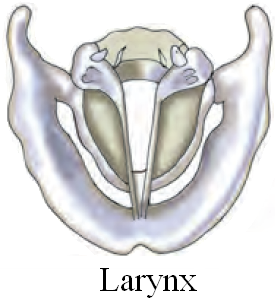
Sketch larynx and explain its function in your own words.
Answer
A sketch of larynx is shown below:
Larynx is that part of throat which is responsible for producing sound. Inside larynx, there are two vocal cords, which are stretched across the voice box or larynx in such a way that it leaves a narrow slit between them for the passage of air. When we speak, air is forced into this small gap by the lungs which prompt vocal cords to vibrate. When the lungs force air through the slit, the vocal cords vibrate, producing sound.
View full question & answer
Question 63 Marks
Your parents are going to buy a house. They have been offered one house on the roadside and another house three lanes away from the roadside. Which house would you suggest your parents should buy? Explain your answer.
Answer
There will be more noise in the house which is along the roadside due to noise produced by transportation vehicles. But, the house which is three lanes away from the roadside would have comparatively less noise . Therefore, it is better to take the house that is three lanes away from the roadside.
View full question & answer
Question 73 Marks
Explain in what way noise pollution is harmful to humans.
Answer
Noise pollution can lead to a number of health-related problems. Some of them are as follows:
$i.$ Hearing loss.
$ii.$ Insomnia; inability to sleep.
$iii.$ Hypertension.
$iv.$ Severe headache.
$v.$ Stress.
View full question & answer
Question 83 Marks
Arrange the following sounds in the order of increasing frequencies $($keeping the sound of lowest frequency first$):$
$a.$ Baby's voice.
$b.$ Man's voice.
$c.$ Woman's voice.
Answer
The following sounds in the order of increasing frequencies:
$a.$ Man's voice.
$b.$ Woman's voice.
$c.$ Baby's voice.
View full question & answer
Question 93 Marks
Three different vibrating objects produce three types of sounds $X, Y$ and $Z$. The sounds $X$ and $Y$ cannot be heard by a man having normal range of hearing but sound $Z$ can be heard easily. The sound $X$ can be heard by a bat whereas the sound $Y$ can be heard by a rhinoceros. What type of sounds are $X, Y$ and $Z?$
Answer
$X:$ Ultrasonic sound waves (Greater than $20,000Hz).$
$Y:$ Infrasonic sound waves $(0-20 Hz).$
$Z:$ Audible sounds $(20Hz-20,000Hz).$
View full question & answer
Question 103 Marks
Define vibrations and frequency with examples.
Answer
When we prick a stretched rubber band, we can see the to and fro motion of the rubber band. This motion of the rubber band is known as vibration. When the rubber band is vibrating, the number of small oscillating loops that the rubber band makes is defined as the frequency of the rubber band. The more the oscillating loops more is the frequency of the rubber band and vice versa.
View full question & answer
Question 113 Marks
Your parents are going to buy a house. They have been offered one on the roadside and another three lanes away from the roadside. Which house would you suggest your parents should buy? Explain your answer.
Answer
I would suggest my parents to buy a house three lanes away from the roadside because there would be more noise along the roadside produced by the vehicles. And the amount of noise will decrease as one move away from the roadside.
View full question & answer
Question 123 Marks
The townhall building is situated close to Boojho’s house. There is a clock on the top of the townhall building which rings the bell every hour. Boojho has noticed that the sound of the clock appears to be much clearer at night. Explain.
Answer
We know that speed, pitch, loudness all are initiated with a vibration. During the day, there is a number of vibrations around us. so, the sound coming from the clock gets disturbed and amplitude of vibrations becomes small. But during the night there are not such multiple vibrations in the enviornment. so,sound is more clear. Further,-''the dew factor at night increases the speed of sound as moisture level increases.
View full question & answer
Question 133 Marks
Name the part which vibrates to produce sound in the following:
$a.$ Drums.
$b.$ Sitar.
$c.$ Flute.
Answer
$a.$ Its stretched membrane.
$b.$ Its strings.
$c.$ Its long hollow pipe.
View full question & answer
Question 143 Marks
Which of the following is the speed of sound in water and which in steel?
$a. 5000\ m/s.$
$b. 1500\ m/s.$
$c. 340\ m/s.$
Answer
The speed of sound is faster in solid as compared to liquid, and then slowest in gases. Thus, the speed of sound is more in steel, then water and then air.
$a. 5000\ m/s -$ Speed of sound in steel.
$b. 1500\ m/s -$ Speed of sound in water.
$c. 340\ m/s -$ Speed of sound in air.
View full question & answer
Question 153 Marks
How do astronauts talk to one another on the surface of moon and why?
Answer
The astronauts have sound transmitting devices in the helmets they wear which help them exchange sound waves with one-another. This is because moon does not have any atmosphere and sound its does not have any medium for sound to travel as sound does not travel in vacuum.
View full question & answer
Question 163 Marks
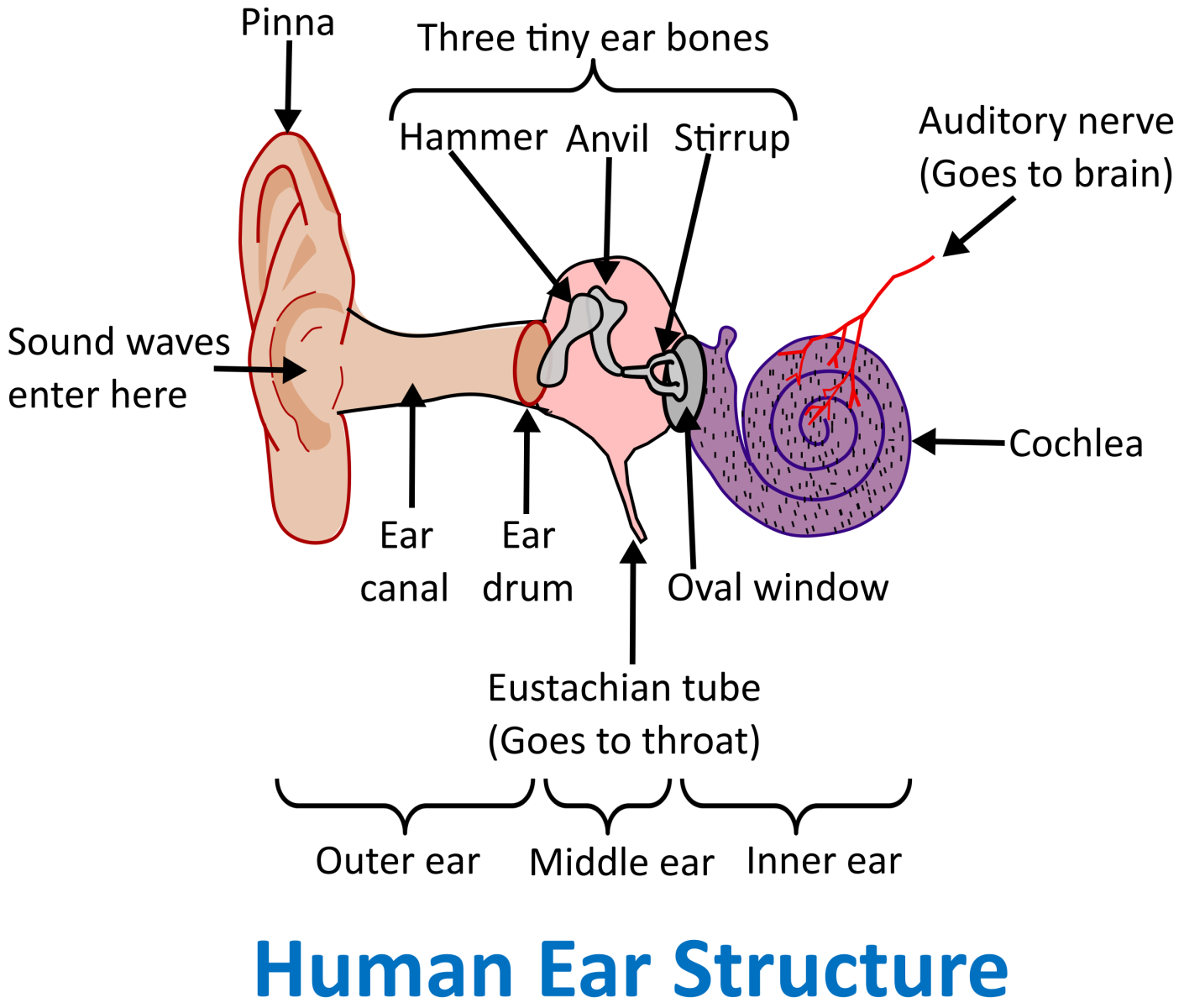
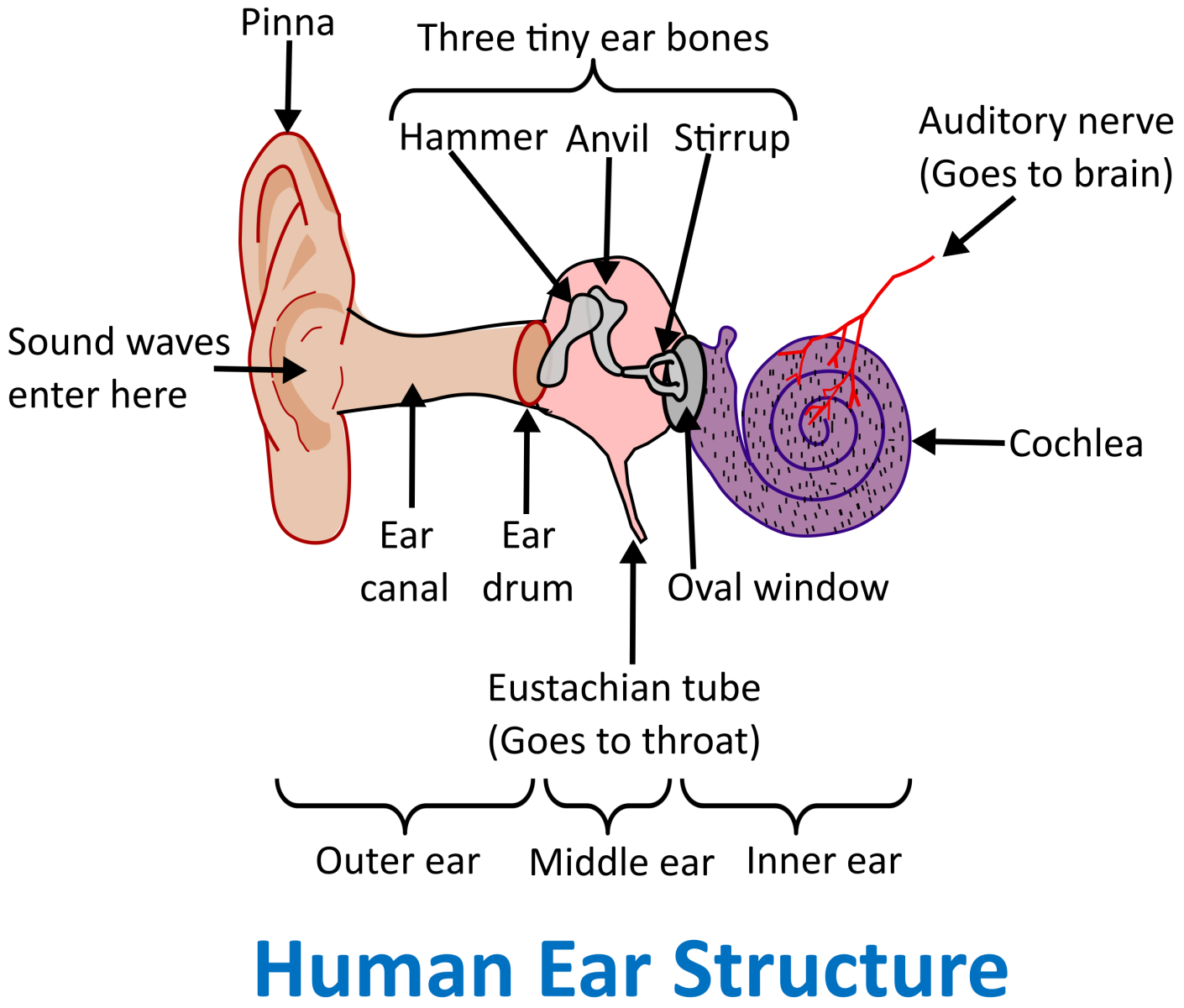
What is the name of passage in outer ear which carries sound waves to the eardrum?
Answer

As seen from the figure given below, the sound is carried through the Ear canal.
View full question & answer
Question 173 Marks
Suggest three measures to limit noise pollution in your locality.
Answer
The following measures to limit noise pollution in our locality is given as:
$i.$ The industries which produce noise should be setup away from the residential areas.
$ii.$ The television and the music system should be run at the low volumes.
$iii.$ The aircraft engines, transport vehicles, industrial machines and home appliances' must be installed with siltncing devices.
View full question & answer
Question 183 Marks
Sound produced by a stretched wire is due to vibrations. Show by an activity.
Answer
Toy telephone works due to sounds produced by vibration of stretched wire. Toy telephone is a basic telephone made out of a long string and two paper or plastic cups. When a person speaks at one of the cups then the vibrations of sound produced by the stretched wire enables the other person to hear his voice successfully. Hence, we can conclude that sound produced by stretched wire is due to vibration.
View full question & answer
Question 193 Marks
Name one solid, one liquid and one gas through which sound can travel.
Answer
Solid: Metal$-$ Iron, Aluminium etc.
Liquid: Water.
Gas: Air.
View full question & answer
Question 203 Marks
The sound from an insect is produced when it vibrates its wings at an average rate of $500$ vibrations per second:
$a.$ What is the time$-$period of the vibrations?
$b.$ What is the frequency of the vibrations in hertz?
$c.$ Can we hear this sound? Why or why not?
Answer
$a.$ The time period $= \frac{1}{\text{f}}= \frac{1}{500}=0.002$ secs.
$b.$ The frequency of the vibrations in hertz is $500Hz$.
Because $1Hz = 1$ vibration/ second.
$c.$ We can hear this because it is in the range of $20H_z$ to $20,000H_z$.
View full question & answer
Question 213 Marks
Give two causes of noise pollution from the homes.
Answer
The causes of noise pollution are as follows:
$a.$ Televisions running at high volumes.
$b.$ Use of Loudspeakers in religious or other functions.
$c.$ Use of crackers.
View full question & answer
Question 223 Marks
Explain why, the flash of lightning is seen first but the sound of thunder is heard a little later (though lightning and thunder take place in the sky at the same time and same distance from us).
Answer
The flash of lightning is seen first but the sound of thunder is heard a little later though lightning and thunder take place in the sky at the same time and same distance from us, because, the velocity of light in air is $3\times 108 m/s$ while the velocity of sound in air is $343 m/s$. Thus, we can see light first and thunder sound later.
View full question & answer
Question 233 Marks
Name the three tiny bones present in the middle part of ear.
Answer

The three tiny bones – the malleus, incus, and stapes – are found in the middle ear. Each bone is named in Latin for its shape.
View full question & answer
Question 243 Marks
Name any two common musical instruments and identify their vibrating parts.
Answer
Dholak. Diaphragm (stretched membrane).
Sitar. Strings of the Sitar.
Flute. Air column inside the flute.
View full question & answer
questions in short. [3 marks ] - Science STD 8 Questions - Vidyadip