Sample QuestionsCongruence of Triangles and Inequalities in a Triangle questions
One sample from each question group in this chapter. Select any group above to see the full set with answer keys.
In $\triangle\text{ABC, BC = AB}$ and $\angle\text{B}=80^{\circ}.$ Then, $\angle\text{A = ?}$
- ✓
$50^\circ$
- B
$40^\circ$
- C
$100^\circ$
- D
$80^\circ$
Answer: A.
View full solution →In $\triangle\text{ABC}$ and $\triangle\text{DEF,}$ it is given that $\angle\text{B}=\angle\text{E}$ and $\angle\text{C}=\angle\text{F}.$ In order that $\triangle\text{ABC}\cong\triangle\text{DEF},$ we must have:
Answer: C.
View full solution →If the altitudes from two vertices of a triangle to the opposite sides are equal, then the triangle is:
Answer: B.
View full solution →Which of the following is not a criterion for congruence of triangles$?$
Answer: A.
View full solution →In $\triangle\text{ABC,}$ if $\angle\text{C}>\angle\text{B},$ then:
- A
$BC > AC$
- ✓
$AB > AC$
- C
$AB < AC$
- D
$BC < AC$
Answer: B.
View full solution →Fill in the blanks. Medians of an equilateral triangle are .
Fill in the blanks. Drawing a $\triangle\text{ABC}$ with $AB = 3\ cm, BC = 4\ cm$ and $CA = 7\ cm$ is .
View full solution →Fill in the blanks with < or >. (Sum of any two sides of a triangle) (twice the median to the 3rd side).
Fill in the blanks with < or >. (Difference of any two sides of a triangle) (the third side).
Fill in the blanks. Each angle of an equilateral triangle measures .
Is it possible to construct a triangle with lengths of its sides as given below? Give reason for your answer. $3\ cm, 4\ cm, 8\ cm$
View full solution →Is it possible to construct a triangle with lengths of its sides as given below? Give reason for your answer. $10\ cm, 5\ cm, 6\ cm$
View full solution →Is it possible to construct a triangle with lengths of its sides as given below? Give reason for your answer. $5\ cm, 4\ cm, 9\ cm$
View full solution →Is it possible to construct a triangle with lengths of its sides as given below? Give reason for your answer.
$2.5\ cm, 5\ cm, 7\ cm$
View full solution →Is it possible to construct a triangle with lengths of its sides as given below? Give reason for your answer.
$8\ cm, 7\ cm, 4\ cm$
View full solution →In $\triangle\text{ABC, }\angle\text {A}= \angle\text{B}=45^{\circ}.$ Which is its longest side?
View full solution →“If two sides and an angle of one triangle are equal to two sides and an angle of another triangle then the two triangles must be congruent.” Is the statement true? Why?
In $\triangle\text{ABC, }\angle\text {A}=100^{\circ}$and $\angle\text{C}=50^{\circ}.$ Which is its shortest side?
View full solution →In $\triangle\text{ABC, }\angle\text {A}=90^{\circ}.$ Which is its longest side?
View full solution →“If two angles and a side of one triangle are equal to two angles and a side of another triangle then the two triangles must be congruent.” Is the statement true? Why?
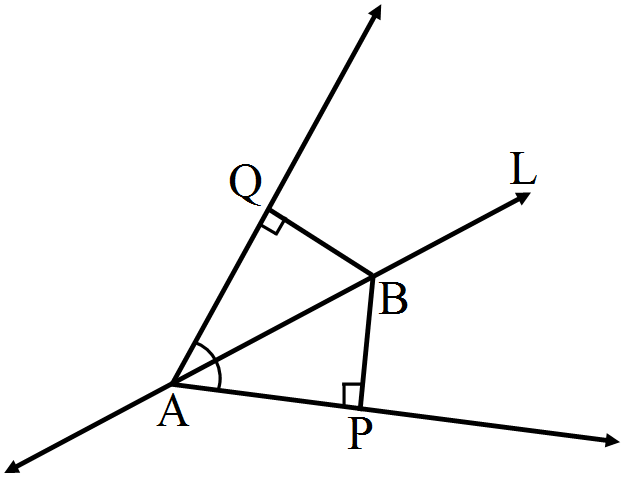
In the given figure, line $l$ is the bisector of an angle $\angle\text{A}$ and $B$ is any point on $l$. If $BP$ and $BQ$ are perpendiculars from $B$ to the arms of $\angle\text{A},$ Show that:
$i. \triangle\text{APB}\cong\triangle\text{AQB}$
$ii. BP = BQ,$ i.e., $B$ is equidistant from the arms of $\angle\text{A}.$
View full solution →In the given figure, $AD$ and $BC$ are equal perpendiculars to a line segment $AB$. Show that $CD$ bisects $AB.$ 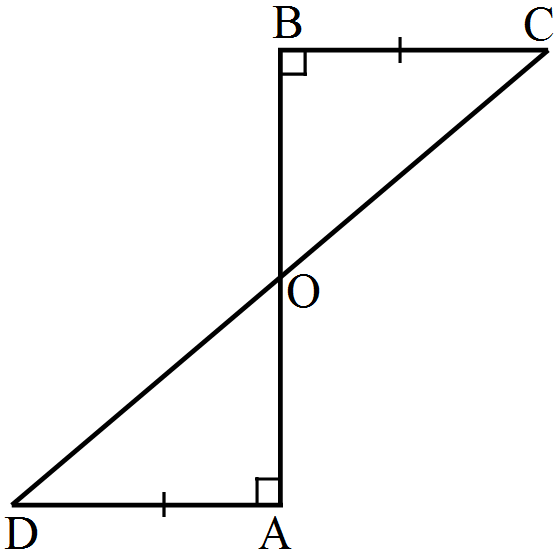
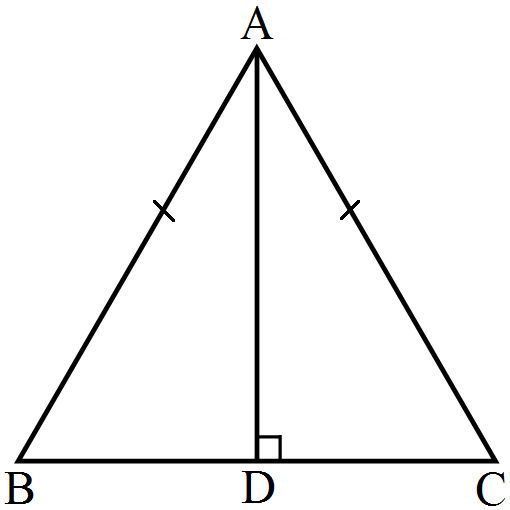
View full solution →$AD$ is an altitude of an isosceles $\triangle\text{ABC}$ in which $AB = AC.$ Show that:
$i. AD$ bisects $BC,$
$ii. AD$ bisects $\angle\text{A}.$
View full solution →The bisectors of $\angle\text{B}$ and $\angle\text{C}$ of an isosceles triangle with $AB = AC$ intersect each other at a point $O. BO$ is produced to meet $AC$ at a point $M.$ Prove that $\angle\text{MOC}=\angle\text{ABC}.$
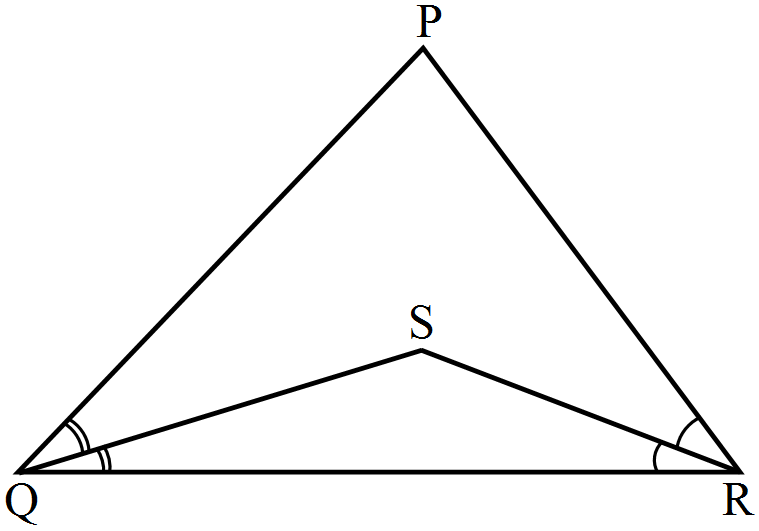
View full solution →In the given figure, $PQ > PR$ and $QS$ and $RS$ are the bisectors of $\angle\text{Q}$ and $\angle\text{R}$ respectively. Show that $SQ > SR.$
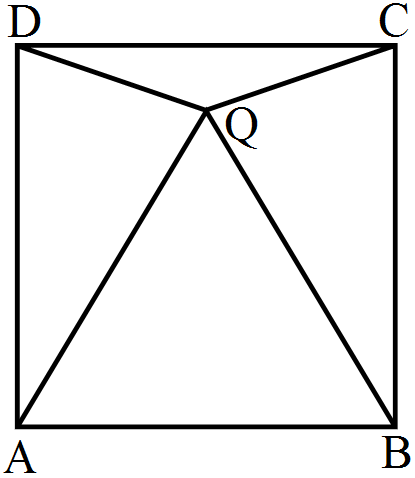
View full solution →In the given figure, $O$ is a point in the interior of square $ABCD$ such that $\triangle\text{OAB}$ is an equilateral triangle. Show that $\triangle\text{OCD}$ is an isosceles triangle.
View full solution →In a quadrilateral $ABCD$, show that $(AB + BC + CD + DA) > (AC + BD)$.
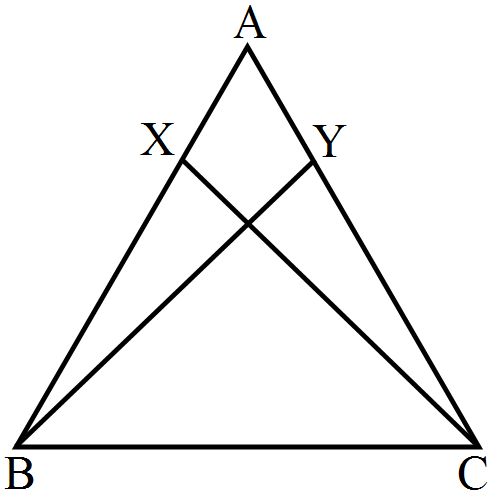
View full solution →In the adjoining figure, $X$ and $Y$ are respectively two point on equal sides $AB$ and $AC$ of $\triangle\text{ABC}$ such thet $AX = AY$. Prove that $CX$ $= BY.$
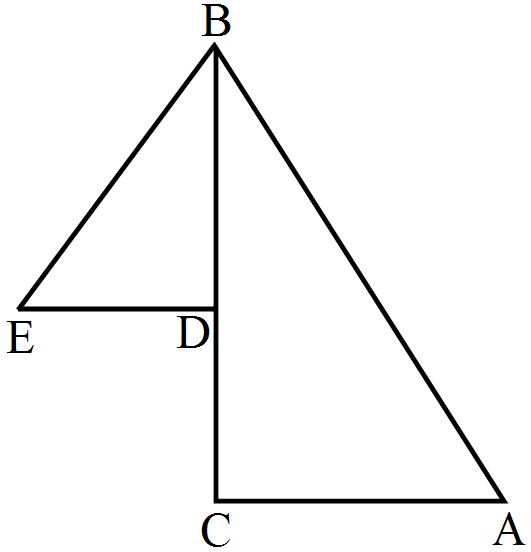
View full solution →In the given figure, $D$ is a point on side $BC$ of a $\triangle\text{ABC}$ and $E$ is a point such that $CD = DE$. Prove that $AB + AC > BE$.
View full solution →In a quadrilateral $ABCD$, show that $(AB + BC + CD + DA) <2 (BD + AC)$.
View full solution →$P$ is a point on the bisector of $\angle\text{ABC}.$ If the line through $P$, parallel to $BA$ meets $BC$ at $Q$, prove that $\triangle\text{BPQ}$ is an isosceles triangle.
View full solution →The bisectors of $\angle\text{B}$ and $\angle\text{C}$ of an isosceles $\triangle\text{ABC}$ with $AB = AC$ intersect each other at a point $O$.Show that the exterior angle adjacent to $\angle\text{ABC}$ is equal to $\angle\text{BOC}.$
View full solution →$D$ is any point on the side $AC$ of $\triangle\text{ABC}$ with $AB = AC$. Show that $CD < BD$.
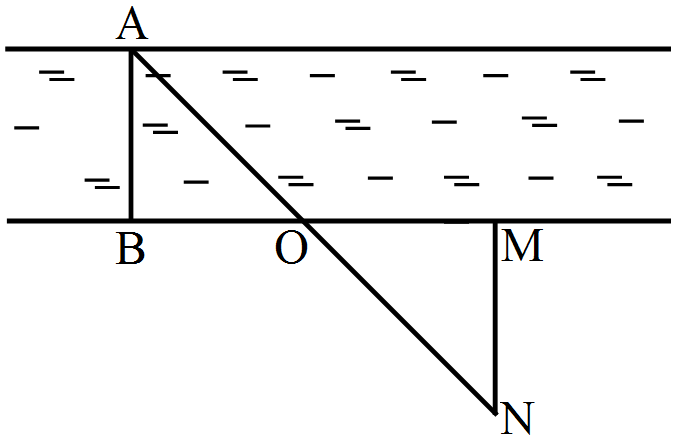
View full solution →In the adjoining figure, explain how one can find the breadth of the river without crossing it.
In the given figure, $\angle\text{B}<\angle\text{A}$ and $\angle\text{C}<\angle\text{D}.$ Show that $\text{AD < BC}.$
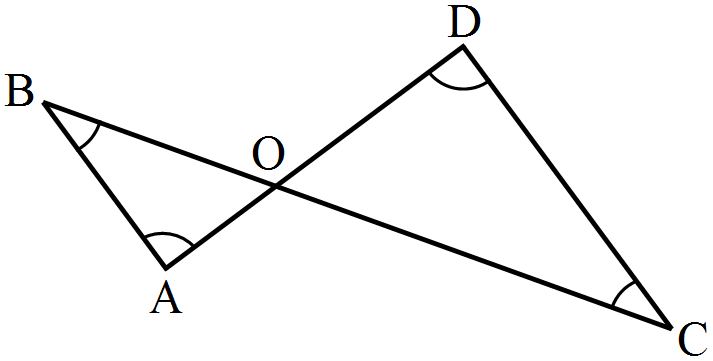
View full solution →