Question
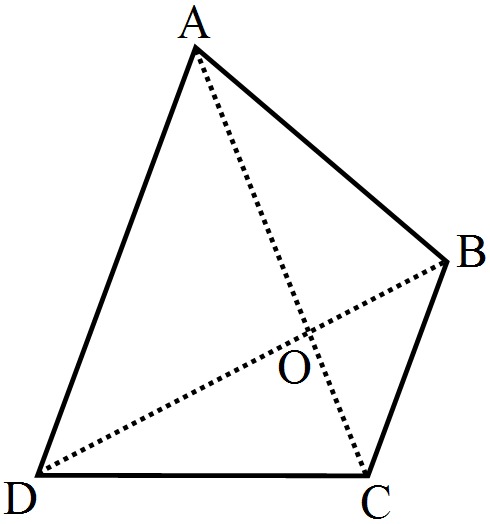
In a quadrilateral $ABCD$, show that $(AB + BC + CD + DA) <2 (BD + AC)$.
Answer

Given: Quadrilateral $ABCD$ To prove: $(AB + BC + CD + DA) < 2(BD + AC)$.
 Proof:

In $\triangle\text{AOB},$ $\text{OA + OB > AB}...\text{(i)}$ In $\triangle\text{BOC},$
$\text{OB + OC > BC}...(\text{ii})$ In $\triangle\text{COD},$
$\text{OC + OD > CD}...(\text{iii})$ In $\triangle\text{AOD},$
$\text{OD + OA >AD}...(\text{iv})$ Adding $(i), (ii), (iii)$ and $(iv)$
​​​​​​​we get $2(\text{OA + OB + OC + OD})>(\text{AB + BC + CD + DA})$
$\Rightarrow2(\text{OB + OD + OA + OC})>(\text{AB + BC + CD + DA})$
$\Rightarrow2(\text{BD + AC})>(\text{AB + BC + CD + DA})$

Need a full question paper?

Generate a complete, print-ready paper with questions like this in minutes — across 16+ boards, with answer keys.
Start Generating Free

Similar questions

$M$ is a point on side $BC$ of a triangle $ABC$ such that $AM$ is the bisector of $\angle\text{BCA}.$ Is it true to say that perimeter of the triangle is greater than $2AM?$ Give reason for your answer$?$
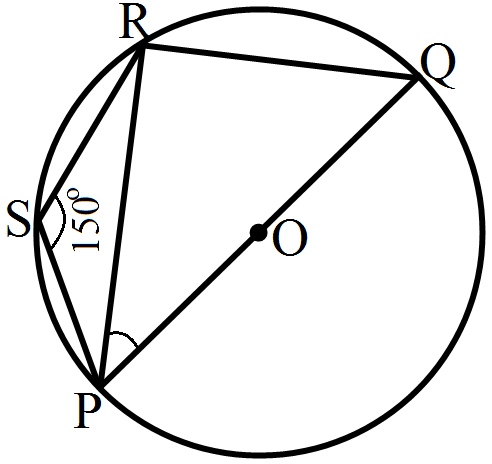
In the given figure, $POQ$ is a diameter and $PQRS$ is a cyclic quadrilateral. If $\angle\text{PSR}=150^\circ,$ find $\angle\text{RPQ}.$
Explain, by taking a suitable example, how the arithmetic mean alters by:
$i.$ Adding a constant $k$ to each term.
$ii.$ Subtracting a constant $k$ from each term.
$iii.$ Multiplying each term by a constant $k.$
$iv.$ Dividing each term by non-zero constant $k.$
The following data gives the amount of manure $($in thousand tonnes$)$ manufactured by a company during some years:
Year
$1992$
$1993$
$1994$
$1995$
$1996$
$1997$
Manure $($in thousand tonnes$)$
$15$
$35$
$45$
$30$
$40$
$20$
$i.$ Represent the above data with the help of a bar graph.
$ii.$ Indicate with the help of the bar graph the year in which the amount of manufactured by the company was maximum.
$iii.$ Choose the correct alternative:
The consecutive years during which there was the maximum decrease in manure production are:
$a. 1994$ and $1995$
$b. 1992$ and $1993$
$c. 1996$ and $1997$
$d. 199$5 and $1996$
The population of Delhi State in different census years is as given below:
Census year
$1961$
$1971$
$1981$
$1991$
$2001$
Population in Lakhs
$30$
$55$
$70$
$110$
$150$
Represent the above information with the help of a bar graph.
In a quadrilateral $ABCD$, show that $(AB + BC + CD + DA) > (AC + BD)$.
Prove: Two distinct lines cannot have more than one point in common.
In a $||$ gm $ABCD$, if $\angle\text{A}=(2\text{x}+25)^{\circ}$ and $\angle\text{B}=(3\text{x}-5)^{\circ},$ find the value of $x$ and the measure of each angle of the parallelogram.
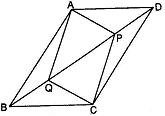
In parallelogram $A B C D$, two points $P$ and $Q$ are taken on diagonal $B D$ such that $D P=B Q$.

Show that
i. $\triangle APD \cong \triangle C Q B$
ii. $A P=C Q$
iii. $\triangle A Q B \cong \triangle C P D$
iv. $A Q=C P$
v. $APCQ$ is a parallelogram.
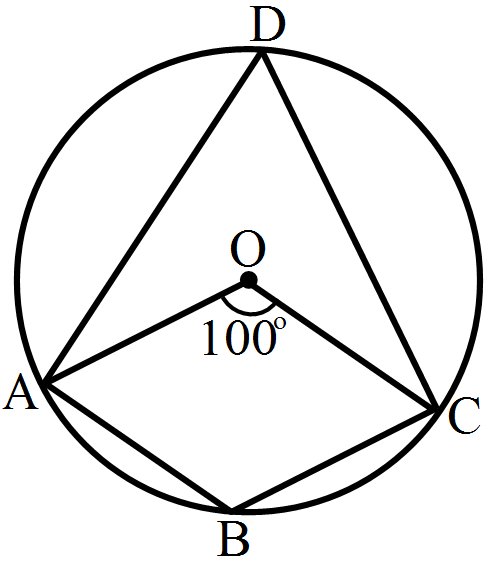
In the given figure, $O$ is the centre of the given circle and measure of arc $ABC$ is $100^\circ$. Determine $\angle\text{ADC}$ and $\angle\text{ABC}.$