Questions

5 Marks Questions

🎯

Test yourself on this topic

7 questions · timed · auto-graded

Question 15 Marks
Find the area of a triangle two sides of which are $18 \ cm$ and $10 \ cm$ and the perimeter is $42 \ cm.$
Answer
$a = 18 cm, b = 10 cm.$
Perimeter $= 42 cm.$
$\Rightarrow a + b + c = 42$
$\therefore 18 + 10 + c = 42$
$\therefore 28 + c = 42$
$\therefore c = 42 – 28$
$\therefore c = 14 cm.$
$s = \frac{42}{2} = 21 cm$
$\therefore $  Areaṁ of the triangle $=\sqrt{s(s-a)(s-b)(s-c)}$
$=\sqrt{21(21-18)(21-10)(21-14)}$
$=\sqrt{21(3)(11)(7)}$
$=\sqrt{(7)(3)(3)(11)(7)}$
$= (7)(3) \sqrt{11}$
$= 21 \sqrt{11} cm^2$
View full question & answer
Question 25 Marks
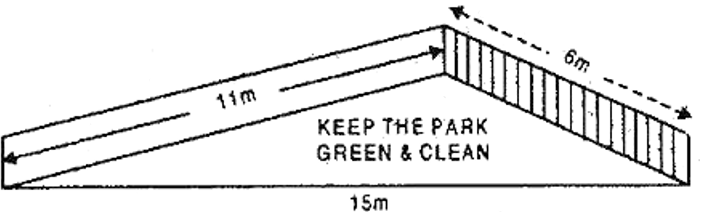
There is slide in a park. One of its side walls has been painted in some colour with a message $KEEP \ THE \ PARK \ GREEN \ AND \ CLEAN$, (see figure). If the sides of the wall are $15 \ m, 11 \ m$ and $6 \ m$, find the area painted in colour.
Answer
Since, sides of coloured triangular wall are $15 \ m, 11 \ m $and $6 m.$
$\therefore$ Semi-perimeter of coloured triangular wall
S =$\frac{15+11+6}{2}$=$\frac{32}{2}=16 m$
Now, Using Heron’s formula,
Area of coloured triangular wall
=$\sqrt{s\left( s-a \right)\left( s-b \right)\left( s-c \right)}$
=$\sqrt{16\left( 16-15 \right)\left( 16-11 \right)\left( 16-6 \right)}$
=$\sqrt{16\times 1\times 5\times 10}$
=$20\sqrt{2}{{m}^{2}}$
Hence area painted in blue colour = $20\sqrt{2}{{m}^{2}}$
View full question & answer
Question 35 Marks
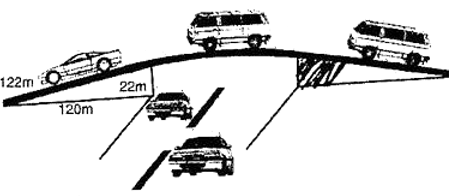
The triangular side walls of a flyover have been used for advertisements. The sides of the walls are $122 m, 22 m$ and $120 m$ (see Fig.). The advertisements yield an earning of ₹ $5000$ per $m^2$ per year. A company hired one of its walls for $3$ months. How much rent did it pay?

Answer
Given: $= 122 m, = 22 m$ and $= 120 m$
Semi-perimeter of triangle (s)$ =\frac{122+22+120}{2}=\frac{264}{2} = 132 m$ Using Heron’s Formula,
Area of triangle =$ \sqrt{s\left( s-a \right)\left( s-b \right)\left( s-c \right)}$
=$\sqrt{132\left( 132-122 \right)\left( 132-22 \right)\left( 132-120 \right)}$
$= \sqrt {132 \times 10 \times 110 \times 12} $$ = \sqrt {11 \times 12 \times 10 \times 10 \times 11 \times 12} $
$= 10 \times 11 \times 12$
$= 1320 m^2$
$\because $ Rent for advertisement on wall for $1$ year $= Rs. 5000 $ per$ {{m}^{2}}$
$\therefore $ Rent for advertisement on wall for $3$ months for $1320 m^2$; $\frac{5000}{12}\times 3\times 1320$
$= Rs.1650000$
Hence rent paid by company $= Rs. 16,50,000$
View full question & answer
Question 45 Marks
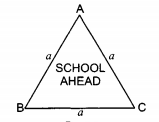
A traffic signal board, indicating $SCHOOL AHEAD$, is an equilateral triangle with side a. Find the area of the signal board, using Heron’s formula. If its perimeter is $180 \ cm$, what will be the area of the signal board?
Answer

A traffic signal board is an equilateral triangle with side a.
Perimeter of the signal board,
$2s = a + a + a$
$\Rightarrow \mathrm{s}=\frac{3}{2} a$
Area of triangle $=\sqrt{s(s-a)(s-b)(s-c)}$
$=\sqrt{\frac{3 a}{2}\left(\frac{3}{2} a-a\right)\left(\frac{3}{2} a-a\right)\left(\frac{3}{2} a-a\right)}$
$=\sqrt{\frac{3 a}{2} \times \frac{a}{2} \times \frac{a}{2} \times \frac{a}{2}}=\sqrt{\frac{3 a^{4}}{16}}=\frac{\sqrt{3}}{4} a^{2}$ sq. units
Now, if perimeter $= 180 cm$
$3a = 180$
$\Rightarrow a = 60 cm$
$\therefore \text { Area of signal board }= \frac{\sqrt{3}}{4} a^{2}=\frac{\sqrt{3}}{4} \times(60)^{2}=900 \sqrt{3} \mathrm{cm}^{2}$
So, area of the signal board is $900 \sqrt{3} \mathrm{cm}^{2}$.
View full question & answer
Question 55 Marks
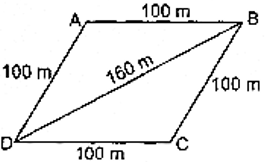
Sanya has a piece of land which is in the shape of a rhombus. She wants her one daughter and one son to work on the land and produce different crops. She divided the land in two equal parts. If the perimeter of the land is $400 \ m$ and one of the diagonals is $160 \ m$, how much area each of them will get for their crops?
Answer
Let $ABCD$ be the field. Given perimeter $= 400 m$
So, each side $=\frac{400}{4}=100 \mathrm{m}$

Diagonal $BD = 160 m$
Let $a = 100 \:m,\: b = 100 \:m, \:c = 160 \:m$
$\therefore \quad s=\frac{a+b+c}{2}=\frac{100+100+160}{2}=180 \mathrm{m}$
Therefore, $Area\ of\ \Delta A B D=\sqrt{s(s-a)(s-b)(s-c)}$
= $\sqrt{180(180-100)(180-100)(180-160)}$
$=\sqrt{180 \times 80 \times 80 \times 20}=4800 \mathrm\ {m}^{2}$
$\therefore$ Each of them will get $4800 m^2$ of area for their crops.
Alternative method:
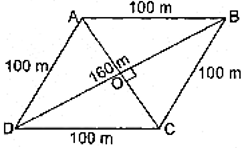
As the diagonals of a rhombus bisect each other: Therefore

$O D=\frac{1}{2} B D=\frac{1}{2} \times 160=80 \mathrm\ {m}$
$O C=\frac{1}{2} A C$
In $\Delta O C D$, we have,
$CD^2 = OC^2 + OD^2$
$100^2 = OC^2 + 80^2$
$\Rightarrow OC^2 = 10000 - 6400$
$\Rightarrow OC^2 = 3600$
$\Rightarrow OC = 60 m$
Therefore, area of $\Delta B C D=\frac{1}{2}(B D \times O C)=\frac{1}{2} \times 160 \times 60=4800 \mathrm\ {m}^{2}$
$\therefore$ Each of them will get 4800 $m^2$ of area for their crops.
View full question & answer
Question 65 Marks
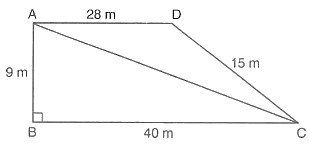
Students of a school staged a rally for cleanliness campaign. They walked through the lanes in two groups. One group walked through the lanes $A B, B C$ and $C A$; while other through $A C, C D$ and $D A$ (See in a given figure). Then they cleaned the area enclosed within their lanes. If $A B=9 m, B C=40 m, C D=15 m, DA =28 m$, and $\angle B=$ $90^{\circ}$, which group cleaned more area and by how much? Find the total area cleaned by the students (neglecting the width of the lanes).
Answer
In $\triangle ABC$, we have
$\angle B = 90^o$
$\therefore AC^2 = AB^2 + BC^2 $ [By pythagoras theorem]
$\Rightarrow AC^2 = 9^2 + 40^2 = 1681$
$\Rightarrow AC = 41$

Computation of area of $\triangle ABC:$
$\triangle_1$ = Area of $\triangle ABC =  \frac{1}{2} (BC \times AB)$ [$\because \angle B = 90^o]$
$\Rightarrow$ $\triangle_1$ = $\frac{1}{2} (40 \times 9) = 180 m^2$
Computation of area of triangle $ACD:$
Let $2s$ be the perimeter of $\triangle ACD$. Then,
$2s = AC + CD + DA = 41 + 15 + 28 = 84$
$\Rightarrow s = 42 m$
$\therefore$ $\triangle_2$ = area of $\triangle$ACD
$\Rightarrow$ $\triangle_2$ = $\sqrt{s(s - AC)(s - CD)(s - DA)}$
$\Rightarrow$ $\triangle_2$
= $\sqrt{42 \times (42-41) \times (42 - 15) \times (42 - 28)}$
= $\sqrt{42 \times 1 \times 27 \times 14} = 126 m^2.$
So, first group cleaned $(180 - 126) = 54m^2$
more area than the second group and total area cleaned by all the students is $(180 + 126) = 306m^2​​​​​​​$​​​​​​​
View full question & answer
Question 75 Marks
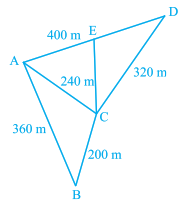
Kamla has a triangular field with sides $240 \ m, 200 \ m, 360 \ m$, where she grew wheat. In another triangular field with sides $240 \ m, 320 \ m, 400 \ m$ adjacent to the previous field, she wanted to grow potatoes and onions.
She divided the field in two parts by joining the mid-point of the longest side to the opposite vertex and grew potatoes in one part and onions in the other part. How much area (in hectares) has been used for wheat, potatoes and onions? [$1$ hectare $= 1000 m^2,$ $\sqrt{2} = 1.41]$
Answer
Let $ABC$ be the field, where wheat is grown. Also, let $ACD$ be the field which has been divided into two parts by joining $C$ to the mid-point $E$ of $AD$. For the area of $\triangle ABC$, we have
$a = 200m, b = 240 m, c = 360m$

Therefore, s = $\frac{200+240+360}{2} = 400 m$
So, area of growing wheat = $\sqrt{s(s-a)(s-b)(s-c)}$
= $\sqrt{400(400-200)(400-240)(400-360)}$
= 1.6 $\times$ $\sqrt{2}$ hec $= 1.6 \times 1.41$ [ $\because 1.6$ hec $= 16000 m^2$]
$= 2.26$ hec(approx.)
Now, we calculate the area of $\triangle ACD.$
Here, s = $\frac{240+320+400}{2} = 480 m$
So, area of $\triangle ACD$
= $\sqrt{480(480-240)(480-320)(480-400)}$
= $\sqrt{480 \times 240 \times 160 \times 80}$= 38400 $m_2$
$= 3.84$ hec [$\because$ 1 $m_2$ = $\frac{1}{10000}$hec]
Now, let $C F \perp AD$. Then,
$\operatorname{ar}(\triangle A E C)=\frac{1}{2} \times A E \times C F=\frac{1}{2} \times E D \times C F[\because A E=E D$, as $E$ is mid-point of $A D]$
$=\operatorname{ar}(\triangle EDC )[\because CF$ is also a height of $\because E D C$ corresponding to base $ED]$
$\therefore$ Area for growing potatoes $=$ Area for growing onions
$=(3.84 \div 2)=1.92 hec$
Hence, area has been used for growing wheat, potatoes and onion are $2.26 hec , 1.92 hec$ and $19.2$ hec , respectively.
View full question & answer