MCQ 511 Mark
In a four-sided field, the length of the longer diagonal is $128m.$ The lengths of the perpendiculars from the opposite vertices upon this diagonal are $22.7m$ and $17.3m.$ Then area of the field is:
- ✓
$2560m^2$
- B
$2530m^2$
- C
$2360m^2$
- D
$2460m^2$
AnswerCorrect option: A. $2560m^2$
According to the question,
Area of the field $=\frac{1}{2}\times128\times17.3+\frac{1}{2}\times128\times22.7$
$=\frac{1}{2}\times128(17.3+22.7)$
$=2560\text{ sq.m}$
View full question & answer→MCQ 521 Mark
The base of an isoscale triangle is $8\ cm$ long and each of its equal sides measures $6\ cm$. The area of the triangle is:
- A
$16\sqrt{5}\text{cm}^2$
- ✓
$8\sqrt{5}\text{cm}^2$
- C
$16\sqrt{3}\text{cm}^2$
- D
$8\sqrt{3}\text{cm}^2$
AnswerCorrect option: B. $8\sqrt{5}\text{cm}^2$
Area of quadrilateral triangle $=\frac{\text{b}}{4}\sqrt{4\text{a}^2-\text{b}^2}$
Here,
$a = 6\ cm$ and $b = 8\ cm$
Thus, we have:
$=\frac{8}{4}\times\sqrt{4(6)^2-8^2}$
$=\frac{8}{4}\times\sqrt{144-64}$
$=\frac{8}{4}\times\sqrt{80}$
$=\frac{8}{4}\times4\sqrt{5}$
$=8\sqrt{5}\text{cm}^2$
View full question & answer→MCQ 531 Mark
The sides of a triangle are $122m, 22m$ and $120m$ respectively. The area of the triangle is:
- ✓
$1320\ sq.m$
- B
$1300\ sq.m$
- C
$1400\ sq.m$
- D
$1420\ sq.m$
AnswerCorrect option: A. $1320\ sq.m$
$1320\ sq.m$
View full question & answer→MCQ 541 Mark
The lengths of the three sides of a triangle are $30\ cm, 24\ cm$ and $18\ cm$ respectively. The length of the altitude of the triangle corresponding to the smallest side is:
- A
$18\ cm$
- B
$30\ cm$
- C
$12\ cm$
- ✓
$24\ cm$
AnswerCorrect option: D. $24\ cm$
Let:
$a = 30\ cm, b = 24\ cm$ and $c = 18\ cm$
$\text{s}=\frac{\text{a}+\text{b}+\text{c}}{2}=\frac{30+24+18}{2}=36\text{cm}$
On applying Heron's formula, we get
Area of triangle $=\sqrt{\text{s}(\text{s}-\text{a})(\text{s}-\text{b})(\text{s}-\text{c})}$
$=\sqrt{36(36-30)(36-24)(36-18)}$
$=\sqrt{36\times6\times12\times18}$
$=\sqrt{12\times3\times12\times6\times3}$
$=12\times3\times6$
$=216\text{cm}^2$
The smallest side is $18\ cm.$
Hence, the altitude of the triangle corresponding to $18\ cm$ is given by:
Area of triangle $= 216\ cm^2$
$\Rightarrow\frac{1}{2}\times\text{Base}\times\text{Height}=216$
$\Rightarrow\text{Height}=\frac{216\times2}{18}=24\text{cm}$
View full question & answer→MCQ 551 Mark
The base of a right triangle is $8\ cm$ and hypotenuse is $10\ cm.$ Its area will be:
- A
$40\ cm^2$
- B
$80\ cm^2$
- ✓
$24\ cm^2$
- D
$48\ cm^2$
AnswerCorrect option: C. $24\ cm^2$
Perpendicular $=\sqrt{10^2-8^2}=\sqrt{100-64}=6\text{cm}$
Area of triangle $=\frac{1}{2}\times\text{Base}\times\text{Height}$
$=\frac{1}{2}\times8\times6=24\text{ sq.cm}$
View full question & answer→MCQ 561 Mark
Each side an equilateral triangle is $10\ cm$ long. The height of the triangle is:
- A
$10\sqrt{3}\text{cm}$
- ✓
$5\sqrt{3}\text{cm}$
- C
$10\sqrt{2}\text{cm}$
- D
$5\text{cm}$
AnswerCorrect option: B. $5\sqrt{3}\text{cm}$
Height of equilateral triangle $=\frac{\sqrt{3}}{2}\times\text{Side}$
$=\frac{\sqrt{3}}{2}\times10$
$=5\sqrt{3}\text{cm}$
View full question & answer→MCQ 571 Mark
The sides of a triangle are $11\ cm, 15\ cm$ and $16\ cm.$ The altitude to the largest side is:
AnswerCorrect option: C. $\frac{15\sqrt{7}}{2}\text{cm}$
$\text{s}=\frac{11+60+61}{2}=66\text{m}$
Area of $\triangle=\sqrt{\text{s}(\text{s}-\text{a})(\text{s}-\text{b})(\text{s}-\text{c})}$
$=\sqrt{21\times10\times6\times5}=30\sqrt{7}\text{cm}^2$
Also if we choose largest side and its Altitude, the area would be
$\text{A}=\frac12\times\text{largest side}\times\text{h}$
$330=\frac12\times11\times\text{Height}$
$\Rightarrow\text{Height}=\frac{2\times330}{11}=60\text{m}$
Hence, correct option is $(d).$
View full question & answer→MCQ 581 Mark
The sides of a triangle are $11\ cm, 15\ cm$ and $16\ cm.$ The altitude to the largest side is:
AnswerCorrect option: D. $\frac{15\sqrt7}{4}\text{cm}$
$\text{s}=\frac{11+15+16}{2}=21\text{cm}$
Area of $=\triangle=\sqrt{\text{s}(\text{s}-\text{a})(\text{s}-\text{b})(\text{s}-\text{c})}$
$=\sqrt{21\times10\times6\times5}=30\sqrt7\text{cm}^2$
Also if we choose largest side and its Altitude, the area would be
$\text{A}=\frac{1}{2}\times\text{largest side}\times\text{h} $
$\Rightarrow\frac{1}{2}\times16\times\text{h}=30\sqrt7$
$\Rightarrow\text{h}=\frac{30\sqrt{7}}{8}=\frac{15\sqrt{7}}{4}\text{cm}$
View full question & answer→MCQ 591 Mark
Each side of an equilateral triangle measures $10\ cm.$ Then the area of the triangle is:
- A
$43.2\ cm^2$
- B
$43.4\ cm^2$
- C
$43.1\ cm^2$
- ✓
$43.3\ cm^2$
AnswerCorrect option: D. $43.3\ cm^2$
Area of equilateral triangle $=\frac{\sqrt{3}}{4}(\text{Side})^2$
$=\frac{1.732}{4}\times10\times10$
$=43.3\text{cm}^2$
View full question & answer→MCQ 601 Mark
The base of an isosceles triangle is $6\ cm$ and each of its equal sides is $5\ cm.$ The height of the triangle is:
- A
$8\text{cm}$
- ✓
$4\text{cm}$
- C
$\sqrt{11}\text{cm}$
- D
$\sqrt{30}\text{cm}$
AnswerCorrect option: B. $4\text{cm}$
Height of isosceles triangle $=\frac{1}{2}\sqrt{4\text{a}^2-\text{b}^2}$
$=\frac{1}{2}\sqrt{4(5)^2-6^2} (a = 5\ cm$ and $b = 6\ cm)$
$=\frac{1}{2}\times\sqrt{100-36}$
$=\frac{1}{2}\times\sqrt{64}$
$=\frac{1}{2}\times8$
$=4\text{cm}$
View full question & answer→MCQ 611 Mark
Area of the triangle is equal to:
- A
Base $\times$ Height
- B
$2($Base $\times$ Height$)$
- ✓
$\frac{1}{2}($Base $\times$ Height$)$
- D
$\frac{1}{2}($Base $+$ Height$)$
AnswerCorrect option: C. $\frac{1}{2}($Base $\times$ Height$)$
$\frac{1}{2}($Base $\times$ Height$)$
View full question & answer→MCQ 621 Mark
The sides of a triangle are $50\ cm, 78\ cm$ and $112\ cm.$ The smallest altitude is:
- A
$20\ cm$
- B
$40\ cm$
- C
$50\ cm$
- ✓
$30\ cm$
AnswerCorrect option: D. $30\ cm$
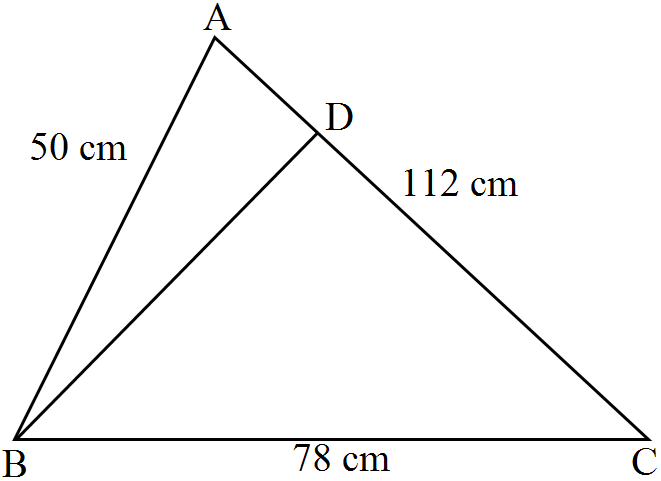
The smallest altitude is $\perp$ drawn to the largest side of a $\triangle$ from opposite point.
i.e. $BD$ Area of $\triangle=\frac{1}{2}\times\text{AC}\times\text{BD}=\frac{1}{2}\times112\times\text{BD}$
$=56\times\text{BD}$
$\text{s}=\frac{50+78+112}{2}=120\text{cm}$
$s - AB = 70\ cm, s - BC = 42\ cm, s - AC = 8\ cm$
Area $=\sqrt{\text{s}(\text{s}-\text{AB})-(\text{s}-\text{BC})(\text{s}-\text{AC})}$
$=\sqrt{120\times70\times42\times8}$
$=1680\text{cm}^2$
Now, $56 × BD = 1680\ cm^2$
$\Rightarrow\text{BD}=\frac{1680}{56}=30\text{cm}$
View full question & answer→MCQ 631 Mark
The perimeter of a rhombus is $20\ cm.$ One of its diagonals is $8\ cm$. Then area of the rhombus is:
- ✓
$24\ cm^2$
- B
$18\ cm^2$
- C
$14\ cm^2$
- D
$36\ cm^2$
AnswerCorrect option: A. $24\ cm^2$
Perimeter of Rhombus $= 20\ cm$
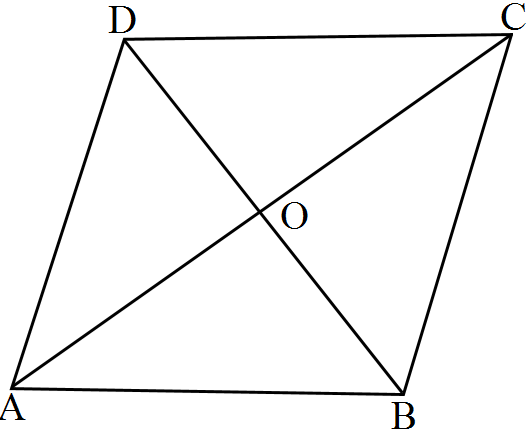
$⇒ 4\ ×$ side $= 20\ cm ⇒$ Side $= 5\ cm$
Since diagonals of rhombus bisect each other at perpendicular, therefore
$\text{OC}=\frac{8}{2}=4\text{cm}$
In triangle $OBC,$
$\text{OB}=\sqrt{5^2-4^2}=\sqrt{25-16}=3\text{cm}$
$\text{AC}=2\times3=6\text{cm}$
Area of rhombus $=\frac{1}{2}\times\text{Product of diagonal}$
$=\frac{1}{2}\times8\times6=24\text{ sq.cm}$ View full question & answer→MCQ 641 Mark
The base of an isoscale triangle is $16\ cm$ and its area is $48\ cm^2$. The perimeter of the triangle is:
- A
$41\ cm$
- ✓
$36\ cm$
- C
$48\ cm$
- D
$324\ cm$
AnswerCorrect option: B. $36\ cm$
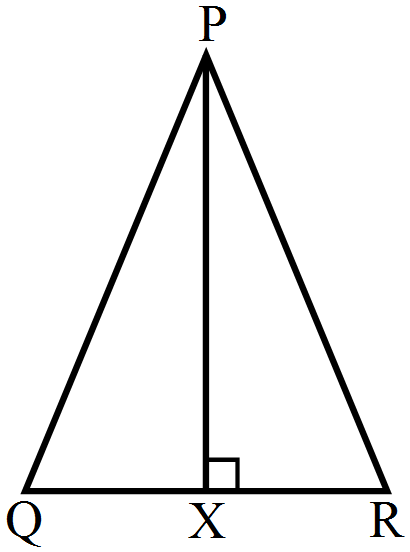
Let $\triangle\text{PQR}$ be an isoscale triangle and $\text{PX}\bot\text{QR}.$
Now,
Area of triangle $= 48\ cm^2$
$\Rightarrow\frac{1}{2}\times\text{QR}\times\text{PX}=48$
$\Rightarrow\text{h}=\frac{96}{16}=6\text{cm}$
Also,
$\text{QX}=\frac{1}{2}\times24=12\text{cm}\ \text{and}\ \text{PX}=12\text{cm}$
$\text{PQ}=\sqrt{\text{QX}^2+\text{PX}^2}$
$\text{a}=\sqrt{8^2+6^2}=\sqrt{64+36}=\sqrt{100}=10\text{cm}$
$\therefore$ Perimeter $= (10 + 10 + 16)\ cm = 36\ cm$
View full question & answer→MCQ 651 Mark
If the height of a parallelogram having $500\ cm^2$ areas is $20\ cm,$ then its base is of length:
- A
$20\ cm$
- B
$50\ cm$
- ✓
$25\ cm$
- D
$15\ cm$
AnswerCorrect option: C. $25\ cm$
Area of parallelogram $=$ Base $×$ Height
$⇒ 500 =$ Base $×\ 20$
$⇒$ Base $= 25\ cm.$
View full question & answer→MCQ 661 Mark
Find the length of each side of an equilateral triangle having area of $9$ root $3\ cm$ square:
- A
$36\ cm$
- B
$5\ cm$
- C
$15\ cm$
- ✓
$6\ cm$
AnswerCorrect option: D. $6\ cm$
$6\ cm$
View full question & answer→MCQ 671 Mark
If side of a scalene $\triangle$ is doubled then area would be increased by:
- A
$200\%$
- B
$25\%$
- C
$50\%$
- ✓
$300\%$
AnswerCorrect option: D. $300\%$
Area of triangle with sides $a, b, c (\text{A})=\sqrt{\text{s}(\text{s}-\text{a})(\text{s}-\text{b})(\text{s}-\text{c})}$
New sides are $2a, 2b$ and $2c$
Then $\text{s}' =\frac{2\text{a}+2\text{b}+2\text{c}}{2}=\text{a}+\text{b}+\text{c}$
$\Rightarrow\text{s}'=2\text{s}\ ...(\text{i})$
New area $=\sqrt{\text{s}'(\text{s}'-2\text{a})(\text{s}'-\text{2b})(\text{s}'-\text{2c})}$
$=\sqrt{2\text{s}(2\text{s}-2\text{a})(2\text{s}-2\text{b})(2\text{s}-2\text{c})}$
$=4\sqrt{\text{s}(\text{s}-\text{a})(\text{s}-\text{b})(\text{s}-\text{c})}$
$=4\text{A}$
Increased area $= 4A - A = 3A$
$\%$ of increased area $=\frac{3\text{A}}{\text{A}}\times100=300\%$
View full question & answer→MCQ 681 Mark
The sides of a triangle are $16\ cm, 30\ cm, 34\ cm$. Its area is:
- A
$225\text{cm}^2$
- ✓
$225\sqrt{3}\text{cm}^2$
- C
$225\sqrt{2}\text{cm}^2$
- D
$450\text{cm}^2$
AnswerCorrect option: B. $225\sqrt{3}\text{cm}^2$
Let $a = 16\ cm, b = 30\ cm, c = 34\ cm$
Semi-perimeter of a triangle $=\frac{\text{a}+\text{b}+\text{c}}{2}=\frac{16+30+34}{2}=40$
Now, $s - a = 24\ cm, s - b = 10\ cm$ and $s - c = 6\ cm$
By Heron's formula.
Area of a triangle $=\sqrt{\text{s}(\text{s}-\text{a})(\text{s}-\text{b})(\text{s}-\text{c})}$
$=\sqrt{40\times24\times10\times6}$
$=\sqrt{4\times10\times4\times6\times10\times6}$
$=\sqrt{4^2\times10^2\times6^2}$
$=4\times10\times6$
$= 240\text{cm}^2$
Note: Correct option not given.
View full question & answer→MCQ 691 Mark
The area of a rhombus is $96\ cm^2$. If one of its diagonals is $16\ cm$, then the length of its side is:
- ✓
$10\ cm$
- B
$12\ cm$
- C
$8\ cm$
- D
$6\ cm$
AnswerCorrect option: A. $10\ cm$
Area of rhombus $=\frac{1}{2}\times$ Product of diagonal
$\Rightarrow96=\frac{1}{2}(16\times\text{d}_2)$
$\Rightarrow\text{d}_2=\frac{96\times2}{16}=12\text{cm}$
Since diagonals of a rhombus bisect each other at a right angle.
Therefore, the side of the rhombus is the hypotenuse of a triangle.
Side $=\sqrt{8^2+6^2}=10\text{cm}.$
View full question & answer→MCQ 701 Mark
The adjacent sides of a parallelogram are $20\ cm$ and $15\ cm$ in length. Then the ratio between the corresponding altitudes is:
- A
$2 : 3$
- ✓
$3 : 4$
- C
$4 : 3$
- D
$1 : 2$
AnswerCorrect option: B. $3 : 4$
Since the adjacent sides and corresponding altitudes of a parallelogram are in proportion.
Therefore, $\frac{15}{20}=\frac{3}{4}$
Thus, the required ratio is $3 : 4.$
View full question & answer→MCQ 711 Mark
The area of a triangle whose sides are $12\ cm, 16\ cm$ and $20\ cm$ is:
- A
$320\ cm^2$
- ✓
$96\ cm^2$
- C
$72\ cm^2$
- D
$240\ cm^2$
AnswerCorrect option: B. $96\ cm^2$
Here, $\text{s}=\frac{12+16+20}{2}=24\text{cm}$
Area of triangle $=\sqrt{\text{s}(\text{s}-\text{a})(\text{s}-\text{b})(\text{s}-\text{c})}$
$=\sqrt{24(24-12)(24-16)(24-20)}$
$=96\text{sq.cm}$
View full question & answer→MCQ 721 Mark
The base of an isosceles triangle is $8\ cm$ long and each of its equal sides measures $6\ cm$. The area of the triangle is:
- A
$16\sqrt5\text{cm}^2$
- B
$8\sqrt3\text{cm}^2$
- C
$16\sqrt3\text{cm}^2$
- ✓
$8\sqrt5\text{cm}^2$
AnswerCorrect option: D. $8\sqrt5\text{cm}^2$
Area of isosceles triangle $=\frac{\text{b}}{4}\sqrt{4\text{a}^2-\text{b}^2}$
Here,
$a = 6\ cm$ and $b = 8\ cm$
Thus, we have
$\frac{8}{4}\times\sqrt{4(6)^2-8^2}$
$=\frac{8}{4}\times\sqrt{144-64}$
$=\frac{8}{4}\times\sqrt{80}$
$=\frac{8}{4}\times4\sqrt{5}$
$=8\sqrt{5}\text{cm}^2$
View full question & answer→MCQ 731 Mark
Each side of an equilateral triangle is $10\ cm$ long. The height of the triangle is:
- A
$10\sqrt3\text{ cm}$
- B
$10\sqrt2\text{ cm}$
- C
$5\text{ cm}$
- ✓
$5\sqrt3\text{ cm}$
AnswerCorrect option: D. $5\sqrt3\text{ cm}$
Height of equilateral triangle $=\frac{\sqrt3}{2}\times$ Side
$=\frac{\sqrt3}{2}\times10$
$=5\sqrt3\text{ cm}$
View full question & answer→MCQ 741 Mark
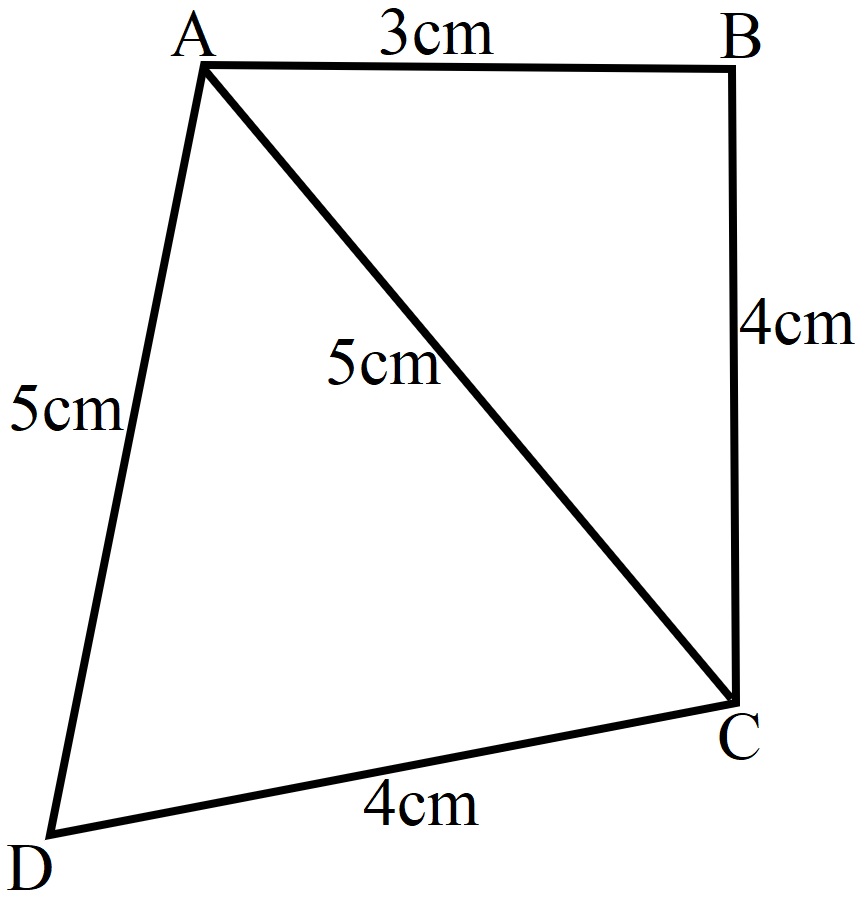
A quadrilateral whose sides are $3\ cm, 4\ cm, 4\ cm, 5\ cm$ and one of the diagonal is equal to $5\ cm$ as per the below figure. The area of the quadrilateral is:
- A
$19.17\ sq. cm$
- ✓
$15.17\ sq. cm$
- C
$20.17\ sq. cm$
- D
$22.17\ sq. cm$
AnswerCorrect option: B. $15.17\ sq. cm$
Using Pythagoras theorem, in $\triangle\text{ABC}$
$AC^2 = AB^2 + BC^2$
$⇒ 5^2 = 3^2 + 4^2$
$⇒ 25 = 25$
Hence, $ABC$ is a right triangle.
Area of $\triangle\text{ABC}=\frac{1}{2}\times3\times4=6\text {sq}.\text{cm}$
Semiperimeter of $\triangle\text{ACD}=\text{s}=\frac{(5+5+4)}{2}=\frac{14}{2}=7\text{cm}$
Area of $\triangle{\text{ABC}}$ can be determined by using Heron’s formula.
$\text{A}=\sqrt{\text{s}(\text{s-a})(\text{s-b})(\text{s-c})}$
$=\sqrt{7(7-5)(7-5)(7-4)} $
$=\sqrt{(7\times2\times2\times3)}$
$=9.17\text{sq}.\text{cm}$
Therefore, the area of quad. $ABCD =$ Area of $\triangle{\text{ABC}}$
$=\text{Area}\text{ of }\triangle\text{ABC}+\text{Area}\text{ of }\triangle\text{ACD}$
$=(6+9.17)\text{sq.cm}=15\text{sq.cm}$
View full question & answer→MCQ 751 Mark
One of the diagonals of a rhombus is $12\ cm$ and the area is $96\ sq.cm$. The perimeter of the rhombus is:
- A
$\sqrt[3]{10}\text{cm}$
- B
$7\text{cm}$
- ✓
$40\text{cm}$
- D
$\sqrt[6]{10}\text{cm}$
AnswerCorrect option: C. $40\text{cm}$
$\text{d}_2=\frac{\text{Area}\times2}{\text{d}_1}$
$=\frac{96\times2}{12}$
$=16\text{cm}$
length of side of rhombus $=\sqrt{6^2+8^2}=10\text{cm}$
peimeter of rhombus $= 4\ ×$ side
$=4 × 10 = 40\ cm$
View full question & answer→MCQ 761 Mark
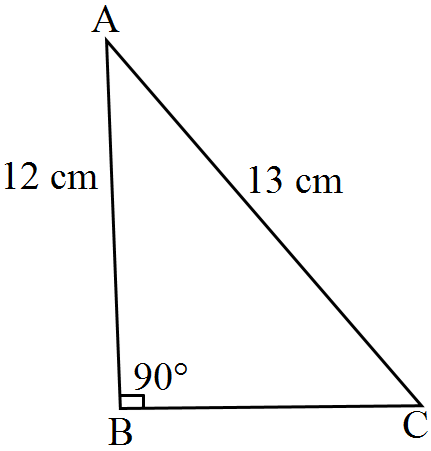
Area of the given triangle is:
- A
$78\ cm^2$
- B
$60\ cm^2$
- ✓
$30\ cm^2$
- D
$32.5\ cm^2$
AnswerCorrect option: C. $30\ cm^2$
In the given triangle,
$\text{Base}(\text{BC})=\sqrt{13^2-12^2}=\sqrt{169-144}=5\text{cm}$
Area of triangle ABC $=\frac{1}{2}\times\text{BC}\times\text{AB}$
$=\frac{1}{2}\times5\times12$
$=30\text{ sq.cm}$
View full question & answer→MCQ 771 Mark
The length of the sides of a triangle are $5\ cm, 7\ cm$ and $8\ cm$. Area of the triangle is:
- ✓
$10\sqrt3\text{cm}^2$
- B
$100\sqrt3\text{cm}^2$
- C
$300\text{cm}^2$
- D
$50\sqrt3\text{cm}^2$
AnswerCorrect option: A. $10\sqrt3\text{cm}^2$
$10\sqrt3\text{cm}^2$
View full question & answer→MCQ 781 Mark
The base of a right triangle is $8\ cm$ and the hypotenuse is $10\ cm.$ Its area will be:
- ✓
$24\ cm^2$
- B
$40\ cm^2$
- C
$48\ cm^2$
- D
$80\ cm^2$
AnswerCorrect option: A. $24\ cm^2$
Given: Base $= 8\ cm$ and Hypotenuse $= 10\ cm$
Hence, height $=\sqrt{(10^{2}-8^2)}=\sqrt{36}=6\text{cm}$
Therefore area $=\big(\frac{1}{2}\big)\times\text{b}\times\text{h}=\big(\frac{1}{2}\big)\times8\times6=24\text{cm}^2$
View full question & answer→MCQ 791 Mark
If one side and one diagonal of a rhombus and $20m$ and $24m,$ then its area $=$
- A
$284m^2$
- B
$96m^2$
- C
$192m^2$
- ✓
$384m^2$
AnswerCorrect option: D. $384m^2$
Since diagonals of a rhombus bisect each other at right angle.
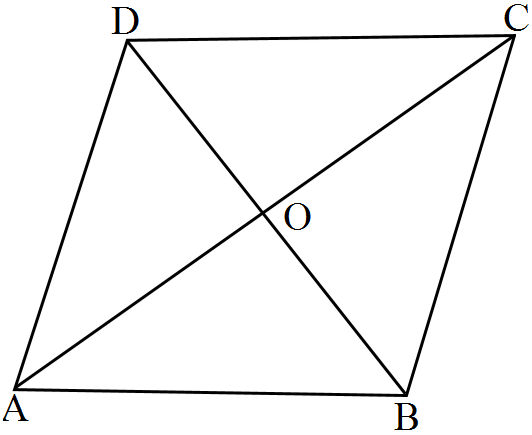
$\text{OB}=\frac{24}{2}=12\text{m}$
In triangle $OBC, OC =\sqrt{20^2-12^2}=\sqrt{400-144}=16\text{m}$
$\text{AC}=2\times16=32\text{m}$
Area of rhombus $=\frac{1}{2}\times\text{Product of diagonals}$
$=\frac{1}{2}\times24\times32$
$=384\text{ sq.m}$
View full question & answer→MCQ 801 Mark
The perimeter of a rhombus is $20\ cm.$ If one of its diagonals is $6\ cm,$ then its area is:
- A
$36\ cm^2$
- B
$20\ cm^2$
- ✓
$24\ cm^2$
- D
$28\ cm^2$
AnswerCorrect option: C. $24\ cm^2$
Side $=\frac{20}{5}=5\text{cm}$
Half diagonal $=\sqrt{5^2-3^2}=4\text{cm}$
Diagonal $=4\times2=8\text{cm}$
Area $=\frac{1}{2}\times6\times8=24\text{cm}^2.$
View full question & answer→MCQ 811 Mark
Write the correct answer in the following: The perimeter of an equilateral triangle is $60m.$ The area is:
- A
$10\sqrt{3}\text{m}^2$
- B
$15\sqrt{3}\text{m}^2$
- C
$20\sqrt{3}\text{m}^2$
- ✓
$100\sqrt{3}\text{m}^2$
AnswerCorrect option: D. $100\sqrt{3}\text{m}^2$
Perimeter of triangle $= 3a$
Now, $3\text{a}=60$
$\Rightarrow\text{ a}=60\div3=20\text{m}$
Area of equilateral $\triangle=\frac{\sqrt{3}}{4}(\text{side})^2$
$=\frac{\sqrt{3}}{4}\times(20)^2=100\sqrt{3}\text{m}^2$
View full question & answer→MCQ 821 Mark
If the area of an equilateral triangle is $36\sqrt{3}\text{cm}^2,$ then the perimeter of the triangle is:
- A
$12\sqrt{3}\text{cm}^2$
- B
$12\ cm$
- C
$18\ cm$
- ✓
$36\ cm$
AnswerCorrect option: D. $36\ cm$
$36\sqrt{3}=\frac{\sqrt{3}}{4}\text{a}^2$
$\text{a}^2=\frac{36\sqrt{3}\times4}{\sqrt{3}}=144$
$a = 12\ cm$
Perimeter $= 3 × 12 = 36\ cm.$
View full question & answer→MCQ 831 Mark
If the area of an isosceles right triangle is $8\ cm^2$, what is the perimeter of the triangle$?$
- A
$4+8\sqrt{2}\text{cm}^2$
- B
$12\sqrt{2}\text{cm}^2$
- C
$8+\sqrt{2}\text{cm}^2$
- ✓
$8+4\sqrt{2}\text{cm}^2$
AnswerCorrect option: D. $8+4\sqrt{2}\text{cm}^2$
Let each of the two equal sides of an isosceles right triangle be $a\ cm.$
Then, third side $=\text{a}\sqrt{2}\text{m}$
Area of $\triangle=\frac{1}{2}\times2\times2$
$\Rightarrow8=\frac{\text{a}^2}{2}$
$⇒ a^2 = 4\ cm$
$⇒ a = 4\ cm$
$⇒$ Perimeter
$\Rightarrow\text{a}+\text{a}+\text{a}\sqrt{2}=4+4+4\sqrt{2}$
$=8+4\sqrt{2}\text{cm}^2.$
View full question & answer→MCQ 841 Mark
The perimeter of an equilateral triangle is $48\ cm$. Its area is:
- A
$18\sqrt{3}\text{ sq.cm}$
- B
$72\sqrt{3}\text{ sq.cm}$
- C
$60\sqrt{3}\text{ sq.cm}$
- ✓
$64\sqrt{3}\text{ sq.cm}$
AnswerCorrect option: D. $64\sqrt{3}\text{ sq.cm}$
Side $=\frac{48}{3}=16\text{ cm}$
$=\frac{\sqrt{3}}{4}\times16\times16=64\sqrt{3}\text{ sq.cm}$
View full question & answer→MCQ 851 Mark
The area of an isosceles triangle having base $24\ cm$ and length of one of the equal sides $20\ cm$ is:
- A
$480\ cm^2$
- B
$240\ cm^2$
- C
$196\ cm^2$
- ✓
$192\ cm^2$
AnswerCorrect option: D. $192\ cm^2$
$\text{S}=\frac{(24+20+20)}{2}=32\text{cm}$
$\text{Area}=\sqrt{\text{s}(\text{s}-\text{a})(\text{s}-\text{b})(\text{s}-\text{c})}$
$=\sqrt{32(32-24)(32-20)(32-20)}$
$=192\text{sq}.\text{cm}.$
View full question & answer→MCQ 861 Mark
The area of a triangle with base $8\ cm$ and height $10\ cm$ is:
- A
$20\ cm^2$
- B
$18\ cm^2$
- C
$80\ cm^2$
- ✓
$40\ cm^2$
AnswerCorrect option: D. $40\ cm^2$
$40\ cm^2$
View full question & answer→MCQ 871 Mark
Area of an equilateral triangle of side $10\ cm$ is:
- A
$50\sqrt{3}\text{cm}^2$
- B
$100\sqrt{3}\text{cm}^2$
- C
$10\sqrt{3}\text{cm}^2$
- ✓
$25\sqrt{3}\text{cm}^2$
AnswerCorrect option: D. $25\sqrt{3}\text{cm}^2$
Area of equilateral triangle $=\frac{\sqrt{3}}{4}(\text{Side})^2$
$=\frac{\sqrt{3}}{4}(10)^2$
$=25\sqrt{3}\text{sq.cm}$
View full question & answer→MCQ 881 Mark
Two adjacent sides of a parallelogram are $74\ cm$ and $40\ cm$ and one of its diagonals is $102\ cm.$ Area of the parallelogram is:
- ✓
$2448\ sq.cm$
- B
$4896\ sq.cm$
- C
$612\ sq.cm$
- D
$1224\ sq.cm$
AnswerCorrect option: A. $2448\ sq.cm$
Let the two adjacent sides of the parallelogram be $a = 74\ cm, b = 40\ cm$
Let the length of diagonal be $c = 102\ cm$
These two sides and the diagonal forms a triangle
semi perimeter, $\text{s}=\frac{\text{a}+\text{b}+\text{c}}{2}$
$\text{s}=\frac{74+40+102}{2}$
$=\frac{216}{2}$
$= 108\ cm$
By Heron's formula, we have area of triangle $=\sqrt{\text{s}(\text{s}-\text{a})(\text{s}-\text{b})(\text{s}-\text{c})}$
Area of triangle $=\sqrt{108(108-74)(108-40)(108-102)}$
$= 1224\ cm^2$
therefore, area of parallelogram $= 1224 × 2$
$= 2448\ sq.cm$
View full question & answer→MCQ 891 Mark
Each side of an equilateral triangle measures $10\ cm.$ Then the area of the triangle is:
- ✓
$43.3\ cm^2$
- B
$43.1\ cm^2$
- C
$43.4\ cm^2$
- D
$43.2\ cm^2$
AnswerCorrect option: A. $43.3\ cm^2$
$43.3\ cm^2$
View full question & answer→MCQ 901 Mark
The area of the rhombus is $96\ sq\ m$. If one of its diagonals is $16\ cm,$ then the length of its another diagonal is:
- ✓
$12\ cm$
- B
$5\ cm$
- C
$10\ cm$
- D
$8\ cm$
AnswerCorrect option: A. $12\ cm$
Area of rhombus $=\frac{1}{2}\text{d}_1\text{d}_2$
$96=\frac{1}{2}\times16\times\text{d}_2$
$\text{d}_2=\frac{96\times2}{16}$
$\text{d}_2=6\times2=12\text{cm}$
View full question & answer→MCQ 911 Mark
The perimeter of a rhombus is $20\ cm.$ One of its diagonals is $8\ cm.$ Then area of the rhombus is:
- ✓
$24\ cm^2$
- B
$42\ cm^2$
- C
$18\ cm^2$
- D
$36\ cm^2$
AnswerCorrect option: A. $24\ cm^2$
$24\ cm^2$
View full question & answer→MCQ 921 Mark
Each equal side of an isosceles triangle is $13\ cm$ and its base is $24\ cm$ Area of the triangle is:
- ✓
$60\text{cm}^2$
- B
$40\sqrt{3}\text{cm}^2$
- C
$50\sqrt{3}\text{cm}^2$
- D
$25\sqrt{3}\text{cm}^2$
AnswerCorrect option: A. $60\text{cm}^2$
$\text{s}=\frac{13+13+24}{2}=25\text{cm}$
Area of triangle $=\sqrt{\text{s}(\text{s}-\text{a})(\text{s}-\text{b})(\text{s}-\text{c})}$
$=\sqrt{25(25-13)(25-13)(25-24)}$
$=\sqrt{25\times12\times12\times1}$
$=60\text{ sq.cm}$
View full question & answer→MCQ 931 Mark
An isosceles right triangle has an area of $8\ cm^2$. The length of its hypotenuse is:
- ✓
$\sqrt{{32}\text{cm}}$
- B
$\sqrt{{16}\text{cm}}$
- C
$\sqrt{{48}\text{cm}}$
- D
$\sqrt{{24}\text{cm}}$
AnswerCorrect option: A. $\sqrt{{32}\text{cm}}$
$\text{Given that area of the isosceles triangle}=8\text{cm}^2$
As the given triangle is isosceles triangle, let base $=$ height $= h$
Hence,
$\frac{1}{2}\times\text{h}\times\text{h=8} $
$\frac{1}{2}\text{h}^2=8$
$\text{h}^2=16$
$\text{h}=4\text{cm}$
$\text{Since it is isosceles right triangle,}\text{Hypotenuse}^2 = \text{Base}^2+\text{Height}^2$
$\text{Hypotenuse}^2 = 42 + 42$
$\text{Hypotenuse}^2 = 32$
$\text{Hypotenuse} = \sqrt{{32}\text{cm}}$
View full question & answer→MCQ 941 Mark
The length of each side of an equilateral triangle of area $4\sqrt{3}\text{cm}^2,$ is:
- A
$3\ cm$
- B
$6\ cm$
- C
$5\ cm$
- ✓
$4\ cm$
AnswerCorrect option: D. $4\ cm$
If side of an equilateral triangle is $'a',$ then its
Area $=\frac{\sqrt{3}}{4}\text{a}^2$
Now $\frac{\sqrt{3}}{4}\text{a}^2=4\sqrt3$
$a^2 = 4^2$
$a = 4\ cm$
View full question & answer→MCQ 951 Mark
The area of triangle with given two sides $18\ cm$ and $10\ cm,$ respectively and a perimeter equal to $42\ cm$ is:
- A
$20\sqrt11\text{cm}^2$
- B
$19\sqrt11\text{cm}^2$
- C
$22\sqrt11\text{cm}^2$
- ✓
$21\sqrt11\text{cm}^2$
AnswerCorrect option: D. $21\sqrt11\text{cm}^2$
Explanation: Perimeter$ = 42$
$a + b + c = 42$
$18 + 10 + c = 42$
$c = 42 - 28 = 14\ cm$
$\text{Semi perimeter,s}=\frac{42}{2}=21\text{cm}$
Using Heron’s formula:
$\text{A}=\sqrt{8(8-\text{a})(8-\text{b})(8-\text{c})}$
$=\sqrt{21(21-18)(21-10)(21-14)}$
$=\sqrt{(21\times3\times11\times7)}$
$=21\sqrt{11\text{cm}^2}$
View full question & answer→MCQ 961 Mark
The area of an equilateral triangle is $36\sqrt{3}\text{cm}^2.$ Its perimeter is:
- ✓
$36\ cm$
- B
$12\sqrt{3}\text{cm}$
- C
$24\ cm$
- D
$30\ cm$
AnswerCorrect option: A. $36\ cm$
Area of equilateral triangle $=\frac{\sqrt{3}}{4}\times(\text{side})^2$
$\Rightarrow\frac{\sqrt{3}}{4}\times(\text{side})^2=36\sqrt{3}$
$\Rightarrow(\text{Side})^2=144$
$\Rightarrow\text{Side}=12\text{cm}$
Now,
Perimeter $= 3 × 12 = 36\ cm$
View full question & answer→MCQ 971 Mark
The area of an equilateral triangle of side $6\ cm$ is:
- A
$18^{\text{cm}^2}$
- ✓
$9\sqrt3^{\text{cm}^2}$
- C
$56\sqrt3^{\text{cm}^2}$
- D
$58\sqrt3^{\text{cm}^2}$
AnswerCorrect option: B. $9\sqrt3^{\text{cm}^2}$
$9\sqrt3^{\text{ cm}^2}$
View full question & answer→MCQ 981 Mark
Each side of an equilateral triangle measures $10\ cm.$ Then the area of the triangle is:
- A
$43.1\ cm^2$
- B
$43.4\ cm^2$
- C
$43.2\ cm^2$
- ✓
$43.3\ cm^2$
AnswerCorrect option: D. $43.3\ cm^2$
Area of equilateral triangle $=\frac{\sqrt{3}}{4}$ (Side)$^2$
$=\frac{1.732}{4}\times10\times10$
$=43.3\text{ sq.cm}$
View full question & answer→MCQ 991 Mark
The lengths of the three sides of a triangular field are $40m, 24m$ and $32m$ respectively. The area of the triangle is:
- A
$480\ m^2$
- B
$320\ m^2$
- ✓
$384\ m^2$
- D
$360 \ m^2$
AnswerCorrect option: C. $384\ m^2$
Let:
$a = 40m, b = 24m$ and $c = 32m$
$\text{s}=\frac{\text{a}+\text{b}+\text{c}}{2}=\frac{40+24+32}{2}=48\text{m}$
Byu Heron's formula, we have:
Area of triangle $=\sqrt{\text{s}(\text{s}-\text{a})(\text{s}-\text{b})(\text{s}-\text{c})}$
$=\sqrt{48(48-40)(48-24)(48-32)}$
$=\sqrt{48\times8\times24\times16}$
$=\sqrt{24\times2\times8\times24\times8\times2}$
$=24\times8\times2$
$=384\text{m}^2$
View full question & answer→MCQ 1001 Mark
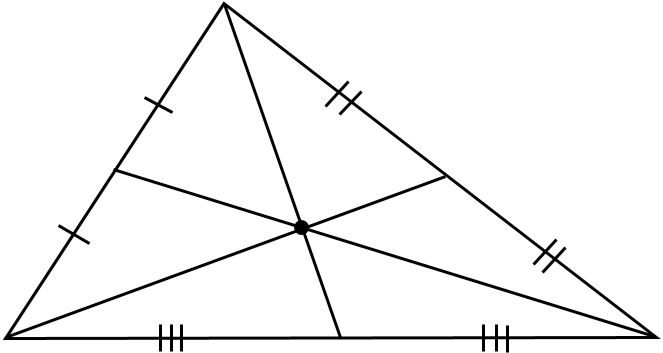
Length of perpendicular drawn on smallest side of scalene triangle is:
AnswerLength of the perpendicular drawn on the smallest side of the scalene triangle is largest.
View full question & answer→