MCQ 1011 Mark
The sides of a triangle are $5\ cm, 12\ cm$ and $13 \ cm.$ then its area is:
- A
$0.0024\ m^2$
- B
$0.0015\ m^2$
- C
$0.0026\ m^2$
- ✓
$0.003 \ m^2$
AnswerCorrect option: D. $0.003 \ m^2$
$\text{s}=\frac{5+12+13}{2}=15\text{cm}$
Area of triangle $=\sqrt{\text{s}(\text{s}-\text{a})(\text{s}-\text{b})(\text{s}-\text{c})}$
$=\sqrt{15(15-5)(15-12)(15-13)}$
$=\sqrt{15\times10\times3\times2}$
$=30\text{ sq.cm}$
$=0.003\text{ sq.m}$
View full question & answer→MCQ 1021 Mark
If the perimeter of an equilateral triangle is $24\ m,$ then its area is:
- A
$8\sqrt{3}\text{ m}^2$
- B
$20\sqrt{3}\text{ m}^2$
- C
$24\sqrt{3}\text{ m}^2$
- ✓
$16\sqrt{3}\text{ m}^2$
AnswerCorrect option: D. $16\sqrt{3}\text{ m}^2$
Side$=\frac{24}{3}=8\text{ m}$
Area$=\frac{\sqrt{3}}{4}\times8\times8$
$=16\sqrt{3}\text{ m}^2.$
View full question & answer→MCQ 1031 Mark
Given the product of diagonals of a rhombus $ABCD$ is $2500\ cm^2$, its area is:
- A
$1200\ cm^2$
- ✓
$1250 \ cm^2$
- C
$625\ cm^2$
- D
$2000\ cm^2$
AnswerCorrect option: B. $1250 \ cm^2$
Area of rhombus $=\frac{1}{2}\times$ Product of diagonals
$=\frac{1}{2}\times2500$
$=1250\text{sq.cm}$
View full question & answer→MCQ 1041 Mark
The area of a rightangled triangle if the radius of its circumcircle is $3\ cm$ and altitude drawn to the hypotenuse is $2\ cm.$
- ✓
$6\ cm^2$
- B
$3\ cm^2$
- C
$4\ cm^2$
- D
$8\ cm^2$
AnswerCorrect option: A. $6\ cm^2$
$6\ cm^2$
View full question & answer→MCQ 1051 Mark
The area of a triangle is $150\ cm^2$ and its sides are in the ratio $3 : 4 : 5.$ What is its perimeter$?$
- A
$40\ cm$
- ✓
$60\ cm$
- C
$50\ cm$
- D
$70\ cm$
AnswerCorrect option: B. $60\ cm$
$60\ cm$
View full question & answer→MCQ 1061 Mark
The sides of a parallelogram are $100m$ each and the length of the longest diagonal is $160m.$ The area of a parallelogram is:
- ✓
$9600\ sq.m$
- B
$9000\ sq.m$
- C
$9200\ sq.m$
- D
$8800\ sq.m$
AnswerCorrect option: A. $9600\ sq.m$
$9600\ sq.m$ Solution:The diagonal divides the parallelogram into two equivalent triangles. Hence, its area will be equal to the sum of the area of the two triangles.
Thus, the sides of one triangle will be $100m, 160m,$ and $100m.$
So, $a = 100m, b = 160m, c = 100m$
$\text{Semiperimeter}(\text{s})=\frac{(\text{a}+\text{b}+\text{c})}{2} =\frac{(100+160+100)}{2}=\frac{360}{2}=180\text{m} $
Using Heron’s formula,
$\text{A}=\sqrt{{3}(\text{s}-\text{a})(\text({s}-\text{b})(\text{s}-\text{ c})}$
$= \sqrt{{180}(180-100)(180-160)(180-100)}$
$=\sqrt{(180\times80\times20\times80)}$
$= 4800\text{s}\text{q}.\text{m}$
$\text{Thus},\text{the area of the parallelogram}=2\times4800\text{s}\text{q}.\text{m} =9600\text{s}\text{q}.\text{m}$
View full question & answer→MCQ 1071 Mark
An isosceles right triangle has area $8\ cm^2$. The length of its hypotenuse is:
- ✓
$\sqrt{32}\text{cm}$
- B
$\sqrt{24}\text{cm}$
- C
$\sqrt{16}\text{cm}$
- D
$\sqrt{48}\text{cm}$
AnswerCorrect option: A. $\sqrt{32}\text{cm}$
Area of isosceles triangle $=\frac{1}{2}\times\text{Base}\times\text{Height}$
Since in an isosceles triangle, Base and Height are equal.
$\Rightarrow8=\frac{1}{2}\times\text{Base}\times\text{Base}$
$\Rightarrow\text{Base}=\text{Height}=\text{4cm}$
Hypotenuse $=\sqrt{4^{2}+4^2}=\sqrt{32}\text{cm}$
View full question & answer→MCQ 1081 Mark
The perimeter of a triangle is $60\ cm$. If its sides are in the ratio $1 : 3 : 2,$ then its smallest side is:
- A
$5\ cm$
- ✓
$10\ cm$
- C
$15\ cm$
- D
$30\ cm$
AnswerCorrect option: B. $10\ cm$
Given: Ratio of sides: $1 : 3 : 2$
Let the sides of triangle be $x, 3x$ and $2x\ cm$
Perimeter $= 60\ cm$
$x + 3x + 2x = 60$
$⇒ 6x = 60$
$⇒ x = 10$
So, sides are
$a = 1 × 10 = 10\ cm$
$b = 3 × 10 = 30\ cm$
$c = 2 × 10 = 20\ cm$
Therefore, Length of smallest side $= 10\ cm.$
View full question & answer→MCQ 1091 Mark
The edges of a triangular board are $6\ cm, 8\ cm$ and $10\ cm$. The cost of painting it at the rate of $70$ paise per $cm^2$ is:
- A
$₹17$
- ✓
$₹16.80$
- C
$₹7$
- D
$₹16$
AnswerCorrect option: B. $₹16.80$
$₹16.80$
View full question & answer→MCQ 1101 Mark
The length of the sides of a triangle are $5\ cm, 7\ cm$ and $8\ cm$. Area of the triangle is:
- A
$100\sqrt{3}\text{cm}^2$
- B
$300\text{cm}^2$
- ✓
$10\sqrt{3}\text{cm}^2$
- D
$50\sqrt{3}\text{cm}^2$
AnswerCorrect option: C. $10\sqrt{3}\text{cm}^2$
$\text{s}=\frac{5+7+8}{2}=10\text{cm}$
Area of triangle $=\sqrt{\text{s}(\text{s}-\text{a})(\text{s}-\text{b})(\text{s}-\text{c})}$
$=\sqrt{10(10-5)(10-7)(10-8)}$
$=\sqrt{10\times5\times3\times2}$
$=10\sqrt{3}\text{ sq.cm}$
View full question & answer→MCQ 1111 Mark
The lengths of the sides of $\triangle\text{ABC}$ are consecutive integers. It $\triangle\text{ABC}$ has the same perimeter as an equilateral triangle with a side of length 9cm, what is the length of the shortest side of $\triangle\text{ABC}?$
AnswerLet the sides of $\triangle\text{ABC}$ be $n, n + 1, n + 2.$
$⇒$ Perimeter $= n + n + 1 + n + 2$
$⇒ (9 + 9 + 9) = 3n + 3$
$⇒ 3n = 24$
$⇒ n = 8\ cm$
Thus, the shortest side is $8\ cm.$
Hence, correct option is $(c).$
View full question & answer→MCQ 1121 Mark
If the side of an equilateral triangle is $4\ cm,$ then its area is:
- A
$16\sqrt{3}\text{cm}^2$
- B
$12\sqrt{3}\text{cm}^2$
- ✓
$4\sqrt{3}\text{cm}^2$
- D
$8\sqrt{3}\text{cm}^2$
AnswerCorrect option: C. $4\sqrt{3}\text{cm}^2$
Area of equilateral triangle $=\frac{\sqrt{3}}{4}\text{a}^2$
$=\frac{\sqrt{3}}{4}\times4\times4$
$=4\sqrt{3}\text{cm}^2.$
View full question & answer→MCQ 1131 Mark
If the area of an equilateral triangle is $16\sqrt{3}\text{cm}^2,$ then the perimeter of the triangle is:
- A
$48\ cm$
- B
$36\ cm$
- C
$12\ cm$
- ✓
$24\ cm$
AnswerCorrect option: D. $24\ cm$
Area of equilateral triangle $=\frac{\sqrt{3}}{4}(\text{Side})^2=16\sqrt{3}$
$⇒ ($Side$)^2 = 64$
$⇒$ Side $= 8\ cm$
Perimeter of equilateral triangle $= 3\ ×$ side
$= 3 × 8 = 24\ cm.$
View full question & answer→MCQ 1141 Mark
The area and length of one diagonal of a rhombus are given as $200\ cm^2$ and 10cm respectively. The length of other diagonal is:
- A
$20\ cm$
- ✓
$40\ cm$
- C
$25\ cm$
- D
$10\ cm$
AnswerCorrect option: B. $40\ cm$
Area of rhombus $=\frac{1}{2}\times\text{Product of diagonal}$
$\Rightarrow200=\frac{1}{2}\times10\times\text{d}_2$
$\Rightarrow\text{d}_2=\frac{200\times2}{10}=40\text{cm}$
View full question & answer→MCQ 1151 Mark
The area of an equilateral triangle with sides $2\sqrt3\text{cm}$ is:
- ✓
$5.196\ cm^2$
- B
$0.866\ cm^2$
- C
$3.496\ cm^2$
- D
$1.732\ cm^2$
AnswerCorrect option: A. $5.196\ cm^2$
Given: Side $=2\sqrt3\text{cm}$
We know that, area of equilateral triangle $=\bigg(\frac{\sqrt3}{4}\bigg)\text{a}^2$ square units.
$=\bigg(\frac{\sqrt3}{4}\bigg)(2\sqrt3)^2=\bigg(\frac{\sqrt3}{4}\bigg)(12)$
$=3\sqrt3=3(1.732)=5.196\text{cm}^2$
View full question & answer→MCQ 1161 Mark
Each of the equal sides of an isosceles triangle is $2\ cm$ greater than its height. If the base of the triangle is $12\ cm$, then its area is:
- ✓
$48\ cm^2$
- B
$36\ cm^2$
- C
$30\ cm^2$
- D
$24\ cm^2$
AnswerCorrect option: A. $48\ cm^2$
Let the height of the isosceles triangle be $x\ cm$
Then length of equal side $= (x + 2)cm$
Since altitude of isosceles triangle bisects the base.
Then, in a right-angled triangle,
$(x + 2)^2 = x^2 + 6^2$
$⇒ 4 + 4x = 36$
$⇒ x = 8\ cm$
Now, area of triangle $ = \frac{1}{2}\times \text{Base}\times\text{Height}$
$=\frac{1}{2}\times12\times8=48\text{cm}^2$
View full question & answer→MCQ 1171 Mark
The perimeter of a rhombus is $146\ cm.$ One of its diagonals is $55\ cm.$ The length of the other diagonal and area of the rhombus are:
- A
$48\ cm, 2320\ cm^2$
- B
$48\ cm, 1820\ cm^2$
- C
$88\ cm, 1320\ cm^2$
- ✓
$48\ cm, 1320\ cm^2$
AnswerCorrect option: D. $48\ cm, 1320\ cm^2$
$48\ cm, 1320\ cm^2$
View full question & answer→MCQ 1181 Mark
The sides of a triangle are $35\ cm, 54\ cm$ and $61\ cm,$ respectively. The length of its longest altitude.
- ✓
$24\sqrt{5}\text{cm}$
- B
$28\text{cm}$
- C
$10\sqrt{5}\text{cm}$
- D
$16\sqrt{5}\text{cm}$
AnswerCorrect option: A. $24\sqrt{5}\text{cm}$
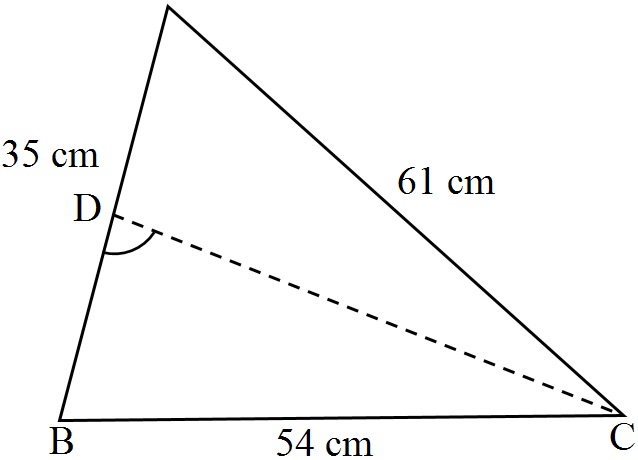
Let $ABC$ be a triangle in which sides $AB = 35\ cm, BC = 54\ cm$ and $CA = 61\ cm$
Now semi-perimeter of a triangle,
$\text{s}=\frac{\text{a}+\text{b}+\text{c}}{2}=\frac{35+54+61}{32}=\frac{150}{2}=75\text{cm}$
$\Big[\therefore$ semiperimeter, $\text{s}=\frac{\text{a}+\text{b}+\text{c}}{2}\Big]$
$\because$ Area of $\triangle\text{ABC}=\sqrt{\text{s}(\text{s}-\text{a})(\text{s}-\text{b})(\text{s}-\text{c})}$ [by Heron's formula]
$=\sqrt{75(75-35)(75-54)(75-61)}$
$=\sqrt{75\times40\times21\times14}$
$=\sqrt{25\times3\times4\times2\times5\times7\times3\times7\times2}$
$=5\times2\times2\times3\times7\sqrt{5}$
$=420\sqrt{5}\text{cm}^2$
Also, Area of $\triangle\text{ABC}=\frac{1}{2}\times\text{AB}\times\text{Altitude}$
$\Rightarrow\frac{1}{2}\times35\times\text{CD}$
$\Rightarrow\text{CD}=\frac{420\times2\sqrt5}{35}$
$\therefore\text{CD}=24\sqrt5$
Hence, the length of altitude is $24\sqrt5\text{cm}.$
View full question & answer→MCQ 1191 Mark
The area of a triangle whose sides are $12\ cm, 16\ cm$ and $20\ cm$ is:
- ✓
$96\ cm^2$
- B
$320\ cm^2$
- C
$240\ cm^2$
- D
$72\ cm^2$
AnswerCorrect option: A. $96\ cm^2$
$96\ cm^2$
View full question & answer→MCQ 1201 Mark
The edges of a triangular board are $6\ cm, 8\ cm$ and $10\ cm.$ The cost of painting it at the rate of $9$ paise per $cm^2$ is:
- A
$Rs. 2.00$
- ✓
$Rs. 2.16$
- C
$Rs. 2.48$
- D
$Rs. 3.00$
AnswerCorrect option: B. $Rs. 2.16$
$\text{s}=\frac{6+8+10}{2}=12\text{cm}$
Area of triangle $=\sqrt{\text{s}(\text{s}-\text{a})(\text{s}-\text{b})(\text{s}-\text{c})}$
$=\sqrt{12(12-6)(12-8)(12-10)}$
$=\sqrt{12\times6\times4\times2}$
$=24\text{ sq.cm}$
Therefore, the cost of painting it at the rate of $Rs. 0.09$ per sq.cm $= 24 × 0.09 = Rs 2.16$
View full question & answer→MCQ 1211 Mark
He base of an isosceles triangle is $10\ cm$ and one of its equal sides is $13\ cm.$ The area of the triangle is:
- A
$80\ cm^2$
- B
$100\ cm^2$
- C
$50\ cm^2$
- ✓
$60\ cm^2$
AnswerCorrect option: D. $60\ cm^2$
$60\ cm^2$
View full question & answer→MCQ 1221 Mark
If the perimeter of an equilateral triangle is $180\ cm$. Then its area will be:
- A
$900 \text{cm}^2$
- ✓
$900\sqrt3\text{cm}^2$
- C
$300\sqrt3\text{cm}^2$
- D
$600\sqrt3\text{cm}^2$
AnswerCorrect option: B. $900\sqrt3\text{cm}^2$
Given, Perimeter $= 180\ cm$
$3a = 180 ($Equilateral triangle$)$
$a = 60\ cm$
Semi-perimeter $\frac{180}{2}=90\text{cm}$
Now as per Heron’s formula,
$\text{A}=\sqrt{\text{a}(8-\text{a})(8-\text{b})(8-\text{c})}$
In the case of an equilateral triangle, $a = b = c = 60\ cm$
Substituting these values in the Heron’s formula, we get the area of the triangle as:
$\text{A}=\sqrt{90(90-60)(90-60)(90-60)} $
$ = \sqrt{(90\times{30}\times{30}\times{30})}$
$\text{A}=900\sqrt{3\text{cm}^2}$
View full question & answer→MCQ 1231 Mark
The edges of a triangular board are $6\ cm, 8\ cm$ and $10\ cm.$ The cost of painting it at the rate of $9$ paise per $cm^2$ is:
- A
$Rs 2.00$
- ✓
$Rs 2.16$
- C
$Rs 2.48$
- D
$Rs 3.00$
AnswerCorrect option: B. $Rs 2.16$
Given: $a = 6\ cm, b = 8\ cm, c = 10\ cm.$
$\text{s}=(\frac{6+8+10}{2})=12\text{cm}$
Hence, by using Heron’s formula, we can write:
$\text{A}=\sqrt{12(12-6)(12-8)(12-10)}=\sqrt{(12)(6)(4)(2)}=\sqrt{576=24\text{cm}^2}$
$\text{Therefore, the cost of painting at a rate of 9 paise per cm}^2=24\times9\text{paise}=\text{Rs.2.16}$
View full question & answer→MCQ 1241 Mark
The lengths of the sides of $\triangle\text{ABC}$ are consecutive integers. It $\triangle\text{ABC}$ has perimeter as an equilateral triangle triangle with a side of length $9cm,$ what is the length of the shortest side of $\triangle\text{ABC}?$
AnswerLet the sides of $\triangle\text{ABC}$ be $n, n + 1, n + 2$
$⇒$ Perimeter $= n + n + 1 + n + 2$
$⇒ (9 + 9 + 9) = 3n + 3$
$⇒ 27 = 3n + 3$
$⇒ 3n = 24$
$⇒ n = 8\ cm$
Thus, the shortest side is $8\ cm.$
View full question & answer→MCQ 1251 Mark
The base of a right triangle is $8\ cm$ and hypotenuse is $10\ cm$. Its area will be:
- A
$48\ cm^2$
- B
$80\ cm^2$
- C
$40\ cm^2$
- ✓
$24\ cm^2$
AnswerCorrect option: D. $24\ cm^2$
Perpendicular $=\sqrt{10^2-8^2}=\sqrt{100-64}=\sqrt{36}=6\text{cm}$
Area of triangle $=\frac{1}{2}\times\text{Base}\times\text{Perpendicular}$
$=\frac{1}{2}\times8\times6$
$=24\text{cm}^2$
View full question & answer→MCQ 1261 Mark
If the length of a median of an equilateral triangle is $x\ cm$, then its area is:
AnswerCorrect option: C. $\frac{\text{x}^2}{\sqrt{3}}$
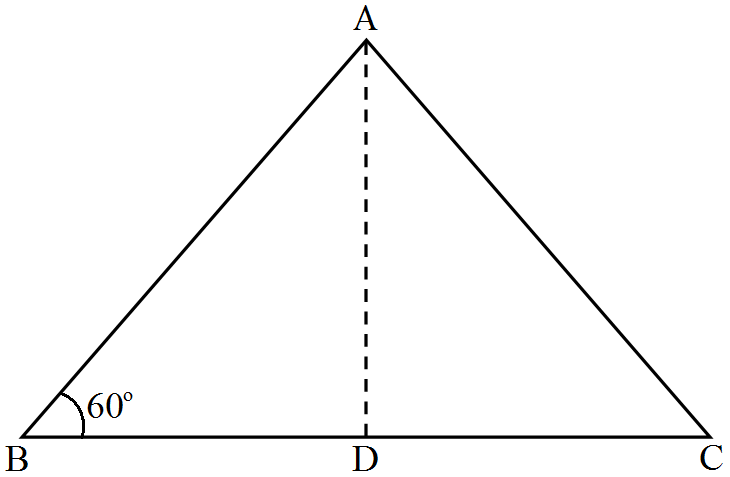
Let the side of equilateral $\triangle\text{ABC}$ be $a\ cm$
The median of equilateral triangle is its altitude drawn from $A$ to $BC.$
$\big($i.e. the height of $\triangle$ over Base $BC\big)$
$\Rightarrow\text{x}=\frac{\text{a}\sqrt{3}}{2}[AD = x($ given$)]$
$\Rightarrow\text{a}=\frac{2\text{x}}{\sqrt{3}}$
Area of equilateral $\triangle$ of side a
$=\frac{\sqrt{3}\text{a}^2}{4}$
$=\frac{\sqrt{3}}{4}\Big(\frac{2\text{x}}{\sqrt{3}}\Big)^3$
$=\frac{\text{x}^2}{\sqrt{3}}$
Hence, correct option is $(c).$ View full question & answer→MCQ 1271 Mark
If each side of a $\triangle$ is halved then its perimeter will be decreased by:
- A
$70\%$
- B
$200\%$
- ✓
$50\%$
- D
$25\%$
AnswerCorrect option: C. $50\%$
Perimeter of triangle with sides $a, b$ and $c$ is $P = a + b + c ....(i)$
New sides are $\frac{\text{a}}{2},\frac{\text{b}}{2},\frac{\text{c}}{2}$
New perimeter $=\frac{\text{a}+\text{b}+\text{c}}{2}=\frac{\text{P}}{2}. ($From eq.$(i))$
Decreased perimeter $=\text{P}-\frac{\text{P}}{2}=\frac{\text{P}}{2}$
$\%$ of decreased perimeter $=\frac{\frac{\text{P}}{2}}{\text{P}}\times100=50\%$
View full question & answer→MCQ 1281 Mark
The diagonal of a rhombus are $24\ cm$ and $10\ cm$. Then its perimeter is:
- A
$40\ cm$
- ✓
$52\ cm$
- C
$26\ cm$
- D
$68\ cm$
AnswerCorrect option: B. $52\ cm$
Since diagonals of a rhombus bisect each other at right angle.
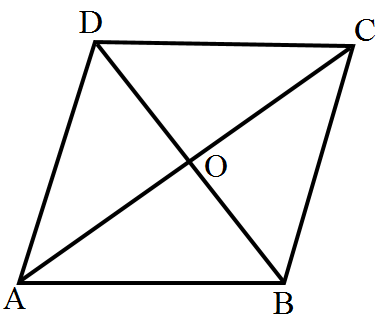
$\text{OB}=\frac{24}{2}=12\text{cm}$ and $\text{OC}=\frac{10}{2}=5\text{cm}$
In triangle $OBC,$
$\text{BC}=\sqrt{12^2+5^2}=\sqrt{144+25}=13\text{cm}$
Perimeter of rhombus $= 4\ ×$ side $= 4 × 13 = 52\ cm$
View full question & answer→MCQ 1291 Mark
The length of each side of an equilateral triangle having an area of $ 9\sqrt3\text{cm}^2$ is:
- A
$8\ cm$
- B
$36\ cm$
- C
$4\ cm$
- ✓
$6\ cm$
AnswerCorrect option: D. $6\ cm$
Given: Area of equilateral triangle $= 9\sqrt3\text{cm}^2$
Hence, $\bigg({\frac{\sqrt3}{4}}\bigg)\text{a}^2=9\sqrt{3}$
$\text{a}^2=\frac{[(9\sqrt3)(4)]}{\sqrt3}$
$\text{a}^2=36$
$\text{a}=6\text{cm}$
View full question & answer→MCQ 1301 Mark
The perimeter of an equilateral triangle is $60m.$ The area is:
- A
$20\sqrt{3}\text{m}^2$
- B
$15\sqrt{3}\text{m}^2$
- C
$10\sqrt{3}\text{m}^2$
- ✓
$100\sqrt{3}\text{m}^2$
AnswerCorrect option: D. $100\sqrt{3}\text{m}^2$
Perimeter of equilateral triangle $= 60m$
$⇒ 3\ ×$ side $= 60m$
$⇒$ side $= 20m$
Area of equilateral triangle $=\frac{\sqrt{3}}{4}(\text{Side})^2$
$=\frac{\sqrt{3}}{4}20\times20$
$=100\sqrt{3}\text{sq}.\text{m}.$
View full question & answer→MCQ 1311 Mark
Directions: In the following questions, the Assertions $(A)$ and Reason(s) $(R)$ have been put forward. Read both the statements carefully and choose the correct alternative from the following:
Assertion: The perimeter of a right angled triangle is $60\ cm$ and its hypotenuse is $26\ cm.$ The other sides of the triangle are $10\ cm$ and $24\ cm.$ Also, area of the triangle is $120\ cm^2$.
Reason:$ ($Base)$^2+ ($Perpendicular$)^2 = ($Hypotenuse$)^2$ .
- A
$A$ is true, $R$ is true; $R$ is a correct explanation for $A.$
- ✓
$A$ is true, $R$ is true; $R$ is nol a correct explanation for $A.$
- C
$A$ is true; $R$ is false.
- D
$A$ is false; $R$ is true.
AnswerCorrect option: B. $A$ is true, $R$ is true; $R$ is nol a correct explanation for $A.$
$A$ is true, $R$ is true; $R$ is nol a correct explanation for $A.$
View full question & answer→MCQ 1321 Mark
The sides of a triangle are in the ratio $5 : 12 : 13$ and its perimeter is $150\ cm.$ The area of the triangle is:
- A
$375\ cm^2$
- ✓
$750\ cm^2$
- C
$250\ cm^2$
- D
$500\ cm^2$
AnswerCorrect option: B. $750\ cm^2$
Let the sides of the triangle be $5x \ cm, 12x \ cm$ and $13x\ cm.$
Perimeter $=$ Sum of all sides
Or, $150 = 5x + 12x + 13x$
Or, $30x = 150x$
Or, $x = 5$
Thus, the sides of the triangle are $5 × 5\ cm, 12 × 5\ cm$ and $13 × 5\ cm,$ i.e., $25\ cm, 60\ cm$ and $65\ cm$.
Now,
Let:
$a = 25\ cm, b = 60\ cm$ and $c = 65\ cm$
$\text{s}=\frac{150}{2}=75\text{cm}$
By using Heron's formula, we have:
Area of triangle $=\sqrt{\text{s}(\text{s}-\text{a})(\text{s}-\text{b})(\text{s}-\text{c})}$
$=\sqrt{75(75-25)(75-60)(75-65)}$
$=\sqrt{75\times50\times15\times10}$
$=\sqrt{15\times5\times5\times10\times15\times10}$
$=15\times5\times10$
$=750\text{cm}^2$
View full question & answer→MCQ 1331 Mark
The lengths of the three sides of a triangular are $30\ cm, 24\ cm$ and $18\ cm$ respectively. The length of the altitude of the triangle corresponding to the smallest side is:
- ✓
$24\ cm$
- B
$18\ cm$
- C
$30\ cm$
- D
$12\ cm$
AnswerCorrect option: A. $24\ cm$
Let:
$a = 30\ cm, b = 24\ cm$ and $c = 18\ cm$
$\text{s}=\frac{\text{a}+\text{b}+\text{c}}{2}=\frac{30+24+18}{2}=36\text{cm}$
By applying Heron's formula, we get:
Area of triangle $=\sqrt{\text{s}(\text{s}-\text{a})(\text{s}-\text{b})(\text{s}-\text{c})}$
$=\sqrt{36(36-30)(36-24)(36-18)}$
$=\sqrt{36\times6\times12\times18}$
$=\sqrt{12\times3\times12\times6\times3}$
$=12\times3\times6$
$=216\text{cm}^2$
The smallest side is $18\ cm.$
Hence, the altitude of the triangle corresponding to $18\ cm$ is given by:
Area of triangle $ =216\ cm^2$
$\Rightarrow\frac{1}{2}\times\text{Base}\times\text{Height}=216$
$\Rightarrow\text{Height}=\frac{216\times2}{18}=24\text{cm}$
View full question & answer→MCQ 1341 Mark
The height of an equilateral triangle is $6\ cm.$ Its area:
- ✓
$12\sqrt{3}\text{cm}^2$
- B
$6\sqrt{3}\text{cm}^2$
- C
$12\sqrt{2}\text{cm}^2$
- D
$18\text{cm}^2$
AnswerCorrect option: A. $12\sqrt{3}\text{cm}^2$
Height of equilateral triangle $=\frac{\sqrt{3}}{2}\times\text{Side}$
$\Rightarrow6=\frac{\sqrt{3}}{2}\times\text{Side}$
$\Rightarrow\text{Side}=\frac{12}{\sqrt{3}}\times\frac{\sqrt{3}}{\sqrt{3}}=\frac{12}{3}\times\sqrt{3}=4\sqrt{3}\text{cm}$
Now,
Area of equilateral triangle $=\frac{\sqrt{3}}{2}\times(\text{Side})^2$
$=\frac{\sqrt{3}}{4}\times(4\sqrt{3})^2$
$=\frac{\sqrt{3}}{4}\times48$
$=12\sqrt{3}\text{cm}^2$
View full question & answer→MCQ 1351 Mark
The area of an equilateral triangle having side length equal to $\frac{3}{\sqrt{4}}\text{ cm}$ is:
- A
$\frac{2}{27}\text{sq.}\text{cm}$
- B
$\frac{2}{15}\text{sq.}\text{cm} $
- ✓
$\frac{3}{16}\text{sq.}\text{cm}$
- D
$\frac{3}{14}\text{sq.}\text{cm}$
AnswerCorrect option: C. $\frac{3}{16}\text{sq.}\text{cm}$
$\frac{3}{16}\text{sq.}\text{cm}$
View full question & answer→MCQ 1361 Mark
The area of an isosceles triangle having base $2\ cm$ and the length of one of the equal sides $4\ cm$, is:
AnswerCorrect option: B. $\sqrt{15}\text{cm}^2$
$\text{s}=\frac{4+4+2}{2}=5\text{cm}$
Area of triangle $=\sqrt{\text{s}(\text{s}-\text{a})(\text{s}-\text{b})(\text{s}-\text{c})}$
$=\sqrt{5(5-4)(5-4)(5-2)}$
$=\sqrt{5\times1\times1\times3}$
$=\sqrt{15}\text{ sq.cm}$
View full question & answer→MCQ 1371 Mark
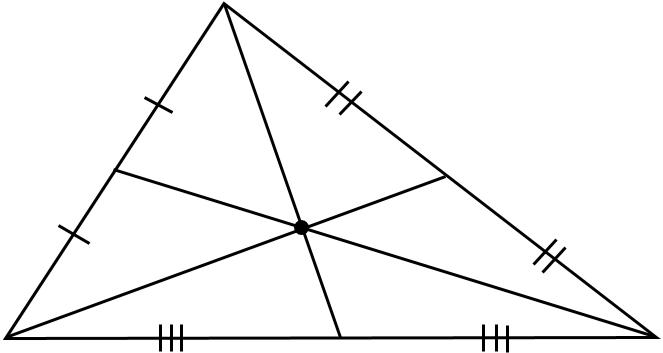
Length of perpendicular drawn on longest side of a scale $\triangle$ is:
AnswerLength of the perpendicular drawn on the longest side of a scale is $\triangle$ smallest.
View full question & answer→MCQ 1381 Mark
The lengths of the three sides of a triangular field are $40m, 24m$ and $32m$ respectively. The area of the triangle is:
- A
$480\ m^2$
- ✓
$384\ m^2$
- C
$320\ m^2$
- D
$360\ m^2$
AnswerCorrect option: B. $384\ m^2$
Let:
$a = 40m, b = 24m$ and $c = 32m$
$\text{s}=\frac{40+24+32}{2}=48\text{cm}$
By Heron's formula, we have
Area of triangle $=\sqrt{\text{s}(\text{s}-\text{a})(\text{s}-\text{b})(\text{s}-\text{c})}$
$=\sqrt{48(48-40)(48-24)(48-32)}$
$=\sqrt{48\times8\times24\times16}$
$=\sqrt{24\times2\times8\times24\times8\times2}$
$=24\times8\times2$
$=384\text{m}^2$
View full question & answer→MCQ 1391 Mark
Write the correct answer in the following:
The sides of a triangle are $35\ cm, 54\ cm$ and $61\ cm$, respectively. The length of its longest altitude:
- A
$16\sqrt{5}\text{cm}$
- B
$10\sqrt{5}\text{cm}$
- ✓
$24\sqrt{5}\text{cm}$
- D
$28\text{cm}$
AnswerCorrect option: C. $24\sqrt{5}\text{cm}$
Sides of the triangle are $35\ cm, 54\ cm$ and $61\ cm$
$\text{s}=\frac{35+54+61}{2}=75\text{cm}$
Area of $\triangle=\sqrt{75(75-35)(75-54)(75-61)}$
$=\sqrt{75\times40\times21\times14}$
$=\sqrt{5\times5\times3\times2\times2\times2\times5\times3\times7\times7\times2}$
$=5\times3\times2\times2\times7\sqrt{5}$
$=420\sqrt{5}\text{cm}^2$
Now, longest altitude will be the perpendicular on the smallest side of the triangle from the opposite vertex.
$\therefore$ Length of longest altitude $=\frac{2(\text{Area of }\triangle)}{35}$
$=\frac{2\times420\sqrt{5}}{35}=24\sqrt{5}\text{cm}$
View full question & answer→MCQ 1401 Mark
Write the correct answer in the following: The sides of a triangle are $56\ cm, 60\ cm$ and $52\ cm$ long. Then the area of the triangle is:
- A
$1322\ cm^2$
- B
$1311\ cm^2$
- ✓
$1344\ cm^2$
- D
$1392\ cm^2$
AnswerCorrect option: C. $1344\ cm^2$
Since, the three sides of a triangle are $a = 56\ cm, b = 60\ cm$ and $c = 52\ cm$
Then, semi-perimeter of a triangle,
$\text{s}=\frac{\text{a}+\text{b}+\text{c}}{2}=\frac{56+60+52}{2}=\frac{168}{2}=84\text{cm}$
Area of triangle $=\sqrt{\text{s}(\text{s}-\text{a})(\text{s}-\text{b})(\text{s}-\text{c})}$ [by Heron's formula]
$=\sqrt{84(84-56)(84-60)(84-52)}$
$=\sqrt{4\times7\times3\times4\times7\times4\times2\times3\times4\times4\times2}$
$=\sqrt{(4)^6\times(7)^2\times(3)^2}$
$=(4)^3\times7\times3=1344\text{cm}^2$
Hence, the area of triangle is $1344\ cm^2$
View full question & answer→MCQ 1411 Mark
The length of the sides of a triangle are $5x, 5x$ and $8x.$ The area of the triangle is:
- A
$144x^2$ sq.units.
- B
$24x^2$ sq.units.
- C
$100x^2$ sq.units.
- ✓
$12x^2$ sq.units.
AnswerCorrect option: D. $12x^2$ sq.units.
$\text{s}=\frac{5\text{x}+5\text{x}+8\text{x}}{2}=9\text{x}\text{ cm}$
Area of triangle $=\sqrt{\text{s}(\text{s}-\text{a})(\text{s}-\text{b})(\text{s}-\text{c})}$
$=\sqrt{9\text{x}(9\text{x}-5\text{x})(9\text{x}-5\text{x})(9\text{x}-8\text{x})}$
$=\sqrt{9\text{x}\times4\text{x}\times4\text{x}\times\text{x}}$
$=12\text{x}^2\text{ sq.cm}$
View full question & answer→MCQ 1421 Mark
The edges of a triangular board are$ 6\ cm, 8\ cm$ and $10\ cm.$ The cost of painting it at the rate of $70$ paise per $cm^2$ is:
- ✓
$Rs. 16.80$
- B
$Rs. 7$
- C
$Rs. 17.80$
- D
$Rs. 16$
AnswerCorrect option: A. $Rs. 16.80$
$\text{s}=\frac{6+8+10}{2}=12\text{cm}$
$\text{A}=\sqrt{12(12-8)(12-10)(12-6)}$
$=24\text{cm}^2$
$\text{Cost}=24\times0.70=\text{Rs}.16.80$
View full question & answer→MCQ 1431 Mark
The base of a triangle is $12\ cm$ and height is $8\ cm$ then area of triangle is:
- A
$96\ cm^2$
- ✓
$48\ cm^2$
- C
$24\ cm^2$
- D
$56\ cm^2$
AnswerCorrect option: B. $48\ cm^2$
Area of triangle $=\frac{1}{2}\times\text{base}\times\text{height}$
$=\frac{1}{2}\times12\times8=48\text{cm}$
View full question & answer→MCQ 1441 Mark
The sides of a triangle are $16\ cm, 30\ cm, 34\ cm$. Its area is:
- ✓
$240\ cm^2$
- B
$225\ cm^2$
- C
$225\sqrt2\text{cm}^2$
- D
$450\ cm^2$
AnswerCorrect option: A. $240\ cm^2$
Let $a = 16\ cm, b = 30\ cm, c = 34\ cm$
semi perimeter of a triangle $=\frac{\text{a}+\text{b}+\text{c}}{2}$
$=\frac{16+30+34}{2}=40$
Now, $s - a = 24\ cm, s - b = 10\ cm$ and $s - c = 6\ cm$
By Heron's formula, we have area of triangle $=\sqrt{\text{s}(\text{s}-\text{a})(\text{s}-\text{b})(\text{s}-\text{c})}$
$=\sqrt{40\times24\times10\times6}$
$=\sqrt{4\times10\times4\times6\times10\times6}$
$=\sqrt{4^2\times10^2\times6^2}$
$=4\times10\times6$
$=240\text{cm}^2$
View full question & answer→MCQ 1451 Mark
The sides of a triangle are $56\ cm, 60\ cm$ and $52\ cm$ long. Then the area of the triangle is:
- A
$1311\ cm^2$
- B
$1392\ cm^2$
- ✓
$1344\ cm^2$
- D
$1322\ cm^2$
AnswerCorrect option: C. $1344\ cm^2$
$\text{s}=\frac{56+60+52}{2}=\frac{168}{2}=84\text{cm}$
Area of triangle $=\sqrt{\text{s}(\text{s}-\text{a})(\text{s}-\text{b})(\text{s}-\text{c})}$
$=\sqrt{84(84-56)(84-60)(84-52)}$
$=\sqrt{84\times28\times24\times32}$
$=\sqrt{12\times7\times7\times4\times12\times2\times16\times2}$
$=12\times7\times2\times2\times4$
$=1344\text{ sq.cm}$
View full question & answer→MCQ 1461 Mark
The cost of turfing a triangular field at the rate of $Rs. 45$ per $100m^2$ is Rs. 900. If the double the base of the triangle is $5$ times its height, then its height is:
- A
$42\ cm$
- ✓
$40\ cm$
- C
$44\ cm$
- D
$32\ cm$
AnswerCorrect option: B. $40\ cm$
Cost of turfing a triangular field at the rate of $Rs. 45$ per $100 = Rs. 900$
$\frac{\text{Area}\times45}{100}=900$
$⇒$ Area $= 2000\ sq.cm$
According to question,
$2\ ×$ Base $= 5\ ×$ Height
$\Rightarrow\text{Base}=\frac{\text{Height}\times5}{2}$
Areo of triangle $= 2000$ sq.cm
$\Rightarrow\frac{1}{2}\times\text{Base}\times\text{Height}=2000$
$\Rightarrow\frac{1}{2}\times\frac{\text{Height}\times5}{2}\times\text{Height}=2000$
$⇒ ($Height$)^2 = 1600$
$⇒$ Height $= 40cm$
View full question & answer→MCQ 1471 Mark
The base of an isoscale triangle is $6\ cm$ and each of its equal sides is $5\ cm.$ The height of the triangle is:
- A
$8\text{cm}$
- B
$\sqrt{30}\text{cm}$
- ✓
$4\text{cm}$
- D
$\sqrt{11}\text{cm}$
AnswerCorrect option: C. $4\text{cm}$
Height of isoscale triangle $=\frac{1}{2}\sqrt{4\text{a}^2-\text{b}^2}$
$=\frac{1}{2}\sqrt{4(5)^2-6^2} (a = 5\ cm$ and $b = 6\ cm)$
$=\frac{1}{2}\times\sqrt{100-36}$
$=\frac{1}{2}\times\sqrt{64}$
$=\frac{1}{2}\times8$
$=4\text{cm}$
View full question & answer→MCQ 1481 Mark
An isosceles right triangle has area $8\ cm^2$. The length of its hypotenuse is:
- A
$\sqrt{48}\text{cm}$
- ✓
$\sqrt{32}\text{cm}$
- C
$\sqrt{16}\text{cm}$
- D
$\sqrt{24}\text{cm}$
AnswerCorrect option: B. $\sqrt{32}\text{cm}$
Area of isosceles triangle $=\frac{1}{2}\times\text{Base}\times\text{Height}$
Since in an isosceles triangle, Base and Height are equal.
$\Rightarrow8=\frac{1}{2}\times\text{Base}\times\text{Base}$
$⇒$ Base $=$ Height $= 4cm$
Hypotenuse $=\sqrt{4^2+4^2}=\sqrt{32}\text{cm}.$
View full question & answer→MCQ 1491 Mark
A square sheet whose perimeter is $32\ cm$ is painted at the rate of $Rs. 5\ per\ m^2.$ The cost of painting is:
- ✓
$₹320$
- B
$₹350$
- C
$₹340$
- D
$₹160$
AnswerCorrect option: A. $₹320$
$₹320$
View full question & answer→MCQ 1501 Mark
Each side of an equilateral triangle is $2x\ cm$. If $\text{x}\sqrt{3}=\sqrt{48},$ then area of the triangle is:
- A
$\sqrt{48}\text{cm}^2$
- B
$48\sqrt{3}\text{cm}^2$
- ✓
$16\sqrt{3}\text{cm}^2$
- D
$16\text{cm}^2$
AnswerCorrect option: C. $16\sqrt{3}\text{cm}^2$
Here, $\text{x}\sqrt{3}=\sqrt{48}$
$\Rightarrow\text{x}=\sqrt{16}$
Side $= 2x$
Area of equilateral triangle $=\frac{\sqrt{3}}{4}\text{(Side)}^2$
$=\frac{\sqrt{3}}{4}(2\text{x})^2$
$=\sqrt{3}\text{x}^2\text{ sq. cm}$
$=\sqrt{3}(\sqrt{16})^2$
$=16\sqrt{3}\text{cm}^2$
View full question & answer→