Questions

Que-Ans (Each of 5 Mark )

🎯

Test yourself on this topic

15 questions · timed · auto-graded

Question 15 Marks
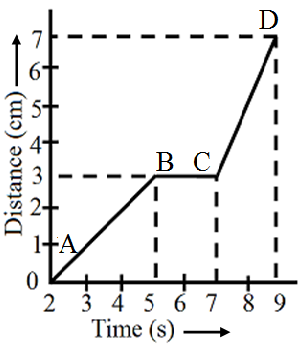
The graph given alogside shows the positions of a body at different times. Calculate the speed of the body as it moves from:
  1. $A$ to $B.$
  2. $B$ to $C.$
  3. $C$ to $D.$
Answer
  1. The distance covered from $A$ to $B,$
$= 3 - 0$
$= 3cm$
Time taken to cover the distance from $A$ to $B$
$= 5 - 2$
$= 3s$
Hence speed,
$=\frac{\text{Distance}}{\text{Time}}$
$=\frac{3}{3}\text{cm/s}$
$=1\text{cm/s}$
  1. The speed of the body as it moves from $B$ to $C$ is zero because the distance travelled is zero.
  2. The distance covered from $C$ to $D,$
$= 7 - 3$
$= 4cm$
Time taken to cover the distance from $C$ to $D,$
$= 9 - 7$
$= 2s$
Hence speed,
$=\frac{\text{Distance}}{\text{Time}}$
$=\frac{4}{2}\text{cm/s}$
$=21\text{cm/s}$
View full question & answer
Question 25 Marks
A body starting from rest travels with uniform acceleration. If it travels $100m$ in $5s$, what is the value of acceleration$?$
Answer
Initial velocity, $u = 0m/s$
Time, $t = 5s$
Distance, $s = 100m$
Acceleration, $a = ?$
$\text{s}=\text{ut}+\frac{1}{2}\text{at}^2$
$100=0\times5+\frac{1}{2}\times\text{a}\times5\times5$
$100=0+\frac{25\text{a}}{2}$
$\text{a}=\frac{200}{25}=8\text{m/s}^2$
View full question & answer
Question 35 Marks
A boy walks from his classroom to the bookshop along a straight corridor towards North. He covers a distance of $20m$ in $25$ seconds to reach the bookshop. After buying a book, he travels the same distance in the same time to reach back in the classroom. Find $(a)$ average speed, and $(b)$ average velocity, of the boy.
Answer
  1. Total distance covered in going to the bookshop and coming back to the classroom $= 20 + 20 = 40m$
Total time taken $= 25 + 25 = 50\ sec$
Average speed $=\frac{\text{Total distance}}{\text{Total time}}=\frac{40}{50}=0.8\text{m/s}$
  1. Average velocity $=\frac{\text{Total displacement}}{\text{Total time}}=\frac{0}{50}=0\text{m/s}$
View full question & answer
Question 45 Marks
A train travels the first $15km$ at a uniform speed of $30 km/h;$ the next $75km$ at a uniform speed of 50km/h; and the last 10km at a uniform speed of $20km/h.$ Calculate the average speed for the entire train journey.
Answer
  1. In the first part, train travels at a speed of $30\ km/h$ for distance of $15\ km$.
$\text{Speed}=\frac{\text{Distance}}{\text{Time}}$
$\text{Time}=\frac{\text{Distance}}{\text{Speed}}$
$\text{t}_1=\frac{15}{30}=\frac{1}{2}\text{h}$
  1. In the second part, train travels at a speed of $50\ km/h$ for a distance of $75\ km.$
$\text{t}_2=\frac{75}{50}=\frac{3}{2}\text{h}$
  1. In the third part, train travels at a speed of $20\ km/h$ for a distance of $10\ km.$
$\text{t}_3=\frac{10}{20}=\frac{1}{2}\text{h}$
Total distance covered $= 15 + 75 + 10 = 100\ km$
Average speed $=\frac{\text{Total distance covered}}{\text{Total time taken}}$
$=\frac{100}{\frac{5}{2}}=40\text{km/h}$
View full question & answer
Question 55 Marks
Define motion. What do you understand by the terms ‘uniform motion’ and ‘non-uniform motion’? Explain with examples.
Answer
A body is said to be in motion when its position changes continuously with respect to a stationary point taken as the reference point.
  • Uniform motion: A body is said to be in uniform motion if it travels equal distances in equal intervals of time in a particular direction, no matter how small these time intervals are.
For example: A car running at a constant speed of 10m/s towards east will cover the equal distance of 10m every second towards east, so its motion will be uniform.
  • Non-uniform motion: A body is said to be in non-uniform motion if it travels unequal distances in equal intervals of time.
For example: Motion of a freely falling ball from the roof of a tall building.
View full question & answer
Question 65 Marks
The distance between Delhi and Agra is $200\ km.$ A train travels the first $100\ km$ at a speed of 50km/h. How fast must the train travel the next $100\ km,$ so as to average $70\ km/h$ for the whole journey$?$
Answer
Total distancce $= 200km$
Average speed $= 70km/h$
Total time taken $=\frac{\text{Total distance}}{\text{Average speed}}=\frac{200}{70}=\frac{20}{7}\text{h}$
For first part of the journey,
Distance $= 100km$
Speed $= 50km/h$
Time taken, $\text{t}_1=\frac{100}{50}=2\text{h}$
Speed $=\text{x}\ \text{km/h}$
Time taken, $\text{t}_2=\frac{100}{\text{x}}=\text{h}$
$\text{t}_1+\text{t}_2=\frac{20}{7}$
$2+\frac{100}{\text{x}}=\frac{20}{7}$
$\frac{100}{\text{x}}=\frac{6}{7}$
$700=6\text{x}$
$\Rightarrow\text{x}=116.6\text{km/h}$
View full question & answer
Question 75 Marks
A car is travelling at $20\ m/s$ along a road. A child runs out into the road $50m$ ahead and the car driver steps on the brake pedal. What must the car's deceleration be if the car is to stop just before it reaches the child$?$
Answer
We have to find the deceleration. We have the following information given,
Initial velocity, $(u) = 20\ m/s$
Final velocity, $(v) = 0\ m/s$
Distance travelled, $(s) = 50\ m$
Let the deceleration for the entire journey be $(a)$ We can calculate acceleration by using the $3^{rd}$ equation of motion, $\text{a}=\frac{\text{v}^2-\text{u}^2}{2\text{s}}$
Where, $(s) -$ Displacement $(u) -$ Initial velocity $(a) - $ Acceleration $(v) -$ Final velocity Put the values in above equation to find the deceleration,
$\text{a}=\Big[\frac{0-400}{2(50)}\Big]\text{m/s}^2$
$=\Big(-\frac{400}{100}\Big)\text{m/s}^2$
$=-4\text{m/s}^2$
Hence, deceleration is $4\ m/s^2.$
View full question & answer
Question 85 Marks
A car is travelling along the road at $8\ ms^{-1}.$ It accelerates at $1\ ms^{-2}$ for a distance of $18\ m.$ How fast is it then travelling$?$
Answer
We have to find the final velocity of the moving object. And we have the following information:
Initial velocity, $(u) = 8\ m/s$
Acceleration, $(a) = 1\ m/s^2$
Distance, $(s) = 18\ m$
So applying $3^{rd}$ equation of motion to calculate the final velocity,
$\text{v}=\sqrt{\text{u}^2+2\text{as}}$
Where, $(a) -$ Acceleration $(ν) - $ Final velocity $(u) -$ Initial velocity $(s) -$ Distance Put the values in the above equation to get the value of final velocity,
$\text{v}=\sqrt{64+36}\text{m/s}$
$=\sqrt{100}\text{m/s}$
$=10\text{m/s}$
View full question & answer
Question 95 Marks
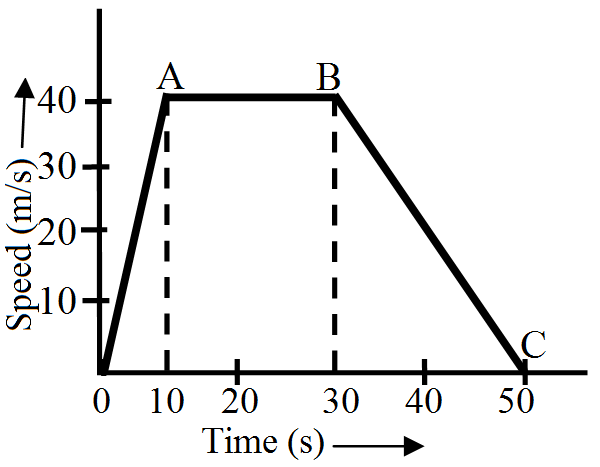
Study the speed-time graph of a car given alongside and answer the following questions:
  1. What type of motion is represented by $OA?$
  2. What type of motion is represented by $AB?$
  3. What type of motion is represented by $BC?$
  4. What is the acceleration of car from $O$ to $A?$
  5. What is the acceleration of car from $A$ to $B?$
  6. What is the retardation of car from $B$ to $C?$
Answer
  1. $OA$ represents uniform acceleration.
  2. $AB$ represents constant speed.
  3. $BC$ represents uniform retardation.
  4. Acceleration of car from $O$ to $A =$ slope of line $OA$
$\text{a}=\frac{(40-0)}{(10-0)}\text{m/s}^2$
$=4\text{m/s}^2$
  1. Acceleration of car from $A$ to $B$ is zero as it has uniform speed.
  1. Retardation of car from $B$ to $C =$ slope of line $BC.$
$\text{a}=\frac{(40-0)}{(50-30)}\text{m/s}^2$
$=2\text{m/s}^2$
View full question & answer
Question 105 Marks
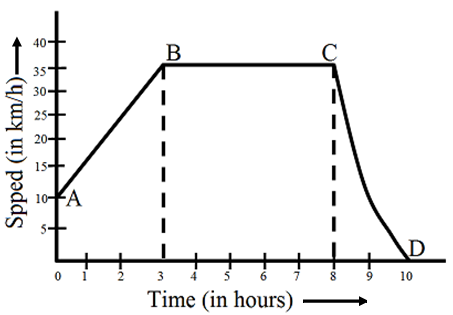
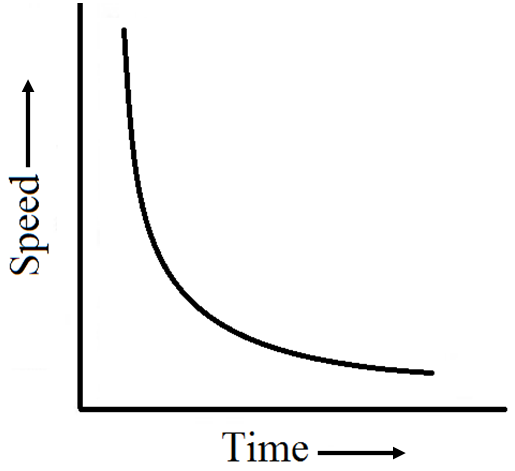
The graph given alongside shows how the speed of a car changes with time:
  1. What is the initial speed of the car$?$
  2. What is the maximum speed attained by the car$?$
  3. Which part of the graph shows zero acceleration
  4. Which part of the graph shows varying retardation$?$
  5. Find the distance travelled in first $8$ hours.
Answer
  1. Initial speed of the car is $10\ km/h$
  2. Maximum speed attained by the car is $35\ km/h$
  3. $BC$ represents zero acceleration.
  4. $CD$ represents varying retardation.
  5. Distance travelled is given by the area enclosed within the curve. So,
Distance travelled $=$ Area or trapezium $+$ Area of rectangle
So distance travelled,
$= \Big(\frac{1}{2}\Big)(8+5)(25) + (8)(10)$
$= 242.5\text{km}$
View full question & answer
Question 115 Marks
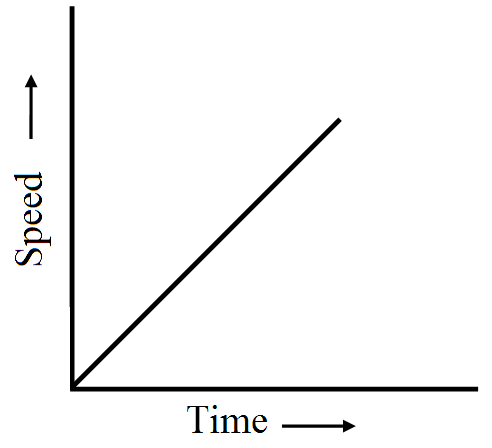
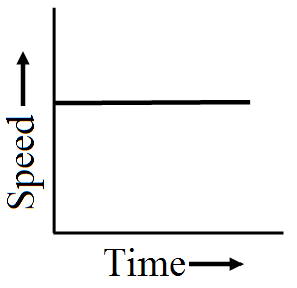
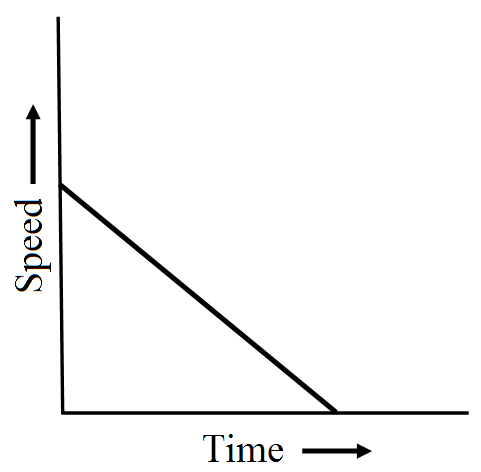
What type of motion is represented by each one of the following graphs?
Answer
  1. Graph $(a)$ represents uniformly accelerating motion as it has a constant slope.
  2. Graph $(b)$ represents a motion of constant speed.
  3. Graph $(c)$ represents uniformly retarding motion as it has a constant negative slope.
  4. Graph $(d)$ represents non-uniformly retarding as it has a varying slope.
View full question & answer
Question 125 Marks
A car travels $100\ km$ at a speed of $60\ km/h$ and returns with a speed of $40\ km/h.$ Calculate the average speed for the whole journey.
Answer
In the first case, car travels at a speed of $60\ km/h$ for a distance of $100\ km.$
In the second case, car travels at a speed of $40\ km/h$ for a distance of $100\ km.$
Total distance travelled $= 200\ km.$
In the first case, car travels at a speed of $60\ km/h$ for a distance of $100\ km.$
$\text{Speed}=\frac{\text{Distance}}{\text{Time}}$
$\text{Time}=\frac{\text{Distance}}{\text{Speed}}$
$\text{t}_1=\frac{100}{60}\text{h}$
In the second case, car travels at a speed of $40\ km/h$ for a distance of $100\ km.$
$\text{t}_2=\frac{100}{40}\text{h}$
Total distance travelled $= 200\ km$
Total time taken $=\frac{100}{60}+\frac{100}{40}$
Average speed $=\frac{\text{Total distance travelled}}{\text{Total time taken}}$
$=\frac{200}{\frac{100}{60}+\frac{100}{40}}=\frac{2}{\frac{1}{60}+\frac{1}{40}}$
$=\frac{240}{5}=48\text{km/h}$
View full question & answer
Question 135 Marks
Show by using the graphical method that:
$\text{s}=\text{ut}+\frac{1}{2}\text{at}^2$
where the symbols have their usual meanings.
Answer
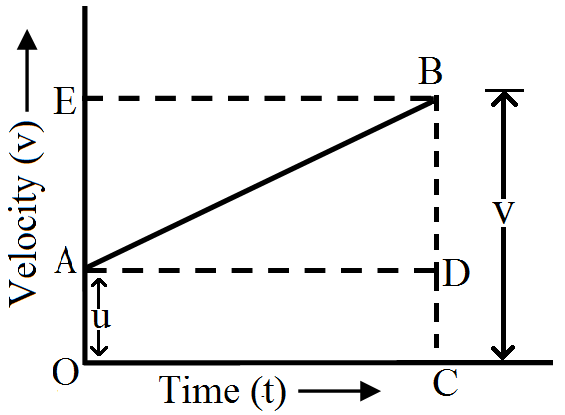
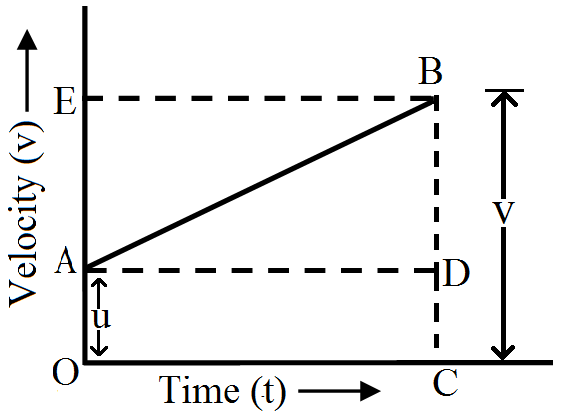
Consider the velocity-time graph of a body shown in figure. The body has an initial velocity $u$ at a point $A$ and then its velocity changes at a uniform rate from $A$ to $B$ in time $t.$ In other words, there is a uniform acceleration a from $A$ to $B,$ and after time $t$ its final velocity becomes $v$ which is equal to $BC$ in the graph. The time $t$ is represented by $OC.$

Suppose the body travels a distance $s$ in time $t.$ In the figure, the distance travelled by the body is given by the area of the space between the velocity-time graph AB and the time axis $OC,$ which is equal to the area of the figure $OABC.$ Thus:
Distance travelled $=$ Area of figure $OABC$
$=$ Area of rectangle $OABC\ +$ area of triangle $ABD$
Now, we will find out the area of rectangle $OABC$ and area of triangle $ABD.$​​​​​​​
  1. Area of rectangle $OADC = OA × OC$
$= u × t$
$= ut$
  1. Area of triangle ABD $=\Big(\frac{1}{2}\Big)\times\text{Area of rectangle AEBD}$
$=\Big(\frac{1}{2}\Big)\times\text{AD}\times\text{BD}$
$=\Big(\frac{1}{2}\Big)\text{at}^2$
Distance travelled, $s =$ Area of rectangle $OADC\ +$ Area of triangle $ABD$
$\text{s}=\text{ut}+\frac{1}{2}\text{at}^2$
View full question & answer
Question 145 Marks
Show by means of graphical method that: $v = u + at$ where the symbols have their usual meanings.
Answer
Consider the velocity-time graph of a body shown in figure.

The body has an initial velocity $u$ at a point $A$ and then its velocity changes at a uniform rate from $A$ to $B$ in time $t.$
In other words, there is a uniform acceleration a from $A$ to $B, $  and after time t its final velocity becomes $v$ which is equal to $BC$ in the graph.
The time $t$ is represented by $OC.$
To complete the figure, we draw the perpendicular $CB$ from point $C$, and draw $AD$ parallel to $OC.$
$ BE$ is the perpendicular from point $B$ to $OE.$
Now, Initial velocity of the body, $u = OA ...(1)$ And,
Final velocity of the body, $v = BC ...(2)$ But from the graph $BC = BD + DC$
Therefore, $v = BD + DC ...(3)$
Again $DC = OA$ So, $v = BD + OA$
Now, from equation $(1),$
$OA = u$ So, $v = BD + u ...(4)$
We should find out the value of $BD$ now.
We know the slope of a velocity-time graph is equal to the acceleration,
$a.$ Thus, Acceleration, $a =$
slope of line $AB$ or $\text{a} =\frac{\text{BD}}{\text{AD}}$
But $AD = OC = t,$ so putting t in place of $AD$ in the above relation,
we get: $\text{a}=\frac{\text{BD}}{\text{t}}$
Now, putting this value of $BD$ in equation $(4),$ we get: $v = u + at$
View full question & answer
Question 155 Marks
Derive the following equation of motion by the graphical method: $v^2 = u^2 + 2\ as$ where the symbols have their usual meanings.
Answer

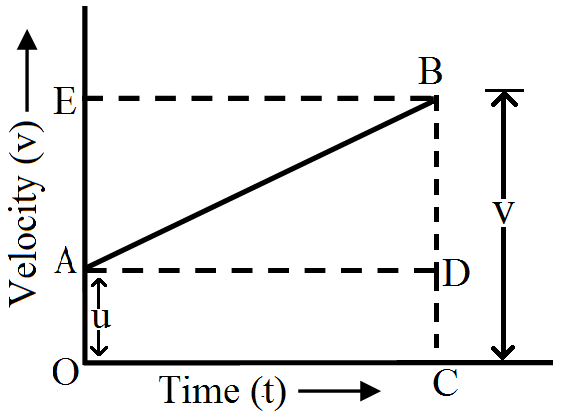
Consider the velocity-time graph of a body shown in figure.
The body has an initial velocity $u$ at a point $A$ and then its velocity changes at a uniform rate from $A$ to $B$ in time $t.$
In other words, there is a uniform acceleration a from $A$ to $B,$ and after time t its final velocity becomes $v$ which is equal to $BC$ in the graph.
The time t is represented by $OC.$
To complete the figure, we draw the perpendicular $CB$ from point $C,$ and draw $AD$ parallel to $OC.$
BE is the perpendicular from point $B$ to $OE.$
The distance travelled s by a body in time t is given by the area of the figure $OABC$ which is a trapezium.
Distance travelled, $s =$ Area of trapezium $OABC$
$\text{s}=\frac{(\text{Sum of parallel sides})\times\text{Height}}{2}$
$\text{s}=\frac{(\text{OA+CB})\times\text{OC}}{2}$
Now, $OA + CB = u + v$ and $OC = t$
Putting these values in the above relation,
we get: $\text{s}=\Big(\frac{\text{u+v}}{2}\Big)\times\text{t}\ ...(1)$
Eliminate from the above equation. This can be done by obtaining the value of t from the first equation of motion.
Thus, $v = u + at ($first equation of motion$)$ And, $at = v.$
View full question & answer
Que-Ans (Each of 5 Mark ) - Science STD 9 Questions - Vidyadip