Questions

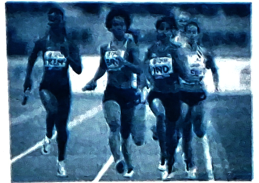
Case study (4 Marks)

Take a timed test

13 questions · self-marked practice — reveal the answer and mark yourself.

Question 14 Marks
Answer
(i) Number of throws form an A.P. with first term $a=40$, and common differeno $d=12$.
$\therefore \quad$ Number of throws Sanjitha practiced on $11^{\text {th }}$ day $=a+(11-1) d=40+10 \times 12=160$
(ii) Sanjitha's throw distances form an A.P. with first term $a=7.56 m$ and common differene $d=9 cm=0.09 m$. We find that
$
6 \text { months }=6 \times 4 \text { weeks }=24 \text { weeks. }
$
$\therefore$ Sanjitha's throw distance at the end of 6 months $=a+(24-1) d=(7.56+23 \times 0.09) m =9.63 m$
(iii) Suppose Sanjitha achieve throw of 11.16 m at the end of $n^{\text {th }}$ weeks. Then,
$
\begin{aligned}
& 11.16=7.56+(n-1) \times 0.09 \\
\Rightarrow \quad & 11.16-7.56=(n-1) \times 0.09 \Rightarrow 3.6=(n-1) \times 0.09 \Rightarrow n-1=\frac{3.6}{0.09} \Rightarrow n-1=40 \Rightarrow n=41
\end{aligned}
$
Hence, Sanjitha achieved throw of 11.16 m in 41 weeks.
(iv) Number of throws per day, in the camp of 15 days, form an A.P. with first term $a=40$ and $d=$ common difference $=12$.
$\therefore$ Total number of throws in the camp of 15 days $=\frac{15}{2}\{2 \times 40+(15-1) \times 12\}=\frac{15}{2}(80+168)=1860$ Hence, Sanjitha threw 1860 throws in the camp of 15 days.
View full question & answer
Question 24 Marks
Answer
(i) The distances run by Neha on each day in first, second, third, .... week are:
$
d_1=3, d_2=5, d_3=7, d_4=9, \ldots \ldots
$
Clearly, these distances form an A.P. with common difference 2.
The distance covered by Neha on each day of the $8^{\text {th }}$ week is the $8^{\text {th }}$ term of the above A.P. and is given by
$
d_8=(3+(8-1) \times 2) km=17 km
$
(ii) Suppose Neha runs 45 km each day in $n^{\text {th }}$ week. Then, 45 is the $n^{\text {th }}$ term of the A.P. $3,5,7,9, \ldots$.
$
\therefore \quad 45=3+(n-1) \times 2 \Rightarrow 2(n-1)=42 \Rightarrow n-1=21 \Rightarrow n=22
$
Thus, Neha would be able to run 45 km each day in $22^{\text {nd }}$ week.
(iii) (a) The distance $d_n$ run by Neha on each day of $n^{\text {th }}$ week is given by
$
d_n=3+(n-1) \times 2=(2 n+1) km
$
So, the distance $D_n$ covered by Neha in the $n^{\text {th }}$ week is given by
$
D_n=5 d_n=5(2 n+1) km
$
$\therefore$ Total distance covered by Neha after 11 weeks $=D_1+D_2+\ldots .+D_{11}$
$
\begin{array}{l}
=15+25+35+45+\ldots .11 \text { terms } \\
=\frac{11}{2}\{2 \times 15+(11-1) \times 10\} km=715 km
\end{array}
$
OR
(b) If Neha runs 3 km each day and increases the distance by 3 km each week, then the distances run on each day of first, second, third, ...., week are $3,6,9,12, \ldots$.
Clearly, it is an A.P. with first term 3 and common difference 3.
Suppose Neha runs 42 km each day in $n^{\text {ih }}$ week. Then,
$
42=3+(n-1) \times 3 \Rightarrow 3(n-1)=39 \Rightarrow n-1=13 \Rightarrow n=14
$
Thus, Neha trained herself in 13 weeks to run 42 km each day of $14^{\text {th }}$ week.
View full question & answer
Question 34 Marks
Answer
The number $a_n$ on $n^{\text {th }}$ spot is given by $a_n=20+4 n$.
(i) Number on first spot $=a_1=20+4 \times 1=24$
(ii) (a) Let $n^{\text {th }}$ spot be numbered as 112 . Then,
$
a_n=112 \Rightarrow 20+4 n=112 \Rightarrow 4 n=92 \Rightarrow n=23
$
So, $23^{\text {rd }}$ spot is numbered as 112 .
OR
(b) Sum of all the numbers on first 10 spots.
$
\begin{array}{l}
=\text { Sum of first } 10 \text { terms of an A.P. with } a_n=20+4 n \\
=\frac{10}{2}\left(a_1+a_{10}\right) \quad\left[\because a_n=20+4 n \therefore a_1=20+4=24 \text { and } a_{10}=20+4 \times 10=60\right] \\
=5(24+60)=420
\end{array}
$
(iii) Number on $(n-2)^{t h}$ spot $=a_{n-2}=20+4(n-2)=12+4 n$.
View full question & answer
Question 44 Marks
Answer
(i) 6,30 (ii) 61, 60 
View full question & answer
Question 54 Marks
Rishi wants to buy a car and plans to take loan from a bank to buy the car. He pays his total loan of ₹ $1,180,000$ by paying every month starting with the first instalment of ₹ $10,000$. If he increases the instalment by ₹ $1000$ every month answer the following:
Image
(i) The amount paid by Rishi in $30^{\text {th }}$ instalment, is
(a) ₹ 39,000 $\qquad$ (b) ₹ 35,000 $\qquad$ (c) ₹ 37,000 $\qquad$ (d) ₹ 36,000
(ii) The amount paid by Rishi in 30 instalments, is
(a) ₹ 370,000 $\qquad$ (b) ₹ 735,000 $\qquad$ (c) ₹ 753,000 $\qquad$ (d) ₹750,000
(iii) After paying $30^{\text {th }}$ instalment the amount still to be paid is
(a) ₹ 455,000 $\qquad$ (b) ₹ 490,000
(c) ₹ 445,000 $\qquad$ (d) ₹ 540,000
(iv) If the loan is to be repaid in 40 instalments, then amount paid in the last instalment is
(a) ₹ 49,000 $\qquad$ (b) ₹ 39,000
(c) ₹ 59,000 $\qquad$ (d) ₹ 94,000
Answer
(i) (a): Various instalments form an A.P. with first term $a=10,000$ and common difference $d=1,000$
$\therefore \quad$ Amount paid in $30^{\text {th }}$ instalment $=$₹$|a+(30-1) d\rangle=$₹$(10,000+29 \times 1000)=$₹$ 39,000$
(ii) (b): The amount paid by Rishi in 30 instalments is
₹$
\left[\frac{30}{2}\{2 a+(30-1) d\}\right]=$₹$\{15(2 a+29 d)\}=$₹$ 15(20,000+29,000)=$₹$ 735,000
$
(iii) (c): Loan amount $=$₹$ 1,180,000$, Amount paid in 30 instalments $=$₹$ 735,000$
$\therefore \quad$ Amount to be paid after paying 30 instalments $=$₹$(1,180,000-735,000)=$₹$ 445,000$
(iv) (a): Amount paid in first 39 instalments is
₹$
\left[\frac{39}{2}\{2 a+(39-1) d\}\right]=$₹$\{39(a+19 d)\}=$₹$ 39(10,000+19,000)=$₹$ 1,131,000
$
$\therefore \quad$ Amount to be paid in $40^{\text {th }}$ instalment $=$₹$(1,180,000-1,131,000)=$₹$ 49,000$
View full question & answer
Question 64 Marks
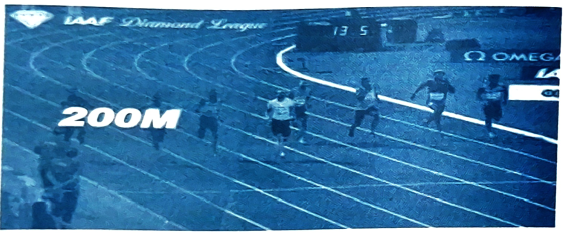
John wants to participate in a 200 m race. He can currently run that distance in 51 secons and with each day of practice it takes him 2 seconds less. He wants to do it in 31 seconds.
Image
(i) Which of the following are in A.P. for the given situation?
(a) 51,53,55,... $\qquad$ (b) 51,49,47,... $\qquad$ (c) -51,-53,-55, ... $\qquad$ (d) 51,55,59,...
(ii) The minimum number of days he needs to practice to achieve the goal is
(a) 10 $\qquad$ (b) 12 $\qquad$ (c) 11 $\qquad$ (d) 9
(iii) Which of the following terms is not in the A.P. of the given situation?
(a) 41 $\qquad$ (b) 30 $\qquad$ (c) 37 $\qquad$ (d) 39
(iv) The common difference of the A.P. having $a_n=2 n+3$ as $n^{\text {th }}$ term, is
(a) 2 $\qquad$ (b) 3 $\qquad$ (c) 5 $\qquad$ (d) 1
Answer
(i) (b): John takes 51 seconds to cover the distance in first run and takes 2 seconds less in each subsequent runs. So, time taken in first, second, third ... days are $51,49,47,45, \ldots$
(ii) (c): Suppose he practices for $n$ days to achieve the goal. Then, $n^{\text {th }}$ term of the A.P. 51, 49, 47, $45, \ldots$ is 31 .
$
\therefore \quad 31=51+(n-1) \times(-2) \Rightarrow 31=51-2 n+2 \Rightarrow 2 n=22 \Rightarrow n=11
$
(iii) (b): Terms of the given A.P. are odd numbers. Therefore, 30 being an even number, cannot be a term of the given A.P.
(iv) (a): Common difference $=a_n-a_{n-1}=(2 n+3)-(2 n+1)=2$
View full question & answer
Question 74 Marks
India is competitive manufacturing location due to the low cost manpower and strong technical and engineering capabilities contributing to higher quality production runs. The production of TV sets in a factory increases uniformly by a fixed number every year. It produced 16,000 sets in $6^{\text {th }}$ year and 22,600 in $9^{\text {th }}$ year. Based on the above information, answer the following:
Image
(i) The production of TV sets during the first year was
(a) 2200 sets $\qquad$ (b) 5650 sets $\qquad$ (c) 5000 sets $\qquad$ (d) 5750 sets
(ii) The number of $T V$ sets produced during the $8^{\text {th }}$ year was
(a) 20,600 $\qquad$ (b) 20,000 $\qquad$ (c) 20,400 $\qquad$ (d) 20,200
(iii) Total number of TV sets produced in first five years was
(a) 47,000 $\qquad$ (b) 45,000 $\qquad$ (c) 48,000 $\qquad$ (d) 50,000
(iv) In which year the production was 29,200. TV sets
(a) 10 $\qquad$ (b) 12 $\qquad$ (c) 14 $\qquad$ (d) 8
Answer
(i) (c): As the production increases uniformly so the number of TV sets produced form an A.P. with first term ' $a$ ' (say) and common difference ' $d$ ' (say). It is given that
$a_6=16000$ and $a_9=22,600 \Rightarrow a+5 d=16,000$ and $a+8 d=22,600 \Rightarrow a=5000, d=2200$
(ii) (c): $a_{ s }=a+7 d=5000+7 \times 2200=20400$
(iii) (a): $S_5=\frac{5}{2}(2 a+4 d)=5(a+2 d)=5(5000+4400)=47,000$
(iv) (b): Let the production be 29,200 in $n^{\text {th }}$ year. Then,
$
\begin{array}{ll}
\therefore & a_n=29,200 \\
\Rightarrow & a+(n-1) d=29,200 \\
\Rightarrow & 5000+(n-1) \times 2200=29200 \Rightarrow 50+22 n-22=292 \Rightarrow 22 n=264 \Rightarrow n=12
\end{array}
$
View full question & answer
Question 84 Marks
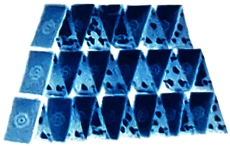
Figure, shows playing cards stacked together in a following manner: 56 cards are stacked in this manner. 14 cards are in the bottom row, 12 in the next row, 10 in the row next to it and so on. Based on this information answer the following questions
Image
(i) The total number of rows in which the cards are stacked is
(a) 7 $\qquad$ $\qquad$ (b) 6 $\qquad$ (c) 8 $\qquad$ (d) 9
(ii) The number of cards in the top row is
(a) 4 $\qquad$ (b) 6 $\qquad$ (c) 1 $\qquad$ (d) 2
(iii) The mathematical concept applied in solving the above problem is
(a) Linear equations $\qquad$ (b) Probability
(c) Arithmetic progression $\qquad$ (d) Coordinate geometry
Answer
(i) (a) (ii) (d) (iii) (c) 
View full question & answer
Question 94 Marks
Answer
(i) (b) (ii) (b) (iii) (c) (iv) (b) 
View full question & answer
Question 104 Marks
In a potato race, a bucket is placed at the starting point, which is 5 m from the first potato, and the other potatoes are placed 3 m apart in a straight line. There are $n$ potatoes in the line (See Fig. 5.10). Each competitor starts from the bucket, picks up the nearest potato, runs back with it, drops it in the bucket, runs back to pick up the next potato, runs to the bucket to drop it in the bucket, and she continues in the same way until all the potatoes are in the bucket. Based on the above information answer the following questions:
Image
(i) Distance run by the competitor to pickup and drop first potato in the bucket, is
(a) 5 cm $\qquad$ (b) 8 m $\qquad$ (c) 10 m $\qquad$ (d) 7 m
(ii) Distance run by the competitor to pick up and drop $n^{\text {th }}$ potato in the bucket, is
(a) $(3 n+2) m$ $\qquad$ (b) $2(3 n+2) m$ $\qquad$ (c) $2(3 n-1) m$ $\qquad$ (d) $6(n-1) m$
(iii) Total distance run by the competitor to pick up and drop first four potatoes is
(a) 36 metres $\qquad$ (b) 40 metres $\qquad$ (c) 86 metres $\qquad$ (d) 76 metes
(iv) Total distance run by the competitor to pick up and drop $n$ potatoes in the bucket is
(a) $n(3 n+2) m$ $\qquad$ (b) $2 n(3 n+2) m$ $\qquad$ (c) $n(3 n+7) m$ $\qquad$ (d) $\left(3 n^2+7\right) m$
Answer
(i) (c) (ii) (b) (iii) (d) (iv) (c)
View full question & answer
Question 114 Marks
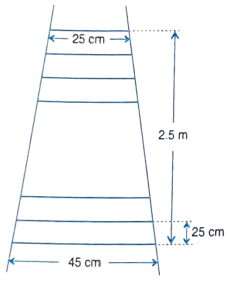
A Carpenter wants to manufacture a 3 metre ladder having rungs 25 cm apart (see Fig. 5.9). The rungs decrease uniformly in length from 45 cm at the bottom to 25 cm at the top and the top and bottom rungs are 2.5 metre apart.
Based on the above information answer the following questions:
(i) Total number of rungs in the ladder is
(a) 10 $\qquad$ (b) 9 $\qquad$ (c) 11 $\qquad$ (d) 12
(ii) The lengths of rungs from bottom to top form an A.P. with first and last terms as 45 cm and 25 cm respectively. The common difference of the A.P. formed is
(a) -2 cm $\qquad$ (b) -2.5 cm $\qquad$ (c) 4.5 cm $\qquad$ (d) 2 cm
(iii) The length of the middle rung is
(a) 33 cm $\qquad$ (b) 35 cm $\qquad$ (c) 37 cm $\qquad$ (d) 35.5 cm .
Image
(iv) Length of the wood used for rungs is
(a) 3.75 metres $\qquad$ (b) 2.85 metres $\qquad$ (c) 3.85 metres $\qquad$ (d) 4 metres
Answer
(i) (c) (ii) (a) (iii) (b) (iv) (c)
View full question & answer
Question 124 Marks
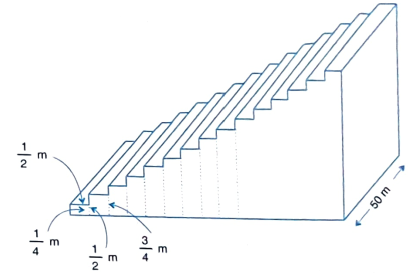
A small terrace at a football ground comprises of 15 steps each of which is 50 m long and built of solid concrete. Each step rises of $\frac{1}{4} m$ and a tread of $\frac{1}{2} m$ (see Fig. 5.8). Let $V_1, V_2, V_3, \ldots, V_{15}$ denote respectively the volumes of concrete required to build the first, second, third, ... fifteenth step. Based on the above information answer the following questions:
Image
(i) Heights of first, second, third, $\ldots, 15^{\text {th }}$ steps form an A.P. with common difference
(a) $\frac{1}{4} m$ $\qquad$ $\qquad$ (b) $\frac{1}{2} m$ $\qquad$ (c) $\frac{3}{4} m$ $\qquad$ (d) $-\frac{1}{4} m$.
(ii) The value of $V_2$ is
(a) $25 m^3$ $\qquad$ (b) $50 m^3$ $\qquad$ c) $12.5 m^3$ $\qquad$ (d) $6.25 m^3$
(iii) The volume of concrete used in the middle step is
(a) $25 m^3$ $\qquad$ (b) $50 m^3$ $\qquad$ c) $75 m^3$ $\qquad$ (d) $6.25 m^3$
(iv) The sum of the surface areas of 15 treads is
(a) $350 m^2$ $\qquad$ (b) $400 m^2$ $\qquad$ (c) $375 m^2$ $\qquad$ (d) $475 m^2$
Answer
(i) (a) (ii) (c) (iii) (b) (iv) (c)
View full question & answer
Question 134 Marks
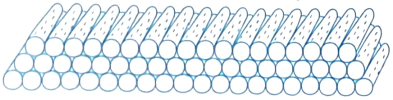
Lumber is a significant natural resource that contributes jobs to the US economy. Lumber companies source their raw materials from privately-managed or government-leased forests. In order to process tree wood into usable lumber, this raw material is transported to lumber mills, where it is cut to different sizes. Lumber is primarily used by the construction industry, though it can also be used to produce furniture, paper and pulp, and composites such as plywood. A lumber company stacks 200 logs in the following manner:
Image
20 logs in the bottom row, 19 in the next row, 18 in the row next to it and so on as shown in Fig. 5.7. Based on the above information answer the following questions:
(i) Number of logs in first row, second row, third row,
(a) follow a pattern forming an A.P. with common difference 1.
(b) follow a pattern forming on A.P. with common difference -1 .
(c) do not follow any specific pattern.
(d) follow a pattern forming an A.P. with common difference 2.
(ii) The number of rows in which 200 logs are stacked is
(a) 25 $\qquad$ (b) 20 $\qquad$ (c) 16 $\qquad$ (d) 10
(iii) The number of logs in the top row is
(a) 5 $\qquad$ (b) 7 $\qquad$ (c) 10 $\qquad$ (d) 2
(iv) The number of logs in the middle rows are:
(a) 11,10 $\qquad$ (b) 12,11 $\qquad$ (c) 14,13 $\qquad$ (d) 13,12
Answer
(i) (b) (ii) (c) (iii) (a) (iv) (d)
View full question & answer