MCQ 11 Mark
If the points $A (x, 2), B(-3,-4)$ and $C (7,-5)$ are collinear, then the value of $x$ is:
AnswerIt is given that the three points $A(x, 2), B(-3,-4)$ and $C(7,-5)$ are collinear.
Area of $\triangle \text{ABC}=0 ($Points are collinear$)$
$\frac{1}{2}\left[x_1\left(y_2-y_3\right)+x_2\left(y_3-y_1\right)+x_3\left(y_1-y_2\right)\right]=0$
Here, $x_1=x, y_1=2, x_3=-3, y_2=-4$ and $x_3=7$,
$y_3=-5$
$x[-4-(-5)]-3(-5-2)+7[2-(-4)]=0$
$x(-4+5)-3(-5-2)+7(2+4)=0$
$x-3 \times(-7)+7 \times 6=0$
$x+21+42=0$
$x+63=0$
$x=-63$
Hence, the correct option is $(a).$
View full question & answer→MCQ 21 Mark
ABCD is a rectangle whose three vertices are B $(4,0), C(4,3)$ and $D(0,3)$. The length of one of its diagonals is
Answer(a)
For the rectangle $A B C D$, the diagonals are $A C$ and $B D$.
Distance between two points
$
=\sqrt{\left(x_2-x_1\right)^2+\left(y_2-y_1\right)^2}
$
Let $B=\left(x_1, y_1\right)=(4,0)$ and $D=\left(x_2, y_2\right)=(0,3)$
Length of $B D=\sqrt{(0-4)^2+(3-0)^2}$
Length of $B D=\sqrt{(4)^2+(3)^2}$
Length of $B D=\sqrt{16+9}=\sqrt{25}=5$
The correct answer is (a).
View full question & answer→MCQ 31 Mark
In Fig, find the area of triangle $\text{ABC}\ ($in sq. units$)$ is:
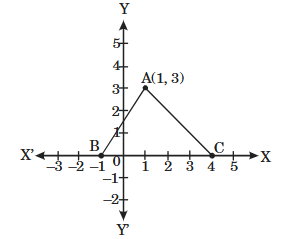
Answer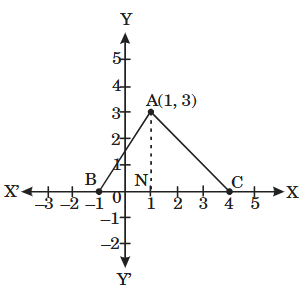
Construction: Draw $AN \perp BC$.
Here, $B C=4-(-1)=5$ units and $A N=3$ units.
In $\triangle A B C$,
The base is $B C$ and the height is $A N$.
Now,
Area of triangle $ABC =\frac{1}{2} \times$ base $\times$ height
$=\frac{1}{2} \times BC \times AN$
$=\frac{1}{2} \times 5 \times 3$
$=7.5 \text { Sq. Units. }$
Thus the area of the given triangle is $=7.5 \text { Sq. Units. }$
Hence the option $" c \ "$ is the correct answer. View full question & answer→MCQ 41 Mark
In Figure, $P (5,-3)$ and $Q (3, y)$ are the points of trisection of the line segment joining $A(7,-2)$ and $B (1,-5)$. Then $y$ equals?

- A
$2$
- B
$4$
- ✓
$-4$
- D
$-\frac{5}{2}$
Answer$P$ and $Q$ are the points of trisection of $\text{AB,}$
$\therefore \text{AP=PQ=QB}$
Thus, $Q$ divide $\text{AB}$ internally in the ratio $2: 1$.
Let $A(7,-2) \equiv\left(x_1, y_1\right)$ and $B(1,-5) \equiv\left(x_2, y_2\right)$.
Applying the section formula at point $Q(3, y)$
where $m : n \equiv 2: 1$,
we have $y=\frac{m y_2+n y_1}{m+n}$
$\Rightarrow y=\frac{2 \times(-5)+1 \times(-2)}{2+1}$
$\Rightarrow y=\frac{-10-2}{3}$
$\Rightarrow y=\frac{-12}{3}$
$\Rightarrow y=-4$
Thus, the $y-$coordinate of point $Q$ is $-4 .$
$\therefore$ Option $(c)$ is correct.
View full question & answer→MCQ 51 Mark
The distance of the point $(-3,4)$ from the $x$-axis is
Answer(c)
We know that, $y$-coordinate or ordinate of a point is the distance from the $x$-axis.Therefore, the distance of the point $(-3,4)$ from the $x$-axis is 4 units.Option (c) is correct.
View full question & answer→MCQ 61 Mark
The mid $-$ point of segment $A B$ is the point $P(0,4)$. If the coordinates of $B$ are $(-2,3)$ then the coordinates of $A$ are
- ✓
$(2,5)$
- B
$(-2,-5)$
- C
$(2,9)$
- D
$(-2,11)$
AnswerCorrect option: A. $(2,5)$
Let the coordinates of $A$ be $(x, y)$
According to the question, $P$ is the midpoint of the line segment $A B$.
Coordinates of the midpoint of the line segment $A B=$ Coordinate of the point $P$
$\left(\frac{x-2}{2}, \frac{y+3}{2}\right)=(0,4)$
Equating the coordinate on both the sides.
$\Rightarrow \frac{x-2}{2}=0$ and $ \frac{y+3}{2}=4$
$\Rightarrow x-2=0$ and $ y+3=8$
$\Rightarrow x=2$ and $y=5$
Therefore, the coordinate of point $A$ is $(2,5)$
View full question & answer→MCQ 71 Mark
The point $P$ which divides the line segment joining the points $A(2,-5)$ and $B(5,2)$ in the ratio $2: 3$ lies in the quadrant
AnswerGiven that, Coordinate of point $A(2,-5)$ and $B(5,2)$.
Let $(x, y)$ be the coordinate of the point $P$, which divides the line segment $A B$ in the ratio $2: 3$.
Coordinate of $P$ are given by
$=\left(\frac{2 \times 5+3 \times 2}{2+3}, \frac{2 \times 2+3(-5)}{2+3}\right)$
$=\left(\frac{10+6}{5}, \frac{4-15}{5}\right)$
$=\left(\frac{16}{5}, \frac{-11}{5}\right)$
Clearly, from the coordinate of $P, x$ is positive and $y$ is negative.
Therefore, $P$ lies in $IV$ quadrant.
View full question & answer→MCQ 81 Mark
The base $B C$ of an equilateral $\triangle A B C$ lies on the y -axis. The co$-$ordinates of $C$ are $(0,-3)$. If the origin is the mid$-$point of the base $BC$ , what are the co-ordinates of $A$ and $B ?$
- A
$A (\sqrt{3}, 0), B (0,3)$
- B
$A ( \pm 3 \sqrt{3}, 0), B (3,0)$
- ✓
$A ( \pm 3 \sqrt{3}, 0), B (0,3)$
- D
$A (-\sqrt{3}, 0), B (3,0)$
AnswerCorrect option: C. $A ( \pm 3 \sqrt{3}, 0), B (0,3)$
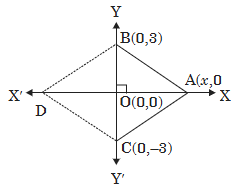
$O$ is the midpoint of the base $BC$
i.e., $O$ is the midpoint of $B$ and $C(0,-3)$
Therefore, coordinates of point $B$ is $(0,3)$
$So , BC =6$ units.
Let the coordinates of point A be $( x , 0 ).$
Using distance formula,
$AB=\sqrt{(0-x)^2+(3-0)^2}=\sqrt{x^2+9}$
$BC=\sqrt{(0-0)^2+(-3-3)^2}=\sqrt{36}$
$\text { Also, } BC=AB$
$\sqrt{x^2+9}=\sqrt{36}$
$x^2=27 \text { or } x= \pm 3 \sqrt{3}$
Coordinates of $A$ and $B$ are $( \pm 3 \sqrt{3}, 0)$ and $(0,3)$ respectively. View full question & answer→MCQ 91 Mark
If $A(4,-2), B(7,-2)$ and $C(7,9)$ are the vertices of a $\triangle ABC$, then $\triangle ABC$ is
- A
- B
- ✓
- D
isosceles right angled triangle
Answer(c)
$A (4,-2), B (7,-2)$ and $C (7,9)$ are the vertices of a triangle.
Using distance formula,
$
\begin{aligned}
d & =\sqrt{\left(x_2-x_1\right)^2+\left(y_2-y_1\right)^2} \\
AB & =\sqrt{[7-4]^2+[-2-(-2)]^2}=\sqrt{3^2+0}=3 \\
BC & =\sqrt{[7-7]^2+[9-(-2)]^2}=\sqrt{0+11^2}=11 \\
AC & =\sqrt{[7-4]^2+[9-(-2)]^2} \\
& =\sqrt{3^2+11^2}=\sqrt{9+121}=\sqrt{129}
\end{aligned}
$
Clearly, they are not equilateral or isosceles.
Also, $AC ^2= AB ^2+ BC ^2$
Which mean it is following Pythagoras theorem.
$\therefore \triangle ABC$ is a right angled triangle.
View full question & answer→MCQ 101 Mark
The line segment joining the points $P (-3,2)$ and $Q (5,7)$ is divided by the $y -$axis in the ratio
- A
$3: 1$
- B
$3: 4$
- C
$3: 2$
- ✓
$3: 5$
AnswerCorrect option: D. $3: 5$
Let the point on $y$-axis which divides the line PQ is $M (0, y)$ and the ratio be $k: 1$.
According to the section formula,
$M(x, y)=\left(\frac{m_1 x_2+m_2 x_1}{m_1+m_2}, \frac{m_1 y_2+m_2 y_1}{m_1+m_2}\right)$
$M(0, y)=\left(\frac{5 k+(-3)}{k+1}, \frac{k(7)+1(2)}{k+1}\right)$
On comparing, we get
$0=\frac{5 k -3}{ k +1}$ or $5 k-3=0$
or $k=\frac{3}{5}$
View full question & answer→MCQ 111 Mark
The ratio in which the line $3 x+y-9=0$ divides the line segment joining the points $(1,3)$ and $(2,7)$ is
- A
$3: 2$
- B
$2: 3$
- ✓
$3: 4$
- D
$4: 3$
AnswerCorrect option: C. $3: 4$
(c)
Let the point of intersection be $M (x, y)$
This point M lies on the line $\lambda$.
Therefore, $3\left(\frac{2 k +1}{ k +1}\right)+\frac{7 k +3}{ k +1}-9=0$
or $6 k+3+7 k+3-9(k+1)=0$
or $4 k-3=0$
or $k =\frac{3}{4}$
The ratio is $k: 1$ or $3: 4$.
View full question & answer→MCQ 121 Mark
Three vertices of a parallelogram ABCD are $A(1,4), B(-2,3)$ and $C(5,8)$. The ordinate of the fourth vertex $D$ is
Answer(b)
In the question value of ordinate is asked
$
\begin{aligned}
6 & =\frac{3+b}{2} \\
12 & =3+b \\
\text { or } \quad b & =9
\end{aligned}
$
View full question & answer→MCQ 131 Mark
If $A (3, \sqrt{3}), B (0,0)$ and $C (3, k)$ are the three vertices of an equilateral triangle $A B C$, then the value of $k$ is
- A
- B
- ✓
$-\sqrt{3}$
- D
$-\sqrt{2}$
AnswerCorrect option: C. $-\sqrt{3}$
(c)
$A (3, \sqrt{3}), B (0,0)$ and $C (3, k)$ are the vertices of the triangle ABC .
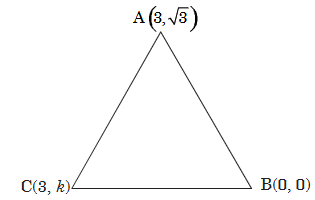
As in the equilateral triangle ABC all sides are equal.
Then, apply distance formula for sides AB and $B C$.
According to the distance formula,
$
d=\sqrt{\left(x_2-x_1\right)^2+\left(y_2-y_1\right)^2}
$
$
\begin{aligned}
AB & =\sqrt{(3-0)^2+(\sqrt{3}-0)^2} \\
& =\sqrt{9+3}=\sqrt{12} \text { units } \\
BC & =\sqrt{(3-0)^2+(k-0)^2} \\
& =\sqrt{9+k^2} \text { units }
\end{aligned}
$
Now, $AB = BC$
$
\sqrt{12}=\sqrt{9+k^2}
$
or, $12=9+k^2$
or $k^2=3$
or $\quad k= \pm \sqrt{3}$ View full question & answer→MCQ 141 Mark
The point of intersection of the line represented by $3 x - y =3$ and y -axis is given by
- ✓
$(0,-3)$
- B
$(0,3)$
- C
$(2,0)$
- D
$(-2,0)$
AnswerCorrect option: A. $(0,-3)$
(a) - $3 x-y=3\quad \quad \ldots \ldots(1)$
For y -axis, $x =0$
So,
$
\begin{aligned}
3 \times(0)-y =3 \\
y =-3
\end{aligned}
$
Now,
$\begin{aligned} \text { put } y =-3 \text { in eq(1) } \\ 3 x -(-3) =3 \\ 3 x +3 =3 \\ 3 x =0 \\ x =0\end{aligned}$
View full question & answer→MCQ 151 Mark
The distance of the point $(-6,8)$ from $x$-axis is
Answer(c)
Let us mark the point $P (-6,8)$ in the Cartesian plane.
The shortest distance between the coordinate (6,8 ) and the $x$-axis is a straight line to the point $(-6,0)$.
We are said to find the shortest distance from ( x - axis). So the point is $(-6,0)$.
$
\begin{aligned}
\text { Distance formula } & =\sqrt{\left(x_2-x_1\right)^2+\left(y_1-y_1\right)^2} \\
\text { Here, } \quad x_1, y_1 & =(-6,0) \\
x_2, y_2 & =(-6,8) \\
\text { Now, } \quad & =\sqrt{(-6-(-6))^2+(8-0)} \\
& =\sqrt{(0)+(8)^2} \\
& =\sqrt{64}=8
\end{aligned}
$
View full question & answer→MCQ 161 Mark
If the point $P (6,2)$ divides the line segment joining $A(6,5)$ and $B(4, y)$ in the ratio $3: 1$, then the value of $y$ is
Answer
$m: n=3: 1$
$2=\frac{m y_2+n y_1}{m+n}$
$ 2 =\frac{3 \times y+1 \times 5}{3+1}$
$2 =\frac{3 y+5}{4}$
$\Rightarrow 8 =3 y+5$
$\Rightarrow 3 y =3$
$\Rightarrow y =1$ View full question & answer→MCQ 171 Mark
The co-ordinates of the point which is reflection of point $(-3,5)$ in $x$-axis are
- A
$(3,5)$
- B
$(3,-5)$
- ✓
$(-3,-5)$
- D
$(-3,5)$
AnswerCorrect option: C. $(-3,-5)$
(c)
$(-3,-5)$
View full question & answer→MCQ 181 Mark
The point $P$ on $x -$axis equidistant from the points $A (-1,0)$ and $B (5,0)$ is
- ✓
$(2,0)$
- B
$(0,2)$
- C
$(3,0)$
- D
$(2,2)$
AnswerCorrect option: A. $(2,0)$
$AP = BP$
$\Rightarrow AP ^2 = BP ^2$
$ A (-1,0) B (5,0) P (x, 0)$
$\text { Distance formula }=\sqrt{\left(x_1-x_2\right)^2+\left(y_1-y_2\right)^2}$
$\Rightarrow(-1-x)^2+(0-0)^2=(5-x)^2+(0-0)^2$
$\Rightarrow 1+x^2+2 x=25+x^2-10 x$
$\Rightarrow 12 x=24$
$\Rightarrow x=2$
$\therefore P =2,0$
View full question & answer→MCQ 191 Mark
The mid$-$point of line segment joining the points $(-3,9)$ and $(-6,-4)$ is
- A
$\left(\frac{-3}{2}, \frac{-13}{2}\right)$
- B
$\left(\frac{9}{2}, \frac{-5}{2}\right)$
- ✓
$\left(\frac{-9}{2}, \frac{5}{2}\right)$
- D
$\left(\frac{9}{2}, \frac{5}{2}\right)$
AnswerCorrect option: C. $\left(\frac{-9}{2}, \frac{5}{2}\right)$
The mid$-$point of the line joining these two points can be found with the help of mid$-$point formula
$\left(\frac{x_1+x_2}{2}, \frac{y_1+y_2}{2}\right)$
$\Rightarrow \text { mid-point, } O=\left(\frac{-3+(-6)}{2}, \frac{9+(-4)}{2}\right)$
$\Rightarrow \text { mid-point, } O=\left(\frac{-9}{2}, \frac{5}{2}\right)$
View full question & answer→MCQ 201 Mark
A circle of radius 3 units is centered at ( 0,0 ). Which of the following points lie outside the circle?
- A
$(-1,-1)$
- B
$(0,3)$
- C
$(1,2)$
- ✓
$(3,1)$
AnswerCorrect option: D. $(3,1)$
(d)
Since the centre of circle lies at $(0,0)$ and its radius is 3 units.
From the given options, let us calculate the distance of each from the centre using distance formula, $d =\sqrt{\left( x _2- x _2\right)^2+\left( y _2- y _1\right)^2}$
For $(-1,-1)$,
$
\begin{aligned}
OA & =\sqrt{(-1-0)^2+(-1-0)^2}=\sqrt{(-1)^2+(-1)^2} \\
& =\sqrt{1+1=\sqrt{2}}
\end{aligned}
$
Since $\sqrt{2}<3$, it lies inside the circle.
For ( 0,3 ),
$
\begin{aligned}
OC & =\sqrt{(1-0)^2+(2-0)^2}=\sqrt{(1)^2+(2)^2} \\
& =\sqrt{1+4}=\sqrt{5}
\end{aligned}
$
Since $\sqrt{5}<3$, it lies inside the circle.
For $(3,1)$,
$
\begin{aligned}
OD & =\sqrt{(3-0)^2+(1-0)^2} \\
& =\sqrt{(3)^2+(1)^2}=\sqrt{9+1}=\sqrt{10}
\end{aligned}
$
Since $\sqrt{10}>3$, so point $(3,1)$ it lies outside the circle.
View full question & answer→MCQ 211 Mark
The perpendicular bisector of a line segment $A (-8,0)$ and $B (8,0)$ passes through a point $(0, k )$. The value of $k$ is
AnswerThe point $A (-8,0)$ and $B (8,0)$ lie on $X-$axis.
The mid$-$point of the line joining these two points can be found with the help of mid$-$point formula
$\left(\frac{x_1+x_2}{2}, \frac{y_1+y_2}{2}\right)$
$\Rightarrow O=\left(\frac{-8+8}{2}, \frac{0+0}{2}\right)$
$\Rightarrow O=(0,0)$
Therefore, the line that bisects $AB$ is the $y -$axis and it is given that it passes through a point $(0, k)$; so, $k$ is any real number.
View full question & answer→MCQ 221 Mark
The origin divides the line segment $AB$ joining the points $A (1,-3)$ and $B (-3,9)$ in the ratio :
- A
$3: 1$
- ✓
$1: 3$
- C
$2: 3$
- D
$1: 1$
AnswerCorrect option: B. $1: 3$
Let the ratio be $k : 1$
Using section formula,
$(x, y)=\left(\frac{m_1 x_2+m_2 x_1}{m_1+m_2}, \frac{m_1 y_2+m_2 y_1}{m_1+m_2}\right)$
$\Rightarrow(0,0)=\left(\frac{k \times-3+1 \times 1}{k+1}, \frac{k \times 9+1 \times-3}{k+1}\right)$
$\Rightarrow(0,0)=\left(\frac{-3 k+1}{k+1}, \frac{9 k-3}{k+1}\right)$
$\therefore 0=\frac{-3 k+1}{k+1} $ and $0=\frac{9 k-3}{k+1}$
$\Rightarrow 0=-3 k+1 $and $ 0=9 k-3$
$\Rightarrow 3 k=1 $ and $ 9 k=3$
$\therefore \frac{k}{1}=\frac{1}{3}$ and $\frac{k}{1}=\frac{3}{9}=\frac{1}{3}$
Therefore, the required ratio is $1: 3$.
View full question & answer→MCQ 231 Mark
A point $(x, 1)$ is equidistant from $(0,0)$ and $(2,0)$. The value of $x$ is
AnswerLet the point $(x, 1)$ be $A,(0,0)$ be $B$ and $(2,0)$ be $C$.
According to question, $AB = AC$
${\left[\text { Using distance formula } \sqrt{\left(x_2-x_1\right)^2+\left(y_2-y_1\right)^2}\right]}$
$ \Rightarrow \sqrt{(0-x)^2+(0-1)^2}=\sqrt{(2-x)^2+(0-1)^2}$
Squaring both sides
$\Rightarrow\left(\sqrt{(0-x)^2+(0-1)^2}\right)^2=\left(\sqrt{(2-x)^2+(0-1)^2}\right)^2$
$\Rightarrow(0-x)^2+(0-1)^2=(2-x)^2+(0-1)^2$
$\Rightarrow(-x)^2+(-1)^2=\left(4-4 x+x^2\right)+(-1)^2$
$\left\{\right.$ Since, $\left.(a-b)^2=\left(a^2-2 a b+b^2\right)\right\}$
$\Rightarrow x^2+1=4-4 x+x^2+1$
$\Rightarrow 0=4-4 x$
$\Rightarrow 4 x=4$
$\Rightarrow x=1$
View full question & answer→MCQ 241 Mark
If $(3,-6)$ is the mid point of the line segment joining $(0,0)$ and $(x, y)$, then the point $(x, y)$ is
AnswerCorrect option: C. $(6,-12)$
(c)
$M (3,-6)$ is mid point of $A (0,0)$ and $b (x, y)$
$
\begin{array}{rlrl}
\text { Mid point } =\left[\frac{x_1+x_2}{2}, \frac{y_1+y_2}{2}\right] \\
\Rightarrow 3 =\frac{0+x}{2} \\
\Rightarrow x =6 \\
\Rightarrow -6 =\frac{0+y}{2} \\ \Rightarrow \quad y=-12\\
\therefore
\text { B is }(6,-12)
\end{array}
$
View full question & answer→MCQ 251 Mark
The distance between the points $(3,-2)$ and $(-3,2)$ is
- ✓
$\sqrt{52}$ units
- B
$4 \sqrt{10}$ units
- C
$2 \sqrt{10}$ units
- D
AnswerCorrect option: A. $\sqrt{52}$ units
(a)
$A (3,-2), B (-3,2)$
$
\begin{aligned}
AB & =\sqrt{\left(x_1-x_2\right)^2+\left(y_1-y_2\right)^2} \\
& =\sqrt{(3-3)^2+(-2-2)^2} \\
& =\sqrt{(6)^2+(-4)^2} \\
& =\sqrt{36+16} \\
& =\sqrt{52} \text { units }
\end{aligned}
$
View full question & answer→MCQ 261 Mark
If the points $A (2,3), B (4, K)$ and $C (6,-3)$ are collinear, then the value of $k$ be
AnswerLet $\left( x _1=2, y _1=3\right),\left( x _2=4, y _2= K \right)$ and $\left( x _3=6, y _3=-3\right)$
$\because$ Point $A, B$ and $C$ are collinear.
$\therefore \Delta=0$
$\Rightarrow x_1\left(y_2-y_3\right)+x_2\left(y_3-y_1\right)+x_2\left(y_1-y_2\right)=0$
$\Rightarrow 2(K+3)+4(-3-3)+6(3-K)=0$
$\Rightarrow 2 K+6-24+18-6 K=0$
$\Rightarrow-4 K=0 $
$\Rightarrow K=0$
View full question & answer→MCQ 271 Mark
The area of $\triangle \text{ABC}$ with vertices $A (3,0), B (7,0)$ and $C(8,4)$ is
- A
$14$ sq units
- ✓
$28$ sq units
- C
$8$ sq units
- D
$6$ sq units
AnswerCorrect option: B. $28$ sq units
Here, $\left(x_1=3, y_1=0\right),\left(x_2=7, y_2=0\right)$ and
$\left(x_3=8, y_3=4\right)$
$\therefore$ area of $\triangle \text{ABC}$
$=\frac{1}{2}\left|x_1\left(y_2-y_3\right)+x_2\left(y_3-y_1\right)+x_3\left(y_1-y_2\right)\right|$
$=\frac{1}{2}|3(0-4)+7(4-0)+8(0-0)|$
$=\frac{1}{2}|-12+28+0|$
$=\frac{1}{2} \times 16$
$=8 \text { sq. units }$
View full question & answer→MCQ 281 Mark
If the points $A (1,2), O (0,0)$ and $C ( a , b )$ are collinear then
- A
$a = b$
- B
$a =2 b$
- ✓
$2 a = b$
- D
$a + b =0$
AnswerCorrect option: C. $2 a = b$
Here, $\left( x _1=1, y _2=2\right),\left( x ^2=0, y ^2=0\right)$ and ( $x _3= a , y _3= b$ ).
Since the given points are collinear, we have
$x_1\left(y_2-y_3\right)+x_2\left(y_3-y_1\right)+x_3\left(y_1-y_2\right)=0$
$\Rightarrow 1 \cdot(0-b)+0 \cdot(b-2)+a(2-0)=0$
$\Rightarrow-b+0+2 a=0$
$\Rightarrow 2 a=b$
View full question & answer→MCQ 291 Mark
If the points $A (2,3), B (5, K)$ and $C (6,7)$ are collinear then .
- A
$K =4$
- B
$K =6$
- C
$K =\frac{-3}{2}$
- ✓
$K =\frac{11}{4}$
AnswerCorrect option: D. $K =\frac{11}{4}$
Here, $\left( x _1=2, y _1=3\right),\left( x _2=5, y _2= K \right)$ and $\left( x _3=6, y _3=7\right.$ )
Since the given points are collinear, we must have:
$x_1\left(y_2-y_3\right)+x_2\left(y_3-y_1\right)+x_3\left(y_1-y_2\right)=0$
$\Rightarrow 2(K-7)+5(7-3)+6(3-k)=0$
$\Rightarrow 2 K-14+20+18-6 K=0$
$\Rightarrow 4 K=24$
$\Rightarrow K=\frac{24}{4}=6$
View full question & answer→MCQ 301 Mark
Two vertices of $\triangle \text{ABC}$ are $A(-1,4)$ and $B(5,2)$ and its centroid is $G (0,-3)$. Then the coordinates of $C$ are
- A
$(4,3)$
- B
$(4,15)$
- ✓
$(-4,-15)$
- D
$(-15,-4)$
AnswerCorrect option: C. $(-4,-15)$
Let the vertex $C$ be $C( x , y )$.
Then, $\frac{-1+5+x}{3}=0$ and $\frac{4+2+y}{3}=-3$
$\Rightarrow x+4=0$ and $6+y=-9$
$\therefore x=-4$ and $y=-15$
So, the coordinates of $C$ are $(-4,-15)$.
View full question & answer→MCQ 311 Mark
If $A(-1,0), B(5,-2)$ and $C(8,2)$ are the vertices of a $\triangle A B C$ then its centroid is
- A
$(12,0)$
- B
$(6,0)$
- C
$(0,6)$
- ✓
$(4,0)$
AnswerCorrect option: D. $(4,0)$
Centroid of $\triangle ABC$
$G=\left(\frac{x_1+x_2+x_3}{3}, \frac{y_1+y_2+y_3}{3}\right)$
$=\left(\frac{-1+5+8}{3}, \frac{0-2+2}{3}\right)$
$=\left(\frac{12}{3}, \frac{0}{3}\right)$
$=(4,0)$
View full question & answer→MCQ 321 Mark
The area of $\triangle A B C$ with vertices $A(a, 0), O(0,0)$ and $B(0, b)$ in square units is
- A
- ✓
$\frac{1}{2} ab$
- C
$\frac{1}{2} a ^2 b^2$
- D
$\frac{1}{2} b^2$
AnswerCorrect option: B. $\frac{1}{2} ab$
(b)
Here, base = a units and height = b units
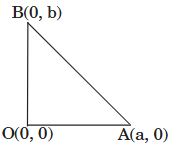
$
\begin{aligned}
\therefore \text { Area } & =\frac{1}{2} \times \text { base } \times \text { height } \\
& =\frac{1}{2} ab \text { sq. units }
\end{aligned}
$ View full question & answer→MCQ 331 Mark
The area of a triangle with vertices $A (5,0)$, $B(8,0)$ and $C(8,4)$ in square units is
AnswerHere, $\left( x _1=5, y =0\right),\left( x _2=8, y _2=0\right)$ and $\left(x_3=8, y_3=4\right)$
$\therefore \Delta=\frac{1}{2}\left|x_1\left(y_2-y_3\right)+x_2\left(y_3-y_1\right)+x_3\left(y_1-y_2\right)\right|$
$=\frac{1}{2}|5(0-4)+8(4-0)+8(0-0)|$
$=\frac{1}{2}|-20+32|=\frac{1}{2} \times 12=6 \text { sq units. }$
View full question & answer→MCQ 341 Mark
If the points $A ( x , 2), B (-3,-4)$ and $C (7,-5)$ are collinear then the value of $x$ is
AnswerHere, $\left(x_1=x, y_1=2\right),\left(x_2=-3, y_2=-4\right)$ and
$\left(x_3=7, y_3=-5\right)$
$\therefore x_1\left(y_2-y_3\right)+x_2\left(y_3-y_1\right)+x_3\left(y_1-y_2\right)=0$
$\Rightarrow x(-4+5)-3(-5-2)+7(2+4)=0$
$\Rightarrow x+21+42=0 $
$\Rightarrow x=-63$
View full question & answer→MCQ 351 Mark
If the centroid of $\triangle A B C$ having vertices $A(a, b)$, $B ( b , c )$ and $C ( c , a )$ is the origin, then the value of $(a+b+c)$ is
AnswerCentroid of $ \triangle ABC =\left(\frac{ a + b + c }{3}, \frac{ a + b + c }{3}\right)$
But the coordinate of centroid $=(0,0)$
$\therefore \frac{ a + b + c }{3}=0 $
$\Rightarrow a + b + c =0$
View full question & answer→MCQ 361 Mark
If $A(-6,7)$ and $B(-1,-5)$ are two given points then the distance $2 \ AB$ is
Answer$2 \ AB =2 \times \sqrt{(-1+6)^2+(-5-7)^2}$
$=2 \times \sqrt{5^2+(-12)^2}$
$=2 \times \sqrt{169}$
$=2 \times 13$
$=26$
View full question & answer→MCQ 371 Mark
The midpoint of segment $AB$ is $P (0,4)$. If the coordinates of $B$ are $(-2,3)$ then the coordinates of $A$ are.
- ✓
$(2,5)$
- B
$(-2,-5)$
- C
$(2,9)$
- D
$(-2,11)$
AnswerCorrect option: A. $(2,5)$
Let the point $A$ be $(a, b).$
Then,
$\frac{a+(-2)}{2}=0 $ and $ \frac{b+3}{2}=4$
$\Rightarrow a-2=0$ and $ b=8-3$
$\Rightarrow a=2, b=5$
$\therefore$ the point $A$ is $(2,5)$
View full question & answer→MCQ 381 Mark
The coordinates of the point $P$ dividing the line segment joining the points $A (1,3)$ and $B (4,6)$ in the ratio $2: 1$ is
- A
$(2,4)$
- ✓
$(3,5)$
- C
$(4,2)$
- D
$(5,3)$
AnswerCorrect option: B. $(3,5)$
Coordinates of point $p$ are
$=\left(\frac{2 \times 4+1 \times 1}{2+1}, \frac{2 \times 6+1 \times 3}{2+1}\right)$
$=\left(\frac{8+1}{3}, \frac{12+3}{3}\right)$
$=\left(\frac{9}{3}, \frac{15}{3}\right)$
$=(3,5)$
View full question & answer→MCQ 391 Mark
If $P \left(\frac{ a }{2}, 4\right)$ is the midpoint of the line segment joining the points $A(-6,5)$ and $B(-2,3)$ then the value of $'a\ '$ is
AnswerAccording to the question,
$\frac{a}{2}=\frac{-6-2}{2}$
$\Rightarrow a=-8$
View full question & answer→MCQ 401 Mark
If the point $C ( k , 4)$ divides the join of the points $A (2, 6)$ and $B(5,1)$ in the ratio $2: 3$ then the value of $k$ is
- A
$16$
- B
$\frac{28}{5}$
- ✓
$\frac{16}{5}$
- D
$\frac{8}{5}$
AnswerCorrect option: C. $\frac{16}{5}$
$ K =\frac{(2 \times 5)+(3 \times 2)}{(2+3)}$
$=\frac{10+6}{5}$
$=\frac{16}{5}$
View full question & answer→MCQ 411 Mark
If $R (5,6)$ is the midpoint of the line segment AB joining the points $A (6,5)$ and $B (4, y )$ then y equals
Answer(b)
According to the question,
$
6=\frac{5+y}{2} \Rightarrow 5+y=12 \Rightarrow y=12-5=7
$
View full question & answer→MCQ 421 Mark
The point on $X -$axis which is equidistant from points $A (-1,0)$ and $B (5,0)$ is.
- A
$(0,2)$
- ✓
$(2,0)$
- C
$(3,0)$
- D
$(0,3)$
AnswerCorrect option: B. $(2,0)$
Let the required point be $P ( x , 0)$.
Then, $(PA)^2=(PB)^2$
$\Rightarrow(x+1)^2=(x-5)^2$
$\Rightarrow x^2+2 x+1=x^2-10 x+25$
$\Rightarrow 12 x=24 $
$\Rightarrow=\frac{24}{12}=2$
So, the required point is $P (2,0)$
View full question & answer→MCQ 431 Mark
The distance of the point $P (-6,8)$ from the origin is
AnswerLet $P(-6,8)$ be the given point and $O(0,0)$ be the original,
Then, $O P=\sqrt{(-6-0)^2+(8-0)^2}$
$=\sqrt{36+64}=\sqrt{100}=10$
View full question & answer→MCQ 441 Mark
If the point $P ( k -1,2)$ is equidistant from the points $A (3, k )$ and $B ( k , 5)$, then the value of $k$ equal to.
AnswerCorrect option: C. $1$ or $5$
It is being given that $P ( K -1,2)$ is equidistant from the points $A (3, K)$ and $B ( K , 5)$.
So, we have
$PA=PB$
On squaring both side
$(PA)^2=(PB)^2$
$\Rightarrow(K-1-3)^2+(2-K)^2$
$=(K-1-K)^2+(2-5)^2$
$\Rightarrow(K-4)^2+(2-K)^2=(-1)^2+(-3)^2$
$\Rightarrow 2 K^2-12 K+20=1+9$
$\Rightarrow 2 K^2-12 K+10=0$
$\Rightarrow K^2-6 K+5=0$
$\Rightarrow K^2-5 K-K+5=0$
$\Rightarrow K(K-5)-(K-5)=0$
$\Rightarrow(K-5)(K-1)=0$
$\Rightarrow K=1$ or $ K=5$
Hence, the required value of $K$ are $1$ and $5$ .
View full question & answer→MCQ 451 Mark
The value of $y$ for which the distance between the points $A (3,-1)$ and $B (11, y )$ is $10$ units are.
AnswerCorrect option: C. $5$ or $-7$
We have
$A B=10$
$\therefore(A B)^2=100$
$(11-3)^2+(y+1)^2=100$
$8^2+(y+1)^2=100$
$(y+1)^2=100-64$
$(y+1)^2=36$
$\Rightarrow(y+1)^2=(6)^2$
$\Rightarrow y+1= \pm 6$
$\Rightarrow y+1=6$ or $ y+1=-6$
$\Rightarrow y=5$ or $y=-7$
Hence, the required values of $y$ are $5$ and $-7.$
View full question & answer→MCQ 461 Mark
The distance of the point $P(6,-6)$ from the origin are.
- A
$6$ units
- ✓
$6 \sqrt{2}$ units
- C
$6 \sqrt{3}$ units
- D
$5$ units
AnswerCorrect option: B. $6 \sqrt{2}$ units
Let $P (6,-6)$ be the given point and $O (0,0)$ be the origin,
$\text { Then, } OP=\sqrt{(6-0)^2+(-6-0)^2}$
$=\sqrt{6^2+(-6)^2}$
$=\sqrt{36+36}$
$=\sqrt{72}$
$=6 \sqrt{2} \text { units. }$
View full question & answer→MCQ 471 Mark
The distance between the points $A (7,13)$ and $B(10,9)$ are
- ✓
$5$ units
- B
$6$ units
- C
$7$ units
- D
$8$ units
AnswerCorrect option: A. $5$ units
The given points are $A (7,13)$ and $B (10,9)$.
Then, $x _1=7, y _1=13$ and $x _2=10, y _2=9$
$\therefore AB=\sqrt{\left(x_2-x_1\right)^2+\left(y_2-y_1\right)^2}$
$=\sqrt{(10-7)^2+(9-13)^2}$
$=\sqrt{(3)^2+(-4)^2}$
$=\sqrt{9+16}$
$=\sqrt{25}$
$=5 \text { units. }$
View full question & answer→