Questions

3 Marks Question

🎯

Test yourself on this topic

8 questions · timed · auto-graded

Question 13 Marks
In a $2-$digit number, the digit at the unit's place is $5$ less than the digit at the ten's place. The product of the digits is $36$. Find the number.
Answer
Let digit at ten's place be $x$ then digit at unit's place $= x - 5$
$x(x-5)=36$
$\Rightarrow x^2-5 x-36=0$
$(x-9)(x+4)=0$
$x \neq-4 \text { so, } x=9$
$\therefore$ Required number is $94$
View full question & answer
Question 23 Marks
In a test, the marks obtained by $100$ students $($out of $50)$ are given below:Find the mean marks of the students.
Marks obtained: $0-10$ $10-20$ $20-30$ $30-40$ $40-50$
Number of students: $12$ $23$ $34$ $25$ $6$
Answer
Marks Obtained Number of students(f₁) $X_i$ $f_ix_i$
$0-10$ $12$ $5$ $60$
$10-20$ $23$ $15$ $345$
$20-30$ $34$ $25$ $850$
$30-40$ $25$ $35$ $875$
$40-50$ $4$ $45$ $270$
$\text{Total}$ $100$   $2400$
$ \text { Mean } =\frac{2400}{100}$
$ =24$
View full question & answer
Question 33 Marks
Prove that $\frac{1+\sec \theta-\tan \theta}{1+\sec \theta+\tan \theta}=\frac{1-\sin \theta}{\cos \theta}$.
Answer

$\begin{aligned} \text { LHS } & =\frac{\left(\sec ^2 \theta-\tan ^2 \theta\right)+(\sec \theta-\tan \theta)}{1+\sec \theta+\tan \theta} \\ & =\frac{(\sec \theta-\tan \theta)(\sec \theta+\tan \theta+1)}{1+\sec \theta+\tan \theta} \\ & =\sec \theta-\tan \theta \\ & =\frac{1}{\cos \theta}-\frac{\sin \theta}{\cos \theta} \\ & =\frac{1-\sin \theta}{\cos \theta}=\text { RHS }\end{aligned}$
View full question & answer
Question 43 Marks
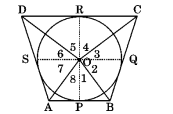
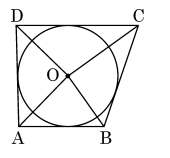
In the given figure, $\text{AB , BC , CD}$ and $DA$ are tangents to the circle with centre $O$ forming a quadrilateral $\text{A B C D}$.
Show that $\angle AOB +\angle COD =180^{\circ}$
Image
Answer
Image
$\text { Join } OP , OQ , OR \text { and } OS$
$\triangle POB \cong \triangle QOB$
$\Rightarrow \angle 1=\angle 2$
$\text { Similarly } \angle 3=\angle 4, \angle 5=\angle 6, \angle 7=\angle 8$
$\text { Now, } \angle 1+\angle 2+\angle 3+\angle 4+\angle 5+\angle 6+\angle 7+\angle 8=360^{\circ}$
$\Rightarrow 2(\angle 1+\angle 8+\angle 4+\angle 5)=360^{\circ}$
$\therefore \angle AOB +\angle COD =180^{\circ}$
View full question & answer
Question 53 Marks
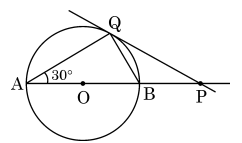
In the given figure, $PQ$ is tangent to a circle centred at $O$ and $\angle B A Q=30^{\circ}$; show that $\text{B P=B Q}$.
Image
Answer
Image
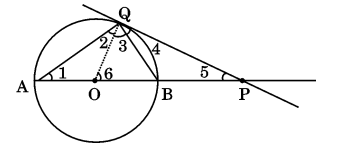
$\text { Join OQ }$
$OQ=OA$
$\Rightarrow \angle 2=30^{\circ}$
$\angle 3=90^{\circ}-30^{\circ}=60^{\circ}$
$\angle 4=90^{\circ}-60^{\circ}=30^{\circ}$
$\angle 6=\angle 1+\angle 2=60^{\circ}$
Hence $\angle 5=90^{\circ}-60^{\circ}=30^{\circ}=\angle 4$
$\therefore BP=BQ$
View full question & answer
Question 63 Marks
Prove that $\sqrt{5}$ is an irrational number.
Answer

Let $\sqrt{5}$ be a rational number.
$\therefore \sqrt{5}=\frac{p}{q}$, where $q \neq 0$ and let $p \& q$ be co-prime.
$5 q ^2= p ^2 \Rightarrow p ^2$ is divisible by $5 \Rightarrow p$ is divisible by $5.....$  (i)
$\Rightarrow p =5 a$, where ' a ' is some integer
$25 a^2=5 q^2 \Rightarrow q^2=5 a^2 \Rightarrow q^2$ is divisible by $5 \Rightarrow q$ is divisible by 5 ........ (ii)
(i) and (ii) leads to contradiction as ' $p$ ' and ' $q$ ' are co-prime.
$\therefore \sqrt{5}$ is an irrational number.
View full question & answer
Question 73 Marks
In an $A.P.$, the sum of three consecutive terms is $24$ and the sum of their squares is $194$ . Find the numbers.
Answer
Let the numbers be $a-d, a, a+d$
$\therefore a-d+a+a+d=24$
$\Rightarrow a=8$
$\text { Also, }(a-d)^2+a^2+(a+d)^2=194$
$\Rightarrow(8-d)^2+8^2+(8+d)^2=194$
$\Rightarrow d^2=1 \Rightarrow d= \pm 1$
$\therefore$ Numbers are $7,8,9$ or $9,8,7$
View full question & answer
Question 83 Marks
If the sum of first $m$ terms of an $A.P.$ is same as sum of its first $n$ terms $( m \neq n )$, then show that the sum of its first $( m + n )$ terms is zero.
Answer
$ S _{ m }= S _{ n }$
$\Rightarrow \frac{ m }{2}\left[ 2 a +( m - 1 ) d =\frac{ n }{2}[ 2 a +( n - 1 ) d ]\right.$
$\Rightarrow 2 a ( m - n )= d \left( n ^2- m ^2\right)- d ( n - m )$
$\Rightarrow 2 a =- d ( m + n - 1 )$
$\text { or } 2 a +( m + n - 1 ) d = 0$
$\text { i. } e , S _{ m + n }=\frac{m+n}{2}[ 2 a +( m + n - 1 ) d ]= 0 $
View full question & answer
3 Marks Question - Maths STD 10 Questions - Vidyadip