Questions

5 Marks Questions

🎯

Test yourself on this topic

6 questions · timed · auto-graded

Question 15 Marks
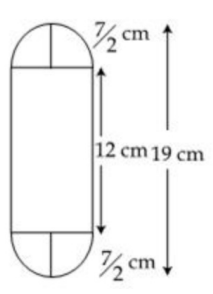
A solid is in the form of a cylinder with hemispherical ends. The total height of the solid is $19 \ cm$ and the diameter of the cylinder is $7 \ cm$ . Find the volume and total surface area of the solid $($Use $\pi=22 / 7 )$
Answer
Diameter of the cylinder $=7 \ cm$
Therefore radius of the cylinder $=\frac{7}{2} \ cm$
Total height of the solid $=19 \ cm$
Therefore, Height of the cylinder portion $=19-7=12 \ cm$
Also, radius of hemisphere $=\frac{7}{2} \ cm$
Image

Let $V$ be the volume and $S$ be the surface area of the solid.
Then, $V =$ Volume of the cylinder $+$ Volume of two hemispheres
$\Rightarrow V=\left\{\pi r^2 h+2\left(\frac{2}{3} \pi r^3\right)\right\} \ cm^3$
$\Rightarrow V=\pi r^2\left(h+\frac{4 r}{3}\right) \ cm^3$
$\Rightarrow V=\left\{\frac{22}{7} \times\left(\frac{7}{2}\right)^2 \times\left(12+\frac{4}{3} \times \frac{7}{2}\right)\right\} \ cm^3$
$=\frac{22}{7} \times \frac{7}{2} \times \frac{7}{2} \times \frac{50}{3} \ cm^3$
$=641.66 \ cm^3$
and,
$S =$ Curved surface area of cylinder $+$ Surface area of two hemispheres
$\Rightarrow S=\left(2 \pi r h+2 \times 2 \pi r^2\right) \ cm^2$
$\Rightarrow S=2 \pi r(h+2 r) \ cm^2$
$\Rightarrow S=2 \times \frac{22}{7} \times \frac{7}{2} \times\left(12+2 \times \frac{7}{2}\right) \ cm^2$
$=\left(2 \times \frac{22}{7} \times \frac{7}{2} \times 19\right) \ cm^2$
$=418 \ cm^2$
View full question & answer
Question 25 Marks
$₹ 9000$ were divided equally among a certain number of persons. Had there been $20$ more persons, each would have got $₹ 160$ less. Find the original number of persons.
Answer
Let the original number of persons be $x$.
Total amount to be divided among all people $= Rs. 9000/-$
So, Share of each person $= Rs. \frac{9000}{x}$
If the number of persons is increased by $20.$ Then,
New share of each person $= Rs. \frac{9000}{x+20}$
According to the question ;
$\frac{9000}{x}-\frac{9000}{x+20}=160$
$\Rightarrow \frac{9000(x+20)-9000 x}{x(x+20)}=160$
$\Rightarrow \frac{9000 x+180000-9000 x}{x^2+20}=160$
$\Rightarrow \frac{180000}{x^2+20}=160$
$\Rightarrow \frac{180000}{160}=x^2+20$
$\Rightarrow 1125=x^2+20 x$
$\Rightarrow x^2+20 x-1125=0$
$\Rightarrow x^2+45 x-25 x-1125=0$
$\Rightarrow x(x+45)-25(x+45)=0$
$\Rightarrow(x+45)(x-25)=0$
$\Rightarrow x-25=0[\because$ The number of persons cannot be negative.$]$
$\therefore x+45 \neq 0]$
$\Rightarrow x=25$
Hence, the original number of persons is $25 .$
View full question & answer
Question 35 Marks
Find the mean from the following frequency distribution of marks at a test in statistics:
Marks$ (x):$ $5$ $10$ $15$ $20$ $25$ $30$ $35$ $40$ $45$ $50$
No. of students $(f):$ $15$ $50$ $80$ $76$ $72$ $45$ $39$ $9$ $8$ $6$
Answer
Let the assumed mean be $A = 25$ and $h = 5.$
$\text{marks} (x_1):$ $\text{no. of students} (f_1):$ $d_1 = x_1 = A = x_1 - 25$ $u _1=\frac{1}{h}\left(d_1\right)$ $f_1u_1$
$5$ $15$ $- 20$ $- 4$ $- 60$
$10$ $50$ $- 15$ $- 3$ $- 150$
$15$ $80$ $- 10$ $- 2$ $- 160$
$20$ $76$ $- 5$ $- 1$ $- 76$
$25$ $72$ $0$ $0$ $0$
$30$ $45$ $5$ $1$ $45$
$35$ $39$ $10$ $2$ $78$
$40$ $9$ $15$ $3$ $27$
$45$ $8$ $20$ $4$ $32$
$50$ $6$ $25$ $5$ $30$
  $\sum f _1=400$     $\sum f _1 u _1=-234$
We know that mean, $\bar{X}= A + h \left(\frac{1}{N} \sum_{i=1}^n f_i u_i\right)$
Now, we have $N =\sum f _1=400,=-234, h=5$ and $A =-234, h=5$ and $A =25$.
Putting the values in the above formula, we get
$\bar{X}=A+h\left(\frac{1}{N} \sum_{i=1}^n f_i u_i\right)$
$=25+5\left(\frac{1}{400} \times(-234)\right)$
$=25-\frac{234}{80}$
$=25-2.925$
$=22.075$
Hence, the mean marks is $22.075$
View full question & answer
Question 45 Marks
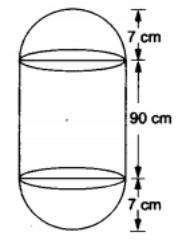
A solid is composed of a cylinder with hemispherical ends. If the whole length of the solid is 104 cm and the radius of each of the hemispherical ends is 7 cm , find the cost of polishing its surface at the rate of ₹ 10 per $dm ^2$.
Answer

Image

Radius of each hemispherical end $=7 cm$.
Height of each hemispherical part $=$ its radius $=7 cm$.
Height of the cylindrical part $=(104-2 \times 7) cm =90 cm$.
Area of surface to be polished $=2$ (curved surface area of the hemisphere) + (curved surface area of the cylinder) $=\left[2\left(2 \pi r^2\right)+2 \pi r h\right]$ sq units
$=\left[\left(4 \times \frac{22}{7} \times 7 \times 7\right)+\left(2 \times \frac{22}{7} \times 7 \times 90\right)\right] cm ^2$
$=(616+3960) cm ^2=4576 cm^2$
$=\left(\frac{4576}{10 \times 10}\right) dm^2=45.76 dm^2[\because 10 cm=1 dm]$
$\therefore$ cost of polishing the surface of the solid
= ₹ (45.76 × 10) = ₹ 457.60 .
View full question & answer
Question 55 Marks
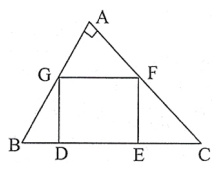
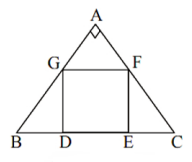
In Fig., $\text{DEFG}$ is a square in a triangle $\text{ABC}$ right angled at $A$ . Prove that
$i. \triangle AGF \sim \triangle DBG$
$ii. \triangle AGF \sim \triangle EFC$
Image
Answer
$GF \| DE\ (\text{DEFG}$ is square$)$
$\therefore \angle AGF=\angle ABC \ ($Corresponding angles$)$
$\therefore \angle A=\angle GDB=90^{\circ}$
$\therefore \angle AGF \sim \angle DBG \ ($By $AA$ similarity$)$
Again $\text{DEFG}$ being a square $\angle AFG =\angle ACB\  ($corresponding angles$)$
$\therefore \angle A=\angle CEF\ ($each $ 90^{\circ})$
$\angle AGF \sim \angle EFC\ ($By $AA$ similarity$)$
Image
View full question & answer
Question 65 Marks
Solve: $\frac{x-1}{2 x+1}+\frac{2 x+1}{x-1}=2, x \neq-\frac{1}{2}, 1$
Answer
Given
$\frac{x-1}{2 x+1}+\frac{2 x+1}{x-1}=0$
Let $\frac{x-1}{2 x+1}$ be $y$ so $\frac{2 x+1}{x-1}=\frac{1}{y}$
$\therefore$ Substituting this value
$y+\frac{1}{y}=2 \text { or } \frac{y^2+1}{y}=2$
or $y^2+1=2 y$
or $y^2-2 y+1=0$
$\text { or }(y-1)^2=0$
Putting $y=\frac{x-1}{2 x+1}$,
$\frac{x-1}{2 x+1}=1 \text { or } x-1=2 x+1$
$\text { or } x=-2$
View full question & answer
5 Marks Questions - Maths STD 10 Questions - Vidyadip