Questions

M.C.Q (1 Marks)

🎯

Test yourself on this topic

18 questions · timed · auto-graded

MCQ 11 Mark
The arithmetic mean of 1, 2, 3, 4, ..., n is:
  • A
    $\frac{n-1}{2}$
  • B
    $\frac{n(n+1)}{2}$
  • C
    $\frac{n}{2}$
  • $\frac{n+1}{2}$
Answer
Correct option: D.
$\frac{n+1}{2}$
(d) $\frac{n+1}{2}$
Explanation: According to question,
Arithmetic Mean $=\frac{1+2+3+\ldots+n}{n}$
$=\frac{\frac{n(n+1)}{2}}{n}$
$=\frac{n+1}{2}$
View full question & answer
MCQ 21 Mark
An unbiased die is thrown once. The probability of getting a composite number is
  • A
    $\frac{2}{5}$
  • $\frac{1}{3}$
  • C
    $\frac{2}{3}$
  • D
    $\frac{1}{2}$
Answer
Correct option: B.
$\frac{1}{3}$
(b) $\frac{1}{3}$
Explanation: Number of composite numbers on a dice $=\{4,6\}=2$
Number of possible outcomes $=2$
Number of Total outcomes $=6$
$\therefore$ Required Probability $=\frac{2}{6}=\frac{1}{3}$
View full question & answer
MCQ 31 Mark
If $P(E) = 0.05,$ what will be the probability of 'not $E\ '$?
  • A
    $0.55$
  • B
    $0.59$
  • $0.95$
  • D
    $0.095$
Answer
Correct option: C.
$0.95$
We know that
$P(E)+P(\text { not } E)=1$
$\therefore P(\text { not } E) =1-P(E)$
$ =1-0.05$
$ =0.95$
View full question & answer
MCQ 41 Mark
The length of an arc of a sector of angle $\theta^{\circ}$ of a circle with radius R is
  • A
    $\frac{\pi R^2 \theta}{180}$
  • B
    $\frac{\pi R^2 \theta}{360}$
  • $\frac{2 \pi R \theta}{360}$
  • D
    $\frac{2 \pi R \theta}{180}$
Answer
Correct option: C.
$\frac{2 \pi R \theta}{360}$
(c) $\frac{2 \pi R \theta}{360}$
Explanation: $\frac{2 \pi R \theta}{360}$
View full question & answer
MCQ 51 Mark
The length of the minute hand of a clock is $21 \ cm$. The area swept by the minute hand in $10$ minutes is
  • A
    $252 \ cm^2$
  • B
    $126 \ cm^2$
  • $231 \ cm^2$
  • D
    $210 \ cm^2$
Answer
Correct option: C.
$231 \ cm^2$
Explanation:
Area swept by minute hand in $60$ minutes $=\pi R^2$
Area swept by it in $10$ minutes
$=\left(\frac{\pi R^2}{60} \times 10\right) \ cm^2$
$=\left(\frac{22}{7} \times 21 \times 21 \times \frac{1}{6}\right) \ cm^2$
$=231 \ cm^2$
View full question & answer
MCQ 61 Mark
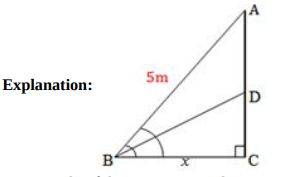
A vertical tower stands on a horizontal plane and is surmounted by a vertical flag staff of height $5 m$ . From a point on the plane the angles of elevation of the bottom and top of the flagstaff are respectively $30^{\circ}$ and $60^{\circ}$. The height of the tower is
  • A
    $10 m$
  • B
    $5 m$
  • $2.5 m$
  • D
    $2 m$
Answer
Correct option: C.
$2.5 m$
Image
Here Height of the tower $= CD = h$
meters, height of the flagstaff $= AD =5$
meters, angle of elevation of top of the tower $=\angle DBC =30^{\circ}$ and angle of elevation of the top of the flagstaff from ground $=\angle ABC=60^{\circ}$
Now, in triangle $\text{DBC},$
$\tan 30^{\circ}=\frac{h}{x}$
$\Rightarrow \frac{1}{\sqrt{3}}=\frac{h}{x}$
$ \Rightarrow x=h \sqrt{3} .....(i)$
And $\tan 60^{\circ}=\frac{h+5}{x}$
$\Rightarrow \sqrt{3}=\frac{h+5}{x}$
$\Rightarrow x=\frac{h+5}{\sqrt{3}} .....(ii)$
From eq. $(i)$ and $(ii),$ we get,
$h \sqrt{3}=\frac{h+5}{\sqrt{3}}$
$\Rightarrow 3 h=h+5$
$\Rightarrow 2 h=5$
$\Rightarrow h=2.5 $ meters 
View full question & answer
MCQ 71 Mark
$\cos ^2 30^{\circ} \cos ^2 45^{\circ}+4 \sec ^2 60^{\circ}+\frac{1}{2} \cos ^2 90^{\circ}-2 \tan ^2 60^{\circ}=$ ?
  • A
    $\frac{75}{8}$
  • B
    $\frac{73}{8}$
  • $\frac{83}{8}$
  • D
    $\frac{81}{8}$
Answer
Correct option: C.
$\frac{83}{8}$
$\cos ^2 30^{\circ} \cos ^2 45^{\circ}+4 \sec ^2 60^{\circ}+\frac{1}{2} \cos ^2 90^{\circ}-2 \tan ^2 60^{\circ}$
$=\left(\frac{\sqrt{3}}{2}\right)^2 \cdot\left(\frac{1}{\sqrt{2}}\right)^2+\left(4 \times 2^2\right)+\left(\frac{1}{2} \times 0^2\right)-2 \times(\sqrt{3})^2$
$=\left(\frac{3}{4} \times \frac{1}{2}\right)+16+0-6$
$=\frac{3}{8}+10$
$=\frac{83}{8}$
View full question & answer
MCQ 81 Mark
$1+\frac{\cot ^2 \alpha}{1+\cos e c \alpha}=$
  • A
    $\sin \alpha$
  • B
    $\sec \alpha$
  • $\operatorname{cosec} \alpha$
  • D
    $\tan \alpha$
Answer
Correct option: C.
$\operatorname{cosec} \alpha$
$\text { Explanation: } 1+\frac{\cot ^2 \alpha}{1+\operatorname{cosec} \alpha}$
$=1+\frac{\operatorname{cosece}^2 \alpha-1}{1+\cos e c \alpha}$
$=1+\frac{(\operatorname{csec} \alpha-1)(\operatorname{cosec} \alpha+1)}{1+\operatorname{cosec} \alpha}$
$=1+\operatorname{cosec} \alpha-1$
$=\operatorname{cosec} \alpha$
View full question & answer
MCQ 91 Mark
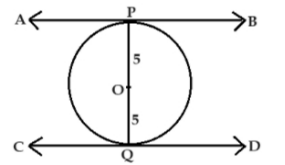
AB and CD are two parallel tangents to a circle of radius 5 cm. The distance between the tangents is
  • A
    5 cm
  • B
    $\sqrt{50} cm$
  • C
    $2 \sqrt{5} cm$
  • 10 cm
Answer
Correct option: D.
10 cm
(d) 10 cm
Explanation: AB and CD are two parallel tangent to a circle
$AB \| CD$
and $OP \perp AB$
$OQ \perp CD$
By fig clear that distance between two tangent is $OP + OQ$
ie. $5+5=10 cm$.
Image
View full question & answer
MCQ 101 Mark
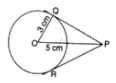
In the given figure, if $OQ = 3 \ cm, OP = 5 m,$ then the length of $PR$ is
Image
  • $4 \ cm$
  • B
    $3 \ cm$
  • C
    $5 \ cm$
  • D
    $6 \ cm$
Answer
Correct option: A.
$4 \ cm$
Explanation:
Here $\angle Q =90^{\circ} \ [$Angle between tangent and radius through the point of contact$]$
Now, in right angled triangle $\text{OPQ},$
$OP^2=OQ^2+PQ^2$
$\Rightarrow(5)^2=(3)^2+PQ^2$
$\Rightarrow PQ^2=25-9=16$
$\Rightarrow PQ=4 \ cm$
But $PQ = PR \ [$Tangents from one point to a circle are equal$]$
Therefore, $PR =4 \ cm$
View full question & answer
MCQ 111 Mark
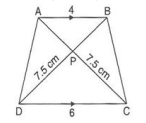
In the given figure, if $A B \| D C,$ then $A P$ is equal to
Image
  • $5 \ cm$.
  • B
    $7 \ cm.$
  • C
    $6 \ cm.$
  • D
    $5.5 \ cm.$
Answer
Correct option: A.
$5 \ cm$.
Explanation :
In triangles $\text{APB}$ and $\text{CPD},$
$\angle APB=\angle CPD\ [$ Vertically opposite angles$] $
$ \angle BAP=\angle ACD \ [$Alternate angles as $ A B \| C D]$
$\therefore \Delta APB \sim \Delta \text{CPD}\ [AA $ similarity$]$
$\therefore \frac{AB}{CD}=\frac{CP}{AP}$
$\Rightarrow \frac{4}{6}=\frac{AP}{7.5}$
$\Rightarrow AP=\frac{7.5 \times 4}{6}=5 \ cm$
View full question & answer
MCQ 121 Mark
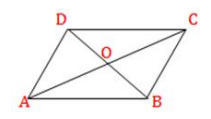
Three consecutive vertices of a parallelogram ABCD are A(1, 2), B(1, 0) and C(4, 0). The co – ordinates of the fourth vertex D are
  • A
    $(-4,2)$
  • B
    $(4,-2)$
  • $(4,2)$
  • D
    $(-4,-2)$
Answer
Correct option: C.
$(4,2)$
(c) $(4,2)$
Explanation: Coordinates are given for $A (1,2), B (1,0)$ and $C (4,0)$ Let coordinates of D be $( x , y )$.
Since diagonals of a parallelogram bisect each other. at point $O$
Therefore O is the midpoint of diagonal AC
Therefore, coordinates of O will be $\left(\frac{1+4}{2}, \frac{2+0}{2}\right)=\left(\frac{5}{2}, 1\right)$
O is also the midpoint of diagonal BD
$\therefore \frac{x+1}{2}=\frac{5}{2} \Rightarrow x=4$
And $\frac{y+0}{2}=1 \Rightarrow y=2$ Therefore, the required coordinates are $(4,2)$.
Image
View full question & answer
MCQ 131 Mark
  • A
    12 units
  • 5 units
  • C
    6 units
  • D
    10 units
Answer
Correct option: B.
5 units
(b) 5 units
Explanation: According to question,
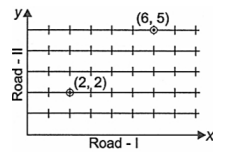
Coordinates of Chaitanya's house are $(6,5)$
Coordinates of Hamida's house are (2, 2)
$\therefore$ Shortest distance between their houses
$=\sqrt{(6-2)^2+(5-2)^2}=5 \text { units. }$
View full question & answer
MCQ 141 Mark
The common difference of the AP $\frac{1}{p}, \frac{1-p}{p}, \frac{1-2 p}{p}, \ldots$ is
  • $-1$
  • B
    $-\frac{1}{p}$
  • C
    1
  • D
    $\frac{1}{p}$
Answer
Correct option: A.
$-1$
(a) -1
Explanation: $d=\left\{\frac{1-p}{p}-\frac{1}{p}\right\}=\left(\frac{1-p-1}{p}\right)=\frac{-p}{p}=-1$.
View full question & answer
MCQ 151 Mark
If $y=1$ is a common root of the equations $a y^2+a y+3=0$ and $y^2+y+b=0$, then ab equals
  • $3$
  • B
    $-3$
  • C
    $6$
  • D
    $-7 / 2$
Answer
Correct option: A.
$3$
Here it is given that $y =1$ is a common root, so we have;
$a y^2+a y+3=0$
$\therefore a \times(1)^2+a(1)+3=0$
$a+a+3=0 \Rightarrow 2 a=-3$
$\Rightarrow a=\frac{-3}{2}$
and $y^2+y+b=0$
$(1)^2+(1)+b=0 \Rightarrow 1+1+b=0$
$\Rightarrow 2+b=0$
$\therefore b=-2$
$a b=\frac{-3}{2} \times(-2)=3$
View full question & answer
MCQ 161 Mark
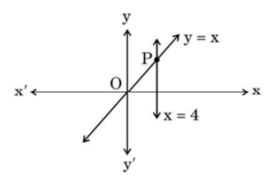
The lines represented by the linear equations y = x and x = 4 intersect at P. The coordinates of the point P are:
Image
  • $(4,4)$
  • B
    $(-4,4)$
  • C
    $(0,4)$
  • D
    $(4,0)$
Answer
Correct option: A.
$(4,4)$
(a) (4, 4)
Explanation: (4, 4)
View full question & answer
MCQ 171 Mark
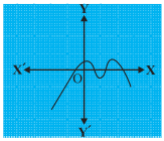
Find the number of zeroes of p(x) in the figure given below.
Image
  • A
    2
  • 4
  • C
    3
  • D
    1
Answer
Correct option: B.
4
(b) 4
Explanation: The number of zeroes is 4. as the graph intersect the x-axis at four point
View full question & answer
MCQ 181 Mark
The sum of the exponents of the prime factors in the prime factorisation of $196,$ is
  • A
    $5$
  • B
    $3$
  • $4$
  • D
    $2$
Answer
Correct option: C.
$4$
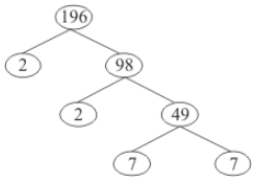
Using the factor tree for prime factorisation, we have:

Image
Therefore,
$196=2 \times 2 \times 7 \times 7$
$196=2^2 \times 7^2$
The exponents of $2$ and $7 $are $2$ and$ 2$ respectively.
Thus the sum of the exponents is $4 .$
View full question & answer
M.C.Q (1 Marks) - Maths STD 10 Questions - Vidyadip