Questions

M.C.Q (1 Marks)

Take a timed test

18 questions · auto-graded multiple-choice test.

MCQ 11 Mark
The mean and median of a statistical data are $21$ and $23$ respectively. The mode of the data is:
  • $27$
  • B
    $23$
  • C
    $22$
  • D
    $17$
Answer
Correct option: A.
$27$
We know that
$3 \text { Median }=\text { Mode }+2 \text { Mean }$
$3 \times 23=\text { Mode }+2 \times 21$
$69-42=\text { Mode }$
$\text { Mode }=27$
View full question & answer
MCQ 21 Mark
A card is drawn at random from a pack of 52 cards. The probability that the card is drawn is a black king.
  • A
    $\frac{11}{13}$
  • B
    $\frac{3}{13}$
  • $\frac{1}{26}$
  • D
    $\frac{1}{52}$
Answer
Correct option: C.
$\frac{1}{26}$
(c) $\frac{1}{26}$
Explanation : Total number of outcomes $=52$
Favourable outcomes, in this case, $=2$ \{2 black kings $\}$
$\therefore P \text { (black king) }=\frac{\text { Favourable outcomes }}{\text { Total outcomes }}=\frac{2}{52}=\frac{1}{26}$
View full question & answer
MCQ 31 Mark
A coin is tossed thrice. The probability of getting at least two tails is
  • A
    $\frac{4}{5}$
  • B
    $\frac{2}{3}$
  • C
    $\frac{1}{4}$
  • $\frac{1}{2}$
Answer
Correct option: D.
$\frac{1}{2}$
(d) $\frac{1}{2}$
Explanation : Total outcomes $==\{$ HHH, TTT, HHT, HTH, HTT, THH, THT, TTH $\}=8$
Number of possible outcomes (at least two tails) $=4$
$\therefore$ Required Probability $=\frac{4}{8}=\frac{1}{2}$
View full question & answer
MCQ 41 Mark
If the area of a sector of a circle is $\frac{7}{20}$ of the area of the circle, then the angle at the centre is equal to
  • A
    $110^{\circ}$
  • B
    $100^{\circ}$
  • C
    $130^{\circ}$
  • $126^{\circ}$
Answer
Correct option: D.
$126^{\circ}$
We have given that area of the sector is $\frac{7}{20}$ of the area of the circle.
Therefore, area of the sector $=\frac{7}{20} \times$ area of the circle
$\therefore \frac{\theta}{360} \times \pi r^2=\frac{7}{20} \times \pi r^2$
Now we will simplify the equation as below,
$\frac{\theta}{360}=\frac{7}{20}$
Now we will multiply both sides of the equation by $360 ,$
$\therefore \theta=\frac{7}{20} \times 360$
$\therefore \theta=126$
Therefore, sector angle is $126^{\circ}$.
View full question & answer
MCQ 51 Mark
A piece of wire $20 \ cm$ long is bent into the form of an arc of a circle subtending an angle of $60^{\circ}$ at its centre. The radius of the circle is
  • A
    $\frac{20}{6+\pi} cm$
  • B
    $\frac{30}{6+\pi} cm$
  • $\frac{60}{\pi} cm$
  • D
    $\frac{15}{6+\pi} cm$
Answer
Correct option: C.
$\frac{60}{\pi} cm$
Given: Length of arc $=20 \ cm$
$\Rightarrow \frac{\theta}{360^{\circ}} \times 2 \pi r=20$
$\Rightarrow \frac{60^{\circ}}{360^{\circ}} \times 2 \pi r=20$
$\Rightarrow \frac{\pi r}{3}=20$
$\Rightarrow r\left(\frac{\pi}{3}\right)=20$
$\Rightarrow r=\frac{60}{\pi} \ cm$
View full question & answer
MCQ 61 Mark
A pole $6 m$ high casts a shadow $2 \sqrt{3} m$ long on the ground, then the sun's elevation is
  • A
    $30^{\circ}$
  • $60^{\circ}$
  • C
    $45^{\circ}$
  • D
    $90^{\circ}$
Answer
Correct option: B.
$60^{\circ}$
Let height $=6 m$
length of shadow $=2 \sqrt{3 m}$
$\theta$ is angle of elevation
$\tan \theta=\text { (height) } / \text { (shadow length) }$
$=\frac{6}{2} \sqrt{3}=\sqrt{3}$
$\theta=\frac{\pi}{3}$
Angle of inclination is $=60^{\circ}$
View full question & answer
MCQ 71 Mark
If $2 \cos \theta=1$, then the value of $\theta$ is
  • $60^{\circ}$
  • B
    $30^{\circ}$
  • C
    $45^{\circ}$
  • D
    $90^{\circ}$
Answer
Correct option: A.
$60^{\circ}$
(a) $60^{\circ}$
Explanation: $60^{\circ}$
View full question & answer
MCQ 81 Mark
$\sqrt{\frac{1+\cos A}{1-\cos A}}=?$
  • A
    cosec A - cot A
  • B
    $-\operatorname{cosec} A \cot A$
  • $\operatorname{cosec} A+\cot A$
  • D
    $\operatorname{cosec} A \cot A$
Answer
Correct option: C.
$\operatorname{cosec} A+\cot A$
(c) $\operatorname{cosec} A +\cot A$
Explanation : $\sqrt{\frac{1+\cos A}{1-\cos A}}=\sqrt{\frac{(1+\cos A)}{(1-\cos A)} \times \frac{(1+\cos A)}{(1+\cos A)}}=\frac{(1+\cos A)}{\sqrt{1-\cos ^2 A}}=\frac{(1+\cos A)}{\sqrt{\sin ^2 A}}$
$=\frac{(1+\cos A)}{\sin A}=\left(\frac{1}{\sin A}+\frac{\cos A}{\sin A}\right)=(\operatorname{cosec} A+\cot A)$
View full question & answer
MCQ 91 Mark
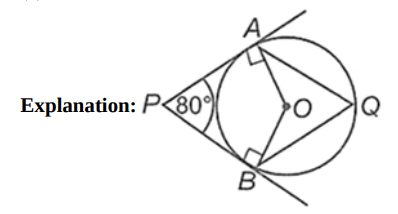
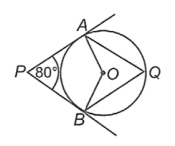
In the given figure, $O$ is the centre of the circle. If $PA$ and $PB$ are tangents, then the value of $\angle AQB$ is
Image
  • A
    $80^{\circ}$
  • B
    $60^{\circ}$
  • $50^{\circ}$
  • D
    $100^{\circ}$
Answer
Correct option: C.
$50^{\circ}$
Image
Since, $PA$ and $PB$ are tangents.
Also, tangent is perpendicular to radius at the point of contact.
$\therefore \angle PAO=90^{\circ} $ and $ \angle PBO=90^{\circ}$
In quadrilateral $\text{APBO};$
$\angle APB+\angle PAO+\angle PBO+\angle AOB=360^{\circ}$
$80^{\circ}+90^{\circ}+90^{\circ}+\angle AOB =360^{\circ}$
$\Rightarrow \angle AOB =100^{\circ} $
$\Rightarrow \angle AQB =\frac{1}{2}\ \angle AOB =50^{\circ}$
View full question & answer
MCQ 101 Mark
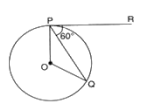
If $O$ is the centre of a circle, $PQ$ is a chord and tangent $PR$ at $P$ makes an angle of $60^{\circ}$ with PQ , then $\angle POQ$ is equal to
Image
  • A
    $110^{\circ}$
  • $120^{\circ}$
  • C
    $100^{\circ}$
  • D
    $90^{\circ}$
Answer
Correct option: B.
$120^{\circ}$
Here $\angle RPO =90^{\circ}$
$\angle RPQ =60^{\circ}$ (given)
$\therefore \angle OPQ =90^{\circ}-60^{\circ}=30^{\circ} \angle PQO =30^{\circ}$ Also$ [$Opposite angles of equal radii] Now, In triangle $OPQ,$
$\angle OPQ+\angle PQO+\angle QOP=180^{\circ}$
$\Rightarrow 30^{\circ}+30^{\circ}+\angle QOP=180^{\circ}$
$\Rightarrow \angle QOP=120^{\circ}$
View full question & answer
MCQ 111 Mark
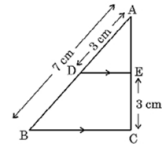
In the given figure, $DE\|BC$. If $AD = 3 \ cm, AB = 7 \ cm$ and $EC = 3 \ cm,$ then the length of $AE$ is
Image
  • A
    $4 \ cm$
  • $2.25 \ cm$
  • C
    $2 \ cm$
  • D
    $3.5 \ cm$
Answer
Correct option: B.
$2.25 \ cm$
Given, $AD =3 \ cm, AB =7 \ cm, EC =3 \ cm$.
Let $AE = x \ cm$
$\therefore A C=A E+E C=x+3 \ cm$
As we know that
$\frac{A D}{A B}=\frac{A E}{A C}$
$\Rightarrow \frac{3}{7}=\frac{x}{x+3}$
$\Rightarrow 3(x+3)=7 x$
$\Rightarrow 3 x+9=7 x$
$\Rightarrow 7 x-3 x=9$
$\Rightarrow 4 x=9$
$\Rightarrow x=\frac{9}{4}=2.25 \ cm$
$\therefore$ length of $AE =2.25 \ cm$
View full question & answer
MCQ 121 Mark
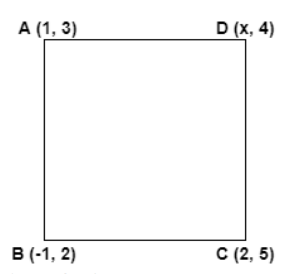
If $A(1,3), B(-1,2), C(2,5)$ and $D(x, 4)$ are the vertices of a $\| g m \text{ABCD}$ then the value of $x$ is
  • A
    $0$
  • B
    $3$
  • C
    $\frac{3}{2}$
  • $4$
Answer
Correct option: D.
$4$
Image
Since $\text{ABCD}$ is a $\| g m$, the diagonals bisect eachother.
so $M$ is the mid$-$point of $BD$ as well as $AC$.
$\frac{1+2}{2}=\frac{x-1}{2}$
$1+2=x-1$
$x=4$
View full question & answer
MCQ 131 Mark
The distance of the point $(5, 0)$ from the origin is
  • A
    $5^2$
  • $5$
  • C
    $0$
  • D
    $\sqrt{5}$
Answer
Correct option: B.
$5$
Distance from origin $=\sqrt{(5-0)^2-(0-0)^2}$
$=\sqrt{25}$
$=5 \text { units }$
View full question & answer
MCQ 141 Mark
The next term of the $A.P. \sqrt{18}, \sqrt{32}$ and $\sqrt{50}$ is
  • $\sqrt{72}$
  • B
    $\sqrt{84}$
  • C
    $\sqrt{64}$
  • D
    $\sqrt{80}$
Answer
Correct option: A.
$\sqrt{72}$
Given: $\sqrt{18}, \sqrt{32}, \sqrt{50}$
$\Rightarrow 3 \sqrt{2}, 4 \sqrt{2}, 5 \sqrt{2}$
$\therefore d=4 \sqrt{2}-3 \sqrt{2}=\sqrt{2}$
Therefore, next term is $5 \sqrt{2}+\sqrt{2}$
$=6 \sqrt{2}$
$=\sqrt{72}$
View full question & answer
MCQ 151 Mark
The values of $k$ for which the quadratic equation $16 x ^2+4 kx +9=0$ has real and equal roots are
  • $6,-6$
  • B
    $\frac{3}{4},-\frac{3}{4}$
  • C
    36,-36
  • D
    $6,-\frac{1}{6}$
Answer
Correct option: A.
$6,-6$
Given equation is; $16 x ^2+4 kx +9=0$
Here $a =16, b=4 k , c =9$
Now $D=b^2-4 a c=(4 k)^2-4 \times 16 \times 9=16 k^2-576$
Roots are real and equal if $D=0$ i,e. $b ^2-4 ac =0$
$\Rightarrow 16 k^2-576=0$
$\Rightarrow k^2-36=0$
$\Rightarrow k^2=36=( \pm 6)^2$
$\Rightarrow k= \pm 6$
View full question & answer
MCQ 171 Mark
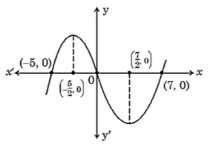
The graph of y = p(x) is given in the adjoining figure. Zeroes of the polynomial p(x) are
Image
  • A
    $-5, \frac{-5}{2}, \frac{7}{2}, 7$
  • B
    $-5,7$
  • $-5,0,7$
  • D
    $\frac{-5}{2}, \frac{-7}{2}$
Answer
Correct option: C.
$-5,0,7$
(c) $-5,0,7$
Explanation : The graph intersect the x -axis at three distinct Points $-5,0,7$. So, there are three zeroes of $P ( x )$ which are $-5,0$, 7.
View full question & answer
MCQ 181 Mark
If the $\text{HCF}$ of $65$ and $117$ is expressible in the form $65 m-117,$ then the value of  $' m\ '$  is
  • A
    $3$
  • B
    $1$
  • $2$
  • D
    $4$
Answer
Correct option: C.
$2$
Explanation :
First, find the $\text{HCF}$ of $65$ and $117$
$117=65 \times 1+52$
$65=52 \times 1+13$
$52=13 \times 4+0 \ ($ zero remainder$)$
Therefore $,\text{HCF} \ (117,65)$ is $13$
Now,
$\therefore 65 m-117=13$
$\Rightarrow 65 m=13+117$
$\Rightarrow 65 m=130$
$\Rightarrow m=2$
View full question & answer
M.C.Q (1 Marks) - Maths STD 10 Questions - Vidyadip