Questions

2 Marks Questions

🎯

Test yourself on this topic

7 questions · timed · auto-graded

Question 12 Marks
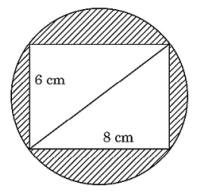
Reeti prepares a Rakhi for her brother Ronit. The Rakhi consists of a rectangle of length $8 \ cm$ and breadth $6 \ cm$ inscribed in a circle as shown in the figure. Find the area of the shaded region. $($Use $\pi=3 \cdot 14 )$​​​​​​​
Image
Answer
Diagonal of rectangle $=\sqrt{6^2+8^2}=10$
$\therefore$ Radius of circle $r =\frac{10}{2}=5$
Area of circle $=3.14 \times 5 \times 5=78.5$
Area of rectangle $=6 \times 8=48$
Area of shaded region $=78.5-48=30.5 \ cm^2$
$\therefore$ Area of shaded region is $30.5 \ cm^2$
View full question & answer
Question 22 Marks
Prove the trigonometric identity: $\sec ^4 \theta-\sec ^2 \theta=\tan ^4 \theta+\tan ^2 \theta$.
Answer
$\text { L.H.S }=\sec ^4 \theta-\sec ^2 \theta$
$=\sec ^2 \theta\left(\sec ^2 \theta-1\right)$
$=\sec ^2 \theta\left(\tan ^2 \theta\right)\left[\because 1+\tan ^2 \theta=\sec ^2 \theta \text { or } \tan ^2 \theta=\sec ^2 \theta-1\right]$
$=\left(1+\tan ^2 \theta\right) \tan ^2 \theta=\tan ^2 \theta+\tan ^4 \theta=\text { R.H.S }$
Hence proved.
View full question & answer
Question 32 Marks
Answer
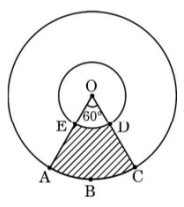
Area of sector $OABC =\frac{\pi \times 5^2 \times 60^{\circ}}{360^{\circ}}=\frac{25 \pi}{6} cm^2$
Area of sector $OED =\frac{\pi \times 2^2 \times 60^{\circ}}{360^{\circ}}=\frac{4 \pi}{6} cm^2$
Area of shaded region $=\frac{25 \pi}{6}-\frac{4 \pi}{6}=\frac{21}{6} \times \frac{22}{7}=11 cm^2$
View full question & answer
Question 42 Marks
If $\sin (A+B)=1$ and $\cos (A-B)=1$, find $A$ and $B$.
Answer
$\sin (A+B)=1=\sin 90^{\circ}$
$A+B=90^{\circ} \quad(1)$
$\cos (A-B)=1=\cos 0^{\circ}$
$\Rightarrow A-B=0^{\circ}(2)$
Solving $(1)$ and $(2)$ we get
$A=45^{\circ}, B=45^{\circ}$
View full question & answer
Question 52 Marks
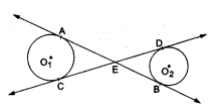
In the given figure, common tangents $\text{AB}$ and $\text{CD}$ to the two circles with centres $O _1$ and $O _2$ intersect at $E.$ Prove that $\text{AB=CD}$.
Image
Answer
We know that tangent segments to a circle from the same external point are congruent.
So, $\text{EA=EC}$ for the circle having centre $O _1$
And, $\text{ED=EB}$ for the circle having centre $O _2$
Now, Adding $\text{ED}$ on both sides in $\text{EA=EC}$, we get
$\text{EA+ED=EC+ED}$
$\Rightarrow \text{EA+EB=EC+ED}$
$\Rightarrow \text{AB=CD}$
View full question & answer
Question 62 Marks
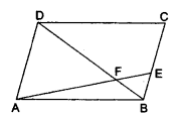
$\text{ABCD}$ is a parallelogram and $E$ is a point on $BC$ . If the diagonal $BD$ intersects $AE$ at $F$ , prove that
$A F \times F B=E F \times F D$
Image
Answer
Given: $\text{ABCD}$ is a parallelogram and $E$ is a point on $BC$ . The diagonal $BD$ intersects $AE$ at $F .$
To prove: $A F \times F B=E F \times F D$
Proof: Since ABCD is a parallelogram, then its opposite sides must be parallel.
$\therefore$ In $\triangle A D F$ and $\triangle E B F$
$\angle FDA =\angle EBF$ and $\angle F A D=\angle F E B$ [Alternate interior angles]
$\angle A F D=\angle B F E$ [vertically opposite angles]
Therefore,by $\text{AAA}$ criteria of similar triangles, we have,
$\triangle ADF=\triangle EBF$
Since the corresponding sides of similar triangles are proportional. Therefore,we have,
$\frac{A F}{F D}=\frac{E F}{F B}$
$\Rightarrow A F \times F B=E F \times F D$
View full question & answer
Question 72 Marks
Prove that $5 \sqrt{2}$ is irrational.
Answer
Let us assume that $5 \sqrt{2}$ is rational.
Then, there exist positive co$-$primes $a$ and $b$ such that
$5 \sqrt{2}=\frac{a}{b}$
$\sqrt{2}=\frac{a}{b}-5$
$\sqrt{2}=\frac{a-5 b}{b}$
As $a-5 b$ and $b$ are integers .
So, $\frac{a-5 b}{b}$ is rational number .
But $\sqrt{2}$ is not rational number.
Since a rational number cannot be equal to an irrational number.
Our assumption that $5 \sqrt{2}$ is rational wrong.
Hence, $5 \sqrt{2}$ is irrational.
View full question & answer
2 Marks Questions - Maths STD 10 Questions - Vidyadip