Questions

M.C.Q (1 Marks)

🎯

Test yourself on this topic

18 questions · timed · auto-graded

MCQ 11 Mark
Mean and median of some data are $32$ and $30$ respectively. Using empirical relation, mode of the data is:
  • A
    $36$
  • B
    $30$
  • C
    $20$
  • $26$
Answer
Correct option: D.
$26$
$\text { Explanation: mode }=3 \text { median }-2 \text { mean }$
$=3(30)-2(32)$
$=90-64$
$=26$
View full question & answer
MCQ 21 Mark
If three coins are tossed simultaneously, what is the probability of getting at most one tail?
  • A
    $\frac{3}{8}$
  • $\frac{5}{8}$
  • C
    $\frac{7}{8}$
  • D
    $\frac{4}{8}$
Answer
Correct option: B.
$\frac{5}{8}$
(B) $\frac{4}{8}$
Explanation:  Three coins are tossed together
Hence, Total outcomes $=\{$ HHH, HHT, HTH, THH, HTT, TTH, TTT, THT $\}=8$
Favourable outcomes of getting atmost one tail $= HHH$, HHT, HTH, THH $=4$
$
P(E)=\frac{(\text { Number of favourable outcomes })}{(\text { Numberof possible outcomes })}=\frac{4}{8}
$
View full question & answer
MCQ 31 Mark
A die is thrown once. Find the probability of getting a number less than 7.
  • A
    $\frac{1}{6}$
  • B
    $0$
  • C
    $\frac{5}{6}$
  • 1
Answer
Correct option: D.
1
(D) 1
Explanation:  1
View full question & answer
MCQ 41 Mark
The area of the sector of a circle of radius $10.5 \ cm$ is $69.3 \ cm^2$. Find the central angle of the sector.
  • A
    $85^\circ$
  • $72^\circ$
  • C
    $70^\circ$
  • D
    $26^\circ$
Answer
Correct option: B.
$72^\circ$
It is given that area of the sector $=69.3 \ cm^2$ and Radius $=10.5 \ cm$
Now, Area of the sector $=\frac{\pi r^2 \theta}{360}$
$\Rightarrow \frac{\pi \times(10.5)^2 \times \theta}{360}=69.3$
$\Rightarrow \theta=\frac{69.3 \times 360 \times 7}{10.5 \times 10.5 \times 22}=72^0$
Therefore, Central angle of the sector $=72^{\circ}$
View full question & answer
MCQ 51 Mark
The area of a sector of angle a (in degrees) of a circle with radius R is:
  • A
    $\frac{\alpha}{180} \times 2 \pi R$
  • B
    $\frac{\alpha}{180} \times \pi R^2$
  • C
    $\frac{\alpha}{360} \times 2 \pi R$
  • $\frac{\alpha}{360} \times \pi R^2$
Answer
Correct option: D.
$\frac{\alpha}{360} \times \pi R^2$
(D) $\frac{\alpha}{360} \times \pi R ^2$
Explanation: $\frac{\alpha}{360} \times \pi R ^2$
View full question & answer
MCQ 61 Mark
The shadow of a $5 m$ long stick is $2 m$ long. At the same time, the length of the shadow of a $12.5 m$ high tree is
  • A
    $3 m$
  • B
    $4.5 m$
  • C
    $3.5 m$
  • $5 m$
Answer
Correct option: D.
$5 m$
Ratio of lengths of objects $=$ ratio of lengths of their shadows.
Let the length of shadow of the tree be $x m$ .
Then,
$\frac{5}{12.5} = \frac{2}{x} $
$\Rightarrow 5 x = 2 \times 12.5=25$
$\Rightarrow x = 5$
View full question & answer
MCQ 71 Mark
If $\cos A=\frac{5}{8}$, then value of $\cot A \cdot \sin A$ is:
  • A
    $\frac{8}{5}$
  • $\frac{5}{8}$
  • C
    $\frac{8}{\sqrt{39}}$
  • D
    $\frac{5}{\sqrt{39}}$
Answer
Correct option: B.
$\frac{5}{8}$
(B) $\frac{5}{8}$
Explanation:  $\frac{5}{8}$
View full question & answer
MCQ 81 Mark
$\sec \theta$ when expressed in terms of $\cot \theta$, is equal to:
  • A
    $\frac{\sqrt{1-\cot ^2 \theta}}{\cot \theta}$
  • B
    $\frac{1+\cot ^2 \theta}{\cot \theta}$
  • $\frac{\sqrt{1+\cot ^2 \theta}}{\cot \theta}$
  • D
    $\sqrt{1+\cot ^2 \theta}$
Answer
Correct option: C.
$\frac{\sqrt{1+\cot ^2 \theta}}{\cot \theta}$
As we know that,
$\sec ^2 \theta=1+\tan ^2 \theta$
$\text { and } \cot \theta=\frac{1}{\tan \theta}$
$\Rightarrow \tan \theta=\frac{1}{\cot \theta}$
$\therefore \sec ^2 \theta=1+\left(\frac{1}{\cot \theta}\right)^2$
$=1+\frac{1}{\cot ^2 \theta}$
$\Rightarrow \sec ^2 \theta=\frac{\cot ^2 \theta+1}{\cot ^2 \theta}$
$\Rightarrow \sec \theta=\frac{\sqrt{1+\cot ^2 \theta}}{\cot \theta}$
View full question & answer
MCQ 91 Mark
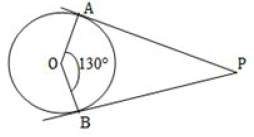
If angle between two radii of a circle is 130°, the angle between tangents at ends of radii is:
  • A
    70°
  • B
    90°
  • C
    60°
  • D
    50°
View full question & answer
MCQ 101 Mark
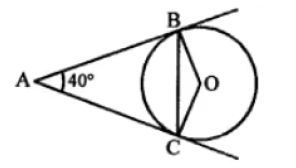
In the given figure, $A B$ and $A C$ are tangents to the circle with centre $O$ such that $\angle \text{B A C} =40^{\circ}$. Then $\angle \text{B O C}$ is equal to
Image
  • $140^\circ$
  • B
    $120^\circ$
  • C
    $80^\circ$
  • D
    $100^\circ$
Answer
Correct option: A.
$140^\circ$
In the given figure$, AB$ and $AC$ are tangents to the circle with centre $O$ such that $\angle \text{BAC} =40^{\circ}, \angle \text{BOC} = ?$
$A B$ and $A C$ are tangents and $O B$ and $O C$ are radii.
$OB \perp AB$ and $OC \perp AC$
$\Rightarrow \angle \text{OBA} =90^{\circ}$ and $\angle \text{OCA} =90^{\circ}$
In quadrilateral $\text{BOCA}$, Angle sum of all angles $=360^{\circ}=\angle \text{OBA} +\angle \text{OCA} =180$
Hence,
$\Rightarrow 40^{\circ}+\angle \text{BOC}=180^{\circ}$
$\Rightarrow \angle \text{BOC}=180^{\circ}-40^{\circ}=140^{\circ}$
View full question & answer
MCQ 111 Mark
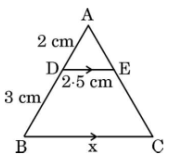
In the given figure, $AD =2 \ cm, DB =3 \ cm, DE =2.5 \ cm$ and $\ce{DE \| BC}$. The value of $x$ is:
Image
  • A
    $7.5 \ cm$
  • B
    $3.75 \ cm$
  • $6.25 \ cm$
  • D
    $6 \ cm$
Answer
Correct option: C.
$6.25 \ cm$
In $\triangle \text{ADE}$ and $\triangle \text{ABC}$
$\angle D =\angle B \{$Corresponding angle $\}$
$\angle E =\angle C \{$Corresponding angle $\}$
$\therefore \triangle \text{ADE}$ and $\triangle \text{ABC} ($by $\text{AA}$ Similarity$)$
$\frac{AD}{AB}=\frac{DE}{BC}$
$\frac{2}{5}=\frac{2.5}{X}$
$X=\frac{5 \times 2.5}{2}$
$=\frac{12.5}{2}$
$=6.25 \ cm$
View full question & answer
MCQ 121 Mark
$x-$ axis divides the line segment joining $A(2, -3)$ and $B(5, 6)$ in the ratio:
  • A
    $2:1$
  • B
    $2:3$
  • C
    $3:5$
  • $1:2$
Answer
Correct option: D.
$1:2$
Let the ratio is $k : 1$
So the coordinate of the point are
$\left[\left(\frac{5 k+2}{k+1}\right),\left(\frac{6 k-3}{k+1}\right)\right]$
Since the point lies on $x-$axis, it's $y$ coordinate will be $0$
Comparing the coordinates
$\frac{6 k-3}{k+1}=0$
$6 k-3=0$
$6 k=3$
$k=\frac{1}{2}$
Required ratio is
$=\frac{1}{2}: 1$
$=1: 2$
View full question & answer
MCQ 131 Mark
The distance between the points $(3, -2)$ and $(-3, 2)$ is:
  • A
    $40$
  • B
    $4 \sqrt{10}$
  • C
    $2 \sqrt{10}$
  • $\sqrt{52}$
Answer
Correct option: D.
$\sqrt{52}$
Let us take $(3,-2)$ and $(-3,2)$ as $\left( x _1, y _1\right)$ and $\left( x _2, y _2\right)$
Using distance formjula, $d =\sqrt{\left(x_2-x_1\right)^2+\left(y_2-y_1\right)^2}$
$d=\sqrt{(-3-3)^2+(2-(-2))^2}$
$d=\sqrt{(-6)^2+(2+2)^2}$
$d=\sqrt{36+(4)^2}$
$d=\sqrt{36+16}$
$d=\sqrt{52}$
View full question & answer
MCQ 141 Mark
The number of terms of an AP 5, 9, 13,………..185 is
  • A
    41
  • B
    51
  • C
    31
  • 46
Answer
Correct option: D.
46
(D) 46
Explanation: $n ^{\text {th }}$ term of an $AP , a _{ n }= a +( n -1) d$
$
5+(n-1) 4=185
$
Hence, $n =46$
Therefore number of terms are 46
View full question & answer
MCQ 151 Mark
The length of a rectangular field exceeds its breadth by $8\  m$ and the area of the field is $240\  m^2.$ The breadth of the field is
  • A
    $16\  m$
  • B
    $30\  m$
  • $12\  m$
  • D
    $20\  m$
Answer
Correct option: C.
$12\  m$
Let the breadth of the rectangular field be $x m$
Therefore Length of the rectangular field $=(x+8) m$
Area of the rectangular field $=240 m^2 ($Given$)$
$\therefore(x+8) \times x=240$ Area $=$ Length $\times$ Breadth
$\Rightarrow x^2+8 x-240=0$
$\Rightarrow x(x+20)-12(x+20)=0$
$\Rightarrow(x+20)(x-12)=0$
$\Rightarrow x+20=0 \text { or } x-12=0$
$\Rightarrow x=-20 \text { or } x=12$
$\therefore x=12$ Breadth cannot be negative
Thus the breadth of the field is $12\ m$.
View full question & answer
MCQ 161 Mark
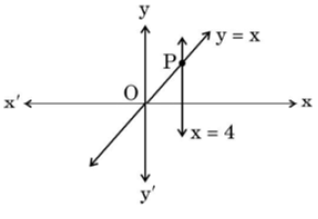
The lines represented by the linear equations y = x and x = 4 intersect at P. The coordinates of the point P are:
Image
  • (4, 4)
  • B
    (-4, 4)
  • C
    (0, 4)
  • D
    (4, 0)
Answer
Correct option: A.
(4, 4)
(A) (4, 4)
Explanation: (4, 4)
View full question & answer
MCQ 171 Mark
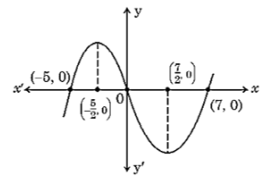
The graph of y = p(x) is given in the adjoining figure. Zeroes of the polynomial p(x) are
Image
  • A
    $-5, \frac{-5}{2}, \frac{7}{2}, 7$
  • B
    $-5,7$
  • $-5,0,7$
  • D
    $\frac{-5}{2}, \frac{-7}{2}$
Answer
Correct option: C.
$-5,0,7$
(C) -5, 0, 7
Explanation:  The graph intersect the x-axis at three distinct Points -5, 0, 7. So, there are three zeroes of P(x) which are -5, 0, 7.
View full question & answer
MCQ 181 Mark
The ratio of HCF to LCM of the least composite number and the least prime number is:
  • A
    1:1
  • B
    2:1
  • 1:2
  • D
    1:3
Answer
Correct option: C.
1:2
(C) 1:2
Explanation: Least composite number is 4 and the least prime number is 2.
LCM (4, 2) = 4
HCF (4, 2) = 2
The ratio of HCF to LCM 2:4 or 1:2.
View full question & answer
M.C.Q (1 Marks) - Maths STD 10 Questions - Vidyadip