Questions

M.C.Q (1 Marks)

Take a timed test

41 questions · auto-graded multiple-choice test.

MCQ 11 Mark
If two different dice are rolled together, the probability of getting an even number on both dice, is:
  • A
    $\frac{1}{36}$
  • B
    $\frac{1}{2}$
  • C
    $\frac{1}{6}$
  • $\frac{1}{4}$
Answer
Correct option: D.
$\frac{1}{4}$
Possible outcomes on rolling the two dice are given below:
$(1,1),(1,2),(1,3),(1,4),(1,5),(1,6)$
$(2,1),(2,2),(2,3),(2,4),(2,5),(2,6)$
$(3,1),(3,2),(3,3),(3,4),(3,5),(3,6)$
$(4,1),(4,2),(4,3),(4,4),(4,5),(4,6)$
$(5,1),(5,2),(5,3),(5,4),(5,5),(5,6)$
$(6,1),(6,2),(6,3),(6,4),(6,5),(6,6)$
Total number of outcomes $=36$
Favorable outcomes are given below:
$\{(2,2),(2,4),(2,6),(4,2),(4,4),(4,6),(6,2),(6,4),(6,6)\}$
Total number of favourable outcomes $=9$
$\therefore$ Probability of getting an even number on both dice
$=\frac{\text { Total number of favourable outcomes }}{\text { Total possible outcomes }}$
$=\frac{9}{36}$
$=\frac{1}{4}$
Hence, the correct option is $(d).$
View full question & answer
MCQ 21 Mark
A number is selected at random from the numbers $1$ to $30 .$ The probability that it is a prime number is:
  • A
    $\frac{2}{3}$
  • B
    $\frac{1}{6}$
  • $\frac{1}{3}$
  • D
    $\frac{11}{30}$
Answer
Correct option: C.
$\frac{1}{3}$
Total number of possible outcomes $=30$
Prime numbers between $1$ to $30$ are $2,3,5,7,11$, $13,17,19,23$ and $29.$
Total number of favourable outcomes $=10$
Probability of selecting a prime number from $1$ to $30$
$=\frac{\text { Total number of favourable outcomes }}{\text { Total possible outcomes }}$
$=\frac{10}{30}$
$=\frac{1}{3}$
Hence, the correct option is $(c).$
View full question & answer
MCQ 31 Mark
The probability that a number selected at random from the numbers $1,2,3, \ldots \ldots . ., 15$ is a multiple of $4 ,$ is
  • A
    $\frac{4}{15}$
  • B
    $\frac{2}{15}$
  • $\frac{1}{5}$
  • D
    $\frac{1}{3}$
Answer
Correct option: C.
$\frac{1}{5}$
It is given that the numbers are from $1$ to $15.$
Total possibilities $=15$
Out of the first $15$ numbers chosen, multiples of $4$ are $4, 8, 12$
Favorable outcomes $=3$
The probability that a number selected at random
from the numbers $1,2,3, \ldots, 15$ is a multiple of $4 ,$
$P(E)=\frac{\text { Number of favourable outcomes }}{\text { Total number of possible outcomes }}$
$=\frac{3}{15}$
$=\frac{1}{5}$
Thus the correct answer is $(c).$
View full question & answer
MCQ 41 Mark
In a family of 3 children, the probability of having at least one boy is
  • $\frac{7}{8}$
  • B
    $\frac{1}{8}$
  • C
    $\frac{5}{8}$
  • D
    $\frac{3}{4}$
Answer
Correct option: A.
$\frac{7}{8}$
(a)
Probability of having a boy child is $\frac{1}{2}$
Probability of having a girl child is $\frac{1}{2}$
Probability of having no boy in the family
$
=\frac{1}{2} \times \frac{1}{2} \times \frac{1}{2}=\frac{1}{8}
$
Thus, the probability of having at least 1 boy
$
=1-\frac{1}{8}=\frac{8-1}{8}=\frac{7}{8}
$
The correct answer is (a).
View full question & answer
MCQ 51 Mark
A box contains dises, numbered from $1$ to $90 .$ If one disc is drawn at random from the box, the probability that it bears a prime$-$number less than $23 ,$ is:
  • A
    $\frac{7}{90}$
  • B
    $\frac{10}{90}$
  • $\frac{4}{45}$
  • D
    $\frac{9}{89}$
Answer
Correct option: C.
$\frac{4}{45}$
There are $90$ discs in the box and one disc is drawn at random.
So, the total number of possible outcomes $=90$
Prime numbers less than $23$ are $2,3,5,7,11,13, 17$ and $19.$
$\therefore$ Number of favourable outcomes $=8$
$\therefore$ Probability of getting a prime numbers less than $23$
$P(E)=\frac{\text { Number of favourable outcomes }}{\text { Total number of possible outcomes }}$
$\Rightarrow P(E)=\frac{8}{90}$
$=\frac{4}{45}$
Thus the probability of getting a disc with prime number less than $23$ is $\frac{4}{45}$
Hence the correct answer is $(c).$
View full question & answer
MCQ 61 Mark
The probability of getting an even number, when a die is thrown once, is:
  • $\frac{1}{2}$
  • B
    $\frac{1}{3}$
  • C
    $\frac{1}{6}$
  • D
    $\frac{5}{6}$
Answer
Correct option: A.
$\frac{1}{2}$
In an event of throwing a die, Total number of possible outcomes $=6$
In a die, even numbers are $2,4$ and $6$
Thus, number of favourable outcomes $=3$
$\therefore$ Probability of getting an even number
$P(E)=\frac{\text { Number of favourable outcomes }}{\text { Total number of possible outcomes }}$
$\Rightarrow P(E)=\frac{3}{6}$
$=\frac{1}{2}$
Thus the probability of getting an even number, when a die is thrown once is $\frac{1}{2}$
Hence the correct option is $(a).$
View full question & answer
MCQ 71 Mark
Cards bearing numbers $2,3,4 \ldots 11$ are kept in a bag. A card is drawn at random from the bag. The probability of getting a card with a prime number is
  • $\frac{1}{2}$
  • B
    $\frac{2}{5}$
  • C
    $\frac{3}{10}$
  • D
    $\frac{5}{9}$
Answer
Correct option: A.
$\frac{1}{2}$
Total cards in the bag $=2,3,4, \ldots ., 11=10$
The cards bearing prime numbers
$=2,3,5,7,11=5$
Therefore, the probability of getting a card with a prime number
$=\frac{\text { Number of cards bearing prime numbers }}{\text { Total number of cards }}$
$=\frac{5}{10}$
$=\frac{1}{2}$
Hence, the correct option is $(a).$
View full question & answer
MCQ 81 Mark
Which of the following cannot be the probability of an event?
  • 1.5
  • B
    $\frac{3}{5}$
  • C
    $25 \%$
  • D
    0.3
Answer
Correct option: A.
1.5
(a)
Let E be any event and $P(E)$ be the probability of the happening of that event.
The value of $P(E)$ will lie in the range $0 \leq P(E) \leq 1$ Therefore, its value can never be greater than 1. Hence, the correct option is (a).
View full question & answer
MCQ 91 Mark
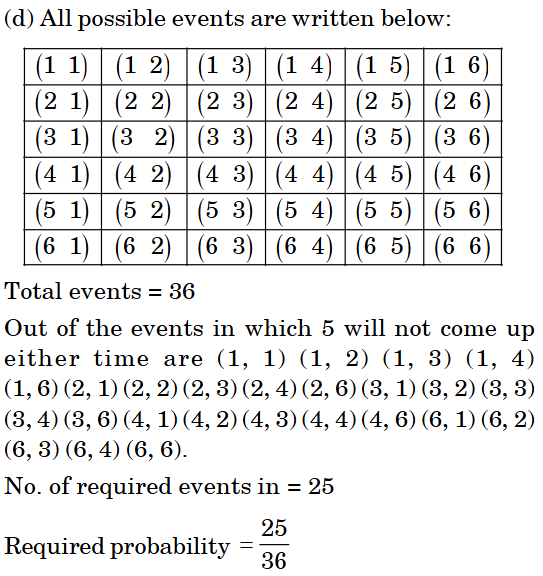
A dice is rolled twice. The probability that 5 will not come up either time is
  • A
    $\frac{11}{36}$
  • B
    $\frac{1}{3}$
  • C
    $\frac{13}{36}$
  • $\frac{25}{36}$
Answer
Correct option: D.
$\frac{25}{36}$
(d)
Image
View full question & answer
MCQ 101 Mark
Which of the following cannot be the probability of an event?
  • A
    0.01
  • B
    $3 \%$
  • C
    $\frac{16}{17}$
  • $\frac{17}{16}$
Answer
Correct option: D.
$\frac{17}{16}$
(d)
Probability of an event is always a proper fraction.
Also, $0 \leq P ( E ) \leq 1$
But $\frac{17}{16}>1$
Therefore, $\frac{17}{16}$ can never be probability of any event.
View full question & answer
MCQ 111 Mark
The probability that the drawn card from a pack of 52 cards is neither an ace nor a spade is
  • $\frac{9}{13}$
  • B
    $\frac{35}{52}$
  • C
    $\frac{10}{13}$
  • D
    $\frac{19}{26}$
Answer
Correct option: A.
$\frac{9}{13}$
(a)
Total ace cards = 4
and total spade cards$=13-1=12$ (One card among aces is also a spade)
Cards which are neither ace or spade
$
\begin{aligned}
& =52-16=36 \\
\text { Required probability } & =\frac{36}{52}=\frac{9}{13}
\end{aligned}
$
View full question & answer
MCQ 121 Mark
For an event $E , P ( E )+ P (\overline{ E })=x$, then the value of $x^3-3$ is
  • -2
  • B
    2
  • C
    1
  • D
    -1
Answer
Correct option: A.
-2
(a)
Given
$
P(E)+P(\overline{E})=x
$
Also, according to the law of probability,
$
P(E)+P(\bar{E})=1
$
From (i) and (ii), we get $
x=1
$
Put value of $x$ in $x^3-3$, we get
$
x^3-3=(1)^3-3=1-3=-2
$
View full question & answer
MCQ 131 Mark
A card is drawn at random from a well shuffled deck of 52 playing cards. The probability of getting a face card is
  • A
    $\frac{1}{2}$
  • $\frac{3}{13}$
  • C
    $\frac{4}{13}$
  • D
    $\frac{1}{13}$
Answer
Correct option: B.
$\frac{3}{13}$
(b)
Total Cards: 52 Total
Face cards: 12 (4 Jacks, 4Queens, 4 Kings)
P (Choosing a Face card)
$
=\frac{12}{52}=\frac{3}{13}
$
View full question & answer
MCQ 141 Mark
A bag contains 5 pink, 8 blue and 7 yellow balls. One ball is drawn at random from the bag. What is the probability of getting neither a blue nor a pink ball?
  • A
    $\frac{1}{4}$
  • B
    $\frac{2}{5}$
  • $\frac{7}{20}$
  • D
    $\frac{13}{20}$
Answer
Correct option: C.
$\frac{7}{20}$
(c)
Let E be the event of drawing neither blue nor pink ball from bag
We know that, Probability P(E)
$
=\frac{(\text { No. of favorable outcomes) }}{\text { Total no. of posible outcomes }}=\frac{7}{20}
$
View full question & answer
MCQ 151 Mark
The probability of happening of an event is $0.02 .$ The probability of not happening of the event is
  • A
    $0.02$
  • B
    $0.8$
  • $0.98$
  • D
    $\frac{49}{100}$
Answer
Correct option: C.
$0.98$
We know that, $P(E)+ P (\operatorname{not} E)=1$
Given, $P(E)=0.02$
So, $0.02+P(\operatorname{not} E)=1$
$\Rightarrow P(\operatorname{not} E)=1-0.02$
$\therefore P(\operatorname{not} E)=0.98$
View full question & answer
MCQ 161 Mark
A bag contains $16$ red balls, $8$ green balls and $6$ blue balls. One ball is drawn at random. The probability that it is blue ball is
  • A
    $\frac{1}{6}$
  • $\frac{1}{5}$
  • C
    $\frac{1}{30}$
  • D
    $\frac{5}{6}$
Answer
Correct option: B.
$\frac{1}{5}$
$\text { (b) } P(E)=\frac{\text { Number of favourable outcomes }}{\text { Number of total outcomes }}$
$\text { Number of blue balls }=6$
$\text { Total number of balls }=16+8+6=30$
$\therefore P(\text { getting a blue ball })=\frac{6}{30}=\frac{1}{5}$
View full question & answer
MCQ 171 Mark
If $P(E)=0.65$, then the value of $P$ (not $E)$ is
  • A
    $1.65$
  • B
    $0.25$
  • C
    $0.65$
  • $0.35$
Answer
Correct option: D.
$0.35$
$(d)$
We know that,
$P(E)+P(\operatorname{not} E)=1$
$\Rightarrow 0.65+P(\operatorname{not} E)=1$
$\Rightarrow P(\operatorname{not} E)=1-0.65$
$\therefore P(\operatorname{not} E)=0.35$
View full question & answer
MCQ 181 Mark
Two coins are tossed together. The probability of getting exactly one head is
  • A
    $1 / 4$
  • $1 / 2$
  • C
    $3 / 4$
  • D
    $1$
Answer
Correct option: B.
$1 / 2$
$(b)$
When two coins are tossed together, the possible outcomes are: $\text{HH, HT, TH}$ and $\text{TT}$
Exactly one head is occurring in only two cases $\text{(HT}$ and $\text{TH)}$ out of the four listed above.
$\text { So, } P(E)=\frac{\text { Number of favourable outcomes }}{\text { Number of total outcomes }}$
$\therefore P(E)=\frac{2}{4}=\frac{1}{2}$
View full question & answer
MCQ 191 Mark
From a well-shuffled deck of 52 cards, a card is drawn at random What is the probability of getting king of hearts ?
  • $\frac{1}{52}$
  • B
    $\frac{1}{26}$
  • C
    $\frac{1}{13}$
  • D
    $\frac{12}{13}$
Answer
Correct option: A.
$\frac{1}{52}$
(a)
The number of king which is a heart $=1$
So, probability of getting a king of heart from a
$
\text { deck }=\frac{1}{52}
$
View full question & answer
MCQ 201 Mark
Let $E$ be an event such that $P (\operatorname{not} E )=\frac{1}{5}$, then $P ( E )$ is equal to :
  • A
    $\frac{1}{5}$
  • B
    $\frac{2}{5}$
  • C
    $0$
  • $\frac{4}{5}$
Answer
Correct option: D.
$\frac{4}{5}$
$(d)$
$\text {} P (\text { not } E )=\frac{1}{5}$
$1- P ( E )=\frac{1}{5}(\text { since } P (\text { not } E )=1- P ( E ))$
$P ( E )=1- P (\text { not } E )$
$P ( E )=1-\frac{1}{5}$
$P ( E )=\frac{4}{5} \text {. }$
View full question & answer
MCQ 211 Mark
The probability of an impossible event is
  • A
    1
  • B
    $\frac{1}{2}$
  • C
    not defined
  • $0$
Answer
Correct option: D.
$0$
(d)
$0$
View full question & answer
MCQ 221 Mark
One card is drawn at random from a well-shuffled deck of 52 cards. What is the probability of getting a queen?
  • $\frac{1}{13}$
  • B
    $\frac{1}{52}$
  • C
    $\frac{1}{26}$
  • D
    $\frac{3}{26}$
Answer
Correct option: A.
$\frac{1}{13}$
(a)
Total number of cards $=52$
Number of queens $=4$
$\therefore$ Required probability $=\frac{4}{52}=\frac{1}{13}$
View full question & answer
MCQ 231 Mark
One card is drawn at random from awell-shuffled deck of 52 cards . What is the probability of getting a face card?
  • A
    $\frac{1}{26}$
  • B
    $\frac{3}{26}$
  • $\frac{3}{13}$
  • D
    $\frac{4}{13}$
Answer
Correct option: C.
$\frac{3}{13}$
(c)
Total number of cards $=52$
Number of face card = 12
(4 kings +4 queens +4 jacks)
$\therefore P ($ getting a face card $)=\frac{12}{52}=\frac{3}{13}$
View full question & answer
MCQ 241 Mark
A card is drawn at random from a well-shuffled deck of 52 cards. What is the probability of getting a black king?
  • A
    $\frac{1}{13}$
  • B
    $\frac{2}{39}$
  • $\frac{1}{26}$
  • D
    $\frac{1}{52}$
Answer
Correct option: C.
$\frac{1}{26}$
(c)
Number of all possible outcomes $=52$
Number of black king $=2$
$P ($ getting a black king $)=\frac{2}{52}=\frac{1}{26}$
View full question & answer
MCQ 251 Mark
A bag contains 8 red, 2 black and 5 white balls. One ball is drawn at random. What is the probability that the ball drawn is not black?
  • A
    $\frac{8}{16}$
  • $\frac{13}{15}$
  • C
    $\frac{2}{15}$
  • D
    $\frac{1}{3}$
Answer
Correct option: B.
$\frac{13}{15}$
(b)
Total number of balls in the bag $=8+2+5$ $=15$.
Number of non-black balls $=8+5=13$
$\therefore$ Required probability $=\frac{13}{15}$
View full question & answer
MCQ 261 Mark
A bag contains 4 red and 6 black balls. A ball is taken out of the bag at random. What is the probability of getting a black ball?
  • A
    $\frac{2}{5}$
  • $\frac{3}{5}$
  • C
    $\frac{1}{10}$
  • D
    none of these
Answer
Correct option: B.
$\frac{3}{5}$
(b)
Total numbers of balls in the bag $=4+6=10$ Number of black ball $=6$
$\therefore P ($ getting a black ball $)=\frac{6}{10}=\frac{3}{5}$
View full question & answer
MCQ 271 Mark
In a lottery, there are 6 prizes and 24 blanks. What is not probability of not getting a prize?
  • A
    $\frac{3}{4}$
  • B
    $\frac{3}{5}$
  • $\frac{4}{5}$
  • D
    $\frac{5}{4}$
Answer
Correct option: C.
$\frac{4}{5}$
(c)
Total number of tickets $=6+24=30$
Number of blanks $=24$
$
\therefore P(\text { not getting a prize })=\frac{24}{30}=\frac{4}{5}
$
View full question & answer
MCQ 281 Mark
Three coins are tossed si multaneously. What is the probability of getting exactly two heads?
  • A
    $\frac{1}{2}$
  • B
    $\frac{1}{4}$
  • $\frac{3}{8}$
  • D
    $\frac{3}{4}$
Answer
Correct option: C.
$\frac{3}{8}$
(c)
When 3 coins are tossed, all possible outcomes are HHH, HHT, HTH, THH, HTT, THT, TTH, TTT
= 8 numbers
Fovourable outcomes = HHT, HTH, THH $=3$ numbers
$\therefore$ Required probability $=\frac{3}{8}$
View full question & answer
MCQ 291 Mark
Two dice are thrown together. The probability of getting a doublet is
  • A
    $\frac{1}{3}$
  • $\frac{1}{6}$
  • C
    $\frac{1}{4}$
  • D
    $\frac{2}{3}$
Answer
Correct option: B.
$\frac{1}{6}$
(b)
Number of all possible outcomes $=6 \times 6=36$.
The doublets are $(1,1),(2,2),(3,3),(4,4),(5,5)$ and $(6,6)$
$=6$ pair
$\therefore$ Required probability $=\frac{6}{36}=\frac{1}{6}$
View full question & answer
MCQ 301 Mark
The probability of getting 2 heads, when two coins are tossed is
  • A
    1
  • B
    $\frac{1}{2}$
  • C
    $\frac{3}{4}$
  • $\frac{1}{4}$
Answer
Correct option: D.
$\frac{1}{4}$
(d)
All possible outcomes = HH, HT, TH, TT
$
=4
$
Getting 2 heads, means getting HH. = 1
$
\therefore \quad P(\text { getting } 2 \text { heads })=\frac{1}{4}
$
View full question & answer
MCQ 311 Mark
Two dice are thrown together. The probability of getting the same number on both dice is
  • A
    $\frac{1}{2}$
  • B
    $\frac{1}{3}$
  • $\frac{1}{6}$
  • D
    $\frac{1}{12}$
Answer
Correct option: C.
$\frac{1}{6}$
(c)
Total number of all possible outcomes $=6 \times 6$ $=36$.
Getting same number on both dice means getting $(1,1),(2,2),(3,3),(4,4),(5,5)$ and $(6,6)$.
$=$ Total number of pairs $=6$
$\therefore$ Required probability $=\frac{6}{36}=\frac{1}{6}$
View full question & answer
MCQ 321 Mark
A die is thrown once. The probability of getting an odd number greater than 3 is
  • $\frac{1}{6}$
  • B
    $\frac{1}{3}$
  • C
    $0$
  • D
    $\frac{1}{2}$
Answer
Correct option: A.
$\frac{1}{6}$
(a)
Number of all possible outcome $=6$
odd number greater than 3 is 5 only $=1$ number
$\therefore P ($ getting an odd number greater than 3$)=\frac{1}{6}$
View full question & answer
MCQ 331 Mark
The probability of throwing a number greater than 2 with a fair die is
  • A
    $\frac{5}{6}$
  • B
    $\frac{2}{5}$
  • $\frac{2}{3}$
  • D
    $\frac{1}{3}$
Answer
Correct option: C.
$\frac{2}{3}$
(c)
Number of all possible outcomes $=6$.
Numbers greater than 2 are $3,4,5,6=4$ numbers.
$\therefore$ Required probability $=\frac{4}{6}=\frac{2}{3}$
View full question & answer
MCQ 341 Mark
A die is throw once The probability of getting an event number is
  • $\frac{1}{2}$
  • B
    $\frac{1}{6}$
  • C
    $\frac{1}{3}$
  • D
    $\frac{5}{6}$
Answer
Correct option: A.
$\frac{1}{2}$
(a)
Number of all possible outcomes $=6$
Even numbers are 2, 4, 6
$=3$ numbers
$\therefore$ Required probability $=\frac{3}{6}=\frac{1}{2}$
View full question & answer
MCQ 351 Mark
There are 20 tickets numbered as $1,2,3,--, 20$ respectively one tickets is drawn at random.what is the probability that the number or the ticket drawn is a multiple of 5 ?
  • A
    $\frac{2}{5}$
  • $\frac{1}{5}$
  • C
    $\frac{3}{10}$
  • D
    $\frac{1}{4}$
Answer
Correct option: B.
$\frac{1}{5}$
(b)
Total number of tickets $=20$
Multiples of 5 are 5, 10, 15, $20=4$ numbers.
Required probability $=\frac{4}{20}=\frac{1}{5}$
View full question & answer
MCQ 361 Mark
If an event cannot occur then its probability is
  • A
    1
  • B
    $\frac{1}{2}$
  • C
    $\frac{3}{4}$
  • $0$
Answer
Correct option: D.
$0$
(d)
If an event cannot occur then its probability is 0 .
View full question & answer
MCQ 371 Mark
If the probability of winning a game is 0.4 then the probability of losing it, is
  • A
    0.96
  • B
    $\frac{1}{0.4}$
  • 0.6
  • D
    none of these
Answer
Correct option: C.
0.6
(c)
$P ($ losing the game $)=1- P ($ winning the game $)$
$
=1-0.4=0.6
$
View full question & answer
MCQ 381 Mark
Card bearing numbers $2,3,4, \cdots-1,11$ are kept in a bag. A card is drawn at random from the bag. The probability of getting a card with a prime numbers is
  • A
    $\frac{2}{5}$
  • $\frac{1}{2}$
  • C
    $\frac{5}{9}$
  • D
    $\frac{3}{10}$
Answer
Correct option: B.
$\frac{1}{2}$
(b)
Total number of card = 10
Prime numbers from given numbers are $2,3,5$, 7, 11
$=5$ numbers
$\therefore$ Required probability $=\frac{5}{10}=\frac{1}{2}$
View full question & answer
MCQ 391 Mark
A box contains 90 discs, numbered from 1 to 90 . If one disc is drawn at random from the box, the probability that it bears prime numbers less then 23 is.
  • A
    $\frac{7}{90}$
  • $\frac{4}{45}$
  • C
    $\frac{8}{89}$
  • D
    $\frac{1}{9}$
Answer
Correct option: B.
$\frac{4}{45}$
(b)
Total number of discs $=90$
Prime numbers less than $23=2,3,5,7,11,13$, $17,19=8$ numbers
$\therefore P ($ getting a prime number less than 23$)=$
$
=\frac{8}{90}=\frac{4}{45}
$
View full question & answer
MCQ 401 Mark
A number is selected at random from the numbers 1 to 30 . What is the probability that the selected number is a prime number?
  • A
    $\frac{11}{30}$
  • $\frac{1}{3}$
  • C
    $\frac{1}{6}$
  • D
    $\frac{2}{3}$
Answer
Correct option: B.
$\frac{1}{3}$
(b)
Prime numbers from 1 to 30 are $2,3,5,7,11,13,17, 19, 23, 29$
$
=10 \text { numbers }
$
$\therefore P ($ getting a prime number $)=\frac{10}{30}=\frac{1}{3}$
View full question & answer
MCQ 411 Mark
Which of the following cannot be the probability of an event?
  • 1.5
  • B
    $\frac{3}{5}$
  • C
    $30 \%$
  • D
    $99 \%$
Answer
Correct option: A.
1.5
(a)
$\because$ The probability of an event cannot be greater than 1. So. 1.5 cannot be the probability of an event.
View full question & answer
M.C.Q (1 Marks) - Maths STD 10 Questions - Vidyadip