MCQ 511 Mark
A cylindrical pencil sharpened at one edge is the combination of :
- A
A hemisphere and a cylinder
- B
- C
A frustum of a cone and a cylinder
- ✓
AnswerA cylindrical pencil sharpened at one edge is the combination of a cone and a cylinder.
View full question & answer→MCQ 521 Mark
On increasing the radii of the base and the height of a cone by $20\%,$ its volume will increase by :
- A
$20\%$
- B
$40\%$
- C
$60\%$
- ✓
$72.8\%$
AnswerCorrect option: D. $72.8\%$
Let the radius and height of the cone be $r$ and $h$ respectively.
Origunal volume $=\frac{1}{3}\pi\text{r}^2\text{h}$
On increasing each by $20\%,$ the new radius and height
become $\text{r}+\frac{1}{5}\text{r}=\frac{6}{5}\text{r}$ and $\text{h}+\frac{1}{5}\text{h}=\frac{6}{5}\text{h}.$
New volume $=\frac{1}{3}\pi\Big(\frac{6}{5}\text{r}\Big)^2\Big(\frac{6}{5}\Big)\text{h}$
$=\frac{1}{3}\pi\Big(\frac{36}{25}\text{r}^2\Big)\Big(\frac{6}{5}\text{h}\Big)$
$=\frac{216}{125}\Big(\frac{1}{3}\pi\text{r}^2\text{h}\Big)$
$=\frac{216}{125} \ ($Original volume$)$
So, change in the volume
$=\frac{216}{125} \ ($Original volume$) - ($Original volume$)$
$=\frac{91}{125} \ ($Original volume$)$
Increase percentage $=\frac{\frac{91}{125}(\text{Original volume})}{\text{Original volume}}\times100$
$=72.8\%$
View full question & answer→MCQ 531 Mark
A solid consists of a circular cylinder surmounted by a right circular cone. The height of the cone is $h$. If the total height of the solid is $3$ times the volume of the cone, then the height of the cylinder is :
- A
$2\text{h}$
- B
$\frac{3\text{h}}{2}$
- C
$\frac{\text{h}}{2}$
- ✓
$\frac{2\text{h}}{2}$
AnswerCorrect option: D. $\frac{2\text{h}}{2}$
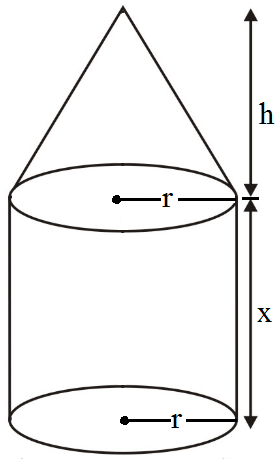
Disclaimer : In the the question, the statement given is incorrect.
Instead of total height of solid being equal to $3$ times the volume of cone,
the volume of the total solid should be equal to $3$ times the volume of the cone.
Let $x$ be the height of cylinder.
Since, volume of the total solid should be equal to $3$ times the volume of the cone,
So,
$\frac{1}{3}\pi\text{r}^2\text{h}+\pi\text{r}^2\text{x}=3\Big(\frac{1}{3}\pi\text{r}^2\text{h}\Big)$
$\Rightarrow\frac{1}{3}\pi\text{r}^2\text{h}-\pi\text{r}^2\text{h}+\pi\text{r}^2\text{x}=0$
$\Rightarrow\pi\text{r}^2\text{x}=\frac{2}{3}\pi\text{r}^2\text{h}$
$\Rightarrow\text{x}=\frac{2}{3}\text{h}$ View full question & answer→MCQ 541 Mark
The edge of the cube whose volume is $1728 \text{ cu.cm}$ is :
- A
$17\ cm$
- ✓
$12\ cm$
- C
$18\ cm$
- D
$72\ cm$
AnswerCorrect option: B. $12\ cm$
Given : Volume of cube $=1728\ \mathrm{ cu} . \mathrm{cm}$
$\Rightarrow a^3=1728$
$\Rightarrow a^3=(12)^3$
$\Rightarrow a=12 \mathrm{~cm}$
View full question & answer→MCQ 551 Mark
The radii of the circular ends of a bucket of height $40\ cm$ are $24\ cm$ and $15\ cm$. The slant height $($in $\ cm)$ of the bucket is :
AnswerSlant height of the buckrd
$=\sqrt{(\text{R}-\text{r})^2+\text{h}^2}$
$=\sqrt{(24-15)^2+40^2}$
$=\sqrt{9^2+40^2}$
$=\sqrt{81+1600}$
$=\sqrt{1681}$
$=41\text{ cm}$
View full question & answer→MCQ 561 Mark
Twelve solid spheres of the same size are made by melting a solid metallic cylinder of base diameter $2\ cm$ and height $16\ cm.$ The diameter of each sphere is :
- ✓
$2\ cm$
- B
$3\ cm$
- C
$4\ cm$
- D
$6\ cm$
AnswerCorrect option: A. $2\ cm$
Radius of the cylinder $=\frac{2}{2}=1\text{ cm}$
$\text{h}=16\text{ cm}$
Since twelve solid spheres of the same size are made by melting a solid metallic cylinder of base diameter $2\ cm$ and height $16\ cm,$
$12\times\frac{4}{3}\pi\text{r}^3=\pi\text{R}^2\text{h}$
$\Rightarrow12\times\frac{4}{3}\text{r}^3=\text{R}^2\text{h}$
$\Rightarrow12\times\frac{4}{3}\times\Big(\frac{\text{d}}{2}\Big)^3=(1)^2\times16$
$\Rightarrow16\times\Big(\frac{\text{d}}{2}\Big)^3=(1)^2\times16$
$\Rightarrow\Big(\frac{\text{d}}{2}\Big)^3=1$
$\Rightarrow\frac{\text{d}^3}{8}=1$
$\Rightarrow\text{d}^3=8$
$\Rightarrow\text{d}=\pm2$
Since the diameter connot be negative $, d = 2\ cm.$
View full question & answer→MCQ 571 Mark
If the radius of the base of a right circular cylinder is halved, keeping the height the same, then the ratio of the volume of the cylinder thus obtained to the volume of original cylinder is :
- A
$1 : 2$
- B
$2 : 1$
- C
$1 : 4$
- ✓
$4 : 1$
AnswerCorrect option: D. $4 : 1$
Let the radius and height of the culinder be $r $ and $h$ respectively.
Since the radius is halved keeping the height the same,
The new radius is $\frac{\text{r}}{2}.$
$\frac{\text{Volume of the new cylinder}}{\text{Volume of the original cylinder}}$
$=\frac{\pi\text{r}^2\text{h}}{\pi\Big(\frac{\text{r}}{2}\Big)^2\text{h}}$
$=\frac{4}{1}$
So, the ratio is $4 : 1$
View full question & answer→MCQ 581 Mark
Choose the correct answer from the given four options : A solid piece of iron in the form of a cuboid of dimensions $49\ cm \times 33\ cm \times 24\ cm,$ is moulded to form a solid sphere. The radius of the sphere is :
- ✓
$21\ cm$
- B
$23\ cm$
- C
$25\ cm$
- D
$19\ cm$
AnswerCorrect option: A. $21\ cm$
Given, dimenions of the cuboid $= 49\ cm \times 33\ cm \times 24\ cm$
$\therefore$ Volume of the cuboid $= 49 \times 33 \times 24 = 38808\ cm^3$
[$\because$ volume of chboid $=$ lenth $\times $ breadth $ \times $ height$]$
Let the radius of the sphere is $r,$ then
Volume of the sphere $=\frac{4}{3}\pi\text{r}^3$
$\Big[\because\text{volume of the sphere}=\frac{4}{3}\pi\times(\text{radius})^3\Big]$
According to the question,
Volume of the sphere $=$ Volume of the chboid
$\Rightarrow\ \ \frac{4}{3}\pi\text{r}^3=38808$
$\Rightarrow\ \ 4\times\frac{22}{7}\text{r}^3=38808\times3$
$\Rightarrow\ \ \text{r}^3=\frac{38808\times3\times7}{4\times22}=441\times21$
$\Rightarrow\ \ \text{r}^3=21\times21\times21$
$\therefore\ \ \text{r}=21\text { cm}$
Hence, the radius of the sphere is $21\ cm.$
View full question & answer→MCQ 591 Mark
A cylindrical pencil sharpened at one end is a combination of :
- ✓
- B
A cylinder and frustum of a cone.
- C
A cylinder and a hemisphere.
- D
Answer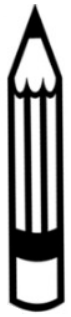
A cylindrical pencil sharpened at one edge is the combination of a cylinder and a cone.
Observe the fingure, the lover portion is a cylinder and the upper tapering portion is a cone.
View full question & answer→MCQ 601 Mark
A cubical block of side $7\ cm$ is surmounted by a hemisphere. The greatest diameter of the hemisphere is :
- A
$14\ cm$
- B
$10.5\ cm$
- C
$3.5\ cm$
- ✓
$7\ cm$
AnswerCorrect option: D. $7\ cm$
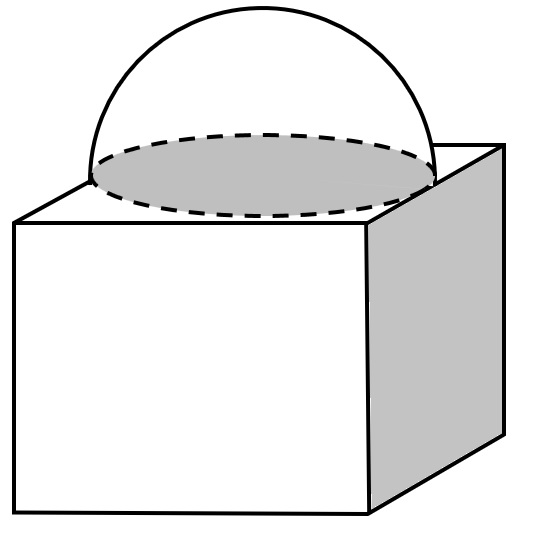
It is clear that Maximum diameter of hemisphere can be the side of the cube.
$\therefore$ The greatest diameter of the hemisphere $= 7\ cm$ View full question & answer→MCQ 611 Mark
The diameter of the base of a cylinder is $4\ cm$ and its height is $14\ cm$. The volume of the cylinder is :
- ✓
$176\ cm^3$
- B
$196\ cm^3$
- C
$276\ cm^3$
- D
$352\ cm^3$
AnswerCorrect option: A. $176\ cm^3$
Volume of the cylinder $=\pi\text{r}^2\text{h}$
$=\frac{22}{7}\times2\times2\times14 ....($Since the diameter $= 4\ cm)$
$=176\text{ cm}^3$
View full question & answer→MCQ 621 Mark
The number of solid spheres, each of diameter $6\ cm,$ that can mabe by melting a solid metal cylinder of height $45\ cm$ and diameter $4 \ cm,$ is :
AnswerLet the number of solid spheres be $n$.
Since the solid metal cylinder is meltes and recast into $n$ solid sheres,
Volume of $n$ solid aphere $=$ volume of the solid metal cylinder
$\Rightarrow\text{n}\times\frac{4}{3}\pi\text{R}^2\text{h}$
$\Rightarrow\text{n}=\frac{3\text{R}^2\text{h}}{4\text{r}^3}$
$\Rightarrow\text{n}\frac{3\times2^2\times45}{4\times3^3}$
$($since diameter of the cylinder $= 4\ cm$ and diameter of each sphere $= 6\ cm)$
$\Rightarrow\text{n}=5$
Hence $,5$ silid spheres can be formed.
View full question & answer→MCQ 631 Mark
The heights of two circular cylinders of equal volume are in the ratio $1 : 2$. The ratio of their radii is :
- A
$1:\sqrt{2}$
- ✓
$\sqrt{2}:1$
- C
$1:2$
- D
$1:4$
AnswerCorrect option: B. $\sqrt{2}:1$
Let the height of the two cylinders be $h$ and $2 h ,$
And the radii of the cylinders be $r_1$ and $r_2$ respectively
Since the volume of the cylinders are equal,
$\pi(\text{r}_1)^2\text{h}=\pi(\text{r}_2)^2(2\text{h})$
$\Rightarrow\frac{\text{r}_1^2}{\text{r}_2^2}=\frac{2}{1}$
$\Rightarrow\frac{\text{r}_1}{\text{r}_2}=\frac{\sqrt{2}}{1}$
Hence, the ratio of their radii is $\sqrt{2}:1$
View full question & answer→MCQ 641 Mark
If the radius of a sphere becomes $3$ times, then its volume will become :
- A
$3$ times
- B
$6$ times
- C
$9$ times
- ✓
$27$ times
AnswerCorrect option: D. $27$ times
Let the radius of the sphere be $r.$
So, the volume of the shere $=\frac{4}{3}\pi\text{r}^3$
If the radius becomes $3r,$
The volume $=\frac{4}{3}\pi(3\text{r})^3$
$=27\times\frac{4}{3}\pi\text{r}^3=27$ times the original sphere.
View full question & answer→MCQ 651 Mark
A hollow cube of internal edge $22\ cm$ is filled with spherical marbles of diameter $0.5\ cm$ and $\frac{1}{8}$ space of the cube remains unfilled. Number of marbles required is
- ✓
$142296$
- B
$142396$
- C
$142496$
- D
$142596$
AnswerCorrect option: A. $142296$
Volume of the cube with edge $22 \mathrm{~cm}=(22)^3$
Given that $\frac{1}{8}$ of the cube remains unfilled.
So, $\frac{7}{8}$ of the volume of the cube is filled.
Let the number of marbles required be $n$.
Thus, $\frac{7}{8}\times(22)^3=\text{n}\times\frac{4}{3}\pi(0.25)^3 ....($Since diameter $0.5\ cm)$
$\Rightarrow\frac{7}{8}\times(22)^3=\text{n}\times\frac{4}{3}\times\frac{22}{7}\times(0.25)^3$
$\Rightarrow\text{n}\frac{7\times(22)^3\times3\times7}{8\times4\times22\times(0.25)^3}$
$\Rightarrow\text{n}=142296$
Hence, the number of marbles required is $142296.$
View full question & answer→MCQ 661 Mark
Choose the correct answer from the given four options: The shape of a glass $($tumbler$)$ see Fig. is usually in the form of :
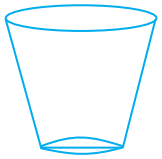
AnswerWe know that, the shape of frustum of a cone is,
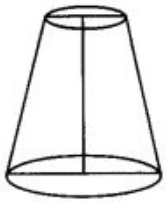
So, the give figure is usually in the form of frustum of a cone.
View full question & answer→MCQ 671 Mark
A cube of side $6\ cm$ is cut into a number of cubes, each of side $2\ cm$. The number of cubes formed is :
AnswerVolume of the cube $= (6\ cm \times 6\ cm \times 6\ cm)$
Volume of each small $= (2\ cm \times 2\ cm \times 2\ cm)$
number of b cubes formed
$=\frac{\text{Volume of the cube}}{\text{Volume of each small cube}}$
$=\frac{6\times6\times6}{2\times2\times2}$
$=27$
View full question & answer→MCQ 681 Mark
The height of a cylinder is $14\ cm$ and its curved surface area is $264\ cm^2$. The volume of the cylinder is :
- A
$308\ cm^3$
- ✓
$396\ cm^3$
- C
$1232\ cm^3$
- D
$1848\ cm^3$
AnswerCorrect option: B. $396\ cm^3$
The curved surface are of the cylinder $=2\pi\text{r}\text{h}$
$\Rightarrow264=2\times\frac{22}{7}\times\text{r}\times14$
$\Rightarrow\text{r}=3\text{cm}$
Volume of the cylinder $=\pi\text{r}^2\text{h}$
$=\frac{22}{7}\times3\times3\times14$
$=396\text{ cm}^3$
View full question & answer→MCQ 691 Mark
The volume of a cube is $2744\mathrm{~cm}^2$. Its surface area is :
- A
$196 \mathrm{~cm}^2$
- ✓
$1176 \mathrm{~cm}^2$
- C
$784 \mathrm{~cm}^2$
- D
$588 \mathrm{~cm}^2$
AnswerCorrect option: B. $1176 \mathrm{~cm}^2$
Let the edge of the cube be $x \mathrm{~cm}$.
Volume of a cube $=x^3$
$\Rightarrow 2744=x^3$
$\Rightarrow x=14 \mathrm{~cm}$
So, the surface area of the cube $=6 x^2$
$=6(14)^2$
$=1176 \mathrm{~cm}^2$
View full question & answer→MCQ 701 Mark
Choose the correct answer from the given four options : Volumes of two spheres are in the ratio $64 : 27.$ The ratio of their surface areas is :
- A
$3 : 4$
- B
$4 : 3$
- C
$9 : 16$
- ✓
$16 : 9$
AnswerCorrect option: D. $16 : 9$
Let the radii of the two spheres are $r_1$ and $r_2,$ respectively.
$\therefore$ Volume of the sphere of radius, $\text{r}_1=\text{V}_1=\frac{4}{3}\pi\text{r}^3_1\ \ \dots(\text{i})$
$\big[\because\text{volume of sphere}=\frac{4}{3}\pi(\text{radius})^3\big]$
and volume of the sphere of radius, $\text{r}_2=\text{V}_2=\frac{4}{3}\pi\text{r}^3_2\ \ \dots(\text{ii})$
Given, ratio of volumes $=\text{V}_1:\text{V}_2=64:27$
$\Rightarrow\ \frac{\frac{4}{3}\pi\text{r}^3_1}{\frac{4}{3}\pi\text{r}^3_2}=\frac{64}{27} \ [$using Eqs. $(i)$ and $(ii)]$
$\Rightarrow\ \ \frac{\text{r}^3_1}{\text{r}_2^3}=\frac{64}{27}$
$\Rightarrow\ \frac{\text{r}_1}{\text{r}_2}=\frac{4}{3}\ \ \dots(\text{iii})$
Now, ratio of surface area $=\frac{4\pi\text{r}^2_1}{4\pi\text{r}^2_2}$
$\big[\because\text{surface area of a sphere}=4\pi(\text{radius})^2]$
$=\frac{\text{r}^2_1}{\text{r}_2^2}$
$=\Big(\frac{\text{r}_1}{\text{r}_2}\Big)^2=\Big(\frac{4}{3}\Big)^2\ [$using Eqs. $(iii)]$
Hence, the required ratio of their surface area is $16 : 9.$
View full question & answer→MCQ 711 Mark
The shape of a gilli in the gilli $-$ danda game is a combination of :

- A
- B
- ✓
Two cones and a cylinder.
- D
Two cylinders and a cone.
AnswerCorrect option: C. Two cones and a cylinder.
The shape of a gill in the gilli $-$ danda is a combination of two and a cylinder.
the cones at either ends withthe culinder in the middle.
View full question & answer→MCQ 721 Mark
The plural form of ‘frustum’ is :
AnswerThe plural form of ‘frustum’ is frusta.
View full question & answer→MCQ 731 Mark
Choose the correct answer from the given four options : The diameters of the two circular ends of the bucket are $44\ cm$ and $24\ cm$. The height of the bucket is $35\ cm$. The capacity of the bucket is :
- ✓
$32.7$ litres.
- B
$33.7$ litres.
- C
$34.7$ litres.
- D
$31.7$ litres.
AnswerCorrect option: A. $32.7$ litres.
Given, diameter of one end of the bucket
$2R = 44$
$ \Rightarrow R = 22\ cm \ [\because\text{diameter, r}=2\times\text{radius}]$
and diameter of the other end,
$2r = 24 $
$\Rightarrow r = 12\ cm \ [\because\text{diameter, r}=2\times\text{radius}]$
Height of the bucket $, h = 35\ cm$
Since, the shape of bucket $=$ Volume of the frustum of the cone
$=\frac{1}{3}\pi\text{h}[\text{R}^2+\text{r}^2+\text{Rr}]$
$=\frac{1}{3}\times\pi\times35\big[(22)^2+(12)^2+22\times12\big]$
$=\frac{35\pi}{3}[484+144+264]$
$=\frac{35\pi\times892}{3}=\frac{35\times22\times892}{3\times7}$
$=32706.6\text{ cm}^3=32.7\text{L}$
$[\because1000\text{ cm}^3=1\text{L}]$
Hence, the capacity of bucket is $32.7L.$
View full question & answer→MCQ 741 Mark
Choose the correct answer from the given four options : In a right circular cone, the cross $-$ section made by a plane parallel to the base is a :
AnswerWe know that, if a cone is cut by a plane parallel to the base of the cone,
then the portion between the place and base is called the frustum of the cone.
View full question & answer→MCQ 751 Mark
A metallic cone of base radius 2.1cm and height 8.4cm is melted and moulded into a sphere. The radius of the sphere is:
Answer$\text { Volume of the cone }=\frac{1}{3} \pi r_c^2 h$
$\text { Volume of the sphere }=\frac{4}{3} \pi r_s^3$
$r_c \text { is the radius of cone }=2.1 cm \text {....(Given) }$
Let $r_s$ be the radius of the sphere
h is the height of cone $=8.4 cm$...(Given)
Volume of cone $=$ Volume of sphere ...(Given)
$\Rightarrow \frac{1}{3} \pi r_{ c }^2 h=\frac{4}{3} \pi r _{ s }^3$
$\Rightarrow \frac{1}{3} r _{ c }^2 h=\frac{4}{3} r _{ s }^3 $
$\Rightarrow r _{ s }^3=9.261$
.$\Rightarrow r _{ s }=2.1 cm$
View full question & answer→MCQ 761 Mark
If the radii of the circular ends of a bucket of height $40\ cm$ are of lengths $35\ cm$ and $14\ cm,$ then the volume of the bucket in cubic centimeters, is :
- A
$60060$
- ✓
$80080$
- C
$70040$
- D
$80160$
AnswerCorrect option: B. $80080$
Height of the bucket $(h)=40 \mathrm{~cm}$
Upper radius ( $r_1$ ) $=35 \mathrm{~cm}$
and lower radius $\left(r_2\right)=14 \mathrm{~cm}$
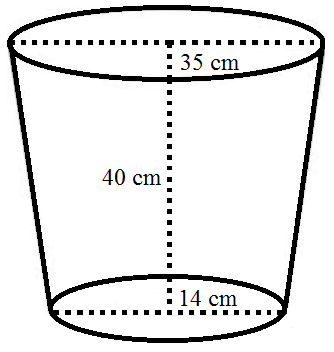
$ \therefore \text { Volume of the bucket }$
$ =\frac{\pi}{3}\left[\mathrm{r}_1^2+\mathrm{r}_1 \mathrm{r}_2+\mathrm{r}_2^2\right] \times \mathrm{h}$
$ =\frac{22}{21}\left[(35)^2+35 \times 14+(14)^2\right] \times 40 \mathrm{~cm}^3$
$ =\frac{22}{21} \times 1911 \times 40 \mathrm{~cm}^3$
$ =\frac{2 \times 40 \times 1911}{21} \mathrm{~cm}^3=80080 \mathrm{~cm}^3$ View full question & answer→MCQ 771 Mark
The circular ends of a bucket are of radii $35\ cm$ and $14\ cm$ and the height of the bucket is $40\ cm.$ Its volume is :
- A
$60060 \mathrm{~cm}^3$
- ✓
$80080 \mathrm{~cm}^3$
- C
$70040 \mathrm{~cm}^3$
- D
$80160 \mathrm{~cm}^3$
AnswerCorrect option: B. $80080 \mathrm{~cm}^3$
Volume of the buclet $=$ Volume of the frustum of the cone
$=\frac{1}{3}\pi\text{h}[\text{R}^2+\text{r}^2+\text{rr}]$
$=\frac{1}{3}\times\frac{22}{7}\times40[35^2+14^2+(35\times14)]$
$=\frac{880}{21}\times1911$
$=80080\text{ cm}^3$
Hence, the volume of the bucket is $80080 \mathrm{~cm}^3$.
View full question & answer→MCQ 781 Mark
The radius $($in $\ cm)$ of the largest right circular cone that can be cut out from a cube of edge $4.2\ cm$ is:
- ✓
$2.1$
- B
$4.2$
- C
$8.4$
- D
$1.05$
AnswerThe diameter of such a cone is equal to the edge of the cube.
So, the diameter $= 4.2\ cm.$
Hence, the radius $= 2.1\ cm.$
View full question & answer→MCQ 791 Mark
Water flows at the rate of $10$ metre per minute from a cylindrical pipe $5\ mm$ in diameter. How long will it take to fill up a conical vessel whose diameter at the base is $40\ cm$ and depth $24\ cm?$
- A
$48$ minutes $15 \sec$
- ✓
$51$ minutes $12 \sec$
- C
$52$ minutes $1 \sec$
- D
$55$ minutes
AnswerCorrect option: B. $51$ minutes $12 \sec$
The radius of cylindrical pipe
$\text{r}=\frac{5}{2}\text{mm}=0.25\text{ cm}$
The volume per minute of water flow from the pipe
$=\pi\times(0.25)^2\times1000$
$=652\pi\text{ cm}^3\text{minutes}$
The radius of cone
$=\frac{40}{2}$
$= 20\ cm$
Depth of cone $= 24\ cm$
The volume of cone
$=\frac{1}{3}\pi(20)^2\times24$
$=3200\pi\text{ cm}^3$
The time it will take to fill up a conical vessel
$=\frac{3200\pi}{62.5\pi}$
$=51\frac{125}{625}\text{ min}$
$=51\text{ min}+\frac{125}{625}\times60\text{ sec}$
$= 51 \min + 12 \sec$
View full question & answer→MCQ 801 Mark
The diameter of a sphere is $14\ cm$. Its volume is :
AnswerCorrect option: C. $1437\frac{1}{3}\text{cm}^3$
Diameter $= 14\ cm$
So, the radius $= 7\ cm$
Volume of the sphere $=\frac{4}{3}\pi\text{r}^3$
$=\frac{4}{3}\times\frac{22}{7}\times(7)^3$
$=1437\frac{1}{3}\text{ cm}^3$
View full question & answer→MCQ 811 Mark
The diameters of the top and the bottom portions of a bucket are $42\ cm$ and $28\ cm$ respectively. If the height of the bucket is $24\ cm,$ then the cost of painting its outer surface at the rate of $50$ paise/ $\mathrm{cm}^2$ is :
- A
$Rs. 1582.50$
- B
$Rs. 1724.50$
- ✓
$Rs. 1683$
- D
$Rs. 1642$
AnswerCorrect option: C. $Rs. 1683$
Diameter of upper and lower portions of a bucket are $42\ cm$ and $28\ cm$
and height $(h) = 24\ cm$
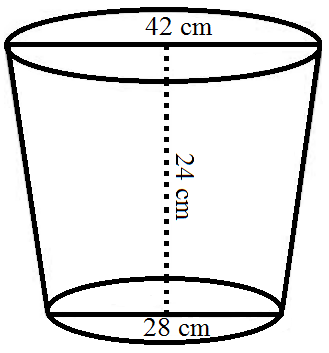
$\therefore\text{r}_1=\frac{42}{2}=21\text{ cm}$
$\text{r}_2=\frac{28}{2}=21\text{ cm}$
$\text{h}=24\text{ cm}$
$\therefore$ slant height $(l)$
$=\sqrt{\text{h}^2+(\text{r}_1-\text{r}_2)^2}$
$=\sqrt{(24)^2+(7)^2}=\sqrt{576+49}$
$=\sqrt{625}=25\text{ cm}$
Now area of outer surface
$\pi(\text{r}_1+\text{r}_2)\text{l}+\pi\text{r}_2^2$
$=\frac{22}{7}(21+14)\times25+\frac{22}{7}\times(14)^2\text{ cm}^2$
$=\frac{22}{7}\times35\times25+\frac{22}{7}\times14\times14\text{ cm}^2$
Rate of polishing $ = 50$ paisa. per $\mathrm{cm}^2$
$\therefore$ Total cost $=3366\times\frac{50}{100}=\text{Rs}.\ 1683$ View full question & answer→MCQ 821 Mark
Choose the correct answer from the given four options : cone is cut through a plane parallel to its base and then the cone that is formed on one side of that plane is removed. The new part that is left over on the other side of the plane is called :
Answer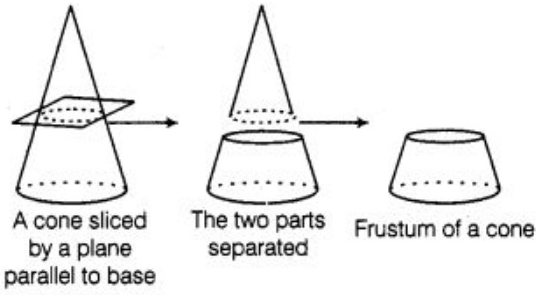
$[$when we remove the upper portion of the cone cut off by plane, we get frustum of a cone$]$ View full question & answer→MCQ 831 Mark
If the radii of the ends of a bucket are $5\ cm$ and $15\ cm$ and it is $24\ cm$ high, then its surface area is :
- A
$1815.3 \mathrm{~cm}^2$
- ✓
$1711.3 \mathrm{~cm}^2$
- C
$2025.3 \mathrm{~cm}^2$
- D
$2360 \mathrm{~cm}^2$
AnswerCorrect option: B. $1711.3 \mathrm{~cm}^2$
$\text{l}=\sqrt{\text{h}^2+(\text{R}-\text{r})^2}$
$\Rightarrow\text{l}=\sqrt{24^2+(15-5)}$
$\Rightarrow\text{l}=\sqrt{576+100}$
$\Rightarrow\text{l}=\sqrt{676}$
$\Rightarrow\text{l}=26\text{ cm}$
Surface area of the bucket
$=\pi\big[\text{r}^2+\text{l}(\text{R}+\text{r})\big]$
$=3.14\times\big[5^2+26(15+5)\big]$
$=3.14\times[545]$
$=1711.3\text{ cm}^2$
View full question & answer→MCQ 841 Mark
A cylindrical vessel of radius $4\ cm$ contains water. A solid sphere of radius $3\ cm$ is lowered into the water until it is completely immersed. The water level in the vessel will rise by :
- A
$\frac{2}{9}\text{ cm}$
- B
$\frac{4}{9}\text{ cm}$
- ✓
$\frac{9}{4}\text{ cm}$
- D
$\frac{9}{2}\text{ cm}$
AnswerCorrect option: C. $\frac{9}{4}\text{ cm}$
The radius of sphere $, r = 3\ cm$
The volume of sphere
$=\frac{4}{3}\pi\text{r}^3$
$=\frac{4}{3}\pi(3)^3$
$=36\pi\ \text{ cm}^3$
Since,
The sphere fully immersed into the vessel, the level of water be raised by $x \ cm.$
Then,
The volume of raised water $=$ volume of sphere
$\pi(4)^2\times\text{x}=36\pi$
$\text{x}=\frac{36}{16}$
$\text{x}=\frac{9}{4}\text{ cm}$
View full question & answer→MCQ 851 Mark
The height of a cone is $30\ cm$. A small cone is cut off at the top by a plane parallel to the base. If its volume be of the volume of the given cone, then the height above the base at which the section has been made, is :
- A
$10\ cm$
- B
$15\ cm$
- ✓
$20\ cm$
- D
$25\ cm$
AnswerCorrect option: C. $20\ cm$
Height of given cone $\left(h_1\right)=30 \mathrm{~cm}$
Let $r_1$ be its radius
Then volume of the larger cone $\Big(\frac{1}{3}\Big)\pi\text{r}_1^2\text{h}_1$
A cone is cut off from the top of the larger cone, such that volume of smaller cone
$\frac{1}{27}$ of that of larger cone
$\therefore\frac{\text{volume of smaller cone}}{\text{Volume of bigger cone}}=\frac{1}{27}$
$=\frac{\frac{1}{3}\pi\text{r}_2^2\text{h}_2}{\frac{1}{3}\pi\text{r}_1^2\text{h}_1}=\frac{1}{27}$
$\Rightarrow\frac{\text{r}_2^2\text{h}_2}{\text{r}_1^2\text{h}_1}=\frac{1}{27}=\Big(\frac{1}{3}\Big)^3$
$\Rightarrow\frac{\text{h}_2}{\text{h}_1}=\frac{1}{3}\frac{\text{h}_2}{30}=\frac{1}{3}$
$\Rightarrow\text{h}_2=\frac{30}{3}=10$
Height of smaller cone $= 10\ cm$
Height from the base of bigger cone will be
$= 30 - 10 = 20\ cm$
View full question & answer→MCQ 861 Mark
A metallic sphere of radius $10.5\ cm$ is melted and then recast into small cones, each of radius $3.5\ cm$ and height $3\ cm$. The number of such cones is :
AnswerRadius of metallic sphere $= 10.5\ cm$
Therefore,
Volume of the sphere
$=\frac{4}{3}\pi\text{r}^3$
$=\frac{4}{3}\times\pi\times10.5\times10.5\times10.5$
$=\frac{4630.5\pi}{3}$
Now,
Radius of the cone $= 3.5\ cm$
and Height of the cone $= 3\ cm$
Therefore,
Volume of the cone
$=\frac{1}{3}\pi\text{r}^2\text{h}$
$=\frac{1}{3}\times\pi\times3.5\times3.5\times3.5$
$=\frac{36.75\pi}{3}$
Number of cone $=\frac{\text{Volume of sphere}}{\text{Volume of cone}}$
Dividing eq. $(i)$ and $(ii)$ we get
$=\frac{\frac{4630.5\pi}{3}}{\frac{36.75\pi}{3}}=126$
Number of cone
Number of cone $= 126$
View full question & answer→Question 871 Mark
Match the following columns:
|
|
Column $I$
|
|
Column $II$
|
| $a.$ |
The radii of the circular ends of a bucket, in the form of the frustum of a cone of height $30\ cm,$ are $20\ cm$ and $10\ cm$ respectively. The capacity of the bucket is $ ......cm^3$. |
$p.
$ |
$2418\pi$
|
| $b.$ |
The radii of the circular ends of a conical bucket of height $15\ cm$ are $20$ and $12\ cm$ respectively. The slant height of the bucket is $ ...... \ cm.$
|
$q.$ |
$22000$ |
| $c.$ |
The radii of the circular ends of a solid frustum of a cone are $33\ cm$ and $27\ cm$ and its slant height is $10\ cm$. The total surface area of the bucket is $....cm^2$.
|
$r.$ |
$12$ |
| $d.$ |
Three solid metallic spheres of radii $3\ cm, 4\ cm$ and $5\ cm$ are melted to form a single solid sphere. The diameter of the resulting sphere is $...... \ cm.$
|
$s.$ |
$17$ |
Answer
|
|
Column $I$
|
|
Column $II$
|
| $a.$ |
The radii of the circular ends of a bucket, in the form of the frustum of a cone of height $30\ cm,$ are $20\ cm$ and $10\ cm$ respectively. The capacity of the bucket is $ ......cm^3$. |
$p.
$ |
$2418\pi$
|
| $b.$ |
The radii of the circular ends of a conical bucket of height $15\ cm$ are $20$ and $12\ cm$ respectively. The slant height of the bucket is $ ...... \ cm.$
|
$q.$ |
$22000$ |
| $c.$ |
The radii of the circular ends of a solid frustum of a cone are $33\ cm$ and $27\ cm$ and its slant height is $10\ cm$. The total surface area of the bucket is $....cm^2$.
|
$r.$ |
$12$ |
| $d.$ |
Three solid metallic spheres of radii $3\ cm, 4\ cm$ and $5\ cm$ are melted to form a single solid sphere. The diameter of the resulting sphere is $...... \ cm.$
|
$s.$ |
$17$ |
$(a)$ Let $R$ and $r$ be the top and base of the bucket and $h$ be the height.
Capacity of the bucket $=$ Volume of the frustum of the cone
$=\frac{\pi\text{h}}{3}(\text{R}^2+\text{r}^2+\text{Rr})$
$=\frac{22}{7}\times\frac{1}{3}\times30\times(20^2+20^2+20+10)$
$=\frac{220}{7}\times700$
$=22000\text{ cm}^3$
$(b)$ Slant height, $\text{l}=\sqrt{\text{h}^2+(\text{R}-\text{r})^2}$
$=\sqrt{15^2+(20-12)^2}$
$=\sqrt{225+64}$
$=\sqrt{289}$
$=17\text{ cm}$
$(c)$ Total surface area of the bucket $=\pi\big[\text{R}^2+\text{r}^2+\text{l}(\text{R}+\text{r})\big]$
$=\pi\big[33^2+27^2+10(33+27)\big]$
$=\pi\big[1089=729+600\big]$
$2418\pi\text{ cm}^2$
$(d)$ Let the diameter be $d$.
So, the radius $=\frac{\text{d}}{2}$
Volume of the sphere $=\frac{4}{3}\pi\text{r}^3=\frac{4}{3}\pi\Big(\frac{\text{d}}{2}\Big)^3$
$\Rightarrow\frac{4}{3}\pi\Big(\frac{\text{d}}{2}\Big)^3=\frac{4}{3}\pi(3)^3+\frac{4}{3}\pi(4)^3+\frac{4}{3}\pi(5)^3$
$\Rightarrow\Big(\frac{\text{d}}{2}\Big)^3=(3)^3+(4)^3+(5)^3$
$\Rightarrow\frac{\text{d}^3}{8}=27+64+125$
$\Rightarrow\frac{\text{d}^3}{8}=216$
$\Rightarrow\text{d}^3=1728$
$\Rightarrow\text{d}=12\text{ cm}$ View full question & answer→MCQ 881 Mark
The ratio of the total surface area to the lateral surface area of a cylinder with base radius $80\ cm$ and height $20\ cm$ is :
- A
$2 : 1$
- B
$3 : 1$
- C
$4 : 1$
- ✓
$5 : 1$
AnswerCorrect option: D. $5 : 1$
The ratio of the total surface area to the lateral surface area
$=\frac{\text{Total surface area}}{\text{Lateral surface area}}$
$=\frac{2\pi\text{r}(\text{h}+\text{r})}{2\pi\text{rh}}$
$=\frac{\text{h+r}}{\text{h}}$
$=\frac{20+80}{20}$
$=\frac{5}{1}$
So, the required ratio is $5 : 1$
View full question & answer→MCQ 891 Mark
Choose the correct answer from the given four options : If two solid hemispheres of same base radius $r$ are joined together along their bases, then curved surface area of this new solid is :
- ✓
$4\pi\text{r}^2$
- B
$6\pi\text{r}^2$
- C
$3\pi\text{r}^2$
- D
$8\pi\text{r}^2$
AnswerCorrect option: A. $4\pi\text{r}^2$
Because curved surface area of a hemisphere is $2 w^2$ and here,
we join two solid hemispheres along their bases of radius $r,$ from which we get a solid sphere.
Hence, the curved surface area of new solid $=2\pi\text{r}^2+2\pi\text{r}^2=4\pi\text{r}^2$
View full question & answer→MCQ 901 Mark
The radius of the base of a cone is $5\ cm$ and its height is $12\ cm$. Its curved surface area is :
- A
$60\pi\text{ cm}^2$
- ✓
$65\pi\text{ cm}^2$
- C
$30\pi\text{ cm}^2$
- D
$\text{None of these}$
AnswerCorrect option: B. $65\pi\text{ cm}^2$
Slant height, $\text{l}=\sqrt{\text{r}^2+\text{h}^2}$
$\Rightarrow\text{l}=\sqrt{5^2+12^2}$
$\Rightarrow\text{l}=\sqrt{25+144}$
$\Rightarrow\text{l}=\sqrt{169}$
$\Rightarrow\text{l}=13\text{ cm}$
Curved surface area of the cone $=\pi\text{rl}$
$=\pi\times5\times13$
$=65\pi\text{ cm}^2$
View full question & answer→MCQ 911 Mark
The number of solid spheres, each of diameter $6\ cm$ that can be made by melting a solid metal cylinder of height $45\ cm$ and diameter $4\ cm$ is :
AnswerLet the number of solid spheres be $n$.
Now, Volume of $n$ solid sphere $=$ Volume of cylinder
$\Rightarrow\text{n}\times\frac{4}{3}\times\frac{22}{7}\times\Big(\frac{6}{2}\Big)^3$
$=\frac{22}{7}\times\Big(\frac{4}{2}\Big)^2\times45$
$\Rightarrow\text{n}\times\frac{4}{3}\times27=4\times45$
$\Rightarrow\text{n}=5$
View full question & answer→MCQ 921 Mark
The surface area of a sphere is same as the curved surface area of a right circular cylinder whose height and diameter are $12\ cm$ each. The radius of the sphere is :
- A
$3\ cm$
- B
$4\ cm$
- ✓
$6\ cm$
- D
$12\ cm$
AnswerCorrect option: C. $6\ cm$
Let $r$ be the radius of sphere
But,
Surface area of sphere $= \text{C.S.A}.$ of cylinder
$4\pi\text{r}^2=2\pi\text{rh}$
$4\text{r}^2=2\times6\times12$
$\text{r}^2=\frac{2\times6\times12}{4}$
$\text{r}=6\text{ cm}$
View full question & answer→MCQ 931 Mark
The surface areas of two spheres are in e ratio $16: 9.$ The ratio o their volumes is :
- ✓
$64 : 27$
- B
$16 : 9$
- C
$4 : 3$
- D
$16^3: 9^3$
AnswerCorrect option: A. $64 : 27$
Given that the surface areas of the two spheres are in the ratio $16 : 9.$
So, $\frac{4\pi\text{r}^2}{4\pi\text{R}^2}=\frac{16}{9}$
$\Rightarrow\frac{\text{r}^2}{\text{R}^2}=\frac{16}{9}$
$\Rightarrow\frac{\text{r}}{\text{R}}=\frac{4}{3}$
Let the volume of the sphere with radius $r$ and $R$ be $\mathrm{V}_1$ and $\mathrm{V}_2$ respectively.
$\frac{\text{V}_1}{\text{V}_2}=\frac{\frac{4}{3}\pi\text{r}^3}{\frac{4}{3}\pi\text{R}^3}$
$\Rightarrow\frac{\text{V}_1}{\text{V}_2}=\Big(\frac{\text{r}}{\text{R}}\Big)^3$
$\Rightarrow\frac{\text{V}_1}{\text{V}_2}=\Big(\frac{4}{3}\Big)^3=\frac{64}{27}$
Hence, the ratio of their volumes is $64 : 27.$
View full question & answer→MCQ 941 Mark
The diameters of two circular ends of a bucket are $44\ cm$ and $24\ cm,$ and the height of the bucket is $35\ cm$. The capacity of the bucket is :
- A
$31.7$ litres.
- ✓
$32.7$ litres.
- C
$33.7$ litres.
- D
$34.7$ litres.
AnswerCorrect option: B. $32.7$ litres.
Since the diameter of the circular ends of the bucket are $44\ cm$ and $24\ cm,$
the radii of thr circular end are $22\ cm$ and $12\ cm.$
Capacity of the bucket $=$ volume of the bucket
$=\frac{1}{3}\pi\text{h}\big[\text{R}^2+\text{r}^2+\text{Rr}\big]$
$=\frac{1}{3}\times\frac{22}{7}\times35\times\big[22^2+12^2+(22\times12)\big]$
$=32.7\text{ litres}$
Hence, the capacity of the bucket is $32.7$ litres.
View full question & answer→MCQ 951 Mark
A metallic spherical shell of internal and external diameters $4\ cm$ and $8\ cm,$ respectively, is melted and recast in the form of a cone of base diameter $8\ cm$. The height of the cone is :
- A
$12\ cm$
- ✓
$14\ cm$
- C
$15\ cm$
- D
$8\ cm$
AnswerCorrect option: B. $14\ cm$
The radii od the spherical shell is $2\ cm$ and $2\ cm$.
Volume of the spherical shell $=\frac{4}{3}\pi\big(\text{R}^3-\text{r}^3\big)$
$=\frac{4}{3}\pi\big(\text{R}^3-\text{2}^3\big)$
$=\frac{4}{3}\pi(56)$
Radius of the cone $= 4\ cm$
Volume of the cone $=\frac{1}{3}\pi\text{r}^2\text{h}$
$=\frac{1}{3}\pi(4)^2\text{h}$
$\Rightarrow16\text{h}=4(56)$
$\Rightarrow\text{h}=14\text{ cm}$
View full question & answer→MCQ 961 Mark
Choose the correct answer from the given four options : A metallic spherical shell of internal and external diameters $4\ cm$ and $8\ cm,$ respectively is melted and recast into the form a cone of base diameter $8\ cm.$ The height of the cone is :
- A
$12\ cm$
- ✓
$14\ cm$
- C
$15\ cm$
- D
$18\ cm$
AnswerCorrect option: B. $14\ cm$
Given, internal diameter of spherical shell $= 4\ cm$
and exiernal diameter of shell $= 8\ cm$
$\therefore$ Internal radius of spherical shell $\text{r}_1=\frac{4}{2}\text{ cm}=2\text{ cm}$
$[\because\text{diameter}=2\times\text{radius}]$
and external radius of shell, $\text{r}_2=\frac{8}{2}=4\text{cm}$
$[\because\text{diameter}=2\times\text{radius}]$
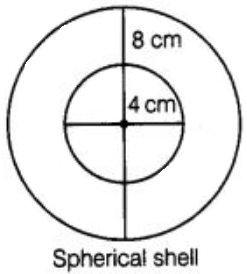
Now, volume of the spherical shell
$=\frac{4}{3}\pi\big[\text{r}^3_2-\text{r}^3_1\big]$
$\left[\because\right.$ volume of the spherical shell $=\frac{4}{3} \pi\left\{(\text { extermal radius })^3\right. - \text{(internal radius}) \left.\left.{ }^3\right\}\right]$
$\frac{4}{3}\pi(4^3-2^3)$
$\frac{4}{3}\pi(64-8)$
$=\frac{224}{3}\pi\text{ cm}^3$
Let height of cone $= h \ cm$
Diameter of the base of cone $= 8\ cm$
$\therefore$ Radius of the base of cone $=\frac{8}{2}=4\text{ cm}$
$[\because\text{diameter}=2\times\text{radius}]$
According to the question,
Volume of cone $=$ Volume of spherical shell
$\Rightarrow\ \ \frac{1}{3}\pi(4)^2\text{ h}=\frac{224}{3}\pi$
$\Rightarrow\ \text{h}=\frac{224}{16}=14\text{ cm}$
$\Big[\because\text{volume of cone}=\frac{1}{3}\times\pi\times(\text{radius})^2\times(\text{height})\Big]$
Hence, the height of the cone is $14\ cm.$ View full question & answer→MCQ 971 Mark
A cylinder with base radius of $8\ cm$ and height of $2\ cm$ is melted to form a cone of height $6\ cm$. The radius of the cone is :
- A
$4\ cm$
- B
$5\ cm$
- C
$6\ cm$
- ✓
$8\ cm$
AnswerCorrect option: D. $8\ cm$
Radius of cylinder $(r_1) = 8\ cm$
and height $(h_1) = 2\ cm$
$\therefore$ Volume $=\pi\text{r}_1^2=\pi\times(8)^2\times2\text{ cm}^3$
$=128\pi\text{ cm}^3$
Now Volume of cone $128\pi\ \text{ cm}^3$
Height of cone $(h_2) = 6\ cm$
Let $r_2$ be its radius, then
$\frac{1}{3}\pi\text{r}_2^2\text{h}_2=128\pi$
$\Rightarrow\frac{1}{3}\pi\text{r}_2^2\times6=128\pi$
$\Rightarrow\text{r}_2^2=\frac{128\pi\times3}{\pi\times6}=64=(8)^2$
$\Rightarrow\text{r}_1=8$
$\therefore$ Radius of cone $= 8\ cm$
View full question & answer→MCQ 981 Mark
The curved surface area of a cylinder is $264 \mathrm{~m}^2$ and its volume is $924 \mathrm{~m}^3$. The ratio of its diameter to its height is :
- A
$3 : 7$
- ✓
$7 : 3$
- C
$6 : 7$
- D
$7 : 6$
AnswerCorrect option: B. $7 : 3$
The $\text{C.S.A}.$ of cylinder
$\mathrm{S}=264 \mathrm{~m}^2$
The volume of cylinder
$V=924 \mathrm{~m}^3$
$2\pi\text{rh}=264$
$2\text{rh}=\frac{264\times7}{22}$
$2\text{rh}=84$
$\text{rh}=42$
$\pi\text{r}^2\text{h}=924$
$\text{r}(\text{rh})=\frac{924\times7}{22}$
From eq. $(i)$ and $(ii),$
We get $r = 7$
Putting the value in $(i)$
$h = 6$
$\frac{\text{d}}{\text{h}}=\frac{14}{6}=\frac{7}{3}$
$\text{d}:\text{h}=7:3$
View full question & answer→MCQ 991 Mark
A cone is cut by a plane parallel to its base and the upper part is removed. The part that is left over is called :
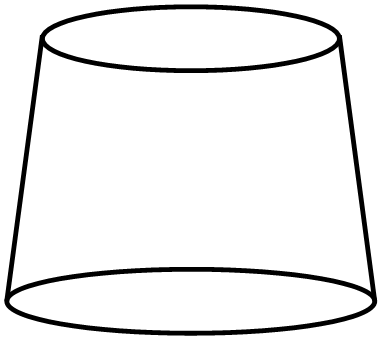
AnswerA cone is cut by a plane parallel to its base the upper part is remove.
part that is left over is called the frutum of a cone.
View full question & answer→MCQ 1001 Mark
The height of a conical tent is $14m$ and its floor area is $346.5 \mathrm{~m}^2$. How much canvas, $1.1$ wide, will be required for it?
- A
$490m$
- ✓
$525m$
- C
$665m$
- D
$860m$
AnswerCorrect option: B. $525m$
Area of the floor of a conical tent $=\pi(\text{r})^2$
$\Rightarrow\pi\text{r}^2=346.5$
$\Rightarrow\text{r}^2=\Big(\frac{3465}{10}\times\frac{7}{22}\Big)$
$\Rightarrow\text{r}^2=\frac{441}{4}$
$\Rightarrow\frac{21}{2}\text{ cm}$
Slant height of the cone, $\text{l}=\sqrt{\text{r}^2+\text{h}^2}$
$\Rightarrow\text{l}=\sqrt{\Big(\frac{21}{2}\Big)^2+14^2}$
$\Rightarrow\text{l}=\sqrt{\frac{1225}{4}}$
$\Rightarrow\text{l}=\frac{32}{2}\text{m}$
Area of the canvas $=$ curved surface area of the conical tent
$\Rightarrow$ Area of the canvas $=\pi\text{r}\text{l}$
$\Rightarrow$ Area of the canvas $=\frac{22}{7}\times\frac{21}{2}\times\frac{35}{2}=577.5\text{m}^2$
Lenght of the canvas $=\frac{\text{Area of the canvas}}{\text{Width of the canvas}}$
$=\frac{577.5}{1.1}$
$=525\text{m}$
View full question & answer→