Questions

3 Marks Question

🎯

Test yourself on this topic

20 questions · timed · auto-graded

Question 13 Marks
State and prove Py thagoras theorem.
Answer
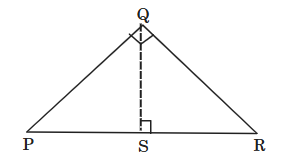
Pythagoras theorem: In a right triangle, the
Image
Given: $\triangle P Q R$ is a right triangle, right angled at $Q$.
To prove: $P R^2=P Q^2+Q R^2$
Construction: Draw $Q S \perp P R$
Proof: In $\triangle P Q S$ and $\triangle P Q R$,
$\angle P S Q=\angle P Q R=90^{\circ}$
$\angle Q P S=\angle Q P R \ ($common$) $
(by AAA similarity criterion)
$\Rightarrow \frac{P S}{P Q}=\frac{P Q}{P R}$
$\Rightarrow P S \times P R=P Q^2 \ldots \ldots(i)$
Now, In $\triangle Q S R$ and $\triangle P Q R$,
$\angle Q S R=\angle P Q R=90^{\circ}$
$\angle Q R S=\angle Q R P \ ($common$)$
$\therefore \triangle Q S R-\triangle P Q R \ ($by $AA$ similarity criterion$) $
$\Rightarrow \frac{R S}{Q R}=\frac{Q R}{P R}$
$\Rightarrow R S \times P R=Q R^2 \ldots \ldots(ii)$
Adding $(i)$ and $(ii)$
$\Rightarrow P Q^2+Q R^2=P S \times P R+R S \times P R$
$\Rightarrow P Q^2+Q R^2=P R(P S+R S)$
$\Rightarrow P Q^2+Q R^2=P R . P R$
$\Rightarrow P Q^2+Q R^2=P R^2 $
$\Rightarrow P R^2=P Q^2+Q R^2$
Hence proved
View full question & answer
Question 23 Marks
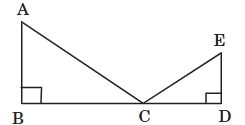
In the given figure $\angle B=\angle D=90^{\circ}$. If $A B=12 \ cm , A C=13 \ cm, C E=5 \ cm$ and $E D=4 \ cm,$ find the length of $B D$.
Image
Answer
In $\triangle A B C$, we have $A B=12 \ cm, A C=13 \ cm$ and $\angle B=90^{\circ}$
Using the Pythagoras theorem we have,
$(A C)^2=(A B)^2+(B C)^2$
$\Rightarrow(13)^2=(12)^2+(B C)^2 $
$\Rightarrow 169=144+(B C)^2$
$\Rightarrow(B C)^2=169-144=25 $
$\Rightarrow B C=5 \ cm$
Now in $\triangle E D C$, we have $C E=5 \ cm$ and $E D=4 \ cm$ and $\angle D=90^{\circ}$
Using the Pythagoras theorem we have,
$(C E)^2=(C D)^2+(E D)^2$
$\Rightarrow(5)^2=(C D)^2+(4)^2 $
$\Rightarrow 25=(C D)^2+16$
$\Rightarrow(C D)^2=25-16=9 $
$\Rightarrow C D=3 \ cm$
$B D=B C+C D$
$\Rightarrow B D=5 \ cm+3 \ cm=8 \ cm$
Hence, the length $B D$ is $8 \ cm .$
View full question & answer
Question 33 Marks
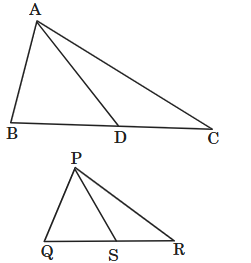
In the given figure $\triangle A B D \sim \triangle P Q S$ when $A D$ and $P S$ are medians. Prove that $\triangle A B C \sim \triangle P Q R$.
Image
Answer
Given: $\triangle A B D \sim \triangle P Q S$
To prove: $\triangle A B C \sim \triangle P Q R$
Proof:
Since $\triangle A B D \sim \triangle P Q S$
$\Rightarrow \frac{A B}{P Q}=\frac{B D}{Q S}=\frac{A D}{P S} $
$($Corresponding sides of similar triangles are proportional$) ............(i)$
Also, $\angle B A D=\angle Q P S,$
$ \angle B=\angle Q, \angle A D B=\angle P S Q$
$($Corresponding angles of similar triangles are equal$)............(ii)$
Now it is given that $A D$ and $P S$ are medians.
Therefore $B D=\frac{B C}{2}$ and $QS =\frac{Q R}{2}$
From $(i)$ we get,
$\frac{A B}{P Q}=\frac{\frac{B C}{2}}{\frac{Q R}{2}}$
$\Rightarrow \frac{A B}{P Q}=\frac{B C}{Q R}......(iii)$
Now in $\triangle A B C$ and $\triangle P Q R$ we have,
$\frac{A B}{P Q}=\frac{B C}{Q R} \ ($From $(iii)) $
Also $\angle B=\angle Q \ ($From $(ii))$
$\Rightarrow \triangle A B C \sim \triangle P Q R$ by $\text{SAS}$ criterion.
Hence proved.
View full question & answer
Question 43 Marks
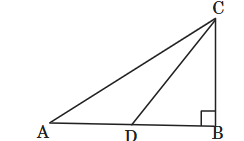
In the figure if $C D=17 m, B D=8 m$ and $A D=4 m, $ then find the value of $A C$.
Image
Answer
In right triangle $\text{CBD}$ using Py thagoras theorem,
$C D^2=B D^2+B C^2$
$17^2=8^2+B C^2$
$B C^2=17^2-8^2$
$=289-64$
$B C^2=225$
$B C=15 m$
Now since $A D=4 m$ and $B D=8 m,$
$A B=A D+B D$
$A B=12 m$
Now in triangle $\text{ABC}$,
$A C^2=A B^2+B C^2$
$A C^2=12^2+15^2$
$=144+225$
$A C^2=369$
$A C=3 \sqrt{41} m$
Hence required answer is $A C=3 \sqrt{41} \ m$.
View full question & answer
Question 53 Marks
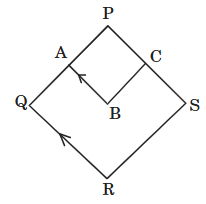
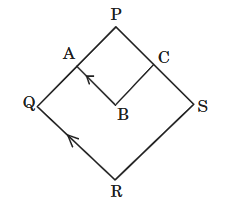
In the figure $A B|\mid Q R$ and $B C| \mid R S$. Prove that
$\frac{P A}{P Q}=\frac{P C}{P S}$
Image
Answer
To prove: $\frac{P A}{P Q}=\frac{P C}{P S}$
Given: $A B \| Q R$ and $B C \| R S$
Proof:
Image
Since $A B|\mid Q R$,
$\angle P A B=\angle P Q R [$Corresponding angles are equal$]$
$\angle P B A=\angle P R Q [$Corresponding angles are equal$]$
Hence in $\triangle P A B$ and $\triangle P Q R$,
$\angle A P B=\angle Q P R$ [Common angle]
$\angle P A B=\angle P Q R$ and $\angle P B A=\angle P R Q$
$\triangle P A B \sim \triangle P Q R$ since all the angles are equal.
Similarly $B C|\mid R S$
$\angle P C B=\angle P S R [$Corresponding angles are equal$]$
$\angle P B C=\angle P R S [$Corresponding angles are equal$]$
Hence in $\triangle P C B$ and $\triangle P S R$,
$\angle C P B=\angle S P R [$common angle$]$
$\angle P C B=\angle P S R$ and $\angle P B C=\angle P R S$
$\triangle P C B \sim \triangle P S R$ since all the angles are equal.
Now $\triangle P C B \sim \triangle P S R$ and $\triangle P A B \sim \triangle P Q R$,
Therefore their corresponding sides are proportional,
$\frac{P C}{P S}=\frac{P B}{P R} \ldots \ldots(i)$
$\frac{P A}{P Q}=\frac{P B}{P R} \ldots \ldots(ii)$
Hence from $(i)$ and $(ii),$
$\frac{P A}{P Q}=\frac{P C}{P S}$
Hence proved.
View full question & answer
Question 63 Marks
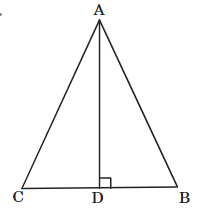
In an equilateral triangle $\text{ABC} , A D$ is an altitude drawn from $A$ on the side $B C$. Prove that $\frac{3}{4} A B^2=A D^2$
Answer
Considering the given situation, following diagram can be drawn:
Image
In the $\triangle A B C, AD$ is the Altitude.
$A D^2+D B^2=A B^2$
$D B=\frac{1}{2} B C \ \ ($Perpendicular to base bisects the side in equilateral triangle$)$
$A D^2+\left(\frac{1}{2} B C\right)^2=A B^2$
$\Rightarrow A D^2+\frac{B C^2}{4}=A B^2$
$\Rightarrow 4 A D^2+B C^2=4 A B^2$
$\Rightarrow 4 A D^2=4 A B^2-B C^2$
$\Rightarrow 4 A D^2=4 A B^2-A B^2 \quad(B C=A B$ in equilateral triangle$)$
$\Rightarrow 4 A D^2=3 A B^2$
$\Rightarrow A D^2=\frac{3}{4} \times A B^2$
Hence Proved.
View full question & answer
Question 73 Marks
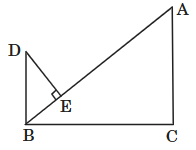
In the given figure, $D B \perp B C ; D E \perp A B$ and $A C \perp B C$. Prove that $\frac{B E}{D E}=\frac{A C}{B C}$
Image
Answer
$B D \| A C$
In $\triangle B E D$ and $\triangle A B C$,
$\angle B E D=\angle A C B \quad\left(\right.$ each $\left.90^{\circ}\right)$
$\angle D B A=\angle B A C \quad$ (Alternate interior angles)
$\Rightarrow \triangle B E D \sim \triangle A C B$ (By AAA rule)
So, $\frac{B E}{A C}=\frac{D E}{B C}$ (Ratio of corresponding sides of similar traingles)
Or, $\frac{B E}{D E}=\frac{A C}{B C}$
Hence Proved.

View full question & answer
Question 83 Marks
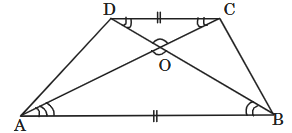
Diagonals of a trapezium $A B C D$ with $A B|\mid D C$ intersect each other at the point $O$. If $A B=2 C D$, find the ratio of the area of triangles $A O B$ and COD.
Answer
Considering the given situation, following diagram can be drawn:
Image
Given that $A B \| D C \cdot A C$ and $B D$ are diagonals that intersect each other at $O$.
Therefore, $\angle A O B=\angle C O D$ (vertically opposite angles)
Also, $\angle O A B=\angle O C D$ (alternate angles)
Similarly, $\angle O B A=\angle O D C$ (alternate angles)
Hence, $\triangle A O B \sim \triangle C O D$ (by AAA similarity criteria)
Also, we know that the ratio of the areas of two similar triangles is equal to the square of the ratio of their corresponding sides
So, $\frac{\operatorname{ar} \triangle A O B}{\operatorname{ar} \triangle C O D}=\frac{(A B)^2}{(C D)^2}$
Or, $\frac{a r \triangle A O B}{a_r \triangle C O D}=\frac{(2 C D)^2}{(C D)^2}=\frac{(2)^2}{(1)^2}=\frac{4}{1}$
Therefore, ar $\triangle A O B:$ ar $\triangle C O D=4: 1$

View full question & answer
Question 93 Marks
Prove that the sum of the squares of the sides of a rhombus is equal to the sum of the squares of its diagonals
Answer
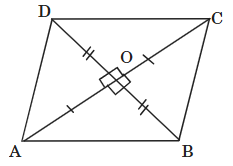
Consider a rhombus ABCD as shown in the figure:
Image
We know that the diagonals of a rhombus bisect each other at right angles. Therefore;
$AO = CO =\frac{1}{2} AC\quad \quad \ldots \ldots(i)$
$BO = DO =\frac{1}{2} BD\quad \quad \ldots \ldots(ii)$
Also, $\angle A O B=\angle B O C=\angle C O D=\angle D O A=90^{\circ}\quad \quad \ldots \ldots(iii)$
Now, consider the right triangle $A O B$.
$A B^2=A O^2+B O^2$
$\Rightarrow A B^2=\left(\frac{1}{2} A C\right)^2+\left(\frac{1}{2} B D\right)^2$
(from equation (i) and (ii)\}
$\Rightarrow A B^2=\frac{1}{4} A C^2+\frac{1}{4} B D^2\quad \quad \ldots \ldots(iv)$
Similarly,
$
B C^2=\frac{1}{4} A C^2+\frac{1}{4} B D^2(v)
$
And, $C D^2=\frac{1}{4} A C^2+\frac{1}{4} B D^2\quad \quad \ldots \ldots(vi)$
Again $A D^2=\frac{1}{4} A C^2+\frac{1}{4} B D^2\quad \quad \ldots \ldots(vii)$
Add equations (iv), (v), (vi) and (vii),
we get; $A B^2+B C^2+C D^2+A D^2$
$=\frac{1}{4} A C^2+\frac{1}{4} A C^2+\frac{1}{4} A C^2+\frac{1}{4} A C^2+$
$\frac{1}{4} B D^2+\frac{1}{4} B D^2+\frac{1}{4} B D^2+\frac{1}{4} B D^2$
$A B^2+B C^2+C D^2+A D^2=A C^2+B D^2$
Hence proved.
View full question & answer
Question 103 Marks
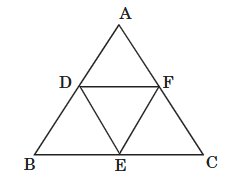
$\text{D, E, F}$ are respectively the mid-points of the sides $\text{A B, B C}$ and $C A$ of $\triangle A B C$. Find the ratios of area of $\triangle D E F$ and $\triangle A B C$.
Answer
According to the given information, the following figure can be drawn:
Image
According to the mid-point theorem, the line joining the midpoints of two sides of a triangle is parallel to third side and half of it.
Therefore, $A B||E F, B C|| D F$ and $A C \| D E$, and or
$\frac{E F}{A B}=\frac{1}{2}$
$\frac{D F}{B C}=\frac{1}{2}$
$\frac{D E}{A C}=\frac{1}{2}$
We know that if in two triangles, sides of one triangle are proportional to the sides of the other triangle, then their corresponding angles are equal and hence the two triangles are similar.
Hence, $\triangle A B C \sim \triangle D F E ($by $SSS$ congruency rule$)$ Again, according to the theorem, the ratio of the areas of two similar triangles is equal to the square of the ratio of their corresponding sides.
$\therefore \frac{\operatorname{ar}(\triangle D F E)}{\operatorname{ar}(\triangle A B C)}=\frac{E F^2}{A B^2}=\left[\frac{(E F)^2}{(2 E F)^2}\right]=\frac{1^2}{2^2}=\frac{1}{4}$
Hence, the ratio of the areas of two triangles will be $1: 4$
View full question & answer
Question 113 Marks
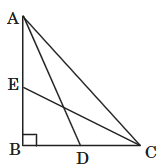
$\triangle A B C$ is right angled at $B . A D$ and $C E$ are the two medians drawn from $A$ and $C$, respectively. If $A C=5 \ cm, A D=\frac{3 \sqrt{5}}{2} \ cm$, find the length of $C E$.
Image
Answer
Applying Pythagoras Theorem in $\triangle A B C$,
$A C^2=A B^2+B C^2 \ldots(i)$
Applying Pythagoras Theorem in $\triangle A B D$,
$A D^2=A B^2+B D^2$
$B D=\frac{1}{2} B C$ as $A D $ is median.
$A D^2=A B^2+\left(\frac{1}{2} B C\right)^2$
$A D^2=A B^2+\frac{1}{4} B C^2 \ldots \ldots\text{(ii)}$
Subtract $(ii)$ from $(i),$
$A C^2-A D^2=A B^2+B C^2-\left(A B^2+\frac{1}{4} B C^2\right)$
Substitute $A C 5 \ cm, A D=\frac{3 \sqrt{5}}{2} \ cm$
$\Rightarrow 5^2-\left(\frac{3 \sqrt{5}}{2}\right)^2=\frac{3}{4} B C^2$
$\Rightarrow 25-\frac{45}{4}=\frac{3}{4} B C^2$
$\Rightarrow \frac{55}{4}=\frac{3}{4} B C^2$
$\Rightarrow B C^2=\frac{55}{3} \ldots . . \text { (iii) }$
Substitute the above value in equation $(i),$ we get
$5^2=A B^2+\left(\frac{55}{3}\right)$
$\Rightarrow A B^2=25-\frac{55}{3}=\frac{20}{3} \ldots(i v)$
Consider $\triangle E B C$,
$C E^2=B C^2+B E^2$
$\Rightarrow C E^2=B C^2+\left(\frac{1}{2} A B\right)^2$
$(CE$ is median, so $B E=\frac{1}{2}(A B))$ 
$\Rightarrow C E^2=B C^2+\frac{1}{4} A B^2$
$\Rightarrow C E^2=\frac{55}{3}+\frac{1}{4}\left(\frac{20}{3}\right)$
$($Using $(iii)$ and $(iv))$
$\Rightarrow C E^2=\frac{55}{3}+\left(\frac{5}{3}\right)=20$
$\Rightarrow C E=\sqrt{20}$
$=2 \sqrt{5} \ cm .$
View full question & answer
Question 123 Marks
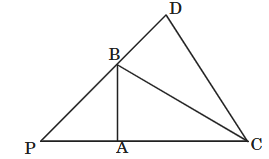
Two right triangles $\text{ABC}$ and $\text{DBC}$ are drawn on the same hypotenuse $B C$ and on the same side of $B C$. If $A C$ and $B D$ intersect at $P$, prove that : $A P \times P C=B P \times D P .$
Answer
$\triangle A B C$ and $\triangle D B C$ are right angled triangles at $A$ and $D$ respectively.
$\triangle D P C$ is a right angled triangle at $D$.
Represent the given information as a diagram,
Image
Using Pythagoras Theorem,
$C P^2=C D^2+D P^2$
$\Rightarrow C D^2=C P^2-D P^2$
Now, $C P=C A+A P$ and $D P=D B+B P$
$\Rightarrow C D^2=(C A+A P)^2-(D B+B P)^2$
$\text { Use }(a+b)^2=a^2+2 a b+b^2$
$\Rightarrow C D^2=C A^2+2 C A \cdot A P+A P^2$
$\left(D B^2+2 D B \cdot B P+B P^2\right)$
$\Rightarrow C D^2=C A^2+A P^2+2$
$C A \cdot A P-D B^2-B P^2-2 D B \cdot B P$
$\Rightarrow C D^2+D B^2=C A^2-\left(B P^2-A P^2\right) +2 C A A P-2 D B \cdot B P$
$\Rightarrow C B^2=C A^2-A B^2+2 C A \cdot A P-2 D B \cdot B P$
$\Rightarrow 2 A B^2=2 C A \cdot A P-2 D B \cdot B P$
$\left(C B^2=A B^2+A C^2 \Rightarrow C B^2-A C^2=A B^2\right)$
$\Rightarrow A B^2=(P C-A P) A P-(D P-B P) B P$
$\Rightarrow A B^2=A P \cdot P C-A P^2-D P \cdot B P+B P^2$
$\Rightarrow A B^2=A P \cdot P C-D P \cdot B P+A B^2$
$\Rightarrow A P \times P C=D P \times B P$
Hence proved. 
View full question & answer
Question 133 Marks
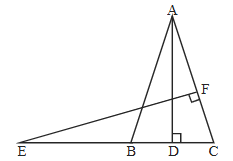
In the given figure, E is a point on the side CB produced of an isosceles triangle $A B C$ with $A B=$ AC . If $AD \perp BC$ and $EFI \perp AC$, then prove that $\triangle ABD \sim \triangle ECF$.
Image
Answer
Given
$
AB=AC
$
$
\therefore \quad \angle B=\angle C
$
In $\triangle ABD$ and $\triangle ECF$
$
\begin{aligned}
\angle B & =\angle C(\text { From (i) }) \\
\angle ADB & =\angle EFC=90^{\circ} \\
& {[\because AD \perp BC \text { and } EF \perp AC .] }
\end{aligned}
$
$\therefore$ By AA Criterion of Similarity, $\triangle ABD \sim \triangle ECF$
[hence proved)
View full question & answer
Question 143 Marks
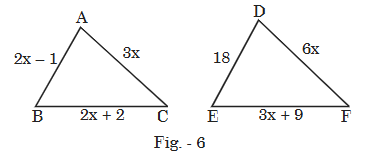
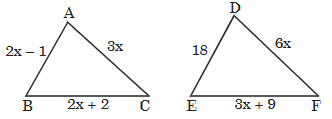
In figure, if $\triangle ABC \sim \triangle DEF$ and their sides of lengths $($in $\ cm )$ are marked along them, then find the lengths of sides of each triangle.
Image
Answer
Image
Given : $\triangle ABC \sim \triangle ADE$
To find: Length of all sides
$\because ABC \sim \triangle DEF$
$\frac{AB}{DE}=\frac{BC}{EF}=\frac{AC}{DF}$
$\Rightarrow \frac{2 x-1}{18}$
$=\frac{2 x+2}{3 x+9}=\frac{3 x}{6 x}=\frac{1}{2}$
$\Rightarrow 2(2 x-1)=18$
$\Rightarrow 2 x-1=9$
$\Rightarrow 2 x=10$
$\Rightarrow x=5$
$\therefore AB=2 x-1=2 \times 5-1=9$
$BC=2 x+2=2 \times 5+2=12$
$AC=3 x=3 \times 5=15$
$DE=18$
$EF=3 x+9=3 \times 5+9=24$
$DF=6 x=6 \times 5=30$
View full question & answer
Question 153 Marks
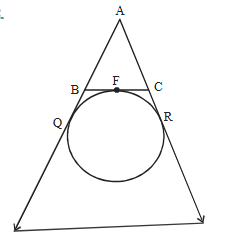
If a circle touches the side $BC$ of a triangle $ABC$ at $P$ and extended sides $A B$ and $A C$ at $Q$ and $R$, respectively, prove that $AQ =\frac{1}{2}( BC + CA + AB )$
Answer
Image
We know that lengths of tangents drawn from an external point to a circle are equal.
$\therefore AQ =AR \ldots(i)(\text { tangents from } A)$
$BP =BQ \ldots \text { (iii) } \text { (tangents from } B)$
$CP =CR \ldots(iii)(\text { tangents from } C)$
$\text { Perimeter of } \triangle ABC=AB+BC+CA$
$=AB+BP+CP+AC$
$=AB+BQ+CR+AC$
$\text { By (ii) and (iii) }$
$=AQ+AR=2 AQ(by(i))$
$\left.\Rightarrow AQ=\frac{1}{2} \text { (Perimeter } ABC\right)$
View full question & answer
Question 163 Marks
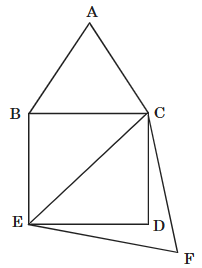
Prove that the area of equilateral triangle described on one side of the square is equal to half of the area of an equilateral triangle described on one of its diagonal.
Answer
The diagram will be:
Image
Let the length of the side of the square be $a$.
Diagonal of the square EC $=\sqrt{2} a$
Area of an equilateral triangle $=\frac{\sqrt{3}}{4}(\text { side })^2$
Area of $\triangle A B C=\frac{\sqrt{3}}{4} a^2$
Area of $\triangle E C F=\frac{\sqrt{3}}{4}(\sqrt{2} a)^2$
$
=\frac{\sqrt{3}}{4} \times 2 a^2=\frac{\sqrt{3}}{2} \times a^2=\frac{1}{2}\left(\frac{\sqrt{3}}{2} \times a^2\right)
$
Which is equal to half of area of $\triangle A B C$.
Hence proved.

View full question & answer
Question 173 Marks
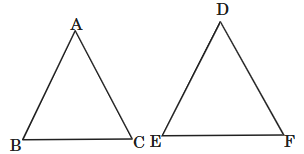
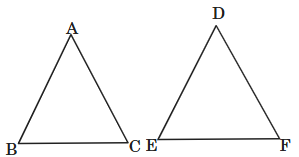
If the area of two similar triangles are equal, prove that they are congruent.
Answer
Let the two triangles be $\triangle A B C$ and $\triangle D E F$
Image
If two triangles are similar than the ratio of areas is equal to square of ratio of its corresponding sides
$\frac{\text { ar } \triangle A B C}{\text { ar } \triangle D E F}=\left(\frac{B C}{E F}\right)^2=\left(\frac{A B}{D E}\right)^2=\left(\frac{A C}{D F}\right)^2$
As the areas are same
$\therefore\left(\frac{B C}{E F}\right)^2=\left(\frac{A B}{D E}\right)^2=\left(\frac{A C}{D F}\right)^2=1$
$\Rightarrow \frac{B C}{E F}=\frac{A B}{D E}=\frac{A C}{D F}=1$
$\text { or } B C=E F, A B=D E \text { and } A C=D F$
Now in $\triangle A B C$ and $\triangle D E F$
Image
$A B=D E$
$B C=E F$
$C A=F D$
Hence by SSS congruency
$\triangle A B C \cong \triangle D E F$
Hence proved.
View full question & answer
Question 183 Marks
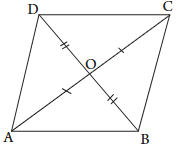
Prove that the sum of the squares of the sides of a rhombus is equal to the sum of the squares of its diagonals.
Answer
$\Rightarrow$ Given: Rhombus $\text{ABCD}$ with diagonals $AC \| B D$ intersecting at $=0$.
Image
To prove: Sum of the square of all sides $=$ sum of the square of it's diagonals.
$\Rightarrow AB^2+BC^2+CD^2+AD^2=AC^2+BD^2$
Proof: Since, side of a rhombus are equal
$\therefore AB=BC=CD=AD$
We know that, diagonals of a rhombus bisect each other at a right angles.
Therefore,
$\angle AOB=\angle BOC=\angle COD=\angle DOA=90^{\circ}$
Also $AO = CO =\frac{1}{2} AC \ldots \ldots(i)$
and $BO = DO =\frac{1}{2} BD \ldots \ldots(ii)$
Now, $\text{AOB}$ is a right angle triangle
By, Py thagoras theorem.
$(AB)^2=(OA)^2+(OB)^2$
$(AB)^2=\left(\frac{1}{2} AC\right)^2+\left(\frac{1}{2} BD\right)^2 \ \ [$ from equation $(i)\  (ii)]$
$AB^2=\frac{AC^2}{4}+\frac{BD^2}{4}$
$4 AB^2=AC^2+BD^2$
$\Rightarrow AB^2+AB^2+AB^2+AB^2=AC^2+BD^2$
$\Rightarrow AB^2+BC^2+CD^2+AD^2=AC^2+BD^2$
$($Since sides of a rhombus are equal$)$
 
View full question & answer
Question 193 Marks
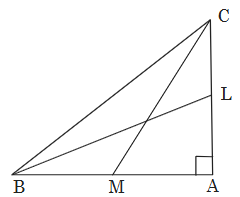
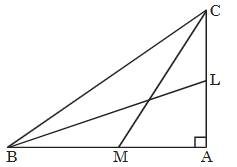
In figure $, BL$ and $CM$ are medians of a $\triangle ABC$ right $-$ angled at $A$ . Prove that $4\left( BL ^2+ CM ^2\right) =5\  BC ^2$.
Image
Answer
Given : $\triangle ABC$, right angled at $A $.
$BL$ and $CM$ are medians.
To prove : $4\left( BL ^2+ CM ^2\right)=5 BC ^2$
Image
proof $\operatorname{In} \triangle ABL$,
By Pythagoras theorem, $( BL )^2=( AB )^2+( AL )^2$
$\Rightarrow BL ^2= AB ^2+\left(\frac{ AC }{2}\right)^2 \ \ (\because BL$ is median $)$
$\Rightarrow BL ^2= AB ^2+\frac{ AC ^2}{4}$.
In $\triangle ACM$, By Pythagoras theorem.
$CM^2=AC^2+AM^2$
$\Rightarrow CM^2=AC^2+\left(\frac{AB}{2}\right)^2 \ \ (\because CM $ is median$)$
$\Rightarrow CM^2=AC^2+\frac{AB^2}{4} \text { ..... (ii) }$
Adding equation $(i) $ and $(ii),$ we get
$BL^2+CM^2=AB^2+\frac{AC^2}{4}+AC^2+\frac{AB^2}{4}$
$\Rightarrow BL^2+CM^2=\frac{5 AB^2}{4}+\frac{5 AC^2}{4}$
$\Rightarrow 4\left(BL^2+CM^2\right)=5\left(AB^2+AC^2\right)$
$\Rightarrow 4\left(BL^2+CM^2\right)=5 BC^2$
[In $\triangle ABC$, by pythagoras theorem $BC ^2$
$\left.[= AB ^2+ AC ^2\right]$
View full question & answer
Question 203 Marks
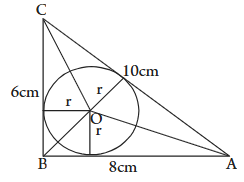
$\text{ABC}$ is a right triangle in which $\angle B =90^{\circ}$. If $A B=8 \ cm$ and $B C=6 \ cm,$ find the diameter of the circle inscribed in the triangle.
Answer
In $\triangle ABC$,
Image
By pythagoras theorem,
$(AB)^2=(AB)^2+(BC)^2$
$AC=\sqrt{(8)^2+(6)^2}=\sqrt{64+36}$
$=\sqrt{100}=10 \ cm$
$\therefore \operatorname{Ar}(\triangle ABC)$
$=\operatorname{Ar}(\triangle AOB)+\operatorname{Ar}(\triangle BOC)+\operatorname{Ar}(\Delta COA)$
$\Rightarrow \frac{1}{2} \times AB \times BC$
$=\frac{1}{2} \times AB \times r+\frac{1}{2} \times BC \times r+\frac{1}{2} \times AC \times r$
$\Rightarrow \frac{1}{2} \times 8 \times 6$
$=\frac{1}{2} \times 8 \times r+\frac{1}{2} \times 6 \times r+\frac{1}{2} \times 10 \times r$
$\Rightarrow 48=8 r+6 r+10 r$
$\Rightarrow 48=24 r$
$ \Rightarrow r=\frac{48}{24}=2$
radius of circle $=2 \ cm$
$\therefore$ diameter of circle $=2 r=2 \times 2=4 \ cm$
View full question & answer
3 Marks Question - Maths STD 10 Questions - Vidyadip