Question
Two right triangles $\text{ABC}$ and $\text{DBC}$ are drawn on the same hypotenuse $B C$ and on the same side of $B C$. If $A C$ and $B D$ intersect at $P$, prove that : $A P \times P C=B P \times D P .$
Answer

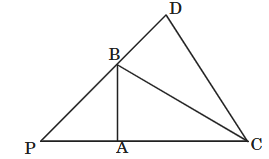
$\triangle A B C$ and $\triangle D B C$ are right angled triangles at $A$ and $D$ respectively.
$\triangle D P C$ is a right angled triangle at $D$.
Represent the given information as a diagram,
Image
Using Pythagoras Theorem,
$C P^2=C D^2+D P^2$
$\Rightarrow C D^2=C P^2-D P^2$
Now, $C P=C A+A P$ and $D P=D B+B P$
$\Rightarrow C D^2=(C A+A P)^2-(D B+B P)^2$
$\text { Use }(a+b)^2=a^2+2 a b+b^2$
$\Rightarrow C D^2=C A^2+2 C A \cdot A P+A P^2$
$\left(D B^2+2 D B \cdot B P+B P^2\right)$
$\Rightarrow C D^2=C A^2+A P^2+2$
$C A \cdot A P-D B^2-B P^2-2 D B \cdot B P$
$\Rightarrow C D^2+D B^2=C A^2-\left(B P^2-A P^2\right) +2 C A A P-2 D B \cdot B P$
$\Rightarrow C B^2=C A^2-A B^2+2 C A \cdot A P-2 D B \cdot B P$
$\Rightarrow 2 A B^2=2 C A \cdot A P-2 D B \cdot B P$
$\left(C B^2=A B^2+A C^2 \Rightarrow C B^2-A C^2=A B^2\right)$
$\Rightarrow A B^2=(P C-A P) A P-(D P-B P) B P$
$\Rightarrow A B^2=A P \cdot P C-A P^2-D P \cdot B P+B P^2$
$\Rightarrow A B^2=A P \cdot P C-D P \cdot B P+A B^2$
$\Rightarrow A P \times P C=D P \times B P$
Hence proved. 

Need a full question paper?

Generate a complete, print-ready paper with questions like this in minutes — across 16+ boards, with answer keys.
Start Generating Free

Similar questions

A right circular cone and a right circular cylinder have equal base and equal height. If the radius of the base and height are in the ratio 5 : 12, write the ratio of the total surface area of the cylinder to that of the cone.
The houses of a row are numbered consecutively from $1$ to $49$. Show that there is a value of x such that the sum of the numbers of the houses preceding the house numbered x is equal to the sum of the numbers of the houses following it. Find this value of $x.$
[Hint: $S_{x-1} = S_{49} - S_x]$
Find the sum of the first 15 terms of each of the following sequences having $n^{th} $term as:
$y_n = 9 - 5n.$
Find the value of k if points A(k, 3), B(6, -2) and C(-3, 4) are collinear.
In the given figure, $\text{AB , BC , CD}$ and $DA$ are tangents to the circle with centre $O$ forming a quadrilateral $\text{A B C D}$.
Show that $\angle AOB +\angle COD =180^{\circ}$
Image
The government rescued $100$ people after a train accident. Their ages were recorded in the following table. Find their mean age.
Age $($in years$)$ Number of people rescued
$10-20$ $9$
$20-30$ $14$
$30-40$ $15$
$40-50$ $21$
$50-60$ $23$
$60-70$ $12$
$70-80$ $6$
Tangents $PA$ and $PB$ are drawn from an external point $P$ to two concentric circles with centre $O$ and radii $8 \ cm$ and $5 \ cm$ respectively, as shown in the figure. If $AP = 15 \ cm$ then find the length of $BP$.
Image
Find whether 55 is a term of the AP $7, 10, 13,---$ or not. If yes, find which term it is.
AB and CD are common tangents to two circles of equal radii. Prove that AB = CD.
If $A(-2,1), B(a, 0), C(4, b)$ and $D(1,2)$ are the vertices of a parallelogram $\text{ABCD},$ find the values of $a$ and $b$. Hence find the lengths of its sides. $A( x_1, y_1)$