Question 14 Marks
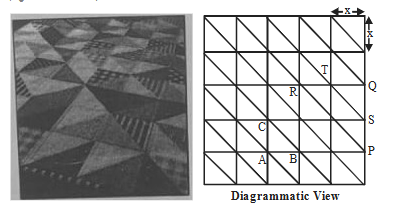
Quilts are available in various colours and design. Geometric design includes shapes like squares, triangles, rectangles, hexagons etc.
One such design is shown above. Two triangles are highlighted, $\triangle ABC$ and $\triangle PQR .$
Based on above information, answer the following questions:
$1.$ Which of the following criteria is not suitable for $\triangle ABC$ to be similar to $\triangle QRP ?$
$(a) \ \text{SAS} \ (b) \ \text{AAA}$
$(c) \ \text{SSS} \ (d) \ \text{RHS}$
$2.$ If each square is of length $x$ unit, then length $B C$ is equal to
$(a) \ x \sqrt{2}$ unit $(b) \ 2 x$ unit
$(c) \ 2 \sqrt{x}$ unit $(d)\ x \sqrt{x}$ unit
$3.$ Ratio $BC : PR$ is equal to
$(a) \ 2: 1 \ (b)\ 1: 4 $
$(c) \ 1: 2 \ (d)\ 4: 1$
$4. \operatorname{ar}( PQR ): \operatorname{ar}( ABC )$ is equal to
$(a) \ 2: 1 \ (b) \ 1: 4 $
$(c) \ 4: 1 \ (d) \ 1: 8$
$5.$ Which of the following is not true?
$(a) \ \triangle TQS \sim \triangle PQR \ (b) \ \triangle CBA \sim \Delta STQ $
$(c) \ \triangle BAC \sim \triangle PQR \ (d) \ \triangle PQR \sim \triangle ABC$
Answer
View full question & answer→$1. - (d)$
$\text{RHS}$ is not a similarity criterion.
$2. - (a)$
Since $AB = AC = x$ units
$\Rightarrow AB^2+AC^2=BC^2
$ (by Pythagoras theorem)
$\Rightarrow x^2+x^2=BC^2$
$\Rightarrow BC^2=2 x^2$
$\therefore BC=x \sqrt{2} \text { units }$
$3. - (c)$
Here $QR =2 x$ and $QP =2 x$
$\Rightarrow PR^2=QR^2+QP^2$
$\Rightarrow PR^2=(2 X)^2+(2 X)^2$
$\Rightarrow PR^2=4 X^2+4 X^2$
$\Rightarrow PR^2=8 X^2$
$\Rightarrow PR=2 \sqrt{2 x}$
Now, $BC : PR =\sqrt{2 x }: 2 \sqrt{2 x }=1: 2$
$4. - (c)$
Since $\frac{ AB }{ QP }=\frac{ BC }{ PR }=\frac{ CA }{ RQ }$
$\triangle ABC \sim \Delta QPR$
$($by SSS similarity criterion$)$
$\Rightarrow \frac{\operatorname{ar}(\triangle QPR)}{\operatorname{ar}(\triangle ABC)}=\left(\frac{PR}{BC}\right)^2$
$($If two triangles are similar, then the ratio of the area of both triangles is proportional to the square of the ratio of their corresponding sides.$)$
$\Rightarrow \frac{\operatorname{ar}(\triangle QPR)}{\operatorname{ar}(\triangle ABC)}=\left(\frac{2}{1}\right)^2$
$\Rightarrow \frac{\operatorname{ar}(\triangle QPR)}{\operatorname{ar}(\triangle ABC)}=\frac{4}{1}$
$5. - (d)$ Since $\triangle A B C \sim \triangle Q P R, \triangle P Q R$ is not similar to $\triangle A B C$. The points $A$ and $B$ are not corresponding to $P$ and $Q$ respectively.
$\text{RHS}$ is not a similarity criterion.
$2. - (a)$
Since $AB = AC = x$ units
$\Rightarrow AB^2+AC^2=BC^2
$ (by Pythagoras theorem)
$\Rightarrow x^2+x^2=BC^2$
$\Rightarrow BC^2=2 x^2$
$\therefore BC=x \sqrt{2} \text { units }$
$3. - (c)$
Here $QR =2 x$ and $QP =2 x$
$\Rightarrow PR^2=QR^2+QP^2$
$\Rightarrow PR^2=(2 X)^2+(2 X)^2$
$\Rightarrow PR^2=4 X^2+4 X^2$
$\Rightarrow PR^2=8 X^2$
$\Rightarrow PR=2 \sqrt{2 x}$
Now, $BC : PR =\sqrt{2 x }: 2 \sqrt{2 x }=1: 2$
$4. - (c)$
Since $\frac{ AB }{ QP }=\frac{ BC }{ PR }=\frac{ CA }{ RQ }$
$\triangle ABC \sim \Delta QPR$
$($by SSS similarity criterion$)$
$\Rightarrow \frac{\operatorname{ar}(\triangle QPR)}{\operatorname{ar}(\triangle ABC)}=\left(\frac{PR}{BC}\right)^2$
$($If two triangles are similar, then the ratio of the area of both triangles is proportional to the square of the ratio of their corresponding sides.$)$
$\Rightarrow \frac{\operatorname{ar}(\triangle QPR)}{\operatorname{ar}(\triangle ABC)}=\left(\frac{2}{1}\right)^2$
$\Rightarrow \frac{\operatorname{ar}(\triangle QPR)}{\operatorname{ar}(\triangle ABC)}=\frac{4}{1}$
$5. - (d)$ Since $\triangle A B C \sim \triangle Q P R, \triangle P Q R$ is not similar to $\triangle A B C$. The points $A$ and $B$ are not corresponding to $P$ and $Q$ respectively.