Question
Image
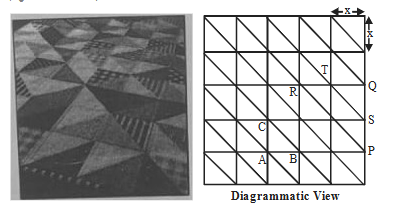
Quilts are available in various colours and design. Geometric design includes shapes like squares, triangles, rectangles, hexagons etc.
One such design is shown above. Two triangles are highlighted, $\triangle ABC$ and $\triangle PQR .$
Based on above information, answer the following questions:
$1.$ Which of the following criteria is not suitable for $\triangle ABC$ to be similar to $\triangle QRP ?$
$(a) \ \text{SAS} \ (b) \ \text{AAA}$
$(c) \ \text{SSS} \ (d) \ \text{RHS}$
$2.$ If each square is of length $x$ unit, then length $B C$ is equal to
$(a) \ x \sqrt{2}$ unit $(b) \ 2 x$ unit
$(c) \ 2 \sqrt{x}$ unit $(d)\  x \sqrt{x}$ unit
$3.$ Ratio $BC : PR$ is equal to
$(a) \ 2: 1 \ (b)\  1: 4 $
$(c) \ 1: 2 \ (d)\  4: 1$
$4. \operatorname{ar}( PQR ): \operatorname{ar}( ABC )$ is equal to
$(a) \ 2: 1 \ (b) \ 1: 4 $
$(c) \ 4: 1 \ (d) \ 1: 8$
$5.$ Which of the following is not true?
$(a) \ \triangle TQS \sim \triangle PQR \ (b) \ \triangle CBA \sim \Delta STQ $
$(c) \ \triangle BAC \sim \triangle PQR \ (d) \ \triangle PQR \sim \triangle ABC$
Answer

$1. - (d)$
$\text{RHS}$ is not a similarity criterion.
$2. - (a)$
Since $AB = AC = x$ units
$\Rightarrow AB^2+AC^2=BC^2
$ (by Pythagoras theorem)
$\Rightarrow x^2+x^2=BC^2$
$\Rightarrow BC^2=2 x^2$
$\therefore BC=x \sqrt{2} \text { units }$
$3. - (c)$
Here $QR =2 x$ and $QP =2 x$
$\Rightarrow PR^2=QR^2+QP^2$
$\Rightarrow PR^2=(2 X)^2+(2 X)^2$
$\Rightarrow PR^2=4 X^2+4 X^2$
$\Rightarrow PR^2=8 X^2$
$\Rightarrow PR=2 \sqrt{2 x}$
Now, $BC : PR =\sqrt{2 x }: 2 \sqrt{2 x }=1: 2$
$4. - (c)$
Since $\frac{ AB }{ QP }=\frac{ BC }{ PR }=\frac{ CA }{ RQ }$
$\triangle ABC \sim \Delta QPR$
$($by SSS similarity criterion$)$
$\Rightarrow \frac{\operatorname{ar}(\triangle QPR)}{\operatorname{ar}(\triangle ABC)}=\left(\frac{PR}{BC}\right)^2$
$($If two triangles are similar, then the ratio of the area of both triangles is proportional to the square of the ratio of their corresponding sides.$)$
$\Rightarrow \frac{\operatorname{ar}(\triangle QPR)}{\operatorname{ar}(\triangle ABC)}=\left(\frac{2}{1}\right)^2$
$\Rightarrow \frac{\operatorname{ar}(\triangle QPR)}{\operatorname{ar}(\triangle ABC)}=\frac{4}{1}$
$5. - (d)$ Since $\triangle A B C \sim \triangle Q P R, \triangle P Q R$ is not similar to $\triangle A B C$. The points $A$ and $B$ are not corresponding to $P$ and $Q$ respectively.

Need a full question paper?

Generate a complete, print-ready paper with questions like this in minutes — across 16+ boards, with answer keys.

Start Generating Free

Similar questions

Read the text carefully and answer the questions:
Kamla and her husband were working in a factory in Seelampur, New Delhi. During the pandemic, they were asked to leave the job.As they have very limited resources to survive in a metro city, they decided to go back to their hometown in Himachal Pradesh.After a few months of struggle, they thought to grow roses in their fields and sell them to local vendors as roses have been always in demand.Their business started growing up and they hired many workers to manage their garden and do packaging of the flowers.
Image

In their garden bed, there are $23$ rose plants in the first row $, 21$ are in the $2^{\text {nd }}, 19$ in $3^{\text {rd }}$ row and so on. There are $5$ plants in the last row.
$(a)$ How many rows are there of rose plants?
$(b)$ Also, find the total number of rose plants in the garden.
OR
If total number of plants are $80$ in the garden, then find number of rows?
$(c)$ How many plants are there in 6th row.
In a class the teacher asks every student to write an example of A.P. Two friends Geeta and
Madhuri writes their progressions as -5, -2, 1, 4, ... and 187, 184, 181,.... respectively. Now,
the teacher asks various students of the class the following questions on these two progressions. Help students to find the answers of the questions
(i) Find the 34th term of the progression written by Madhuri.
(ii) Find the sum of common difference of the two progressions.
(iii) Find the sum of first 10 terms of the progression written by Geeta.
OR
Which term of the two progressions will have the same value?

Siya being a plant lover came up with an idea of opening a nursery during the lockdown and she
bought a few plants with pots. She wants to place pots in such a way that number of pots in row
one is 3, pots in row second is 5 and in third is 7 and so on.

(i) What is the difference in number of pots increasing per row?
(ii) If Siya wants to place 120 pots, how many rows will it require?
OR
Find the difference in number of pots placed in third and eighth row.
(iii)How many pots were placed in the 10th row?
Read the text carefully and answer the questions:
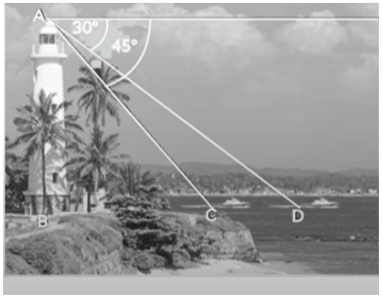
An observer on the top of a $40m$ tall light house $($including height of the observer$)$ observes a ship at an angle of depression $30^{\circ}$ coming towards the base of the light house along straight line joining the ship and the base of the light house.
The angle of depression of ship changes to $45^{\circ}$ after 6 seconds.

Image
$(a)$ Find the distance of ship from the base of the light house after $6$ seconds from the initial position when angle of depression is $45^{\circ}$.
$(b)$ Find the distance between two positions of ship after $6$ seconds?
OR
Find the distance of ship from the base of the light house when angle of depression is $30^{\circ}$.
$(c)$ Find the speed of the ship?
Points A and B representing Chandigarh and Kurukshetra respectively are almost 90 km apart from each other on the highway. A car starts from Chandigarh and another from Kurukshetra at the same time. If these cars go in the same direction, they meet in 9 hours and if these cars go in opposite direction they meet in 9/7 hours. Let X and Y be two cars starting from points A and B respectively and their speed be x km/hr and y km/hr respectively.
Then, answer the following questions.
  1. When both cars move in the same direction, then what situation can be represented as algebraically?
  2. When both cars move in opposite direction, then what situation can be represented as algebraically?
  3. what is the speed of car X?
    Or
    what is the speed of car Y?
The angle of elevation of an aeroplane from a point on the ground is 45°. After a flight of 15 seconds, the elevation changes to 30°. If the aeroplane is flying at a height of 3000 metres, find the speed of the aeroplane.
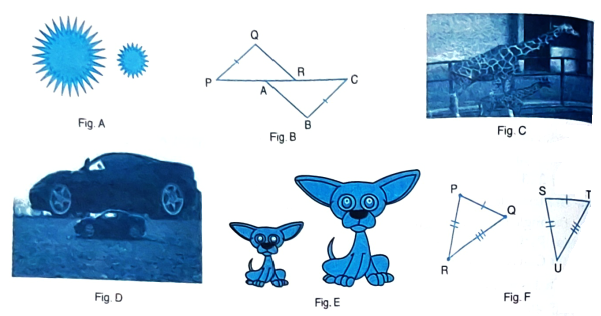
Observe the below given figures carefully and answer the questions:
Image
(i) Which among the above shown figures are congruent figures?
(a) A and C $\qquad$ (b) $E$ and $F$ $\qquad$ (c) $D$ and $F$ $\qquad$ (d) $B$ and $F$
(ii) Which of the following statements is correct?
(a) All similar figures are congruent.
(b) All congruent figures are similar.
(c) The criterion for similarity and congruency is same.
(d) Similar figures have same size and shape.
(iii) If a line divides any two sides of the triangle in the same ratio, then the line is parallel to the third side. Which theorem is depicted by this statement?
(a) Pythagoras
(b) Thales Theorem
(c) Converse of Thales theorem
(d) Converse of Pythagoras theorem
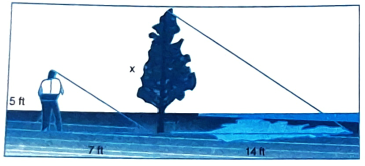
(iv) Using the concept of similarity, the height of the tree is
Image
(a) 12 ft $\qquad$ (b) 10 ft $\qquad$ (c) 15 ft $\qquad$ (d) 7 ft

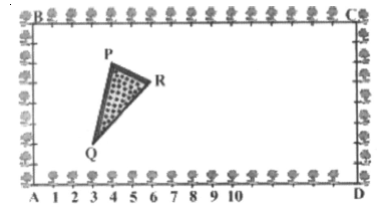
The Class X students of a secondary school in Krishinagar have been allotted a
rectangular plot of land for their gardening activity. Sapling of Gulmohar is planted
on the boundary of the plot at a distance of 1 m from each other. There is a triangular
grassy lawn inside the plot as shown in Fig. The students have to sow seeds of flowering
plants on the remaining area of the plot.

Based on the above information, answer the following questions.
(i) Considering A as the origin, what are the coordinates of A?
(ii) What are the coordinates of P?
(iii) What are the coordinates of R?
OR
What are the coordinates of D?