MCQ 11 Mark
The famous mathematician who gave an important truth called "Basic proportionality theorem" belongs to:
Answer(d)
Famous Greek mathematician Thales ( 600 B.C.) gave an important truth concerning equiangular triangles. Which is called Basic proportionality Theorem.
Hence the correct option is (d).
View full question & answer→MCQ 21 Mark
$\triangle D E F \sim \triangle A B C$; If $D E: A B=2: 3$ and $\operatorname{ar}(\triangle D E F)$ is equal to $44 $ square units, then area $(\triangle A B C)$ in square units is
- ✓
$99$
- B
$120$
- C
$\frac{176}{9}$
- D
$66$
AnswerWe know that,
The ratio of the areas of two similar triangles is equal to the square of the ratio of their corresponding sides.
$\frac{\operatorname{ar}(\triangle D E F)}{\operatorname{ar}(\triangle A B C)}=\frac{D E^2}{A B^2} \ldots \ldots(1)$
We have,
$ar(\triangle D E F)=44$ square units, and $ \frac{D E}{A B}=\frac{2}{3}$
Substituting above values in equation $(1),$
$\frac{44}{\triangle A B C}=\frac{2^2}{3^2}$
$\Rightarrow \frac{44}{\triangle A B C}=\frac{4}{9}$
$\Rightarrow \triangle A B C=\frac{44 \times 9}{4}$
$\Rightarrow \triangle A B C=11 \times 9=99$
The area $(\triangle A B C)$ in square units is $99$ .
View full question & answer→MCQ 31 Mark
In a $\triangle ABC , \angle A =x^{\circ}, \angle B =(3 x-2)^{\circ}, \angle C =y^{\circ}$. Also $\angle C -\angle B =9^{\circ}$. The sum of the greatest and the smallest angles of this triangle is
- ✓
$107^{\circ}$
- B
$135^{\circ}$
- C
$155^{\circ}$
- D
$145^{\circ}$
AnswerCorrect option: A. $107^{\circ}$
$\angle A = x ^{\circ}, \angle B =3 x -2^{\circ}$ and $\angle C = y ^{\circ}$
Sum of angles in a triangle is $180^{\circ}$
Therefore, $x+3 x-2+y=180^{\circ}$
or $4 x + y =182 \ldots \ldots(i)$
Also, $\angle C -\angle B =90^{\circ}$
or $ y-(3 x-2)=90^{\circ}$
or $ y-3 x=70^{\circ} \ldots \ldots(ii)$
Subtracting $(ii)$ from $(i),$ we get
$7 x=175$
or $ x=250$
Put $x=25^{\circ}$ in $(ii),$ we get $y=82^{\circ}$
Therefore,
$\angle A=25^{\circ}, \angle B=3 x-2$
$=3(25)-2=73^{\circ}$
And $\angle C = y ^{\circ}$
Sum of greatest and smallest angle
$=82^{\circ}+25^{\circ}=107^{\circ}$
View full question & answer→MCQ 41 Mark
In $\triangle ABC$ and $\triangle DEF , \angle F =\angle C , \angle B =\angle E$ and $AB =\frac{1}{2} DE$. Then the two triangles are
- A
Congruent, but not similar
- ✓
Similar, but not congruent
- C
Neither congruent nor similar
- D
Congruent as well as similar
AnswerCorrect option: B. Similar, but not congruent
(b)
According to the definition of similarity of two triangles, "Two triangles are similar when their corresponding angles are equal and the sides are in proportion".
View full question & answer→MCQ 51 Mark
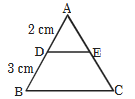
In figure, $DE \| BC , AD =2 cm$ and $BD =$ 3 cm , then $\operatorname{ar}(\triangle ABC ): \operatorname{ar}(\triangle ADE )$ is equal to
- A
$4: 25$
- B
$2: 3$
- C
$9: 4$
- ✓
$25: 4$
AnswerCorrect option: D. $25: 4$
(d)
By, AA similarity rule
$\triangle ABC \sim \triangle ADE$
According to the theorem, "Ration of area of similar triangles is equal to the square of the ratio of corresponding sides."
$
\therefore \frac{\operatorname{ar}(\triangle ABC)}{\operatorname{ar}(ADE)}=\frac{AB^2}{AD^2}=\frac{(2+3)^2}{(2)^2}=\frac{5^2}{2^2}=\frac{25}{4}
$
View full question & answer→MCQ 61 Mark
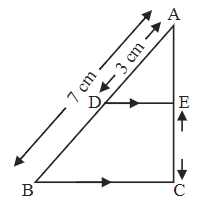
In the given figure, $DE \| BC$. If $AD =3 cm$, $A B=7 cm$ and $E C=3 cm$, then the length of AE is
Answer(d)
By applying the Property of Basic Proportionality Theorem, we know that:
$
\frac{AB}{AD}=\frac{EC}{AE}
$
View full question & answer→MCQ 71 Mark
If $\triangle PQR \sim \triangle ABC ; PQ =6 \ cm, AB =8 \ cm$ and the perimeter of $\triangle A B C$ is $36 \ cm ,$ then the perimeter of $\triangle PQR$ is
- A
$20.25 \ cm$
- ✓
$27 \ cm$
- C
$48 \ cm$
- D
$64 \ cm$
AnswerCorrect option: B. $27 \ cm$
Let perimeter of $\triangle PQR$ be $x \ cm$ .
Since triangles are similar,
$\therefore \frac{PQ}{AB}=\frac{\text { Perimeter of } \triangle PQR}{\text { Perimeter of } \triangle ABC}$
$\Rightarrow \frac{6}{8}=\frac{x}{36}$
$\Rightarrow x=\frac{6 \times 36}{8}$
$\Rightarrow p=27 .$
$\therefore$ Perimeter of $\triangle PQR=27 \ cm .$
View full question & answer→MCQ 81 Mark
In $\triangle ABC , DE \| BC , AD =2 \ cm, DB =3 \ cm , DE : BC$ is equal to
- A
$2: 3$
- ✓
$2: 5$
- C
$1: 2$
- D
$3: 5$
AnswerCorrect option: B. $2: 5$
Since $D E \| B C$
$\Rightarrow \angle ADE=\angle ABC \text { and } \angle AED=\angle ACB$
$\therefore$ By AA similarity criterion
$\triangle ADE \sim \triangle ABC$
$\text { By C.P.C.T. } \frac{ AD }{ AB }=\frac{ DE }{ BC }$
$\Rightarrow \frac{2}{5}=\frac{ DE }{ BC }( AB = AD + DB =2+3=5 \ cm)$
$\Rightarrow DE : BC =2: 5$
View full question & answer→MCQ 91 Mark
Which of the following is a correct statement?
- ✓
Two congruent figures are always similar
- B
Two similar figures are always congruent
- C
All rectangles are similar
- D
The polygons having same number of sides are similar.
AnswerCorrect option: A. Two congruent figures are always similar
(a)
Since two figures are congruent, their corresponding sides are equal and thus the ratio of corresponding sides will always be equal to 1 and equal to each other. Ther efore, two congruent figures are always similar.
View full question & answer→MCQ 101 Mark
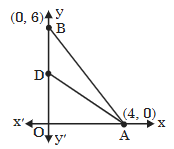
The vertices of a triangle $OAB$ are $O (0,0), A (4,0)$ and $B (0,6)$. The median $AD$ is drawn on $OB$ . The length $A D$ is
- A
$\sqrt{52}$ units
- ✓
$5$ units
- C
$25$ units
- D
$10$ units
AnswerCorrect option: B. $5$ units
Co$-$ordinates of $D$ can be found with help of mid$-$point formulai.e.
$\left(\frac{x_1+x_2}{2}, \frac{y_1+y_2}{2}\right)$
$\Rightarrow D=\left(\frac{0+0}{2}, \frac{0+6}{2}\right)$
$\Rightarrow D=\left(\frac{0}{2}, \frac{6}{2}\right)$
$\therefore D=(0,3)$
Now, length of $AD$ can be found using the distance formula,
$d=\sqrt{\left(x_2-x_1\right)^2+\left(y_2-y_1\right)^2}$
$\Rightarrow AD=\sqrt{(4-0)^2+(0-3)^2}$
$\Rightarrow AD=\sqrt{(4)^2+(3)^2}$
$\Rightarrow AD=\sqrt{16+9}$
$\Rightarrow AD=\sqrt{25}$
$\Rightarrow AD=5$
$\therefore$ Length of $AD =5$ units
View full question & answer→MCQ 111 Mark
The ratio in which the point $(4,0)$ divides the line segment joining the points $(4,6)$ and $(4,-8)$ is
- A
$1: 2$
- ✓
$3: 4$
- C
$4: 3$
- D
$1: 1$
AnswerCorrect option: B. $3: 4$
(b)
Let the ratio be $k : 1$.
Using section formula,
$
\begin{aligned}
& (x, y)=\left(\frac{m_1 x_2+m_2 x_1}{m_1+m_2}, \frac{m_1 y_2+m_2 y_1}{m_1+m_2}\right) \\
\Rightarrow & \left(4,0=\left(\frac{k \times 4+1 \times 4}{k+1}, \frac{k \times-8+1 \times 6}{k+1}\right)\right. \\
\Rightarrow & \left(4,0=\left(\frac{4 k+4}{k+1}, \frac{8 k+6}{k+1}\right)\right. \\
\therefore & 4=\frac{4 k+1}{k+1} \text { and } 0=\frac{-8 k+6}{k+1} \\
\Rightarrow & 0=-8 k+6 \\
\Rightarrow & 8 k=6 \\
\therefore & \frac{k}{1}=\frac{6}{8}=\frac{3}{4}
\end{aligned}
$
Therefore, the required ratio is $3: 4$.
View full question & answer→MCQ 121 Mark
It is the given that $\triangle DEF \sim \triangle PQR . EF : QR =3 : 2$ , then value of $\operatorname{ar}( DEF ): \operatorname{ar}( PQR )$ is
- A
$4: 9$
- B
$4: 3$
- C
$9: 2$
- ✓
$9: 4$
AnswerCorrect option: D. $9: 4$
Since $\triangle DEF \sim \triangle PQR$
$\Rightarrow \frac{\operatorname{ar}(\triangle DEF)}{\operatorname{ar}(\Delta PQR)}=\left(\frac{EF}{QR}\right)^2$
$($ If two triangles are similar, then the ratio of the area of both triangles is proportional to the square of the ratio of their corresponding sides.$)$
$\Rightarrow \frac{\operatorname{ar}(\triangle DEF)}{\operatorname{ar}(\triangle PQR)}=\left(\frac{3}{2}\right)^2$
$\Rightarrow \frac{\operatorname{ar}(\triangle DEF)}{\operatorname{ar}(\triangle PQR)}=\frac{9}{4}$
View full question & answer→MCQ 131 Mark
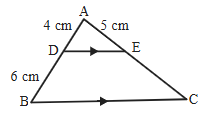
In $\triangle ABC , DE | | BC , AD =4 cm, DB =6 cm$ and $AE =5 cm$. The length of EC is
Answer(c)
Since $DE \left|\mid BC , \frac{ AD }{ DB }=\frac{ AE }{ EC }\right.$
(By Basic Proportionality Theorem)
Since $AD =4 cm, DB =6 cm$ and $AE =5 cm$ so, $\frac{4}{6}=\frac{5}{ EC }$
Therefore, $EC =\frac{6 \times 5}{4}=\frac{30}{4}=7.5 cm$
View full question & answer→MCQ 141 Mark
If $\triangle ABC \sim \triangle DEF$ and $\angle A =47^{\circ}, \angle E =83^{\circ}$, then $\angle C$ is equal:
- A
$47^{\circ}$
- ✓
$50^{\circ}$
- C
$83^{\circ}$
- D
$130^{\circ}$
AnswerCorrect option: B. $50^{\circ}$
(b)
Angle sum property of triangle and angle E is similar to angle B.
View full question & answer→MCQ 151 Mark
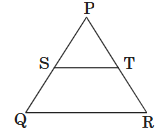
In the adjoining figure, $S$ and $T$ are points on the sides $P Q$ and $P R$ respectively of $\triangle P Q R$ such that $PT =2 \ cm, TR =4 \ cm$ and $ST$ is parallel to $QR$ . Then the ratio of areas of $\triangle PST$ and $\triangle PQR$.
- A
$9: 1$
- ✓
$1: 9$
- C
$3: 2$
- D
$9: 4$
AnswerCorrect option: B. $1: 9$
$\text { Given, ST I IQR }$
$\therefore \angle PST=\angle PQR \text { (corresponding angles) }$
$\text { and } \angle PTS=\angle PRQ \text { (corresponding angles) }$
$\therefore \triangle PST=\triangle PQR \text { (by AA- similarity) }$
$\therefore \frac{\operatorname{ar}(\triangle PST)}{\operatorname{ar}(\triangle PQR)}=\frac{(PT)^2}{(PR)^2}$
$=\frac{PT^2}{(PT+TR)^2}=\frac{2^2}{(2+4)^2}$
$=\frac{4}{36}=\frac{1}{9}$
Hence, Required ratio $=1: 9$
View full question & answer→MCQ 161 Mark
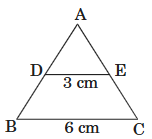
In the given figure, $DE \mid BC$. If $DE =3 \ cm$, $BC =6 \ cm$ and $ar (\triangle ADE )=15 \ cm^2$, then ar $\triangle ABC =$ ?
- ✓
$60 \ cm^2$
- B
$58 \ cm^2$
- C
$70 \ cm^2$
- D
$64 \ cm^2$
AnswerCorrect option: A. $60 \ cm^2$
$\frac{\operatorname{ar}(\triangle ADE )}{\operatorname{ar}(\triangle ABC )}=\frac{( DE )^2}{( BC )^2}$
$\frac{15}{\operatorname{ar}(\triangle ABC )}=\frac{3^2}{6^2}$
$\Rightarrow \operatorname{ar}(\triangle ABC )$
$=\frac{15 \times 36}{9}$
$=60 \ cm^2$
View full question & answer→MCQ 171 Mark
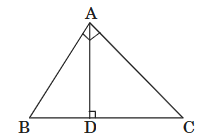
In the given figure, $\angle BAC =90^{\circ}$ and $AD \perp BC$, then,
- A
$BC \cdot CD = BC ^2$
- B
$AB \cdot AC = BC ^2$
- ✓
$BD \cdot CD = AD ^2$
- D
$AB \cdot AC = AD ^2$
AnswerCorrect option: C. $BD \cdot CD = AD ^2$
$\text { In } \triangle DBA \text { and } \triangle DAC \text {, we have }$
$\angle ADB=\angle CDA=90^{\circ}, \angle ABD=\angle CAD=90^{\circ}-\angle C$
$\text { and } \angle BAD=\angle ACD=90^{\circ}-\angle B$
$\therefore \triangle DBA \sim \triangle DAC$
$\frac{BD}{AD}=\frac{AD}{CD}$
$\Rightarrow BD \cdot CD=AD^2$
View full question & answer→MCQ 181 Mark
$\text{ABC}$ and $\text{BDE}$ are two equilateral triangles such that $D$ is the midpoint of $B C$. Ratio of the areas of triangles $\text{ABC}$ and $\text{BDE}$ is
- A
$1: 2$
- B
$2: 1$
- C
$1: 4$
- ✓
$4: 1$
AnswerCorrect option: D. $4: 1$
$\because \triangle \text{ABC} -\triangle DBE$ and $D$ is the midpoint of $BC$
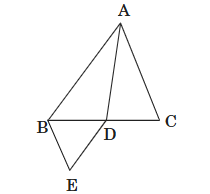
$\therefore BD=\frac{1}{2} BC=\frac{1}{2} AB$
$\frac{\operatorname{ar}(\triangle ABC)}{\operatorname{ar}(\triangle BDE)}=\frac{AB^2}{(BD)^2}=\frac{(AB)^2}{\left(\frac{1}{2} AB\right)^2}$
$\frac{AB^2}{\frac{1}{4} AB^2}$
Hence, required ratio $=4: 1$ View full question & answer→MCQ 191 Mark
In $\triangle ABC$, if $AB =16 cm, BC =12 cm$ and $AC =$ 20 cm , then $\triangle ABC$ is
Answer(b)
$\because AC$ is the longest side of $\triangle ABC$
$
\begin{aligned}
& \therefore AB^2+BC^2=16^2+12^2 \\
= & 256+144=400 \\
= & 20^2=(AC)^2
\end{aligned}
$
$\therefore \angle B =90^{\circ}$ (by the converse of Pythagoras' theorem)
Hence, $\triangle ABC$ is a right-angled triangle.
View full question & answer→MCQ 201 Mark
In an isosceles triangle $ABC ,$ if $AC = BC$ and $AB ^2=2 AC ^2$ then $\angle C =$ ?
- A
$30^{\circ}$
- B
$45^{\circ}$
- C
$60^{\circ}$
- ✓
$90^{\circ}$
AnswerCorrect option: D. $90^{\circ}$
Given, $AB ^2=2 AC ^2$
$\Rightarrow AB^2=AC^2+AC^2 .$
$\Rightarrow AB^2=AC^2+BC^2 .(\because AC=BC)$
$\therefore$ By the converse of Pythagoras theorem, we have $\angle C =90^{\circ}$.
View full question & answer→MCQ 211 Mark
$\triangle ABC \sim \triangle DEF$ such that $\operatorname{ar}(\triangle ABC )=64 cm^2$ and $\operatorname{ar}(\triangle DEF )=81 cm^2$. Then, the ratio of their corresponding sides is
- ✓
$8: 9$
- B
$36: 49$
- C
$7: 9$
- D
$9: 8$
AnswerCorrect option: A. $8: 9$
$\because \triangle ABC \sim \triangle DEF$
$\therefore\left(\frac{AB}{DE}\right)^2=\frac{\operatorname{ar}(\triangle ABC)}{\operatorname{ar}(\triangle DEF)}=\frac{64}{81}$
$\frac{AB}{DE}=\sqrt{\frac{64}{81}}=\frac{8}{9}$
$\therefore$ the ratio of the corresponding sides is $8: 9$
View full question & answer→MCQ 221 Mark
In $\triangle ABC$ and $\triangle DEF$, we have $\frac{ AB }{ DE }=\frac{ BC }{ EF }=\frac{ AC }{ DF }=\frac{5}{7}$, then $\operatorname{ar}(\triangle ABC ):$ $\operatorname{ar}(\triangle DEF )= ?$
- A
$5: 7$
- ✓
$25: 49$
- C
$49: 25$
- D
$125: 343$
AnswerCorrect option: B. $25: 49$
$\because \frac{ AB }{ DE }=\frac{ BC }{ EF }=\frac{ AC }{ DF }$
$\therefore \triangle ABC \sim \triangle DEF$
$\therefore \operatorname{ar}(\triangle ABC ): \operatorname{ar}(\triangle DEF )=( AB )^2:( DE )^2$
$=(5)^2:(7)^2$
$=25: 49$
View full question & answer→MCQ 231 Mark
It is given that $\triangle ABC \sim \triangle PQR$ and $\frac{ BC }{ QR }=\frac{2}{3}$ then $\frac{\operatorname{ar}(\triangle PQR )}{\operatorname{ar}(\triangle ABC )}=$ ?
- A
$\frac{2}{3}$
- B
$\frac{3}{2}$
- C
$\frac{4}{9}$
- ✓
$\frac{9}{4}$
AnswerCorrect option: D. $\frac{9}{4}$
$\frac{\operatorname{ar}(\triangle PQR )}{\operatorname{ar}(\triangle ABC )}=\frac{ QR ^2}{ BC ^2}$
$=\left(\frac{ QR }{ BC }\right)^2$
$=\left(\frac{3}{2}\right)^2$
$=\frac{9}{4}$
View full question & answer→MCQ 241 Mark
In the $\triangle ABC$, it is given that $\frac{ AB }{ DE }=\frac{ BC }{ FD }$ then
- A
$\angle B =\angle E$
- B
$\angle A =\angle D$
- ✓
$\angle B =\angle D$
- D
$\angle A =\angle F$
AnswerCorrect option: C. $\angle B =\angle D$
(c)
It is clear that
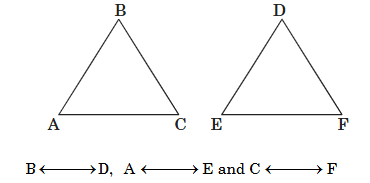
$\therefore \angle B =\angle D$ View full question & answer→MCQ 251 Mark
In $\triangle ABC , AB =6 \sqrt{3} cm, AC =12 cm$ and $BC =6 cm$. Then, $\angle B$ is
- A
$45^{\circ}$
- B
$60^{\circ}$
- ✓
$90^{\circ}$
- D
$120^{\circ}$
AnswerCorrect option: C. $90^{\circ}$
In $\triangle ABC , AC$ is the longest side.
$\therefore AB^2+BC^2=\left\{(6 \sqrt{3})^2+6^2\right\}$
$=108+36=144=(12)^2=(AC)^2$
$\therefore$ By the converse of Pythagoras theorem, we have $\angle B =90^{\circ}$.
View full question & answer→MCQ 261 Mark
It is given that $\triangle ABC \sim \triangle DEF$. If $\angle A =30^{\circ}$, $\angle C =50^{\circ}, AB =5 cm, AC =8 cm$ and $DF =7.5 cm$ then which of the following is true?
- A
$DE =12 cm, \angle F =50^{\circ}$
- ✓
$DE =12 cm, \angle F =100^{\circ}$
- C
$EF =12 cm, \angle D =100^{\circ}$
- D
$EF =12 cm, \angle D =30^{\circ}$
AnswerCorrect option: B. $DE =12 cm, \angle F =100^{\circ}$
(b)
$
\angle B=180^{\circ}-\left(30^{\circ}+50^{\circ}\right)=180^{\circ}-80^{\circ}=100^{\circ}
$
Since $\triangle ABC \sim \triangle DFE$,
We have $\angle D =\angle A =30^{\circ}, \angle F =\angle B =100^{\circ}$ and $\angle E$ $=\angle C =50^{\circ}$.
Let $DE = x cm$. Then,
$
\frac{AB}{DF}=\frac{AC}{DE} \Rightarrow \frac{5}{7.5}=\frac{8}{x}
$
$
\Rightarrow 5 x=8 \times 7.5 \Rightarrow x=\frac{8 \times 7.5}{5}=12
$
Hence, $DE =12 cm$ and $\angle F =100^{\circ}$
View full question & answer→MCQ 271 Mark
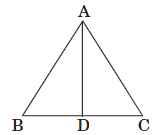
In $\triangle ABC$ it is given that $\frac{ AB }{ AC }=\frac{ BD }{ DC }$. If $\angle B =70^{\circ}$ and $\angle C =50^{\circ}$ then $\angle BAD =$ ?
- ✓
$30^{\circ}$
- B
$40^{\circ}$
- C
$45^{\circ}$
- D
$50^{\circ}$
AnswerCorrect option: A. $30^{\circ}$
$\angle A=180^{\circ}-\left(70^{\circ}+50^{\circ}\right)=180^{\circ}-120^{\circ}=60^{\circ}$
Since $\frac{B D}{D C}=\frac{A B}{A C}$, it means $A D$ is the bisector of $\angle A$.
$\therefore \angle BAD=\frac{1}{2} \times \angle A$
$=\frac{1}{2} \times 60^{\circ}$
$=30^{\circ}$
View full question & answer→MCQ 281 Mark
If the bisector of an angle of a triangle bisects the opposite side then the triangle is
Answer(c )
Let $A D$ be the bisector of $\angle A$ of $\triangle ABC$ such that $BD = DC$.
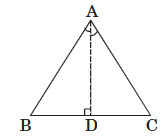
Then, $\frac{ AB }{ AC }=\frac{ BD }{ DC }=1$
$
\Rightarrow AB=AC
$
So, the given triangle is isosceles View full question & answer→MCQ 291 Mark
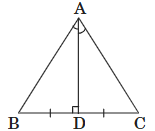
In an equilateral triangle $ABC ,$ if $AD \perp BC$ then which of the following is true?
- A
$2 AB ^2=3 AD ^2$
- B
$4 AB ^2=3 AD ^2$
- ✓
$3 AB ^2=4 AD ^2$
- D
$3 AB ^2=2 AD ^2$
AnswerCorrect option: C. $3 AB ^2=4 AD ^2$
In $\triangle ADB$, by Pythagoras theorem,
$AB^2=BD^2+AD^2$
$\Rightarrow AB^2=\left(\frac{1}{2} BC\right)^2+AD^2$
$\Rightarrow AB^2=\frac{1}{4} BC^2+AD^2$
$\Rightarrow AB^2=\frac{1}{4} AB^2+AD^2 \quad(\because AB=BC=AC)$
$\Rightarrow AB^2-\frac{1}{4} AB^2=AD^2$
$\Rightarrow \frac{3}{4} AB^2=AD^2$
$\Rightarrow 3 AB^2=4 AD^2$
View full question & answer→MCQ 301 Mark
The areas of two similar triangles are in respectively $9 \ cm^2$ and $16 \ cm^2$. The ratio of their corresponding sides is
- ✓
$3: 4$
- B
$4: 3$
- C
$2: 3$
- D
$4: 5$
AnswerCorrect option: A. $3: 4$
$\because \text { two triangles are similar }$
$\therefore \frac{\text { side of first triangle }}{\text { side of second triangle }}$
$=\sqrt{\frac{\text { area of first triangle }}{\text { area of second triangle }}}$
$=\sqrt{\frac{9}{16}}$
$=\frac{3}{4}$
Hence required ratio $=3: 4$
View full question & answer→MCQ 311 Mark
Sides of two similar triangles are in the ratio $4: 9$. Areas of these triangles in the ratio.
- A
$2: 3$
- B
$4: 9$
- ✓
$16: 81$
- D
$81: 16$
AnswerCorrect option: C. $16: 81$
(c)
$\because$ Two triangles are similar
$\therefore \frac{\text { Area of first triangle }}{\text { Area of second triangle }}$
$=\left(\frac{\text { side of first triangle }}{\text { side of second triangle }}\right)^2$
$
=\left(\frac{4}{9}\right)^2=\frac{16}{81}
$
Hence, required ratio $=16: 81$.
View full question & answer→MCQ 321 Mark
The height of an equilateral triangle having each side 12 cm is
- A
$6 \sqrt{2} cm$
- ✓
$6 \sqrt{3} cm$
- C
$3 \sqrt{6} cm$
- D
$6 \sqrt{6} cm$
AnswerCorrect option: B. $6 \sqrt{3} cm$
(b)
Given, sides of triangle $(a)=12 cm$
$
\therefore \text { Height }=\frac{a \sqrt{3}}{2}=\frac{12 \sqrt{3}}{2}=6 \sqrt{3} cm
$
View full question & answer→MCQ 331 Mark
A ladder $25 m$ long just reaches the top of a building $24 m$ high from the ground. What is the distance of the foot of the ladder from the building?
- ✓
$7 m$
- B
$14 m$
- C
$21 m$
- D
$24.5 m$
AnswerLet $AB$ be the ladder and $CB$ be the building. In right angle triangle $ACB$, by Pythagoras theorem
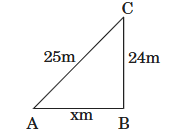
$(AB)^2=(AC)^2+(CB)^2$
$\Rightarrow(25)^2=(24)^2+x^2$
$\Rightarrow x^2=625-576$
$\Rightarrow x=\sqrt{49}=7 m$ View full question & answer→MCQ 341 Mark
The shadow of a $5 m$ long stick is $2 m$ long. At the same time the length of the shadow of a $12.5 m$ high tree $($in m$)$ is
AnswerLet $A B$ be the stick and $A C$ be its shadow.
$\because \triangle ABC-\triangle DEF$
$\therefore \frac{AB}{DE}=\frac{AC}{DF}$
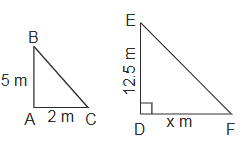
$\Rightarrow \frac{5}{12.5}=\frac{2}{x}$
$\Rightarrow \frac{12.5 \times 2}{5}=5 m$ View full question & answer→