MCQ 11 Mark
In an isosceles Itriangleitext ${A B C},$ if $A C=B C$ and $A B^2=2 A C^2$ then langleltext ${C}=?$
- A
$30^{\circ}$
- B
$45^{\circ}$
- C
$60^{\circ}$
- ✓
$90^{\circ}$
AnswerCorrect option: D. $90^{\circ}$
In an isosceles $\triangle\text{ABC},$ given $AC = BC$
$AB^2 = 2AC^2$
$\Rightarrow AB^2 = BC^2 + AC^2 ....$$(\therefore\text{AC}=\text{BC})$
by the Converse of Pythagoras theorem,
$\triangle\text{ABC}$ will be an isosceles right-angled triangle.
Since $AB$ will be the hypotenuse, the angle opposite $AB$ that is, $\angle\text{C}=90^\circ.$
View full question & answer→MCQ 21 Mark
In an equilateral triangle $\text{ABC}$, if $\text{AD}\perp\text{BC}$ then which of the following is true?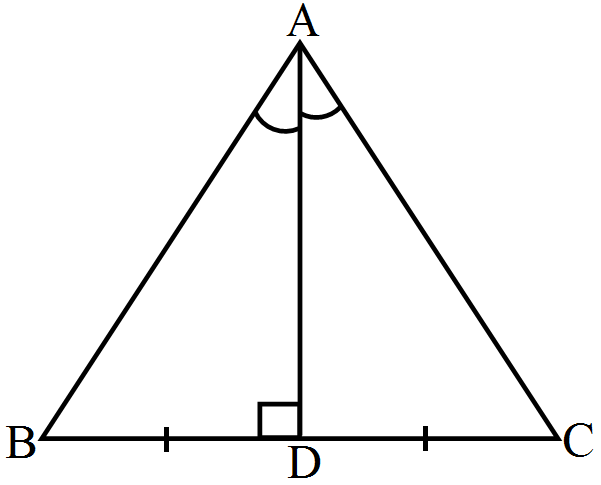
- A
$2 A B^2=3 A D^2$
- B
$4 A B^2=3 A D^2$
- ✓
$3 A B^2=4 A D^2$
- D
$3AB^2=2 A D^2$
AnswerCorrect option: C. $3 A B^2=4 A D^2$
In an equilateral triangle, the perpendicular from the vertex to the base is bisects the base.
In right$-$angled $\triangle\text{ADC},$
$A B^2=A D^2+B D^2$
$\Rightarrow A B^2=A D^2+B D^2$
$\Rightarrow\text{AB}^2=\text{AD}^2+\Big(\frac{1}{2}\text{BC}\Big)^2$
$\Rightarrow\text{AB}^2=\text{AD}^2+\Big(\frac{1}{2}\text{AB}\Big)^2\dots(\therefore\text{AB}=\text{BC} )$
$\Rightarrow\text{AB}^2=\text{AD}^2+\frac{1}{4}\text{AB}^2$
$\Rightarrow\text{AB}^2-\frac{1}{4}\text{AB}^2=\text{AD}^2$
$\Rightarrow\frac{3}{4}\text{AB}^2=\text{AD}^2$
$\Rightarrow3\text{AB}^2=4\text{AD}^2$
View full question & answer→MCQ 31 Mark
In $\triangle\text{ABC},\text{DE }||\text{ BC}$ such that $\frac{\text{AD}}{\text{DB}}=\frac{3}{5}.$ AC = 5.6cm then AE =?
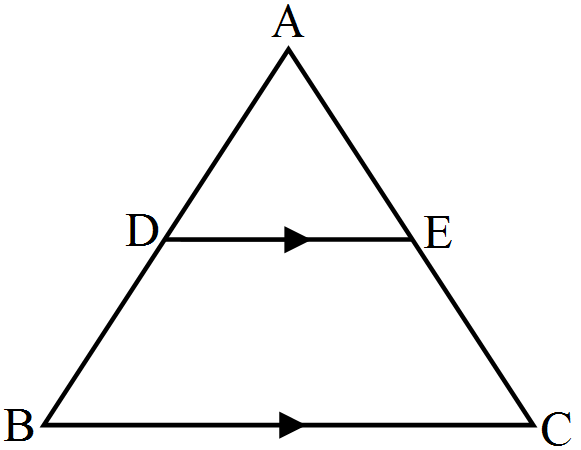
AnswerIn $\triangle\text{ABC},\text{DE }||\text{ BC}$
By Basic proportionality theorem,
$\frac{\text{AD}}{\text{DB}}=\frac{\text{AE}}{\text{EC}}$
$\Rightarrow\frac{\text{AD}}{\text{DB}}=\frac{\text{AE}}{\text{AC}-\text{AE}}$
$\Rightarrow\frac{3}{5}=\frac{\text{AE}}{\text{5.6}-\text{AE}}$
$\Rightarrow3(5.6-\text{AE})=5\text{AE}$
$\Rightarrow16.8-3\text{AE})=5\text{AE}$
$\Rightarrow8\text{AE}=16.8$
$\Rightarrow\text{AE}=2.1\text{cm}$
View full question & answer→MCQ 41 Mark
In a $\triangle\text{ABC},$ it is given that AD is the internal bisector of $\angle\text{A}.$ If AB = 10cm, AC = 14cm and BC = 6cm, then CD = ?
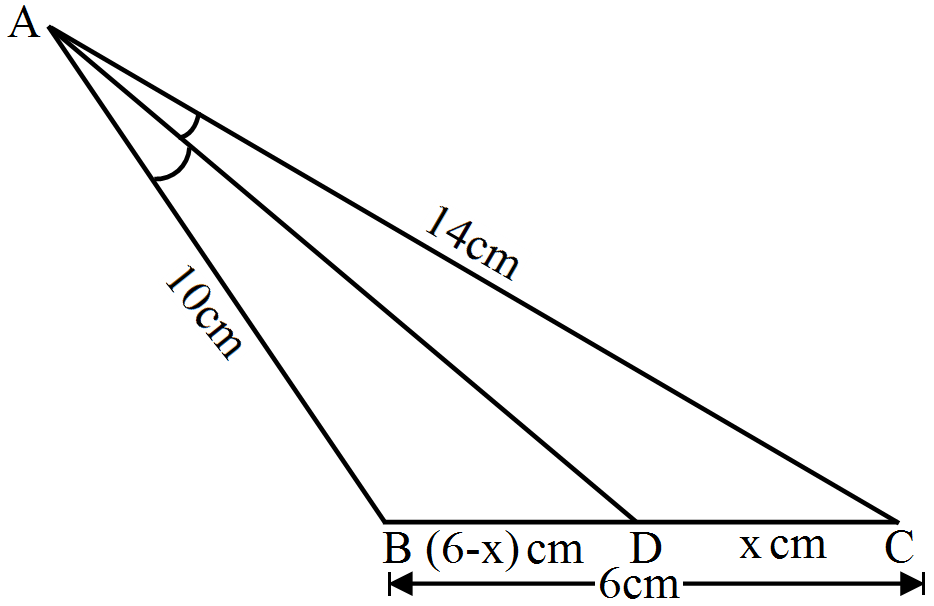
Answersince AD is the bisector of $\angle\text{A},$
by the angle bisector theorem,
$\frac{10}{14}=\frac{6-\text{x}}{\text{x}}$
$\Rightarrow10\text{x}=84-14\text{x}$
$\Rightarrow24\text{x}=84$
$\Rightarrow\text{x}=3.5$
So, CD = 3.5cm.
View full question & answer→MCQ 51 Mark
In a $\triangle\text{ABC},$ if DE is drawn parallel to BC, cutting AB and AC at D and E respectively such that AB = 7.2cm, AC = 6.4cm and AD = 4.5cm. Then, AE =?
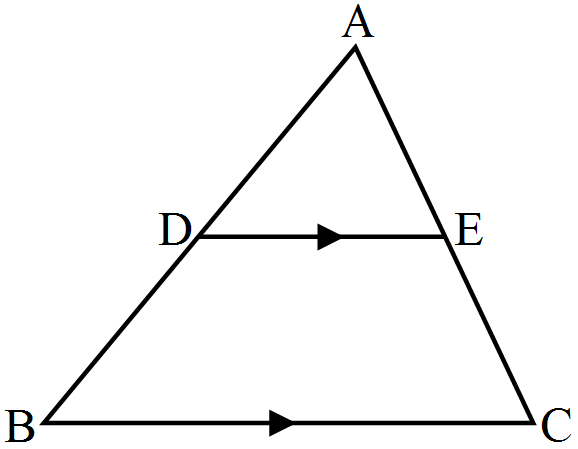
AnswerIn $\triangle\text{ABC},\text{DE }||\text{ BC}$
By Basic proportionality theorem,
$\frac{\text{AE}}{\text{AC}}=\frac{\text{AD}}{\text{AB}}$
$\Rightarrow\frac{\text{AE}}{6.4}=\frac{4.5}{7.2}$
$\Rightarrow\text{AE}=\frac{4.5\times6.4}{7.2}$
$\Rightarrow\text{AE}=4\text{cm}$
View full question & answer→MCQ 61 Mark
$\triangle\text{ABC}$ is an isosceles triangle with $AB = AC = 13\ cm$ and the length of altitude from $A$ on $BC$ is $5\ cm.$ Then, $BC =?$
- A
$12\ cm$
- B
$16\ cm$
- C
$18\ cm$
- ✓
$24\ cm$
AnswerCorrect option: D. $24\ cm$
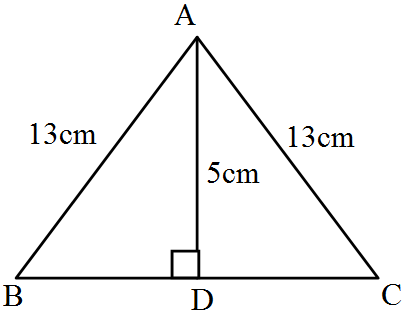
let $\triangle\text{ABC}$ be the isosceles triangle and $AD$ be the altitude.
The height of an isosceles triangle is the same as its median.
So, $BD = DC$
$\triangle\text{ADB}$ is a right$-$angled triangle.
By Pythagoras theorem,
$AB^2 = AD^2 + BD^2$
$\Rightarrow BD^2 = AB^2 - AD^2$
$\Rightarrow BD^2 = 13^2 - 5^2$
$\Rightarrow BD^2 = 169 - 25$
$\Rightarrow BD^2 = 144$
$\Rightarrow BD = 12\ cm$
$\Rightarrow DC = 2\ cm$
So, $BC = 12 + 12 = 24\ cm.$ View full question & answer→MCQ 71 Mark
In $\triangle\text{ABC},$ it is given that AB = 9cm, BC = 6cm and CA = 7.5cm. Also, $\triangle\text{DEF}$ is given such that EF = 8cm and $\triangle\text{DEF}\sim\triangle\text{ABC}.$ Then, perimeter of $\triangle\text{DEF}$ 1s:
Answer$\triangle\text{ABC}\sim\triangle\text{DEF}$
$\Rightarrow\frac{\text{Perimeters of }\triangle\text{DEF}}{\text{Perimeters of }\triangle\text{ABC}}=\frac{\text{EF}}{\text{BC}}$
$\Rightarrow\frac{\text{Perimeters of }\triangle\text{DEF}}{\text{AB+BC+AC}}=\frac{8}{6}$
$\Rightarrow\frac{\text{Perimeters of }\triangle\text{DEF}}{9+6+7.5}=\frac{8}{6}$
$\Rightarrow\frac{\text{Perimeters of }\triangle\text{DEF}}{22.5}=\frac{4}{3}$
$\Rightarrow\text{Perimeters of }\triangle\text{DEF}=\frac{4\times22.5}{3}$
$\Rightarrow\text{Perimeters of }\triangle\text{DEF}=30\text{cm}$
View full question & answer→MCQ 81 Mark
In a thombus of side $10\ cm,$ one of the diagonals is $12\ cm$ long. The length of the second diagonal is:
- A
$20\ cm$
- B
$18\ cm$
- ✓
$16\ cm$
- D
$22\ cm$
AnswerCorrect option: C. $16\ cm$
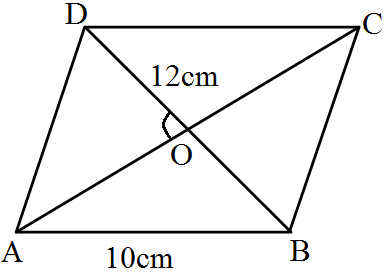
In an rhombus, the diagonals are perpendicular bisetoes of each other.
So, $\text{OD}=\frac{1}{2}\text{BD}=6\text{cm}$
In right$-$angled $\triangle\text{AOD},$
$A O^2=A O^2+O D^2$
$\Rightarrow A O^2=A D^2-O D^2$
$\Rightarrow A O^2=10^2-6^2$
$\Rightarrow A O^2=100-36$
$\Rightarrow A O^2=64$
$\Rightarrow A O=8 \ cm$
So,$A C=2 A O=2(8)=16 \ cm$
Thus, the length of the second diagonal is $16\ cm.$ View full question & answer→MCQ 91 Mark
The shadow of a 5-m-long stick is 2m long. At the same time the langht of the shadow of a 12.5-m-high (in m) is:
Answer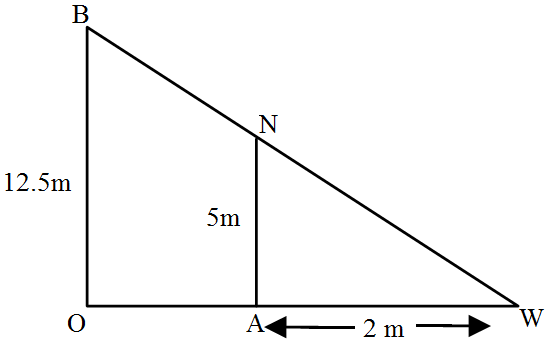
Let AN be the long stick and AW be its shadow.
Let OB be the tree and OW be its shadows.
AW = 2cm
AN = 5m
OW = 12.5m
Ratio of actual lengths = ratio of their shadows
$\Rightarrow\frac{\text{OB}}{\text{AN}}=\frac{\text{OW}}{\text{AW}}$
$\Rightarrow\frac{12.5}{5}=\frac{\text{OW}}{2}$
$\Rightarrow\text{OW}=\frac{12.5\times2}{5}$
$\Rightarrow\text{OW}=5.0\text{m}$
So, the height of the tower is 5.m. View full question & answer→MCQ 101 Mark
A vertical pole 6m long casts a shadow of lenghth 3.6m on the ground. What is the height of a tower which casts a shadow of lenght 18m at the same time?
Answer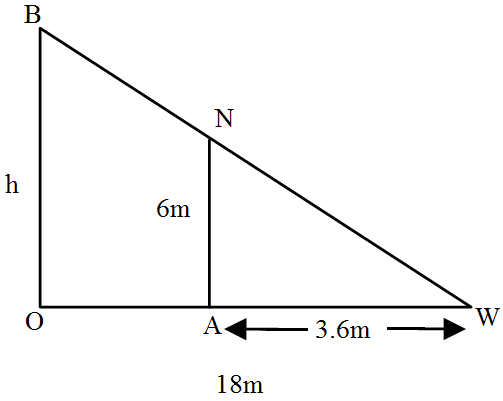
Let AN be the vertical pole and AW be its shadow.
Let OB be the tower and OW be its shadows.
AW = 3.6cm
AN = 6m
OW = 18m
Ratio of actual lengths = ratio of their shadows
$\Rightarrow\frac{\text{OB}}{\text{AN}}=\frac{\text{OW}}{\text{AW}}$
$\Rightarrow\frac{\text{h}}{6}=\frac{18}{3.6}$
$\Rightarrow\text{h}=\frac{6\times18}{3.6}$
$\Rightarrow\text{h}=30\text{m}$
So, the height of the tower is 30m. View full question & answer→MCQ 111 Mark
In a triangle, the perpendicular from the vertex to the base bisect the base. The triangle is:
AnswerIn an isosceles triangle, the perpendicular from the vertex to the base bisects the base.
View full question & answer→MCQ 121 Mark
ABC and BDE are two equoilateral triangles such tha D is the midpoint of BC. Ratio of the areas of triangles ABC and BDE is:
Answer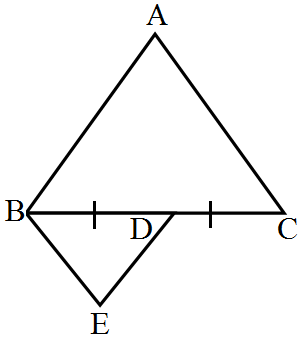
Given that D is the mid-point of BC,
$\Rightarrow\text{BD}=\frac{1}{2}\text{BC}\dots(\text{i})$
Since $\triangle\text{ABC}$ and $\triangle\text{EBD}$ are equilateral triangles.
$\Rightarrow\triangle\text{ABC}\sim\triangle\text{EBD}$
$\Rightarrow\frac{\text{ar}(\triangle\text{ABC})}{\text{ar}(\triangle\text{EBD})}=\frac{\text{BC}^2}{\text{BD}^2}$
$\Rightarrow\frac{\text{ar}(\triangle\text{ABC})}{\text{ar}(\triangle\text{EBD})}=\frac{\text{BC}^2}{\Big(\frac{1}{ 2}\text{BC}\Big)^2}$
$\Rightarrow\frac{\text{ar}(\triangle\text{ABC})}{\text{ar}(\triangle\text{EBD})}=\frac{\text{BC}^2}{\frac{1}{4}\text{BC}^2}$
$\Rightarrow\frac{\text{ar}(\triangle\text{ABC})}{\text{ar}(\triangle\text{EBD})}=\frac{4}{1}$ View full question & answer→MCQ 131 Mark
In $\triangle\text{DEF}$ and $\triangle\text{PQR},$ it is given that $\angle\text{D}=\angle\text{Q}$ and $\angle\text{R}=\angle\text{E},$ then which of the following is not true?
- A
$\frac{\text{EF}}{\text{PR}}=\frac{\text{DF}}{\text{PQ}}$
- ✓
$\frac{\text{DE}}{\text{PQ}}=\frac{\text{EF}}{\text{RP}}$
- C
$\frac{\text{DE}}{\text{QR}}=\frac{\text{DF}}{\text{PQ}}$
- D
$\frac{\text{EF}}{\text{RP}}=\frac{\text{DE}}{\text{QR}}$
AnswerCorrect option: B. $\frac{\text{DE}}{\text{PQ}}=\frac{\text{EF}}{\text{RP}}$
In $\triangle\text{DEF}$ and $\triangle\text{PQR},$ it is given that $\angle\text{D}=\angle\text{Q}$ and $\angle\text{R}=\angle\text{E}$
So, $\text{D}\leftrightarrow\text{Q},\text{E}\leftrightarrow\text{R},\text{F}\leftrightarrow\text{P}$
$\Rightarrow\frac{\text{DE}}{\text{QR}}=\frac{\text{EF}}{\text{RP}}=\frac{\text{DF}}{\text{QP}}$
So, $\frac{\text{DE}}{\text{PQ}}=\frac{\text{EF}}{\text{RP}}$ is not true.
View full question & answer→MCQ 141 Mark
Two isosceles triangles have their corresponding angles equal and their areas are in the ratio $25 : 36.$ The ratio of their corresponding heights is:
- A
$25 : 36$
- B
$36 : 25$
- ✓
$5 : 6$
- D
$6 : 5$
AnswerCorrect option: C. $5 : 6$
Since the triangles have correspondin angles equal, the triangles are similar.
Let the areas of the triangles be $A_1$ and $A_2,$
and let their corresponding heights be $h_1$ and $h_2,$
$\frac{\text{ar}(\text{A}_1)}{\text{ar}(\text{A}_2)}=\frac{\text{h}_1^2}{\text{h}_2^2}$
$\Rightarrow\frac{25}{36}=\frac{\text{h}_1^2}{\text{h}_2^2}$
$\Rightarrow\frac{\text{h}_1}{\text{h}_2}=\frac{5}{6}$
So, the ratio of their heights is $5 : 6.$
View full question & answer→MCQ 151 Mark
$\triangle\text{ABC}\sim\triangle\text{DEF}$ and their perimeters are 32cm and 24cm respectively. If AB = 10cm then DE =?
Answer$\therefore\triangle\text{ABC}\sim\triangle\text{DEF}$
$\therefore\frac{\text{Perimeter}(\triangle\text{ABC})}{\text{Perimeter}(\triangle\text{DEF})}=\frac{\text{AB}}{\text{DE}}$
$\Rightarrow\frac{32}{24}=\frac{10}{\text{DE}}$
$\Rightarrow\text{DE}=\frac{10\times24}{\text{32}}=7.5\text{cm}$
View full question & answer→MCQ 161 Mark
If the diagonals of a quadrilateral divide each other proportionally then it is a:
AnswerRecall that the diagonals of a trapezium divide each other proportionally.
Note that this happens even in a parallelogram, square and rectangle, but without additional information it is not possible to be sure.
View full question & answer→MCQ 171 Mark
In the given figure, O is the point of intersection of two chords AB and CD such that OB = OD and $\angle\text{AOC}=45^\circ.$ Then, $\triangle\text{OAC}$ and $\triangle\text{ODB}$ are:
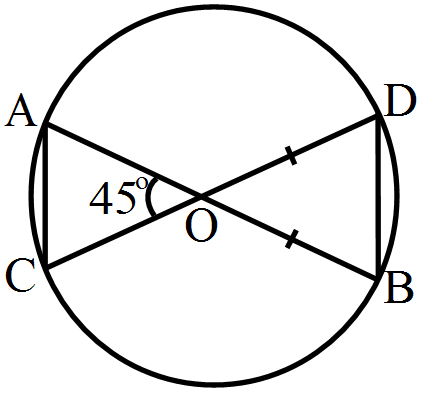
- A
- B
Equilateral but not similar.
- ✓
- D
Isosceles but not similar.
AnswerIn $\triangle\text{AOC}$ and $\triangle\text{ODB}$
$\angle\text{AOC}=\angle\text{DOB}$ ....(Vertically opposite angles)
$\angle\text{OCA}=\angle\text{OBD}$ ....(angels in the same segment)
$\Rightarrow\triangle\text{OAC}\sim\triangle\text{ODB}$ ....(AA criterion for similarity)
The two triangles are surely not equil ateral,
Since the measure of every angle of an equilateral triangle is 60º.
So, the triangles are isosceles and similar.
View full question & answer→MCQ 181 Mark
In $\triangle\text{ABC},\text{DE }||\text{ BC}$ so that AD = (7x - 4)cm, AE = (5x - 2)cm, DB = (3x + 4)cm and EC = 3x cm. Then, we have:
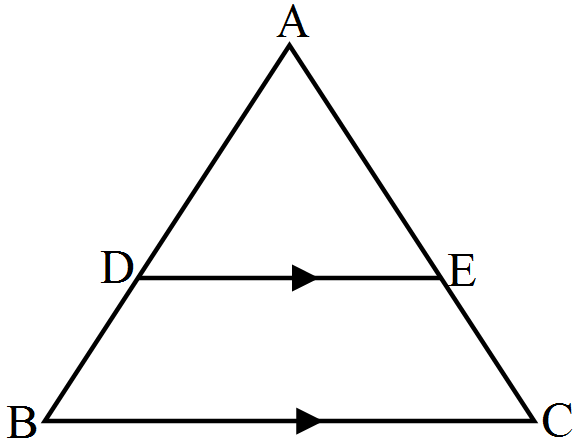
AnswerIn $\triangle\text{ABC},\text{DE }||\text{ BC}$
By Basic proportionality theorem,
$\frac{\text{AD}}{\text{DB}}=\frac{\text{AE}}{\text{EC}}$
$\Rightarrow\frac{7\text{x}-4}{3\text{x}+4}=\frac{5\text{x}-2}{3\text{x}}$
$\Rightarrow21\text{x}^2-12\text{x}=15\text{x}^2+14\text{x}-8$
$\Rightarrow6\text{x}^2-26\text{x}+8=0$
$\Rightarrow3\text{x}^2-13\text{x}+4=0$
$\Rightarrow(\text{x}-4)(3\text{x}-1)=0$
$\Rightarrow\text{x}=4$ or $\text{x}=\frac{1}{3}$
If $\text{x}=\frac{1}{3},$ then $\text{AD}=7\text{x}-4=7\Big(\frac{1}{3}\Big)-4=\frac{-5}{3}<0$
This is not possible since length cannot be negative.
⇒ x = 4
View full question & answer→MCQ 191 Mark
Which of the following is a true statement?
- A
Two similar triangles are always congruent.
- B
Two figures are similar if they have the same shape and size.
- ✓
Two triangles are similar if their corresponding sides are proportional.
- D
Two polygons are similar if their corresponding sides are proportional.
AnswerCorrect option: C. Two triangles are similar if their corresponding sides are proportional.
Is incorrect. Since two similar triangles, may or may not be similar.
Holds even if the size is not the same.
Is surely true.
Holds only if for the polygon, the corresponding sides are proportional and the corresponding angles are equal.
View full question & answer→MCQ 201 Mark
In $\triangle\text{ABC}$ and $\triangle\text{DEF},$ it is given that $\frac{\text{AB}}{\text{DE}}=\frac{\text{BC}}{\text{FD}}$ then:
- A
$\angle\text{B}=\angle\text{E}$
- B
$\angle\text{A}=\angle\text{D}$
- ✓
$\angle\text{B}=\angle\text{D}$
- D
$\angle\text{A}=\angle\text{F}$
AnswerCorrect option: C. $\angle\text{B}=\angle\text{D}$
In $\triangle\text{ABC}$ and $\triangle\text{DEF},$ it is given that $\frac{\text{AB}}{\text{DE}}=\frac{\text{BC}}{\text{FD}}$
So, $\text{A}\leftrightarrow\text{E},\text{B}\leftrightarrow\text{D},\text{C}\leftrightarrow\text{F}$
$\Rightarrow\angle\text{B}=\angle\text{D}$
View full question & answer→MCQ 211 Mark
Two poles of height $6m$ and $11m$ stand vertically upright upright on a plane ground. If distance between their fiit is $12m$ then the distance between their tops is:
Answer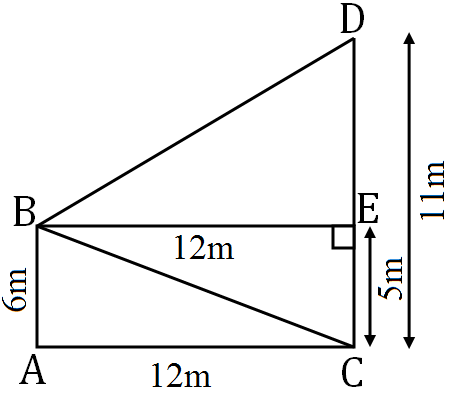
Let the poles be $A B$ and $C D$.
It is given that:
$A B=6 m$ and $C D=11 m$
Let $A C$ be $12 m$ .
Draw a perpendicular from $B$ on $C D$ at $E$.
Then,
$B E=12 m$
We have to finf $BD.$
Applying Pythagoras theorem in right$-$angled triangle $\text{BED}$, we have:
$B D^2=B E^2+E D$
$=12^2+5^2(\therefore E D=C D-C E=11-6)$
$=144+25=169$
$B D=13 m$ View full question & answer→Question 221 Mark
Match the following columns.
|
|
Column $I$
|
|
Column $II$
|
| $(a)$ |
In a given $\triangle\text{ABC},\text{DE }\|\text{ BC}$ and $\frac{\text{AD}}{\text{DB}}=\frac{3}{5}.$ If $AC = 5.6\ cm$ then $AE = ....cm.$
|
$(p)$ |
$6$ |
| $(b)$ |
If$\triangle\text{ABC}\sim\triangle\text{DEF}$ such that $2AB = 3DE$ and $BC = 6\ cm$ then $EF = ....cm.$
|
$(q)$ |
$4$ |
| $(c)$ |
If$\triangle\text{ABC}\sim\triangle\text{PQR}$ such that $\text{ar}(\triangle\text{ABC}):\text{ar}(\triangle\text{PQR})=9:16$ and $BC = 4.5\ cm$ then $QR ...cm.$
|
$(r)$ |
$3$ |
| $(d)$ |
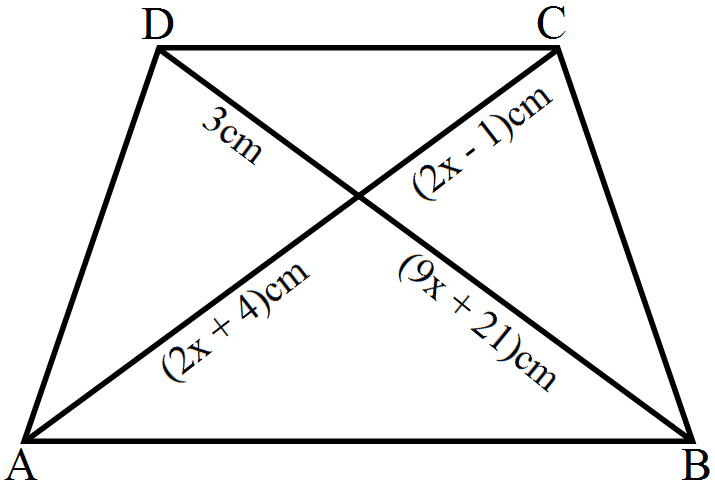
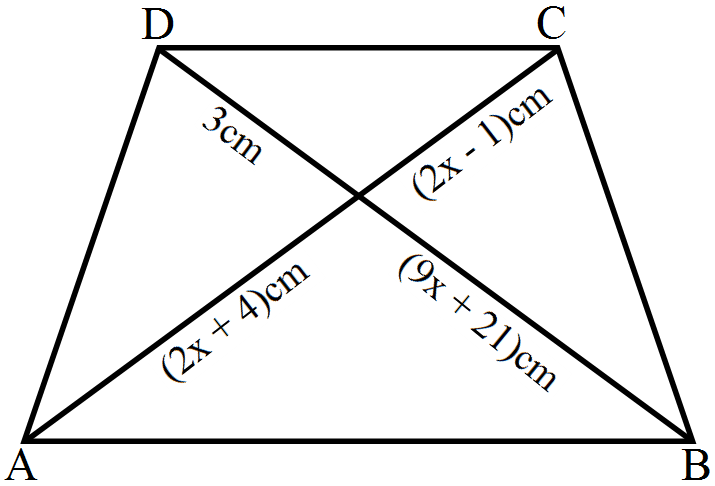
In the given figure, $AB \| CD$ and $OA = (2x + 4)cm, OB = (9x - 21)cm, OC = (2x - 1)cm$ and $OD = 3\ cm.$ Then $x = ?$
|
$(s)$ |
$2.1$ |
The correct answer is:
- $...........$
- $...........$
- $...........$
- $...........$
Answer
|
|
Column $I$
|
|
Column $II$
|
| $(a)$ |
In a given $\triangle\text{ABC},\text{DE }\|\text{ BC}$ and $\frac{\text{AD}}{\text{DB}}=\frac{3}{5}.$ If $AC = 5.6\ cm$ then $AE = ....cm.$
|
$(s)$ |
$2.1$ |
| $(b)$ |
If$\triangle\text{ABC}\sim\triangle\text{DEF}$ such that $2AB = 3DE$ and $BC = 6\ cm$ then $EF = ....cm.$
|
$(q)$ |
$4$ |
| $(c)$ |
If$\triangle\text{ABC}\sim\triangle\text{PQR}$ such that $\text{ar}(\triangle\text{ABC}):\text{ar}(\triangle\text{PQR})=9:16$ and $BC = 4.5\ cm$ then $QR ...cm.$
|
$(p)$ |
$6$ |
| $(d)$ |
In the given figure, $AB \| CD$ and $OA = (2x + 4)cm, OB = (9x - 21)cm, OC = (2x - 1)cm$ and $OD = 3\ cm$. Then $x = ?$
|
$(s)$ |
$3$ |
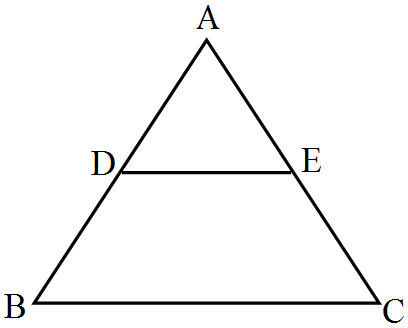
In a given $\triangle\text{ABC},\text{DE }\|\text{ BC}$
By the Basic proportionality theorem,
$\frac{\text{AD}}{\text{DB}}=\frac{\text{AE}}{\text{EC}}$
$\Rightarrow\frac{3}{5}=\frac{\text{AE}}{5.6-\text{AE}}$
$\Rightarrow\text{AE}=2.1\text{ cm}$
$\triangle\text{ABC}\sim\triangle\text{DEF}$
$\Rightarrow\frac{\text{AB}}{\text{DE}}=\frac{\text{BC}}{\text{EF}}$
$\Rightarrow\frac{3}{2}=\frac{\text{6}}{\text{EF}}$
$\Rightarrow\text{EF}=4\text{ cm}$
$\triangle\text{ABC}\sim\triangle\text{PQR}$
$\Rightarrow\frac{\text{ar}(\triangle\text{ABC})}{\text{ar}(\triangle\text{PQR})}=\frac{\text{BC}^2}{\text{QR}^2}$
$\Rightarrow\frac{9}{16}=\frac{\text{4.5}^2}{\text{QR}^2}$
$\Rightarrow\text{QR}^2=36$
$\Rightarrow\text{QR}=6\text{ cm}$
Since $AB \| CD,$ the quadrilateral is a trapzium.
We know that,
diagonals of a trapzium divede each propertionally.
$\Rightarrow\frac{\text{OA}}{\text{OB}}=\frac{\text{OC}}{\text{OC}}$
$\Rightarrow\frac{2\text{x}+4}{9\text{x}-21}=\frac{2\text{x}-1}{3}$
$\Rightarrow6\text{x}+12=18\text{x}^2-51\text{x}+21=0$
$\Rightarrow18\text{x}^2-51\text{x}+9=0$
$\Rightarrow\text{x}=3=0 $ or $\text{x}=\frac{1}{6}$
If $\text{x}=\frac{1}{6},$ then $\text{OC}=2\text{x}-1=2\Big(\frac{1}{6}\Big)-1<0$
This is not possible since lenght cannot be nagetive. View full question & answer→MCQ 231 Mark
A ladder $25m$ long just reaches the top of a building $24m$ high from the ground. What is the distance of the foot of the ladder from the building?
- ✓
$7m$
- B
$14m$
- C
$21m$
- D
$24.5m$
Answer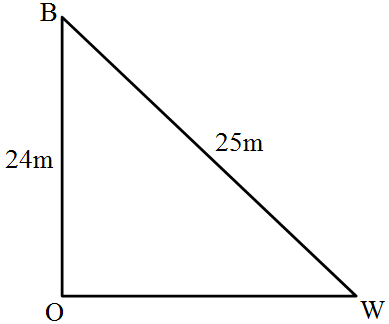
Let $BW$ be the ladder and $OB$ be the building.
$\triangle BOW$ forms a righ$-$angled triangle.
By Pythagoras theorem,
$BW^2=O W^2+O B^2$
$OW^2=B W^2-O B^2$
$OW^2=25^2-24^2$
$OW^2=(25-24)(25+24) \ldots\left(\text { Using }(a+b)^2=a^2+2 a b+b^2\right)$
$OW^2=(1)(49)$
$OW=7 m$
So, the distance of the foot of the ladder from the bulling is $7 m.$ View full question & answer→MCQ 241 Mark
In $\triangle\text{ABC},\text{DE }||\text{ BC}$ so that AD = 2.4cm, AE = 3.2cm and EC = 4.8cm. Then, AB =?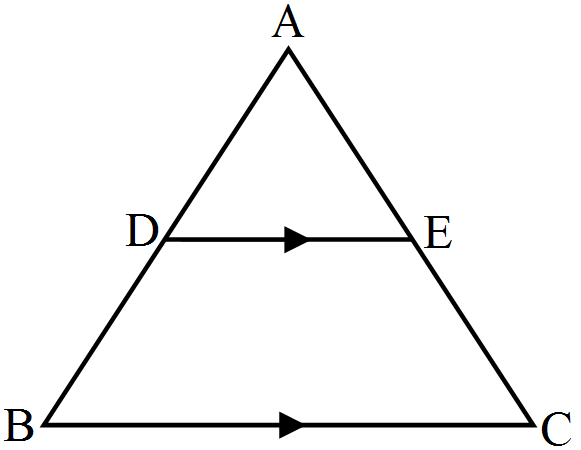
AnswerIn $\triangle\text{ABC},\text{DE }||\text{ BC}$
By Basic Proportionality theorem,
$\frac{\text{AD}}{\text{DB}}=\frac{\text{AE}}{\text{EC}}$
$\Rightarrow\frac{2.4}{\text{DB}}=\frac{3.2}{4.8}$
$\Rightarrow\text{BD}=\frac{2.4\times4.8}{3.2}$
$\Rightarrow\text{BD}=3.6\text{cm}$
$\text{AB}=\text{AD}+\text{DB}=2.4+3.6=6\text{cm}$
View full question & answer→Question 251 Mark
Match the following columns.
|
|
Column $I$
|
|
Column $II$
|
| $(a)$ |
A man goes $10m$ due east and then $20m$ due north. His distance from the starting point is $.... m.$ |
$(p)$ |
$25\sqrt{3}$ |
| $(b)$ |
In an equilateral triangle with each side $10\ cm,$ the altitude is $ ..... \ cm.$ |
$(q)$ |
$5\sqrt{3}$ |
| $(c)$ |
The area of an equilateral triangle having each side $10\ cm$ is $.... \ cm^2.$ |
$(r)$ |
$10\sqrt{5}$ |
| $(d)$ |
The length of diagonal of a rectangle having length $8m$ and breadth $6m$ is $.... m.$
|
$(s)$ |
$10$ |
The correct answer is :
- $...........$
- $...........$
- $...........$
- $...........$
Answer
|
|
Column $ I$
|
|
Column $II$
|
| $(a)$ |
A man goes $10m$ due east and then $20m$ due north. His distance from the starting point is $.... m.$
|
$(r)$ |
$10\sqrt{5}$
|
| $(b)$ |
In an equilateral triangle with each side $10\ cm,$ the altitude is $..... cm$.
|
$(q)$ |
$5\sqrt{3}$
|
| $(c)$ |
The area of an equilateral triangle having each side $10\ cm$ is $.... cm^2.$.
|
$(p)$ |
$25\sqrt{3}$
|
| $(d)$ |
The length of diagonal of a rectangle having length $8m$ and breadth $6m$ is $.... m.$
|
$(s)$ |
$10$
|
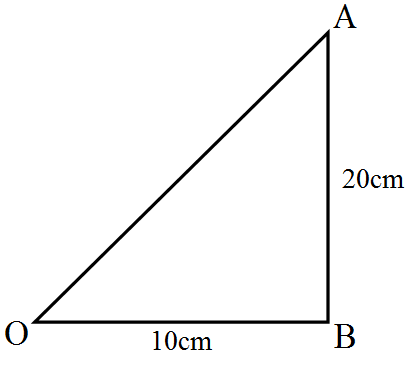
Since $\triangle\text{OAB}$ forms a right $-$ angled triangle,
By Pythagoras theorem,
$OB^2 = OA^2 + AB^2$
$\Rightarrow OB^2 = 10^2 + 20^2$
$\Rightarrow OB^2 = 10\sqrt{5}$
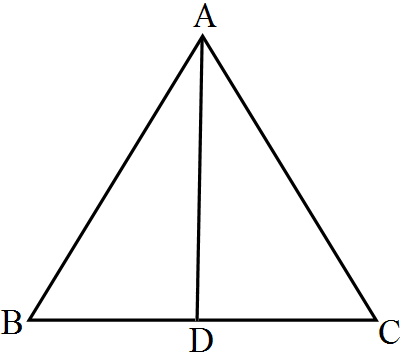
Let $\triangle\text{ABC}$ be an equilateral triangle.
We know that,
In an equilateral triangle the altitude is same as the median.
So, $BD = DC = 5\ cm$
By Pythagoras theorem,
$AC^2 = AD^2 + DC^2$
$\Rightarrow AD^2= AC^2 - DC^2$
$\Rightarrow AD^2 = 10^2- 5^2$
$\Rightarrow AD^2 = 10^2 - 5^2$
$\Rightarrow AD^2= 75$
$\Rightarrow AD = 5\sqrt{3}\text{ cm}$
Area of an equilateral triangle
$=\frac{\sqrt{3}}{4}\text{(side)}^2$
$=\frac{\sqrt{3}}{4}\text{(10)}^2$
$=25\sqrt{3}\text{ cm}^2$
$($Length of the diagonal of the rectangle$)^2 =$ length$^2 \ +$ breadth
$\Rightarrow ($Length of the diagonal of the rectangle$)^2 = 8^2 + 6^2$
$\Rightarrow ($Length of the diagonal of the rectangle$)^2 = 100$
$\Rightarrow ($Length of the diagonal of the rectangle$)^2 = 10m$ View full question & answer→MCQ 261 Mark
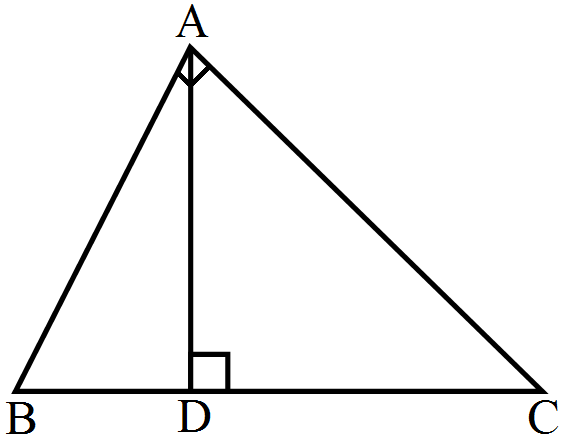
In the given figure, $\angle\text{BAC}=90^\circ$ and $\text{AD}\perp\text{BC}.$ Then:
- A
$\text{BC}\cdot\text{CD}=\text{BC}^2$
- B
$\text{AB}\cdot\text{AC}=\text{BC}^2$
- ✓
$\text{BD}\cdot\text{CD}=\text{AD}^2$
- D
$\text{AB}\cdot\text{AC}=\text{AD}^2$
AnswerCorrect option: C. $\text{BD}\cdot\text{CD}=\text{AD}^2$
In $\triangle\text{ABC},$
$\angle\text{ABD}=90^\circ-\angle\text{C}$
Similarly, in $\triangle\text{ACD},$
$\angle\text{CAD}=90^\circ-\angle\text{C}$
In $\triangle\text{DBA}$ and $\triangle\text{DAC}$
$\angle\text{ADB}=\angle\text{CDA}=90^\circ$
$\angle\text{ABD}=\angle\text{CAD}=90^\circ-\angle\text{C}$
So, $\triangle\text{DBA}\sim\triangle\text{DAC}$ .....(AA criterion of similarity)
$\frac{\text{BD}}{\text{AD}}=\frac{\text{AD}}{\text{CD}}$
$\Rightarrow\text{BD}\cdot\text{CD}=\text{AD}^2$
View full question & answer→MCQ 271 Mark
A man goes $24m$ due west and then $10m$ due north. How far is he from the starting point?
Answer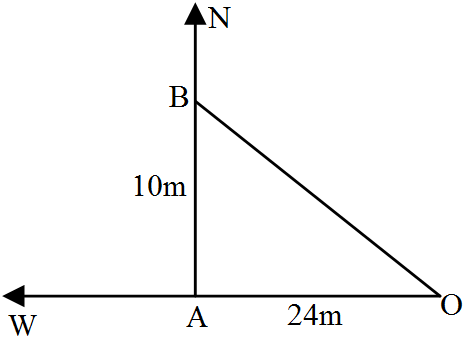
Let $O$ be the starting point.
From $O$ the man goes west that is towards, $W$ till point $A$. He then moves $10m$ due nirth, that is towards $N$ to point $B.$
$\triangle\text{OAB}$ forms a right $-$ angled triangle.
By Pythagoras theorem,
$OB^2=OA^2+AB^2$
$OB^2=24^2+10^2$
$OB^2=576+100$
$OB^2=676$
$OB=26 m$
So, the man is $26m$ away from the the starting point. View full question & answer→MCQ 281 Mark
In the given figure, $O$ is a point inside a $\triangle\text{MNP}$ such that $\angle\text{MOP}=90^\circ,\text{OM}=16\text{cm}$ and $OP = 12\ cm$. If $MN = 21\ cm$ and $\angle\text{NMP}=90^\circ$ then $NP = ?$
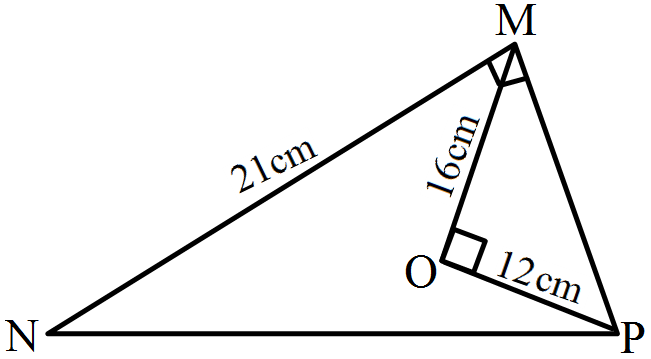
- A
$25\ cm$
- ✓
$29\ cm$
- C
$33\ cm$
- D
$35\ cm$
AnswerCorrect option: B. $29\ cm$
$\triangle MOP$ is a right$-$angled triangle.
By Pythagoras theorem,
$M P^2=M O^2+O P^2$
$M P^2=16^2+12^2$
$M P=20 cm$
$\triangle NMP$ is a right$-$angled triangle.
By PYthagoras theorem,
$N P^2=21^2+20^2$
$N P^2=4411+400$
$N P=29 \ cm$
View full question & answer→MCQ 291 Mark
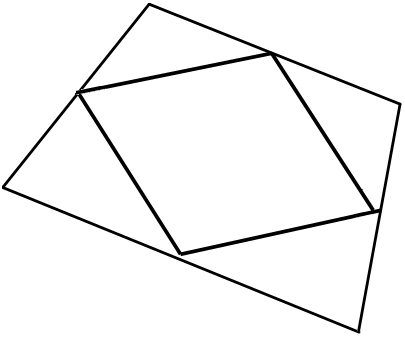
The line segments joining the midpoints of the adjacent side of a quadrilateral from:
AnswerThe line segment joining the midpoint of the adjacent sides of a quadrilateral form a parallelogram as shown below.
View full question & answer→MCQ 301 Mark
In $\triangle\text{ABC}$ and $\triangle\text{DEF},$ we have $\frac{\text{AB}}{\text{DE}}=\frac{\text{BC}}{\text{EF}}=\frac{\text{AC}}{\text{DF}}=\frac{5}{7},$ then $\text{ar}(\triangle\text{ABC}):\text{ar}(\triangle\text{DEF})=?$
AnswerIn $\triangle\text{ABC}$ and $\triangle\text{DEF},$
$\frac{\text{AB}}{\text{DE}}=\frac{\text{BC}}{\text{EF}}=\frac{\text{AC}}{\text{DF}}=\frac{5}{7}$
$\Rightarrow\triangle\text{ABC}\sim\triangle\text{DEF}$ ....(SSS criterion for Similarity)
$\Rightarrow\frac{\text{ar}(\triangle\text{ABC})}{\text{ar}(\triangle\text{DEF})}=\frac{\text{AB}^2}{\text{DE}^2}=\frac{5^2}{7^2}=\frac{25}{49}$
So, the ratio is 25 : 49.
View full question & answer→MCQ 311 Mark
In the given figure, ABCD is a trapezium whose diagonals AC and BD intersect at O such that OA = (3x - 1)cm, OB = (2x + 1)cm, OC = (5x - 3)cm and OD (6x - 5)cm. Then x =?
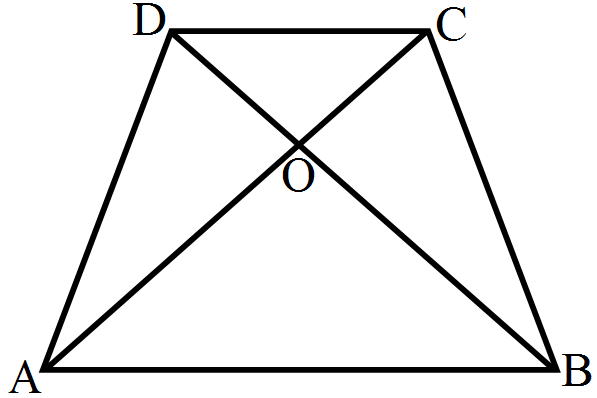
AnswerThe diagonals of a trapezium divide each other proportinally.
$\Rightarrow\frac{\text{OD}}{\text{OB}}=\frac{\text{OC}}{\text{OA}}$
$\Rightarrow\frac{6\text{x}-5}{2\text{x}+1}=\frac{5\text{x}-3}{3\text{x}-1}$
$\Rightarrow18\text{x}^2-21\text{x}+5=10\text{x}^2-\text{x}-3$
$\Rightarrow8\text{x}^2-20\text{x}+8=0$
$\Rightarrow2\text{x}^2-5\text{x}+2=0$
$\Rightarrow(\text{x}-2)(2\text{x}-1)=0$
$\Rightarrow\text{x}=2$ or $\text{x}=\frac{1}{2}$
if $\text{x}=\frac{1}{2},$ then $\text{OD}=6\text{x}-5=6\Big(\frac{1}{2}\Big)-5=-2$
RThis is not possible since length cannot be negative.
⇒ x = 2
View full question & answer→MCQ 321 Mark
If the bisectore of an angle of a triangle bisects the opposite side then the triangle is:
Answer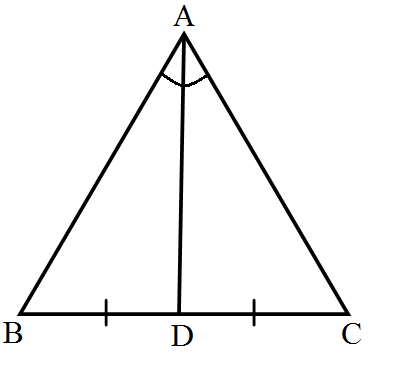
Let ABC be the triangle and AD be the bisector of $\angle\text{A}.$
Also, AD bisects the opposite side that is BC.
$\Rightarrow\text{ BD} =\text{ DC} \dots\text{(i)}$
$\Rightarrow\frac{\text{AB}}{\text{AC}}=\frac{\text{BD}}{\text{DC}}$
$\Rightarrow\frac{\text{AB}}{\text{AC}}=1\dots\text{(from(i))}$
$\Rightarrow\text{AB}=\text{AC}$
So, the triangle is an isosceles triangle. View full question & answer→MCQ 331 Mark
$\triangle\text{ABC}\sim\triangle\text{DEF}$ such that AB = 9.1cm and DE = 6.5cm. If the perimeter of $\triangle\text{DEF}$ is 25cm, what is the perimeter of $\triangle\text{ABC}?$
Answer$\triangle\text{ABC}\sim\triangle\text{DEF}$
$\Rightarrow\frac{\text{Perimeters of }\triangle\text{ABC}}{\text{Perimeters of }\triangle\text{DEF}}=\frac{\text{AB}}{\text{DE}}$
$\Rightarrow\frac{\text{Perimeters of }\triangle\text{ABC}}{25}=\frac{9.1}{6.5}$
$\Rightarrow\text{Perimeters of }\triangle\text{ABC}=\frac{9.1\times25}{6.5}$
$\Rightarrow\text{Perimeters of }\triangle\text{ABC}=35\text{cm}$
View full question & answer→MCQ 341 Mark
It is given that $\triangle\text{ABC}\sim\triangle\text{DFE}.$ If $\angle\text{A}=30^\circ,\angle\text{C}=50^\circ,\text{AB}=5\text{cm},\text{AC}=8\text{cm}$ and $\text{DF}=7.5\text{cm}$ then which of the following is true?
- A
$\text{DE}=12\text{cm},\angle\text{F}=50^\circ$
- ✓
$\text{DE}=12\text{cm},\angle\text{F}=100^\circ$
- C
$\text{EF}=12\text{cm},\angle\text{D}=100^\circ$
- D
$\text{EF}=12\text{cm},\angle\text{D}=30^\circ$
AnswerCorrect option: B. $\text{DE}=12\text{cm},\angle\text{F}=100^\circ$
Given that,
$\angle\text{A}=30^\circ,\angle\text{C}=50^\circ$
$\triangle\text{ABC}\sim\triangle\text{DFE}$
$\Rightarrow\angle\text{A}=\angle\text{D}=30^\circ$
$\angle\text{C}=\angle\text{E}=50^\circ$
Using angle sum property, we can find $\angle\text{B}=100^\circ$
So, $\angle\text{B}=\angle\text{F}=100^\circ$
Also, AB = 5cm, AC = 8cm and DF = 7.5cm
$\frac{\text{AB}}{\text{DF}}=\frac{\text{BC}}{\text{FE}}=\frac{\text{AC}}{\text{DE}}$
$\Rightarrow\frac{5}{7.5}=\frac{\text{BC}}{\text{FE}}=\frac{8}{\text{DE}}$
$\Rightarrow\frac{5}{7.5}=\frac{8}{\text{DE}}\Rightarrow\frac{8\times7.5}{5}=12\text{cm}$
Hence, DE = 12cm and $\angle\text{F}=100^\circ$
View full question & answer→MCQ 351 Mark
In $\triangle\text{ABC, }\text{AB}=6\sqrt{3 }\text{cm},\text{AC}=12\text{cm}$ and $\text{BC}=6\text{cm}.$ Then, $\angle\text{B}$ is:
AnswerIn $\triangle\text{ABC},$
$\text{AB}=6\sqrt{3 }\text{cm},\text{AC}=12\text{cm}$ and $\text{BC}=6\text{cm}$
$\text{AB}^2+\text{BC}^2=3\sqrt{3}^2+6^2=108+36=144$
$\text{AC}^2=12^2=144$
$\Rightarrow\text{AB}^2+\text{BC}^2=\text{AC}^2$
So, by the Converse of Pythagoras theorem,
$\triangle\text{ABC}$ is a right angled triangle and since AC is the hypotenuse,
$\angle\text{B}$ which is opposite $\text{AC} = 90^\circ.$
View full question & answer→MCQ 361 Mark
In a $\triangle\text{ABC}$ it is given that AB = 6cm, AC = 8cm and AD is the bisector of $\angle\text{A}.$ Then, BD : DC =?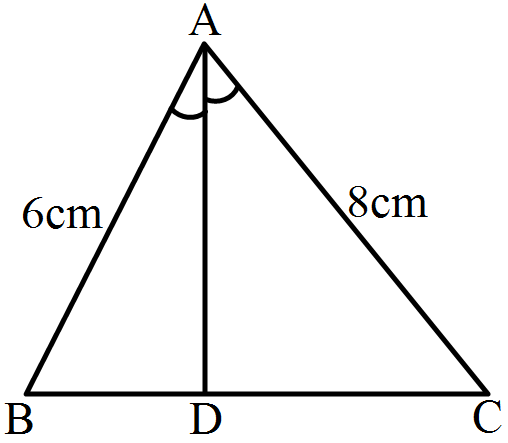
Answersince AD is the bisector of $\angle\text{A},$
by the angle bisector theorem,
$\frac{\text{AB}}{\text{AC}}=\frac{\text{BD}}{\text{DC}}$
$\Rightarrow\frac{6}{8}=\frac{\text{BD}}{\text{DC}}$
$\Rightarrow\frac{\text{BD}}{\text{DC}}=\frac{6}{8}=\frac{3}{4}$
So, BD : DC = 3 : 4.
View full question & answer→MCQ 371 Mark
In $\triangle\text{ABC}\sim\triangle\text{DEF}$ and the perimeters of $\triangle\text{ABC}$ and $\triangle\text{DEF}$ are 30cm and 18cm respectively. If BC = 9cm then EF =?
Answer$\triangle\text{ABC}\sim\triangle\text{DEF}$
$\Rightarrow\frac{\text{Perimeters of }\triangle\text{ABC}}{\text{Perimeters of }\triangle\text{DEF}}=\frac{\text{BC}}{\text{EF}}$
$\Rightarrow\frac{30}{18}=\frac{9}{\text{EF}}$
$\Rightarrow\frac{9\times18}{\text{30}}$
$\Rightarrow\text{EF}=5.4\text{cm}$
View full question & answer→MCQ 381 Mark
Which of the following is a false statement?
- A
If the areas of two similar triangles are equal then the triangles are congruent.
- ✓
The ratio of the areas of two similar triangles is equal to the ratio of their correspondin sides.
- C
The ratio of the areas of two similar triangles is equal to the ratio of squares of their correspondin medians.
- D
The ratio of the areas of two similar triangles is equal to the ratio of squares of their correspondin altitudes.
AnswerCorrect option: B. The ratio of the areas of two similar triangles is equal to the ratio of their correspondin sides.
Is false since the ratio of the areas of two similar triangles is equal to the ratio of squares of their corresponding sides.
View full question & answer→MCQ 391 Mark
It is given that $\triangle\text{ABC}\sim\triangle\text{PQR}$ and $\frac{\text{BC}}{\text{QR}}=\frac{2}{3}$ then $\frac{\text{ar}(\triangle\text{PQR})}{\text{ar}(\triangle\text{ABC})}=?$
- A
$\frac{2}{3}$
- B
$\frac{3}{2}$
- C
$\frac{4}{9}$
- ✓
$\frac{9}{4}$
AnswerCorrect option: D. $\frac{9}{4}$
$\triangle\text{ABC}\sim\triangle\text{PQR}$ and $\frac{\text{BC}}{\text{QR}}=\frac{2}{3}\Rightarrow\frac{\text{QR}}{\text{BC}}=\frac{3}{2}$
$\frac{\text{ar}(\triangle\text{PQR})}{\text{ar}(\triangle\text{ABC})}=\frac{\text{QR}^2}{\text{BC}^2}=\frac{3^2}{2^2}=\frac{9}{4}$
So, the ratio is 9 : 4.
View full question & answer→MCQ 401 Mark
Two poles of height $13m$ and $7m$ respectively stand vertically on a plane ground at a distance of $8m$ from each other. The distance between their tops is:
Answer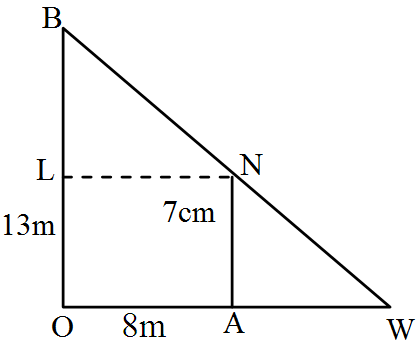
$O B$ and $A N$ are the two poles.
We have to find the distance between their tops
that is, $BN$
Construction: Draw $NL \perp OB$
$\text{OANL}$ is a rectangle$......($Since all the angles are right anglrs$)$
$LN=OA=8 m$
$OL=AN=7 m$
$\Rightarrow BL=OB-OL=13 m-7 m=6 m$
$\triangle BLN$ forms a right$-$angled triangle.
By Pythagoras theorem,
$BN^2=LN^2+BL^2$
$BN^2=8^2+6^2$
$BN^2=64+36$
$BN^2=100$
$BN=10 m$
So, the distance between their tops is $10 m .$ View full question & answer→MCQ 411 Mark
If $\triangle\text{ABC}\sim\triangle\text{EDF}$ and $\triangle\text{ABC}$ is not similar to $\triangle\text{DEF}$ then which of the following is not true?
- A
$\text{BC}\cdot\text{EF}=\text{AC}\cdot\text{FD}$
- B
$\text{AB}\cdot\text{EF}=\text{AC}\cdot\text{DE}$
- ✓
$\text{BC}\cdot\text{DE}=\text{AB}\cdot\text{EF}$
- D
$\text{BC}\cdot\text{DE}=\text{AB}\cdot\text{FD}$
AnswerCorrect option: C. $\text{BC}\cdot\text{DE}=\text{AB}\cdot\text{EF}$
In $\triangle\text{ABC}\sim\triangle\text{EDF},$ but $\triangle\text{ABC}$ is not similar $\triangle\text{DEF}.$
Since $\triangle\text{ABC}\sim\triangle\text{EDF},$
$\Rightarrow\frac{\text{AB}}{\text{DE}}=\frac{\text{BC}}{\text{DF}}=\frac{\text{AC}}{\text{EF}}$
So, $\text{AB}\cdot\text{EF}=\text{AC}\cdot\text{DE}$
Hence, $\text{BC}\cdot\text{DE}\not=\text{AB}\cdot\text{EF}.$
View full question & answer→MCQ 421 Mark
$\Rightarrow\triangle\text{ABC}\sim\triangle\text{DEF}$ such that $\text{ar}(\triangle\text{ABC})=36\text{cm}^2$ and $\text{ar}(\triangle\text{DEF})=49\text{cm}^2.$ Then, the ratio of their corresponding sides is:
Answer$\Rightarrow\triangle\text{ABC}\sim\triangle\text{DEF}$
$\Rightarrow\frac{\text{ar}(\triangle\text{ABC})}{\text{ar}(\triangle\text{DEF})}=\frac{\text{AB}^2}{\text{DE}^2}$
$\Rightarrow\frac{36}{49}=\frac{\text{AB}^2}{\text{DE}^2}$
$\Rightarrow\frac{\text{AB}}{\text{DE}}=\frac{6}{7}$
Since the triangle are similar,
$\frac{\text{AB}}{\text{DE}}=\frac{\text{BC}}{\text{EF}}=\frac{\text{AC}}{\text{DF}}=\frac{6}{7}$
So, the ratio is 6 : 7.
View full question & answer→MCQ 431 Mark
in the given figure, two line segments AC and BD intersect each other at the point P such that PA = 6cm, PB = 3cm, PC = 2.5cm, PD = 5cm, $\angle\text{APB}=50^\circ$ and $\angle\text{CDP}=30^\circ$ then $\angle\text{PBA}=?$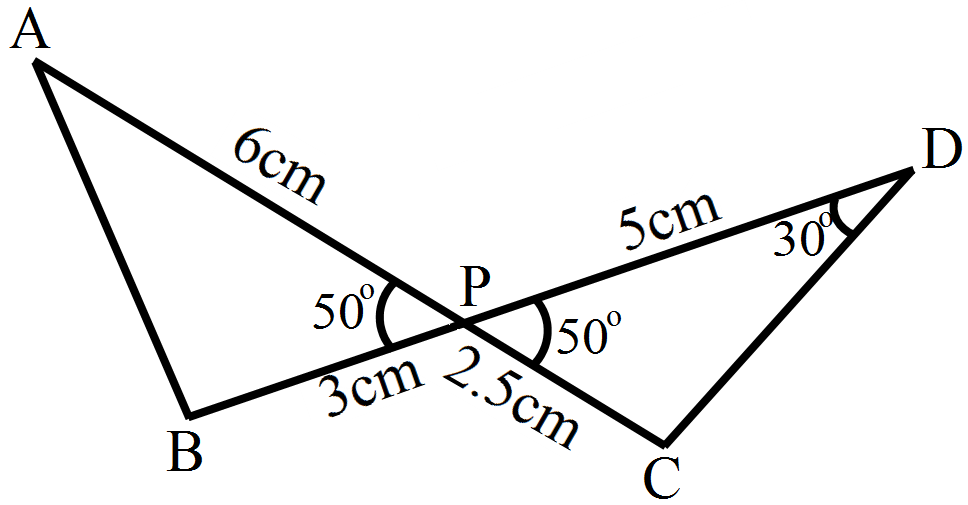
AnswerIn $\triangle\text{PBA}\sim\triangle\text{PCD}$
$\frac{\text{AP}}{\text{PD}}=\frac{\text{PB}}{\text{PC}}\dots\Big(\therefore\frac{\text{AP}}{\text{PD}}=\frac{6}{5 }\text{ and }\frac{\text{BP}}{\text{ BC}}=\frac{3}{2.5}=\frac{6}{5}\Big)$
So, $\angle\text{APB}=\angle\text{DPC}$ ....(Vertically opposite angles)
$\Rightarrow\triangle\text{CAD}\sim\triangle\text{PQR}$ ....(AA criterion for similarity)
$\angle\text{PBA}=\angle\text{DCP}$
In $\triangle\text{PCD},$
$\angle\text{PCD}=180^\circ-\angle\text{DPC}-\angle\text{PDC}$
$\Rightarrow\angle\text{PCD}=180^\circ-50^\circ-30^\circ$
$\Rightarrow\angle\text{PCD}=100^\circ$
So, $\angle\text{PBA}=\angle\text{DCP}=100^\circ.$
View full question & answer→MCQ 441 Mark
The hypotenuse of a right triangle is $25\ cm$. The other two sides are such that one is $5\ cm$ longer than the other. The lengths of these sides are:
- A
$10\ cm, 15\ cm$
- ✓
$15\ cm, 20\ cm$
- C
$12\ cm, 17\ cm$
- D
$13\ cm, 18\ cm$
AnswerCorrect option: B. $15\ cm, 20\ cm$
The pythagoeas theorem states that, in a right$-$angled triangle, the hypotenuse square is equal to the sum of the squares of the opposite sides.
$10^2+15^2=100+225=325$
hypotenuse $^2=25^2=625$
So, this is not possible by $(i).$
$15^2+20^2=225+400=625$
hypotenuse $^2=25^2=626$
So, the lengths of the sides are $15 \ cm$ and $20 \ cm .$
$12^2+172=144+289=433$
hypotenuse $^2=25^2=625$
So, this is not possible by $(i)$
$13^2+18^2=169+324=493$
hypotenuse $^2=25^2=626$
So, this is not possible by $(i).$
View full question & answer→MCQ 451 Mark
Corresponding sides of two similar triangles are in the ratio $4 : 9.$ Areas of these triangles are in the ratio:
- A
$2 : 3$
- B
$4 : 9$
- C
$9 : 4$
- ✓
$16 : 81$
AnswerCorrect option: D. $16 : 81$
Let the areas of the triangle be $A _1$ and $A _2$.
$\frac{\text{ar}(\text{A}_1)}{\text{ar}(\text{A}_2)}=\frac{4^2}{9^2}=\frac{16}{81}$
So, the ratio is $16 : 81.$
View full question & answer→MCQ 461 Mark
A vertical stick 1.8m long casts a shadow 45cm long on the ground. At the same time, what is the lenght of the shadow of a pole 6m high?
Answer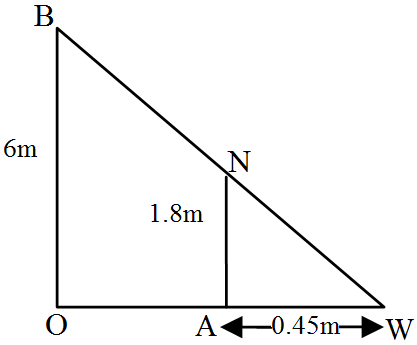
Let AN be the vertical stick and AW be its shadow.
Let OB be the pole and OW be its shadows.
AW = 45cm = 0.45m
AN = 1.8m
OB = 6m
Ratio of actual lengths = ratio of their shadows
$\Rightarrow\frac{\text{OB}}{\text{AN}}=\frac{\text{OW}}{\text{AW}}$
$\Rightarrow\frac{6}{1.8}=\frac{\text{OW}}{0.45}$
$\Rightarrow\text{OW}=\frac{6\times0.45}{1.8}$
$\Rightarrow\text{OW}=1.5\text{m}$ View full question & answer→MCQ 471 Mark
In $\triangle\text{ABC},$ if $AB = 16\ cm, BC = 12\ cm$ and $AC = 20\ cm,$ then $\triangle\text{ABC}$ is:
- A
Acute$-$angled.
- ✓
Right$-$angled.
- C
Obtuse$-$angled.
- D
AnswerCorrect option: B. Right$-$angled.
Note that first check if the sum of any two sides is greater than the third side.
Since in this triangle, it holds, a triangle is possible.
In $\triangle\text{ABC},$
if $AB = 16\ cm, BC = 12\ cm$ and $AC = 20\ cm$
Consider,
$AB^2+BC^2=16^2+12^2=400$
$AC^2=20^2=400$
By the Converse of Pythagoras theorem,
$\triangle\text{ABC}$ will be a right$-$angled triangle.
View full question & answer→MCQ 481 Mark
In $\triangle\text{ABC}$ and $\triangle\text{PQR},$ we have $\frac{\text{AB}}{\text{QR}}=\frac{\text{BC}}{\text{PR}}=\frac{\text{CA}}{\text{PQ}}$ then:
- ✓
$\triangle\text{PQR}\sim\triangle\text{CAB}$
- B
$\triangle\text{PQR}\sim\triangle\text{ABC}$
- C
$\triangle\text{CAB}\sim\triangle\text{PQR}$
- D
$\triangle\text{BCA}\sim\triangle\text{PQR}$
AnswerCorrect option: A. $\triangle\text{PQR}\sim\triangle\text{CAB}$
In $\triangle\text{ABC}$ and $\triangle\text{DEF},$
$\frac{\text{AB}}{\text{QR}}=\frac{\text{BC}}{\text{PR}}=\frac{\text{CA}}{\text{PQ}}$
So, $\angle\text{A}\leftrightarrow\angle\text{Q},\angle\text{B}\leftrightarrow\angle\text{R},\angle\text{C}\leftrightarrow\angle\text{P},$
$\Rightarrow\triangle\text{CAB}\sim\triangle\text{PQR}$
View full question & answer→MCQ 491 Mark
If $\triangle\text{ABC}\sim\triangle\text{QRP},\frac{\text{ar}(\triangle\text{ABC})}{\text{ar}(\triangle\text{PQR})}=\frac{9}{4},\text{AB}=18\text{cm}$ and $\text{BC}=15\text{cm}$ then $\text{PR}=?$
- A
- ✓
- C
- D
$\frac{20}{3}\text{cm}$
Answer$\triangle\text{ABC}\sim\triangle\text{QRP}$
$\Rightarrow\frac{\text{AB}}{\text{QR}}=\frac{\text{BC}}{\text{PR}}=\frac{\text{AC}}{\text{PQ}}$
Also, $\frac{\text{ar}(\triangle\text{ABC})}{\text{ar}(\triangle\text{PQR})}=\frac{\text{AB}^2}{\text{BC}^2}$
$\Rightarrow\frac{9}{4}=\frac{\text{AB}^2}{\text{BC}^2}$
$\Rightarrow\frac{\text{AB}}{\text{QR}}=\frac{3}{2}$
So, $\frac{\text{AB}}{\text{QR}}=\frac{\text{BC}}{\text{PR}}\Rightarrow\frac{\text{BC}}{\text{PR}}=\frac{3}{2}$
$\Rightarrow\frac{15}{\text{PR}}=\frac{3}{2}$
$\Rightarrow\text{PR}=10\text{cm}.$
View full question & answer→MCQ 501 Mark
the lengths of the diagonals of a rhombus are $24\ cm$ and $10\ cm.$ The length of each side of the rhombus is:
- A
$12\ cm$
- ✓
$13\ cm$
- C
$14\ cm$
- D
$17\ cm$
AnswerCorrect option: B. $13\ cm$
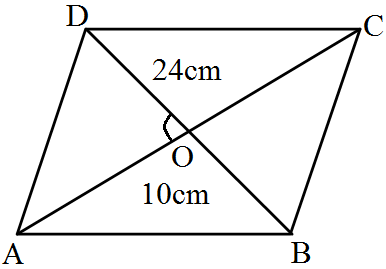
In an rhombus, the diagonals are perpendicular bisetoes of each other, and sides are equal to eachother.
So, $\text{AO}=\frac{1}{2}\text{AC}=12\text{cm}$
$\text{OD}=\frac{1}{2}\text{BD}=5\text{cm}$
In right$-$angled $\triangle\text{AOD},$
$A D^2=A O^2+O D^2$
$\Rightarrow A D^2=12^2+5^2$
$\Rightarrow A D^2=144+25$
$\Rightarrow A D^2=169$
$\Rightarrow A D=13 \ cm$
So, the length of the each side of the rhombus is $13\ cm.$ View full question & answer→