Questions

M.C.Q-[Che-1M]

🎯

Test yourself on this topic

29 questions · timed · auto-graded

Question 11 Mark
Which of the following statements are usually correct for carbon compounds? These:
  1. Are good conductors of electricity.
  2. Are poor conductors of electricity.
  3. Have strong forces of attraction between their molecules.
  4. Do not have strong forces of attraction between their molecules.
  1. 1 and 3
  2. 2 and 3
  3. 1 and 4
  4. 2 and 4
Answer
  1. 2 and 4

Explanation: Organic compound are made of covalent bonds. These bonds have weaker forces of attraction. Covalent compounds are poor conductors of electricity.
View full question & answer
Question 21 Mark
Which of the following represents saponification reaction?

  1. $\text{CH}_3\text{COOHNa}+\text{NaOH}\xrightarrow{\text{CaO}}\text{CH}_4+\text{Na}_2\text{CO}_3$

  2. $2\text{CH}_3\text{COOH}+\text{C}_2\text{H}_5\text{OH}\xrightarrow{\text{H}_2\text{SO}_4}\text{CH}_3\text{COOC}_2\text{H}_5+\text{H}_2\text{O}$

  3. 2CH3COOH + 2Na → 2CH3COONa + H2

  4. CH3COOC2H5 + NaOH → CH3COONa + C2H5OH

Answer
  1. CH3COOC2H5 + NaOH → CH3COONa + C2H5OH

Explanation: Saponification reaction is reaction of ester with base like NaOH to form the parent alcohol and sodium salt of carboxylic acid.

View full question & answer
Question 31 Mark
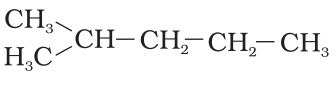
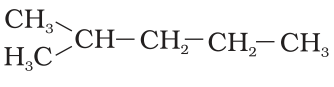
Which of the following is not a straight chain hydrocarbon?

  1. $\text{H}_3\text{C}-\text{CH}_2-\text{CH}_2-\text{CH}_2-\text{CH}_2\\ \ \ \ \ \ \ \ \ \ \ \ \ \ \ \ \ \ \ \ \ \ \ \ \ \ \ \ \ \ \ \ \ \ \ \ \ \ \ \ \ \ \ \ \ \ \ \ \ \ \ \ |\ \\ \ \ \ \ \ \ \ \ \ \ \ \ \ \ \ \ \ \ \ \ \ \ \ \ \ \ \ \ \ \ \ \ \ \ \ \ \ \ \ \ \ \ \ \ \ \ \ \ \ \ \text{CH}_3$

  2. $\text{H}_3\text{C}-\text{CH}_2-\text{CH}_2-\text{CH}_2-\text{CH}_2-\text{CH}_3$

  3. $\ \ \ \ \ \text{CH}_3\\ \ \ \ \ \ \ |\\\text{H}_2\text{C}-\text{H}_2\text{C}-\text{H}_2\text{C}-\text{CH}_2\\ \ \ \ \ \ \ \ \ \ \ \ \ \ \ \ \ \ \ \ \ \ \ \ \ \ \ \ \ \ \ \ \ \ \ \ \ \ \ |\\ \ \ \ \ \ \ \ \ \ \ \ \ \ \ \ \ \ \ \ \ \ \ \ \ \ \ \ \ \ \ \ \ \ \ \ \ \ \text{CH}_3$

  4.  

Answer
  1.  

Explanation: A branched chain hydrocarbon must contain some side chains which are bonded with parent carbon chain.

View full question & answer
Question 41 Mark
Which of the following does not belong to the same homologous series?
  1. CH4
  2. C2H6
  3. C3H8
  4. C4H8
Answer
  1. C4H8

Explanation: Successive members of same homologous series are differ by - CH2 unit. CH4, C2H6, C3H8 belong to same series that is of alkane and differ by ─ CH2 unit but C4H8 does not belong to this.

View full question & answer
Question 51 Mark
Which of the following are correct structural isomers of butane?


  1. 1 and 3
  2. 2 and 4
  3. 1 and 2
  4. 3 and 4
Answer
  1. 1 and 2

Explanation: Formula of butane is C4H10. Options (iii) and (iv) have 8 hydrogen atoms each, hence, they are incorrect.

View full question & answer
Question 61 Mark
Which among the following are unsaturated hydrocarbons?

  1. $\text{H}_3\text{C}-\text{CH}_2-\text{CH}_2-\text{CH}_3$

  2. $\text{H}_3\text{C}-\text{C}\equiv\text{C}-\text{CH}_3$

  3. $\ \text{H}_3\text{C}-\text{CH}-\text{CH}_3\\ \ \ \ \ \ \ \ \ \ \ \ \ \ \ | \ \ \ \\ \ \ \ \ \ \ \ \ \ \ \ \ \ \text{CH}_3$

  4. $\ \text{H}_3\text{C}-\text{C}=\text{CH}_2\\ \ \ \ \ \ \ \ \ \ \ \ \ \ \ | \ \ \ \\ \ \ \ \ \ \ \ \ \ \ \ \ \ \text{CH}_3$

  1. 1 and 3
  2. 2 and 3
  3. 2 and 4
  4. 3 and 4
Answer
  1. 2 and 4

Explanation: These compounds show double and triple bonds. Hence they are unsaturated hydrocarbons.

View full question & answer
Question 71 Mark
Vinegar is a solution of:
  1. 50% – 60% acetic acid in alcohol.
  2. 5% – 8% acetic acid in alcohol.
  3. 5% – 8% acetic acid in water.
  4. 50% – 60% acetic acid in water.
Answer
  1. 5% – 8% acetic acid in water.

Explanation: Vinegar is a 5% - 8% aqueous solution of acetic acid.

View full question & answer
Question 81 Mark
The soap molecule has a:
  1. Hydrophilic head and a hydrophobic tail.
  2. Hydrophobic head and a hydrophilic tail.
  3. Hydrophobic head and a hydrophobic tail.
  4. Hydrophilic head and a hydrophilic tail.
Answer
  1. Hydrophilic head and a hydrophobic tail.

Explanation: Oil and grease is trapped inside a micelle because of hydrophobic tail. Hydrophilic head makes the outer surface of micelle. Thus, a micelle is easily washed by water.

View full question & answer
Question 91 Mark
The name of the compound $\text{CH}_3-\text{CH}_2-\text{CHO}$ is:
  1. Propanal.
  2. Propanone.
  3. Ethanol.
  4. Ethanal.
Answer
  1. Propanal.

Explanation: Compound contains three carbon atoms so prop-would be root word and – CHO functional group so suffix will be – al. Hence name would be propane + al = propanal.

View full question & answer
Question 101 Mark
The heteroatoms present in $\text{CH}_3-\text{CH}_2-\text{O}-\text{CH}_2-\text{CH}_2\text{Cl}$ are:
  1. Oxygen.
  2. Carbon.
  3. Hydrogen.
  4. Chlorine.
  1. 1 and 2
  2. 2 and 3
  3. 3 and 4
  4. 1 and 4
Answer
  1. 1 and 4

Explanation: Oxygen and chlorine are not among essential components of hydrocarbons.

View full question & answer
Question 111 Mark
The first member of alkyne homologous series is:
  1. Ethyne.
  2. Ethene.
  3. Propyne.
  4. Methane.
Answer
  1. Ethyne.

Explanation: Alkyne is an organic compound with triple covalent bond between two carbon atoms therefore first member of homologous series must have atleast two carbon atoms with one triple bond that is ethyne (CH ≡ CH).

View full question & answer
Question 121 Mark
The correct structural formula of butanoic acid is:


Answer
 

Explanation: Formula of butanoic acid is C3H7COOH.

View full question & answer
Question 131 Mark
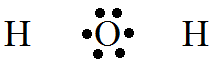
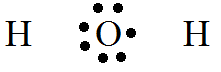
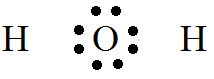
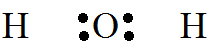
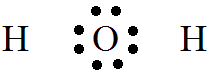
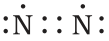
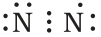
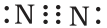
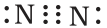
The correct electron dot structure of a water molecule is:

  1.  

  1.  

  1.  

  1.  

Answer
  1.  

Explanation: This dot structure shows a complete octet after oxygen shared two electrons with two univalent atoms of hydrogen.

View full question & answer
Question 141 Mark
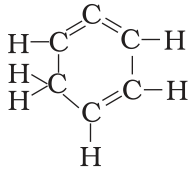
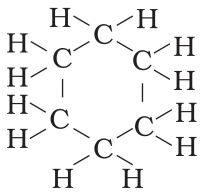
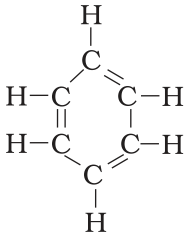
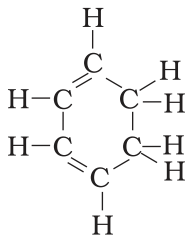
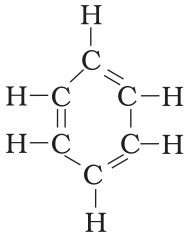
Structural formula of benzene is:
Answer

Explanation: Benzene is simplest aromatic compound with six carbon atoms and six H atoms. There are three alternate pi bonds in ring of carbon atoms.

View full question & answer
Question 151 Mark
$\text{CH}_3\text{CH}_2\text{OH}\xrightarrow[\text{Heat}]{\text{Alkaline KMnO}_4}\text{CH}_3\text{COOH}$

In the above given reaction, alkaline KMnO4 acts as:

  1. Reducing agent.
  2. Oxidising agent.
  3. Catalyst.
  4. Dehydrating agent.
Answer
  1. Oxidising agent.

Explanation: Alkaline KMnO4 is also known as Baeyer’s reagent. It acts as an oxidizing agent.

View full question & answer
Question 161 Mark
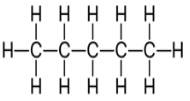
Pentane has the molecular formula C5H12. It has:
  1. 5 covalent bonds.
  2. 12 covalent bonds.
  3. 16 covalent bonds.
  4. 17 covalent bonds.
Answer
  1. 16 covalent bonds.

Explanation: Pentane contains four C - C bonds and twelve C - H covalent bonds.

​​​​​​​

View full question & answer
Question 171 Mark
Oils on treating with hydrogen in the presence of palladium or nickel catalyst form fats. This is an example of:
  1. Addition reaction.
  2. Substitution reaction.
  3. Displacement reaction.
  4. Oxidation reaction.
Answer
  1. Addition reaction.

Explanation: It is hydrogenation reaction means addition of hydrogen to double bonds of unsaturated compounds found in oil.

$\text{CH}_3\text{COOH}_2\text{CH}_3\ +\ \text{NaOH}\xrightarrow[\text{(Sapon ification)}]{\text{Heat}}\text{CH}_3\text{COONa}+\text{CH}_3\text{CH}_2\text{OH}\\ \ \text{Ethyl ethanoate}\ \ \ \ \ \ \ \text{Sodium}\ \ \ \ \ \ \ \ \ \ \ \ \ \ \ \ \ \ \ \ \ \ \ \ \ \ \text{Sodium}\ \ \ \ \ \ \ \ \ \ \ \ \ \ \ \text{Ethanol}\\ \ \ \ \ \ \ \ \ \ \ \ \ \ \ \ \ \ \ \ \ \ \ \ \ \ \ \ \ \ \ \ \ \ \ \ \text{hydroxide}\ \ \ \ \ \ \ \ \ \ \ \ \ \ \ \ \ \ \ \ \ \ \text{ethanoate}$

View full question & answer
Question 181 Mark
Mineral acids are stronger acids than carboxylic acids because:
  1. Mineral acids are completely ionised.
  2. Carboxylic acids are completely ionised.
  3. Mineral acids are partially ionised.
  4. Carboxylic acids are partially ionised.
  1. 1 and 4
  2. 2 and 3
  3. 1 and 2
  4. 3 and 4
Answer
  1. 1 and 4

Explanation: Mineral acids like HCl are completely ionized in solvent like water whereas carboxylic acids such as CH3COOH are only partially ionized.

View full question & answer
Question 191 Mark
In which of the following compounds, -OH is the functional group?
  1. Butanone.
  2. Butanol.
  3. Butanoic acid.
  4. Butanal.
Answer
  1. Butanol.

Explanation: -OH is the functional group in butanol which is an alcohol.

View full question & answer
Question 201 Mark
In the soap micelles:
  1. The ionic end of soap is on the surface of the cluster while the carbon chain is in the interior of the cluster.
  2. Ionic end of soap is in the interior of the cluster and the carbon chain is out of the cluster.
  3. Both ionic end and carbon chain are in the interior of the cluster.
  4. Both ionic end and carbon chain are on the exterior of the cluster.
Answer
  1. The ionic end of soap is on the surface of the cluster while the carbon chain is in the interior of the cluster.
View full question & answer
Question 211 Mark
Identify the unsaturated compounds from the following:
  1. Propane.
  2. Propene.
  3. Propyne.
  4. Chloropropane.
  1. 1 and 2
  2. 2 and 4
  3. 3 and 4
  4. 2 and 3
Answer
  1. 2 and 3

Explanation: Both propene and propyne are unsaturated hydrocarbons.

View full question & answer
Question 221 Mark
Ethanol reacts with sodium and forms two products. These are:
  1. Sodium ethanoate and hydrogen.
  2. Sodium ethanoate and oxygen.
  3. Sodium ethoxide and hydrogen.
  4. Sodium ethoxide and oxygen.
Answer
  1. Sodium ethoxide and hydrogen.

Explanation:

​​​​​​​$2\text{C}_2\text{H}_5\text{OH}+2\text{Na}\rightarrow2\text{C}_2\text{H}_5\text{ONa + H}_2\\ \ \ \ \ \ \ \ \ \ \ \ \ \ \ \ \ \ \ \ \ \ \ \ \ \ \ \ \ \ \ \ \ \ \text{Sod.ethoxide}$​​​​​​​

View full question & answer
Question 231 Mark
Chlorine reacts with saturated hydrocarbons at room temperature in the:
  1. Absence of sunlight.
  2. Presence of sunlight.
  3. Presence of water.
  4. Presence of hydrochloric acid.
Answer
  1. Presence of sunlight.

Explanation: These reactions are called photochemical reactions.

View full question & answer
Question 241 Mark
Carbon forms four covalent bonds by sharing its four valence electrons with four univalent atoms, e.g. hydrogen. After the formation of four bonds, carbon attains the electronic configuration of:
  1. Helium.
  2. Neon.
  3. Argon.
  4. Krypton.
Answer
  1. Neon.

Explanation: The compound formed is methane (CH4). In this, carbon atom has a complete octet and configuration of neon which is a noble gas element.

View full question & answer
Question 251 Mark
Carbon exists in the atmosphere in the form of:
  1. Carbon monoxide only.
  2. Carbon monoxide in traces and carbon dioxide.
  3. Carbon dioxide only.
  4. Coal.
Answer
  1. Carbon monoxide in traces and carbon dioxide.

Explanation: ​​​​​​​Both CO and CO2 gases are present in traces in the atmosphere.

View full question & answer
Question 261 Mark
Buckminsterfullerene is an allotropic form of:
  1. Phosphorus.
  2. Sulphur.
  3. Carbon.
  4. Tin.
Answer
  1. Carbon.

Explanation: Buckminsterfullerene is an allotrope of carbon with 60 carbon atoms which are joined together in a spherical shape.

View full question & answer
Question 291 Mark
A molecule of ammonia (NH3) has:
  1. Only single bonds.
  2. Only double bonds.
  3. Only triple bonds.
  4. Two double bonds and one single bond.
Answer
  1. Only single bonds.

Explanation: Ammonia is a covalent molecule in which center nitrogen atom is bonded with three hydrogen atoms through single covalent bond.

View full question & answer
M.C.Q-[Che-1M] - Science STD 10 Questions - Vidyadip