Questions

case /data -based [Che-4M]

🎯

Test yourself on this topic

10 questions · timed · auto-graded

Question 14 Marks
Read the following and answer any four questions from (i) to (v).Reactions, in which one element takes place of another element in a compound, are known as displacement reactions. ln general, more reactive elements displaces a less reactive element from its compound. ln all single displacement reactions, only one element displaces another element from its compound. The single displacement reactions are, however, written as just displacement reactions. The displacement reaction between iron (III) oxide and powdered aluminum produces so much heat that iron metal obtained is in molten form.
  1. which of the metals from its salt solution displaces copper ?
  2. When zinc reacts with dilute sulfuric acid, which gas is evolved ?
  3. When dry hydrogen is passed over a heated oxide of metal X using the apparatus , what substance is obtained and it could be in which form ?
          OR
    a) Which reactions are called displacement reaction?
    b) When dilute hydrochloric acid is added to granulated zinc placed in a test tube, what result will be there after observation ?
Answer
  1. (c) AgNO3
Explanation:Cu + 2AgNO3  →  Cu(NO3)2 + 2Ag
Copper can displace silver from its salt solution since, copper is more reactive than silver.
  1. (c)$\text{ Zn}+ \text{H}_2\text{SO}_{4(\text{dil.})}\ \rightarrow\ \text{ZnSO}_4+\text{H}_2\uparrow$
Explanation:
H2 is a colourless, odourless gas and burns with a pop sound.
  1. (a)
    $\underset{\text { Copper oxide }}{ CuO }+\underset{\text { Hydrogen }}{ H _2} \xrightarrow{\text { Heat }} \underset{\substack{\text { Copper } \\ \text { (Redidsh-hrowna) }}}{ Cu }+\underset{\substack{\text { Water } \\ \text { Vapour }}}{ H _2 O }$
  2. (c) Mg + CuSO4  →  MgSO4 + Cu
Explanation:It is a single displacement reaction.
  1. (d) The colourless and odourless gas evolves with a pop sound.
Explanation:$\text{ Zn}+ 2\text{HCl} \rightarrow\ \text{ZnCl}_2+\text{H}_2\uparrow$
View full question & answer
Question 24 Marks
Read the following and answer any four questions from (i) to (v).ln decomposition reactions, a single reactant breaks down to form two or more products. Decomposition reaction is opposite to combination reaction. Thermal decomposition reactions use the energy in form of heat for decomposition of reactants. Electrolytic decomposition reactions involve the use of electrical energy for the decomposition of reactant molecules. Photolysis or photochemical decomposition involves the use of light energy for the purpose of decomposition.
  1. Which reactions are a decomposition reaction?
  2. Amino acid is fanned by the decomposition of which component of our diet?
  3. Silver chloride on exposure to sunlight for a long duration turns gray due to which formation?
    OR
    A) What type of chemical reaction takes place when electricity is passed through water?
    B) Which involves the use of light energy for the purpose of decomposition?
Answer
  1. (c) 2KClO3 → 2KCl + 3O2
  2. (b) 4NO2

Explanation:

2Pb(NO3)→ 2PbO + nA + O2

  1. (c) Protein.

Explanation:

Proteins in our diet get broken down into amino acids.

  1. (a) Only (I).

Explanation:

$2\text{Ag}(\text{Cl})_\text{(s)}\xrightarrow{\text{sunlight}}2\text{Ag}_\text{(s)}+{{\text{Cl}_2}_\text{(g)}}$

  1. (b) Electrolytic decomposition.

Explanation:

Electrolysis of water is electrolytic decomposition.

$2\text{H}_2\text{O}\xrightarrow{\text{current}}2\text{H}_2\text{O}+\text{O}_2$

View full question & answer
Question 34 Marks
Read the following and answer any four questions from (i) to (v).
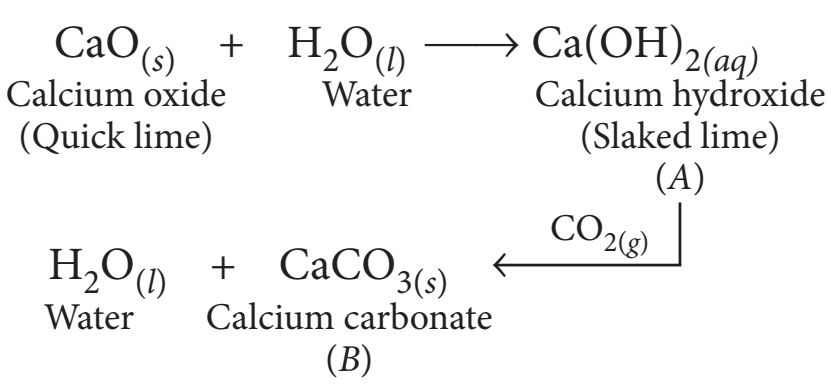
A reaction in which two or more reactants combine to form a single product is called a combination reaction. For example, calcium oxide reacts vigorously with water to form calcium hydroxide. The reaction is highly exothermic in nature, as lots of heat is produced during the reaction.
$\quad$$CaO _{( s )} \ \ \ + \ \ \ H _2 O _{( l )} \longrightarrow Ca ( OH )_{2( aq )} \ + \  H ^2$
Calcium oxide$\qquad$Water $\quad$ Calcium hydroxide
Solution of Ca(OH)2 is used for white wash the walls. Calcium hydroxide reacts slowly with carbon dioxide in air to form a thin layer of calcium carbonate on the wall which gives a shiny appearance to wall. Calcium carbonate will formafter two or three days of white wash.
  1. What is the chemical name of quick lime?
  2. When carbon dioxide is passed through lime water, what will be the reaction?
  3. which reaction is formed when calcium oxide reacts vigorously with water?
    OR
    A) what is a combination reaction?
    B) Which is an endothermic reaction?
View full question & answer
Question 44 Marks
Answer
COMING SOON
View full question & answer
Question 54 Marks
Answer
1. $CO _2$ is not a pollutant when present in the atmosphere upto a certain percent. Rather, it helps to maintain the temperature of the Earth. Combustion of coke is harmful as it increases the concentration of $CO _2$ in the atmosphere which causes global warming (greenhouse effect).

2. Reaction of calcium with oxygen gives quicklime $( CaO )$ which combines with water to form $CaCO _3$

3. Tiffin boxes made up of steel are either tin plated or nickel plated to protect them from rusting. However, tin-plating is preferred because tin is non-poisonous and hence, does not contaminate the food kept in them.
or
A photographic film used in black and white photography is a celluloid film coated with silver chloride. Its working is based on the decomposition of silver chloride in the presence of sunlight.

View full question & answer
Question 64 Marks
Answer
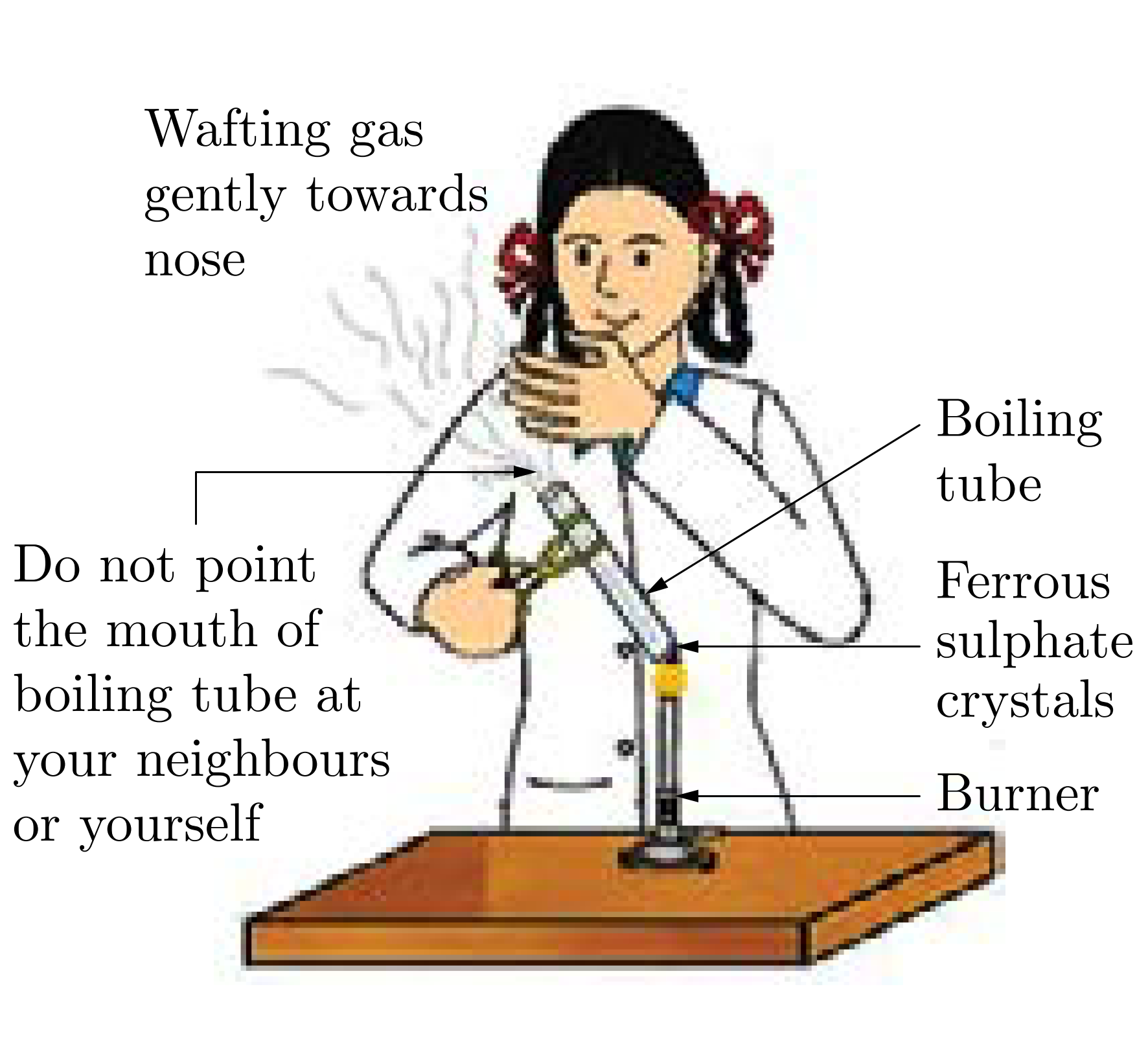
1. Before heating: Pale green colour.
After heating: Reddish brown.

2. $2 FeSO _4( s ) \stackrel{\text { Heat }}{\longrightarrow} Fe _2 O _3( s )+ SO _2( g )+ SO _3( g )$

3.Pungent smelling gas is sulphur dioxide, $SO _2$. It is a non-metallic oxide, hence acidic in nature.
or
Ferric oxide or iron (III) oxide.

View full question & answer
Question 74 Marks
A student prepared oxygen in a lab by catalytic decomposition of potassium chlorate $\left( KClO _3\right)$ as shown in the figure. Decomposition of potassium chlorate gives potassium chloride $( KCl )$ and oxygen $\left( O _2\right)$. The following reaction takes place :
\[KClO _3( s ) \longrightarrow KCl ( s )+ O _2( g )\]
  1. How many moles of $KClO _3$ are required to produce $2.4$ moles of $O _2$ ?
  2. Name the element which is reduced in the given reaction.
  3. How many moles of $KClO _3$ give 3 moles of oxygen?
    or
    What is the oxidation state of chlorine in potassium chlorate?
Answer
SELF
View full question & answer
Question 84 Marks
When steam is passed through red hot iron, iron oxide and hydrogen gas is formed.
The balanced equation for the reaction is shown below.
$\begin{array}{l}3 Fe +4 H _2 O \longrightarrow Fe _3 O _4+4 H _2 \\ \begin{array}{llll}\text { (Iron) } & \text { (water) } & \text { (iron oxide) } & \text { (hydrogen) }\end{array} \\\end{array}$
1. Is heating iron to red hot a physical or a chemical change? Explain your answer.
2. What is true for the balanced chemical equation shown above?
  A. Four atoms of water combine with iron to form four atoms of hydrogen.
  B. Three atoms of iron combine with water to form four atoms of hydrogen.
  C. Four molecules of water combine with iron to form an atom of iron oxide.
  D. Three atoms of iron combine with water to form one molecule of iron oxide.
Answer
1. Mentions that heating iron to red hot is a physical change as no new substance is formed.
For example:
● It is a physical change as iron does not change its form.
2. D. Three atoms of iron combine with water to form one molecule of iron oxide.
View full question & answer
Question 94 Marks
Cellular respiration is a chemical process by which cells convert glucose to energy.
The equation given below shows the reaction for cellular respiration.
$\underset{\text { (glucose) }}{ C _6 H _{12} O _6}+\underset{\text { (oxygen) }}{6 O _2} \longrightarrow \underset {\text { (carbon dioxide) }} {6 CO _2}+\underset{\text { (water) }}{6 H _2 O }+$ Energy
3. In the above reaction, which substance is oxidised?
4. Carbon dioxide and water are the two new substances formed during cellular respiration. What are they known as?
  A. Reactants
  B. Mixtures
  C. Catalysts
  D. Products
Answer
3. Mentions that glucose is oxidised.
For example: 
● Glucose is oxidised.
4. D. Products
View full question & answer
Question 104 Marks
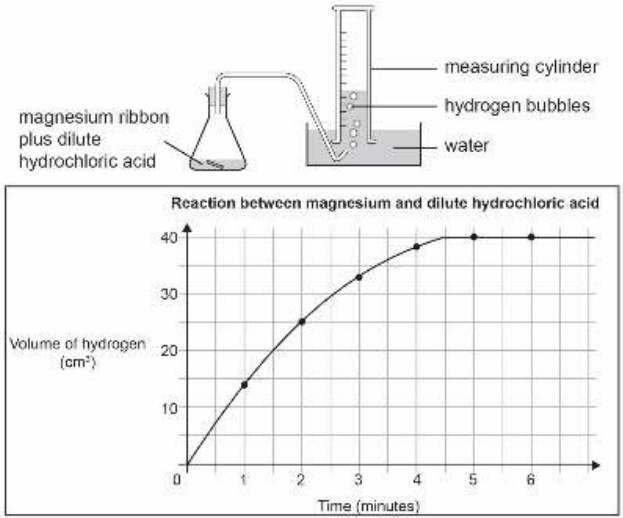
A piece of magnesium ribbon is added to a lask containing dilute hydrochloric acid.
Hydrogen gas is formed which is collected in the measuring cylinder.
The amount of hydrogen formed with time is plotted on a graph.
The line on the graph indicates the rate of chemical reaction occurring in the lask.

Image
5. At what time is the reaction rate the fastest in the lask?
A. At 1 minute
B. At 3 minutes
C. At 4 minutes
D. At 6 minutes
6. The reaction is repeated with magnesium powder in place of magnesium ribbon under the same conditions. Will the reaction rate increase or decrease?
Explain your answer with reference to the volume of hydrogen formed in the lask at 2 minutes.
7. Which of these could increase the rate of reaction in the lask?
Circle ‘Yes’ or ‘No’ for each row.

Will this increase the rate of reaction?

Yes or No

Adding more acid to the flask

Yes/No

Heating the acid in the flask

Yes/No

Using a higher concentration of acid

Yes/No

8. Magnesium reacts with hydrochloric acid to form magnesium chloride and hydrogen gas.
Write a balanced chemical equation to show the reaction.
9. Which of these is an example of decomposition reaction?
A. Melting of glaciers
B. Rusting of old bridges
C. Rotting of fruits and vegetables
D. Absorption of carbon dioxide by oceans
10. Methane gas released from waste water treatment plants can be used as a source of fuel. Which chemical equation represents combustion of methane to produce heat energy?
A. $CH _4+ CO _2 \rightarrow 2 O _2+2 H _2 O$
B. $CH _4+2 O _2 \rightarrow CO _2+2 H _2 O$
C. $2 O _2+2 H _2 O \rightarrow CO _2+ CH _4$
D. $CO _2+2 O _2 \rightarrow CH _4+2 H _2 O$

Answer
5. A. At 1 minute
6. Mentions that the reaction rate will increase and therefore the volume of hydrogen formed at 2 minutes will be higher. 
7. No
  Yes
  Yes
8. Mg + 2HCl → MgCl₂ + H₂
9. C. Rotting of fruits and vegetables
10. B. CH₄ + 2O₂ → CO₂ + 2H₂O
View full question & answer
case /data -based [Che-4M] - Science STD 10 Questions - Vidyadip