Sample QuestionsChemical Reactions and Equations questions
One sample from each question group in this chapter. Select any group above to see the full set with answer keys.
The colour of the solution observed after $30$ minutes of placing zinc metal to copper sulphate solution is
Answer: B.
View full solution →Identify the product which represents the solid state in the above reaction.
Answer: B.
View full solution →In the preparation of soap, a small amount of sodium chloride $($common salt$)$ is added to the mixture of fat and sodium hydroxide. The role of common salt is to
- ✓
Favour the precipitation of soap.
- B
Enhance the cleansing capacity of soap.
- C
Increase the weight of the soap to earn money.
- D
Decrease the acidity of the soap.
Answer: A.
View full solution →In the experiment for determining the percentage of water absorbed by raisins, we do the final weighing of the raisins after keeping them dipped in water for about one hour. For the accuracy of the result, the extra water from the surface of the soaked raisins is removed by :
- A
Rubbing with cotton cloth.
- B
- C
- ✓
Answer: D.
View full solution →A student weighed some raisins and recorded the weight as $‘x\ ’$. She then soaked the raisins in distilled water. After about $2$ hours she removed the raisins, wiped them dry and weighed again and recorded that as $‘y\ ’.$ The percentage of water absorbed by raisins may be determined using the relationship:
- A
$\frac{\text{y $-$ x}}{\text{y}}\times100$
- ✓
$\frac{\text{y $-$ x}}{\text{x}}\times100$
- C
$\frac{\text{y $-$ x}}{\text{x}}\times\frac{1}{100}$
- D
$\text{(y $-$ x)}\times100$
Answer: B.
View full solution →What happens when dilute hydrochloric acid is added to iron fillings? Tick the correct answer.
- ✓
Hydrogen gas and iron chloride are produced.
- B
Chlorine gas and iron hydroxide are produced.
- C
- D
Iron salt and water are produced.
Answer: A.
View full solution →$Fe_2 O_3+2 Al \longrightarrow Al_2 O_3+2 Fe$
The above reaction is an example of a __________.
- A
- B
double displacement reaction.
- C
- ✓
Answer: D.
View full solution →Which of the statements about the reaction below are incorrect?
$2 PbO(s)+C(s) \longrightarrow 2 Pb(s)+CO_2(g)$
i. Lead is getting reduced.
ii. Carbon dioxide is getting oxidised.
iii. Carbon is getting oxidised.
iv. Lead oxide is getting reduced.
Answer: C.
View full solution →The colour of the solution observed after 30 minutes of placing zinc metal to copper sulphate solution is
Answer: B.
View full solution →Identify the product which represents the solid state in the above reaction.
Answer: B.
View full solution →For two statements are given-one labelled Assertion $(A)$ and the other labelled Reason $(R)$. Select the correct answer to these questions from the codes $\ce{(a), (b), (c)} $ and $(d)$ as given below :
Assertion : ln a balanced chemical equation, total mass of the reactants is equal to the total mass of the products.
Reason : Mass can neither be created nor destroyed during a chemical change.
- ✓
Both $A$ and $R$ are true, and $R$ is correct explanation of the assertion.
- B
Both $A$ and $R$ are true, but $R$ is not the correct explanation of the assertion.
- C
$A$ is true, but $R$ is false.
- D
$A$ is false, but $R$ is true.
Answer: A.
View full solution →For two statements are given-one labelled Assertion $(A)$ and the other labelled Reason $(R).$ Select the correct answer to these questions from the codes $(a), (b), (c)$ and $(d)$ as given below:
Assertion: $\ce{MnO_2 + 4HCl → MnCl_2 + Cl_2 + 2H_2O,}$ is a redox reaction.
Reason: $\ce{MnO_2}$ oxidises $\ce{HCl}$ to $\ce{Cl_2}$ and gets reduced to $\ce{MnCl_2}$.
- ✓
Both $A$ and $R$ are true, and $R$ is correct explanation of the assertion.
- B
Both $A$ and $R$ are true, but $R$ is not the correct explanation of the assertion
- C
$A$ is true, but $R$ is false.
- D
$A$ is false, but $R$ is true.
Answer: A.
View full solution →For two statements are given $-$ one labelled Assertion $(A)$ and the other labelled Reason $(R).$ Select the correct answer to these questions from the codes $\ce{(a), (b), (c)}$ and $(d)$ as given below:
Assertion : Exposure of silver chloride to sunlight for a long duration turns gray due to the formation of silver by decomposition of silver chloride.
Reason : ln this process, sublimation of silver chloride takes place.
- A
Both $A$ and $R$ are true, and $R$ is correct explanation of the assertion.
- B
Both $A$ and $R$ are true, but $R$ is not the correct explanation of the assertion.
- ✓
$A$ is true, but $R$ is false.
- D
$A$ is false, but $R$ is true.
Answer: C.
View full solution →For two statements are given $-$ one labelled Assertion $(A)$ and the other labelled Reason $(R).$ Select the correct answer to these questions from the codes $\ce{(a), (b), (c)}$ and $(d)$ as given below :
Assertion : The food items containing oil and fat are flushed with nitrogen.
Reason : Oil and fat become rancid on oxidation which has the bad taste and smell.
- ✓
Both $A$ and $R$ are true, and $R$ is correct explanation of the assertion.
- B
Both $A$ and $R$ are true, but $R$ is not the correct explanation of the assertion.
- C
$A$ is true, but $R$ is false.
- D
$A$ is false, but $R$ is true.
Answer: A.
View full solution →In the following questions, a statement of Assertion is given by the corresponding statement of Reason. Of the statements, mark the correct answer as.
Assertion : $2\text{Na}+\text{H}_2\rightarrow2\text{NaH}$
In the above chemical equal, sodium is getting oxidised and $H_2$ is getting reduced.
Reason : The chemical reaction in which oxidation and reduction take place simultaneously, are called redox reactions.
- A
If both Assertion and Reason are true and Reason is the correct explanation of Assertion.
- ✓
If both Assertion and Reason are true, but Reason is not the correct explanation of Assertion.
- C
If Assertion is true, but Reason is false.
- D
If Assertion is false, but Reason is true.
Answer: B.
View full solution →In the following questions, a statement of Assertion is given by the corresponding statement of Reason. Of the statements, mark the correct answer as. - If both Assertion and Reason are true and Reason is the correct explanation of Assertion.
- If both Assertion and Reason are true, but Reason is not the correct explanation of Assertion.
- If Assertion is true, but Reason is false.
- If Assertion is false, but Reason is true.
- Both Assertion and Reason are false.
Assertion: The following chemical equation is an example of thermal decomposition reaction. $2\text{KClO}_3(\text{s})\xrightarrow[\text{Catalyst}]{\text{Heat}}2\text{KCl}(\text{s})+3\text{O}_2(\text{g})$
Reason: Heat gets released in the decomposition reactions. View full solution →In the following questions, a statement of Assertion is given by the corresponding statement of Reason. Of the statements, mark the correct answer as.
- If both Assertion and Reason are true and Reason is the correct explanation of Assertion.
- If both Assertion and Reason are true, but Reason is not the correct explanation of Assertion.
- If Assertion is true, but Reason is false.
- If Assertion is false, but Reason is true.
- Both Assertion and Reason are false.
Assertion: $2\text{Na}+\text{H}_2\rightarrow2\text{NaH}$
In the above chemical equal, sodium is getting oxidised and H2 is getting reduced.
Reason: The chemical reaction in which oxidation and reduction take place simultaneously, are called redox reactions.
View full solution →For two statements are given-one labelled Assertion (A) and the other labelled Reason (R). Select the correct answer to these questions from the codes (a), (b), (c) and (d) as given below:
- Both A and R are true, and R is correct explanation of the assertion.
- Both A and R are true, but R is not the correct explanation of the assertion.
- A is true, but R is false.
- A is false, but R is true.
Assertion: Zinc reacts with sulphuric acid to form zinc sulphate and hydrogen gas and it is a displacement reaction.
Reason: Zinc reacts with oxygen to form zinc oxide.
For two statements are given-one labelled Assertion (A) and the other labelled Reason (R). Select the correct answer to these questions from the codes (a), (b), (c) and (d) as given below:
- Both A and R are true, and R is correct explanation of the assertion.
- Both A and R are true, but R is not the correct explanation of the assertion.
- A is true, but R is false.
- A is false, but R is true.
Assertion: When calcium carbonate is heated, it decomposes to give calcium oxide and carbon dioxide.
Reason: The decomposition reaction takes place on application of heat, therefore, it is an endothermic reaction.
For two statements are given-one labelled Assertion (A) and the other labelled Reason (R). Select the correct answer to these questions from the codes (a), (b), (c) and (d) as given below:
- Both A and R are true, and R is correct explanation of the assertion.
- Both A and R are true, but R is not the correct explanation of the assertion.
- A is true, but R is false.
- A is false, but R is true.
Assertion: MnO
2 + 4HCl → MnCl
2 + Cl
2 + 2H
2O, is a redox reaction.
Reason: MnO
2 oxidises HCl to Cl
2 and gets reduced to MnCl
2.
Anti-oxidants are often added to fat containing foods to prevent __________ due to oxidation.
A solution made in water is known as an __________ solution and indicated by the symbol __________.
Matter can neither be ____________ nor in a chemical reaction.
Complete and balance the following equations:$\text{Ca}(\text{OH)}_2\ +\ ........\ \xrightarrow{\ \ \ \ \ \ \ \ \ \ \ }\text{CaCO}_3\ +\ \text{H}_2\text{O}$
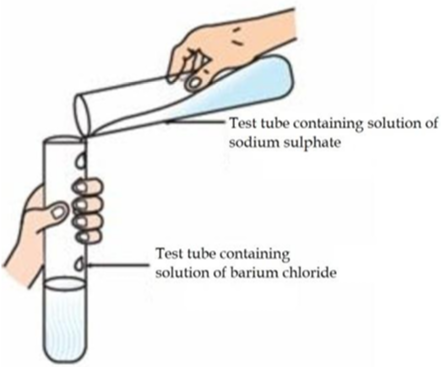
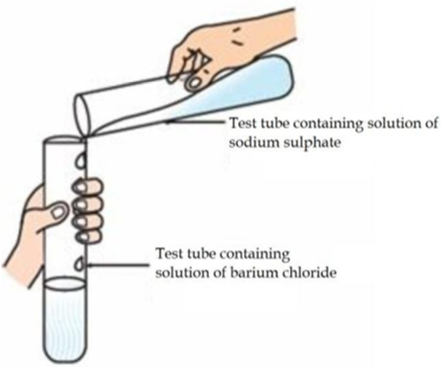
View full solution →$\text{BaCl}_2(\text{aq})\ +\ \text{Na}_2\text{SO}_4(\text{aq})\xrightarrow{\ \ \ \ \ \ \ \ \ \ \ \ \ \ }\text{BaSO}_4(\text{s})\ +\ 2\text{NaCl}(\text{aq})$ Barium sulphate is _____________ in water.
View full solution →The substances which take part in a chemical reaction stances which take part in a chemical reaction are called _____________.
The addition of oxygen to a substance is called __________ whereas removal of oxygen is called __________.
The addition of hydrogen to a substance is called __________ whereas removal of hydrogen is called __________.
$\text{BaCl}_2(\text{aq})\ +\ \text{Na}_2\text{SO}_4(\text{aq})\xrightarrow{\ \ \ \ \ \ \ \ \ \ \ \ \ \ }\text{BaSO}_4(\text{s})\ +\ 2\text{NaCl}(\text{aq})$ Barium sulphate is _____________ in water.
View full solution →Reduction is a process which involves ____________ of electrons.
These are some chemical reactions which shows more than one characteristics of chemical reaction. [True/ False]
Rancidity can be slowed down by storing foods away from light. [True/ False]
A precipate is a liquid product which seperates the solution during a chemical reaction. [True/ False]
State whether the following statement is true or false:
A chemical equation can be balanced easily by altering the formula of a reactant or product.
A solution made in water is indicated by the symbol. [True/ False]
These are some chemical reactions which shows more than one characteristics of chemical reaction. [True/ False]
State whether the following statement is true or false:
A chemical equation can be balanced easily by altering the formula of a reactant or product.
Respiration is an endothermic process. [True/ False]
Rancidity can be slowed down by storing foods away from light. [True/ False]
A solution made in water is indicated by the symbol. [True/ False]
Write the names and chemical formula of the products formed by the action of chlorine on slaked lime.
What change in colour is observed when white silver chloride is left exposed to sunlight? State the type of chemical reaction in this change.
In electrolysis of water, why is the volume of gas collected over one electrode double that of gas collected over the other electrode?
Balance the following chemical equation:$\text{Fe (s) + H}_{2}\text{O (g)}\rightarrow \text{Fe}_{3}\text{O}_{4}\text{ (s) + H}_{2}\text{ (g)}$
View full solution →Why is respiration considered an exothermic process?
Oil and fat containing food items are flushed with nitrogen. Why?
Write the names and chemical formula of the products formed by the action of chlorine on slaked lime.
What change in colour is observed when white silver chloride is left exposed to sunlight? State the type of chemical reaction in this change.
In electrolysis of water, why is the volume of gas collected over one electrode double that of gas collected over the other electrode?
Why is respiration considered an exothermic process?
Dil. $HCl$ is added to $Zn$ granules." How will you prove that chemical change has taken place here? Support your response with two arguments.
View full solution →When the powder of a common metal is heated in an open china dish, its colour turns black. However, when hydrogen is passed over the hot black substance so formed, it regains its original colour. Based on the above information answer the following questions:
- What type of chemical reaction takes place in each of the two given steps?
- Name the metal initially taken in the powder form. Write balanced chemical equations for both reactions.
- What is observed when a solution of potassium iodide is added to a solution of lead nitrate taken in a test tube?
- What type of reaction is this?
- Write a balanced chemical equation to represent the above reaction.
Give an example of a decomposition reaction. Describe an activity to illustrate such a reaction by heating.
What happens when an aqueous solution of sodium sulphate reacts with an aqueous solution of barium chloride? State the physical conditions of reactants in which the reaction between them will not take place. Write the balanced chemical equation for the reaction and name the type of reaction.
Write the balanced chemical equation for the following and identify the type of reaction in each case.
-
Potassium bromide(aq) + Barium iodide(aq) → Potassium iodide(aq) + Barium bromide(s)
-
Zinc carbonate(s) → Zinc oxide(s) + Carbon dioxide(g)
-
Hydrogen(g) + Chlorine(g) → Hydrogen chloride(g)
-
Magnesium(s) + Hydrochloric acid(aq) → Magnesium chloride(aq) + Hydrogen(g)
Write the balanced chemical equations for the following reactions.
-
Calcium hydroxide + Carbon dioxide → Calcium carbonate + Water
-
Zinc + Silver nitrate → Zinc nitrate + Silver
-
Aluminium + Copper chloride → Aluminium chloride + Copper
-
Barium chloride + Potassium sulphate → Barium sulphate + Potassium chloride
Translate the following statements into chemical equations and then balance them.
- Hydrogen gas combines with nitrogen to form ammonia.
- Hydrogen sulphide gas burns in air to give water and sulpur dioxide.
- Barium chloride reacts with aluminium sulphate to give aluminium chloride and a precipitate of barium sulphate.
- Potassium metal reacts with water to give potassium hydroxide and hydrogen gas.
What is a balanced chemical equation? Why should chemical equations balanced?
Why do we apply paint on iron articles?
Write three different chemical reactions showing the conversion of ethanoic acid to sodium ethanoate. Write balanced chemical equation in each case. Write the name of the reactants and the products other than ethanoic acid and sodium ethanoate in each case.
Complete the following chemical equations:
- $\text{C}_2{\text{H}}_5{\text{OH}}+\text{O}_2\xrightarrow{\text{ }\text{ }\text{ }\text{ }\text{ }\text{ }\text{ }\text{ }\text{ }\text{ }\text{ }\text{ }\text{ }\text{ }\text{ }\text{ }\text{ }\text{ }}$
- $\text{C}_2\text{H}_5\text{OH}\xrightarrow[443\text{K}]{\text{ }\text{ }\text{Conc.}\text{H}_2\text{SO}_4\text{ }\text{ }\text{ }\text{ }}$
- $\text{CH}_3\text{COOH}+\text{NaHCO}_3\xrightarrow{\text{ }\text{ }\text{ }\text{ }\text{ }\text{ }\text{ }\text{ }\text{ }\text{ }\text{ }\text{ }\text{ }\text{ }\text{ }\text{ }\text{ }\text{ }}$
View full solution →Write the name and structural formula of the compound obtained when ethanol is heated at 443 K with excess of cone. $H _2 SO _4$. Also write chemical equation for the reaction stating the role of cone. $H _2 SO _4$ in it.
View full solution →Two carbon compounds $X$ and $Y$ have the molecular formula $C _3 H _6$ and $C _4 H _{10}$ respectively. Which one of the two is most likely to show addition reaction? Justify your answer. Also give the chemical equation to explain the process of addition reaction in this case.
View full solution →Complete the following chemical equations:
- $\text{CH}_3\text{COOH}+\text{Na}_2\text{CO}_3\xrightarrow{\text{ }\text{ }\text{ }\text{ }\text{ }\text{ }\text{ }\text{ }\text{ }\text{ }\text{ }\text{ }\text{ }\text{ }\text{ }\text{ }\text{ }\text{ }}$
- $\text{CH}_4+\text{O}_2\xrightarrow{\text{ }\text{ }\text{ }\text{ }\text{ }\text{ }\text{ }\text{ }\text{ }\text{ }\text{ }\text{ }\text{ }\text{ }\text{ }\text{ }\text{ }\text{ }}$
- $\text{C}_2\text{H}_5\text{OH}+ \text{Na}\xrightarrow{\text{ }\text{ }\text{ }\text{ }\text{ }\text{ }\text{ }\text{ }\text{ }\text{ }\text{ }\text{ }\text{ }\text{ }\text{ }\text{ }\text{ }\text{ }}$
View full solution →What does one mean by exothermic and endothermic reactions? Give examples.
Explain the following terms with one example each:
- Corrosion.
- Rancidity.
What do you mean by a precipitation reaction? Explain by giving examples.
What is the difference between displacement and double displacement reactions? aWrite equations for these reactions.
Write one equation each for decomposition reactions where energy is supplied in the form of heat, light or electricity.
Match Column I with Column II.
| |
Column I |
|
Column II |
| (i) |
$\text{H}_2(\text{g})\ +\ \text{S(l)}\xrightarrow{\ (\text{boiling})\ \ }\text{H}_2\text{S(g)}$ |
(A) |
Dispacement reaction. |
| (ii) |
$\text{Zn}\ +\ 2\text{HCl}\ \xrightarrow{\ \ \ \ \ \ \ \ }\text{ZnCl}_2\ +\ \text{H}$ |
(B) |
Neutralisation reaction. |
| (iii) |
$\text{2NaOH}\ +\ \text{H}_2\text{SO}_4\ \xrightarrow{\ \ \ \ \ \ \ \ \ \ }\text{Na}_2\text{SO}_4\ +\ 2\text{H}_2\text{O}$ |
(C) |
Decomposition reaction. |
| (iv) |
$2\text{Cu(NO}_3)_2\xrightarrow{\ \ \ \ \ \ \ \ \ \ }2\text{CuO}\ +\ 4\text{NO}_2\ +\ \text{O}_2$ |
(D) |
Combination reaction. |
View full solution →The metal M reacts vigorously with water to form a solution S and a gas G. The solution S turns red litmus to blue whereas gas G, which is lighter than air, burns with a pop sound. Metal M has a low melting point and it is used as a coolant in nuclear reactors.
- What is metal M?
- What is solution S? Is it acidic or alkaline?
- What is gas G?
- Write a balanced chemical equation for the reaction which takes place when metal M reacts with water.
- Is this reaction exothermic or endothermic?
Gas A, which is the major cause of global warming, combines with hydrogen oxide B in nature in the presence of an environmental factor C and a green material D to form a six carbon organic compounds E and a gas F. The gas F is necessary for breathing.
- What is gas A?
- What is the common name of B?
- What do you think could be C?
- What is material D? Where is it found?
- Name the organic compound E.
- What is gas F? Name the natural process during which it is released.
When water is added gradually to a white solid X, a hissing sound is heard and a lot of heat is produced forming a product Y. A suspension of Y in water is applied to the walls of a house during white washing. A clear solution of Y is also used for testing carbon dioxide gas in the laboratory.
- What could be solid X? Write its chemical formula.
- What could be product Y? Write its chemical formula.
- What is the common name of the solution of Y which is used for testing carbon dioxide gas?
- Write chemical equation of the reaction which takes place on adding water to slid X.
- Which characteristic of chemical reactions is illustrated by this example?
A solid substance P which is very hard is used in the construction of many buildings, especially flooring. When substance P is heated strongly, it decomposes to form another solid Q and a gas R is given out. Solid Q reacts with water with the release of a lot of heat to form a substance S. When gas R is passed into a clear solution of substance S, then a white precipitate of substance T is formed. The substance T has the same chemical composition as starting substance P.
- What is substance P? Write its common name as well as chemical formula.
- What is substance Q?
- What is gas R?
- What is substance S? What is its clear solution known as?
- What is substance T? Name any two natural forms in which substance T occurs in nature.
Read the following and answer any four questions from (i) to (v).Reactions, in which one element takes place of another element in a compound, are known as displacement reactions. ln general, more reactive elements displaces a less reactive element from its compound. ln all single displacement reactions, only one element displaces another element from its compound. The single displacement reactions are, however, written as just displacement reactions. The displacement reaction between iron (III) oxide and powdered aluminum produces so much heat that iron metal obtained is in molten form.
- which of the metals from its salt solution displaces copper ?
- When zinc reacts with dilute sulfuric acid, which gas is evolved ?
- When dry hydrogen is passed over a heated oxide of metal X using the apparatus , what substance is obtained and it could be in which form ?
OR
a) Which reactions are called displacement reaction?
b) When dilute hydrochloric acid is added to granulated zinc placed in a test tube, what result will be there after observation ?
Read the following and answer any four questions from (i) to (v).ln decomposition reactions, a single reactant breaks down to form two or more products. Decomposition reaction is opposite to combination reaction. Thermal decomposition reactions use the energy in form of heat for decomposition of reactants. Electrolytic decomposition reactions involve the use of electrical energy for the decomposition of reactant molecules. Photolysis or photochemical decomposition involves the use of light energy for the purpose of decomposition.
- Which reactions are a decomposition reaction?
- Amino acid is fanned by the decomposition of which component of our diet?
- Silver chloride on exposure to sunlight for a long duration turns gray due to which formation?
OR
A) What type of chemical reaction takes place when electricity is passed through water?
B) Which involves the use of light energy for the purpose of decomposition?
Read the following and answer any four questions from (i) to (v).
A reaction in which two or more reactants combine to form a single product is called a combination reaction. For example, calcium oxide reacts vigorously with water to form calcium hydroxide. The reaction is highly exothermic in nature, as lots of heat is produced during the reaction.
$\quad$$CaO _{( s )} \ \ \ + \ \ \ H _2 O _{( l )} \longrightarrow Ca ( OH )_{2( aq )} \ + \ H ^2$
Calcium oxide$\qquad$Water $\quad$ Calcium hydroxide
Solution of Ca(OH)2 is used for white wash the walls. Calcium hydroxide reacts slowly with carbon dioxide in air to form a thin layer of calcium carbonate on the wall which gives a shiny appearance to wall. Calcium carbonate will formafter two or three days of white wash.- What is the chemical name of quick lime?
- When carbon dioxide is passed through lime water, what will be the reaction?
- which reaction is formed when calcium oxide reacts vigorously with water?
OR
A) what is a combination reaction?
B) Which is an endothermic reaction?
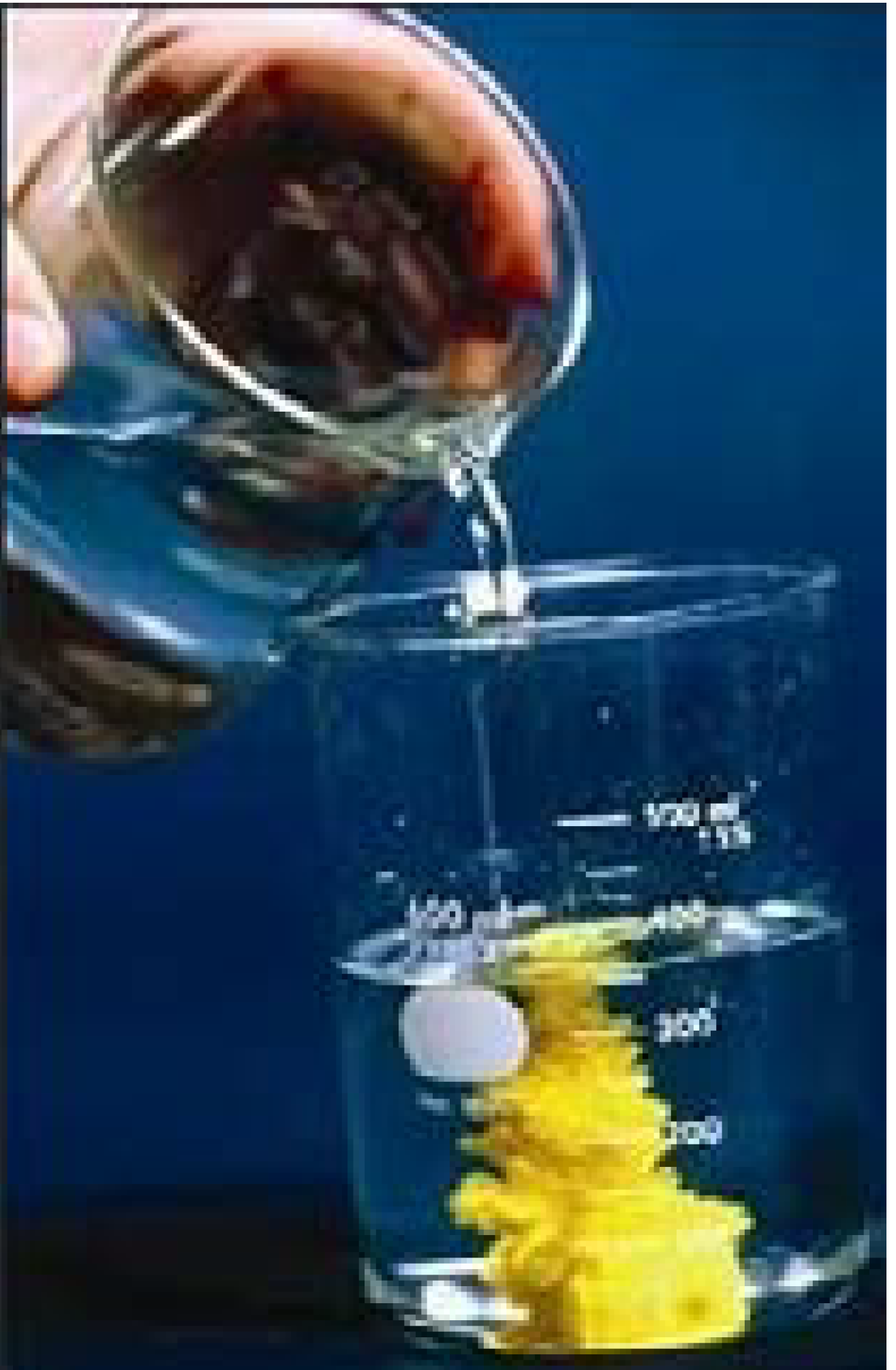
View full solution →When two or more substances react and form some new substance, it is called a chemical reaction. Chemical equation is represented in terms of symbols, molecular formulas, moles, states, etc. As we know, all chemical reaction obeys law of chemical combination. Therefore, chemical reactions need to be balanced. It is done by hit and trial method. The chemical reactions can be classified into different types such as combination reaction, decomposition reaction, displacement reaction, double displacement reaction. The reactions take place in solution is precipitation reactions and neutralisation reactions.
(i) Define a chemical equation.
(ii) Which law is followed by all chemical reactions?
(iii) Name four types of chemical reactions.
or
(iv) Give example of precipitation reactions.
There are different types of chemical reactions occurring around us or being carried out for the benefit of mandkind, e.g. combination reactions, decomposition reactions, displacement reactions, precipitation reactions, reduction-oxidation (redox) reactions, photochemical reactions etc.
Now, answer the following questions :
- Combustion of coke is a combination reaction. $CO _2$ is not a pollutant. Then, why is combustion of coke harmful?
- Which reaction followed by two combination reactions are involved in white wash of walls?
- Give one use of tin plating in daily life.
or
How photochemical reactions have played an important in photography?
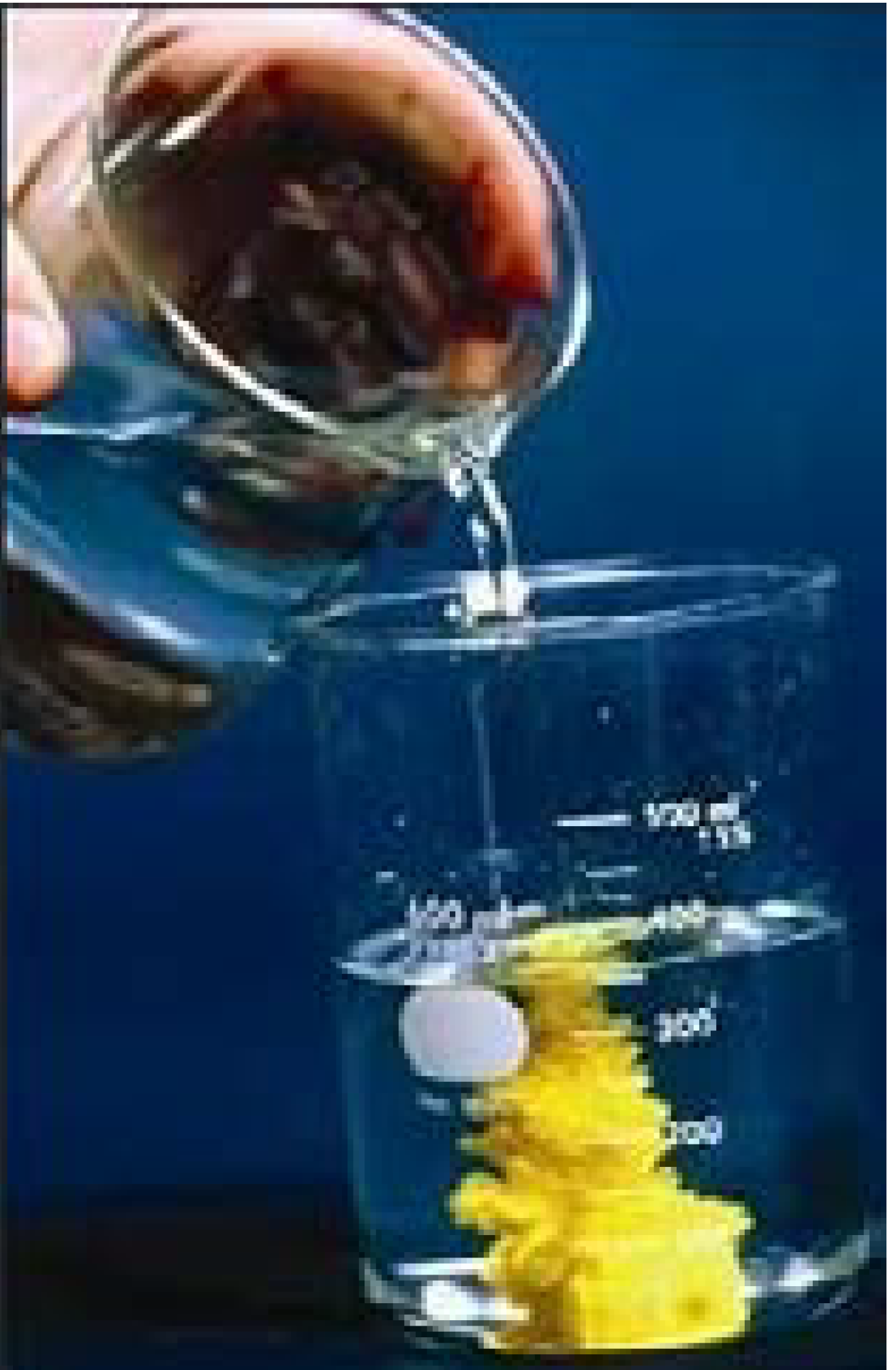
When two or more substances react and form some new substance, it is called a chemical reaction. Chemical equation is represented in terms of symbols, molecular formulas, moles, states, etc. As we know, all chemical reaction obeys law of chemical combination. Therefore, chemical reactions need to be balanced. It is done by hit and trial method. The chemical reactions can be classified into different types such as combination reaction, decomposition reaction, displacement reaction, double displacement reaction. The reactions take place in solution is precipitation reactions and neutralisation reactions.
(i) Define a chemical equation.
(ii) Which law is followed by all chemical reactions?
(iii) Name four types of chemical reactions.
or
(iv) Give example of precipitation reactions.
A student prepared oxygen in a lab by catalytic decomposition of potassium chlorate $\left( KClO _3\right)$ as shown in the figure. Decomposition of potassium chlorate gives potassium chloride $( KCl )$ and oxygen $\left( O _2\right)$. The following reaction takes place :
$KClO _3( s ) \longrightarrow KCl ( s )+ O _2( g )$
- How many moles of $KClO _3$ are required to produce $2.4$ moles of $O _2$ ?
- Name the element which is reduced in the given reaction.
- How many moles of $KClO _3$ give 3 moles of oxygen?
or
What is the oxidation state of chlorine in potassium chlorate?
View full solution →
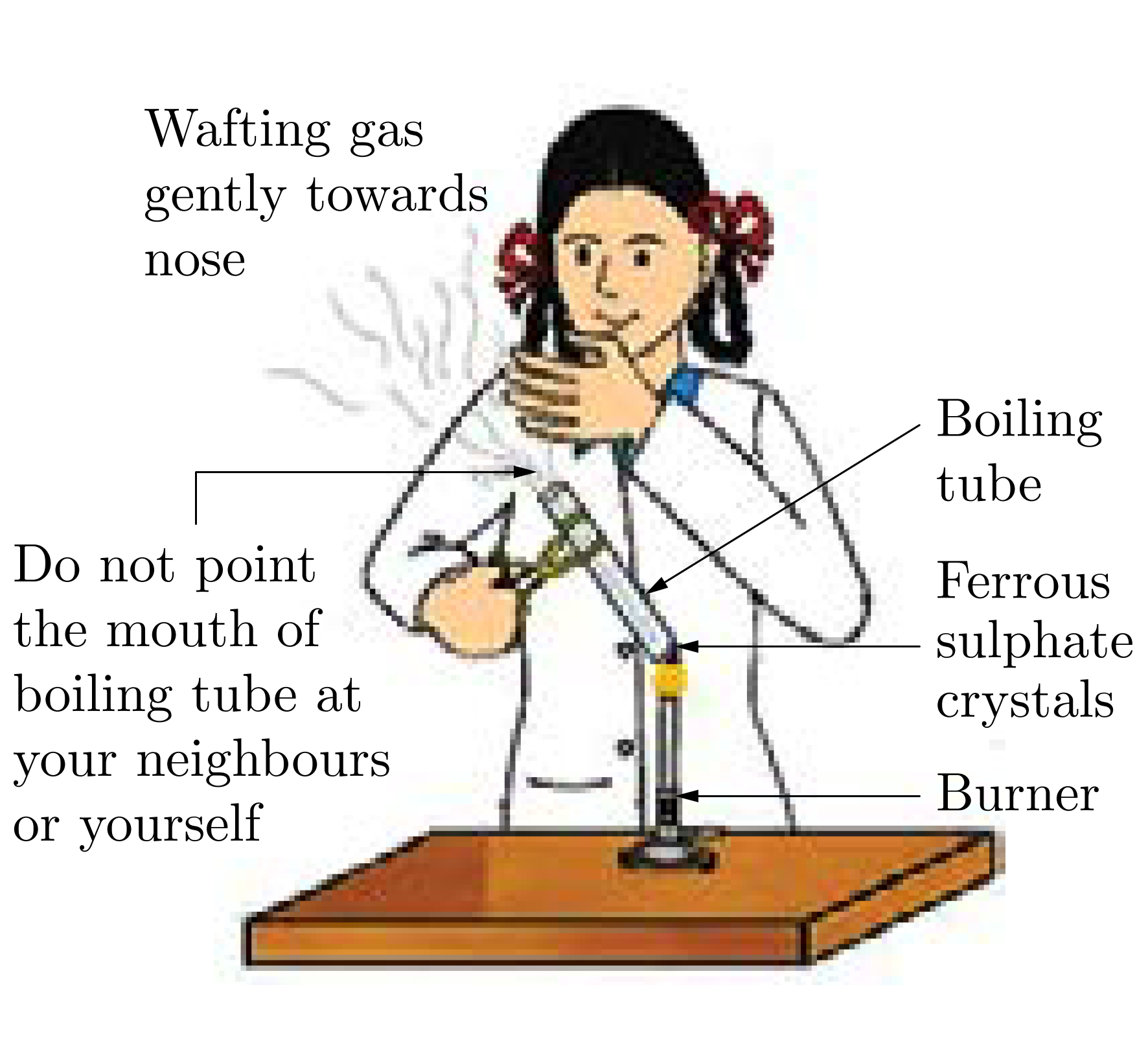
After seeing the above image answer the following questions.
- What was the colour of the crystals before heating and after heating?
- Write the chemical equation for the reaction.
- Which pungent smelling gas is evolved during the reaction? What is the nature of this gas?
or
Write the name of the solid substance formed.
Read the following and answer any four questions from (i) to (v).ln decomposition reactions, a single reactant breaks down to form two or more products. Decomposition reaction is opposite to combination reaction. Thermal decomposition reactions use the energy in form of heat for decomposition of reactants. Electrolytic decomposition reactions involve the use of electrical energy for the decomposition of reactant molecules. Photolysis or photochemical decomposition involves the use of light energy for the purpose of decomposition.
- Which reactions are a decomposition reaction?
- Amino acid is fanned by the decomposition of which component of our diet?
- Silver chloride on exposure to sunlight for a long duration turns gray due to which formation?
OR
A) What type of chemical reaction takes place when electricity is passed through water?
B) Which involves the use of light energy for the purpose of decomposition?
Balance the following chemical equations.
- HNO3 +Ca(OH)2 → Ca(NO3)2 + H2O
- NaOH + H2SO4 → Na2SO4 + H2O
- NaCl + AgNO3 → AgCl + NaNO3
- BaCl2 + H2SO4 → BaSO4 + HCl
Explain the following in terms of gain or loss of oxygen with two examples each.
- Oxidation
- Reduction
You are provided with two containers made up of copper and aluminium. You are also provided with solutions of dilute HCl, dilute HNO3, ZnCl2 and H2O. In which of the above containers these solutions can be kept?
With the help of an activity; demonstrate how do we know that a chemical reaction has taken place?
Which among the following are physical or chemical changes?
- Evaporation of petrol.
- Burning of Liquefied Petroleum Gas (LPG).
- Heating of an iron rod to red hot.
- Curdling of milk.
- Sublimation of solid ammonium chloride.