Questions · Page 1 of 5

M.C.Q

🎯

Test yourself on this topic

50 questions · timed · auto-graded

MCQ 11 Mark
Receptors are usually located in sense organs. Gustatory receptors are present in
  • tongue
  • B
    nose
  • C
    eye
  • D
    ear
Answer
Correct option: A.
tongue
(A) tongue
View full question & answer
MCQ 21 Mark
A part of the body which responds to the in-structions sent from nervous system is called :
  • A
    Receptor
  • Effector
  • C
    Nerves
  • D
    Muscles
Answer
Correct option: B.
Effector
View full question & answer
MCQ 31 Mark
The bending of the shoot of a plant in response to light is called :
  • A
    Geotropism.
  • Phototropism.
  • C
    Thigmotropism.
  • D
    Photonasty.
Answer
Correct option: B.
Phototropism.
Photo means light and tropism means movement. The bending of plant shoots in response to light is called phototropism.
View full question & answer
MCQ 41 Mark
Spinal cord originates from :
  • A
    Cerebrum.
  • Medulla.
  • C
    Pons.
  • D
    Cerebellum.
Answer
Correct option: B.
Medulla.
Spinal cord begins in continuation with medulla and extends downwards.
View full question & answer
MCQ 51 Mark
One of the following is an incorrect statement about insulin. This is :
  • A
    It is produced in pancreas.
  • It regulates growth and development of the body.
  • C
    It regulates blood glucose level in the blood.
  • D
    Its deficiency in the body will cause diabetes.
Answer
Correct option: B.
It regulates growth and development of the body.
Insulin is produced in the pancreas. It regulates blood sugar level and its deficiency causes diabetes. The growth and development of the body is regulated by the growth hormone.
View full question & answer
MCQ 61 Mark
Which of the following endocrine glands is unpaired?
  • A
    Adrenal.
  • B
    Testes.
  • Pituitary.
  • D
    Ovary.
Answer
Correct option: C.
Pituitary.
Pituitary gland is unpaired gland.
View full question & answer
MCQ 71 Mark
The movement of sunflower in accordance with the path of the sun is due to :
  • Photonasty.
  • B
    Phototropism.
  • C
    Hydrotropism.
  • D
    Chemotropism.
Answer
Correct option: A.
Photonasty.
It is a non $-$ directional movement of plant parts in response to light.
View full question & answer
MCQ 81 Mark
The positive response of the plants towards the gravitation is called $..............?$
  • A
    Phototropism
  • Geotropism
  • C
    Hydrotropism
  • D
    Chemotropism
Answer
Correct option: B.
Geotropism
The positive response of the plants towards the gravitation is called geotropism.
Geotropism means response to gravity if the response is in the direction of the gravity then it is called positive geotropism since root is growing downwards $($in the direction of gravity$)$ so it is called positive geotropism.
View full question & answer
MCQ 91 Mark
Deficiency of which hormone causes diabetes?
  • Insulin.
  • B
    Thyroxine.
  • C
    Relaxin.
  • D
    Oestrogen.
Answer
Correct option: A.
Insulin.
Deficiency of insulin causes diabetes.
View full question & answer
MCQ 101 Mark
The hormone which is associated with male puberty is called :
  • A
    Oestrogen.
  • B
    Adrenaline.
  • Testosterone.
  • D
    Progesterone.
Answer
Correct option: C.
Testosterone.
Testosterone is the male sex hormone which is associated with male puberty.
View full question & answer
MCQ 111 Mark
Iodine is necessary for the synthesis of which hormone?
  • A
    Adrenaline.
  • Thyroxin.
  • C
    Auxin.
  • D
    Insulin.
Answer
Correct option: B.
Thyroxin.
Hormones of thyroid gland have iodine as their structural component.
View full question & answer
MCQ 121 Mark
The growth of a pollen tube towards the ovule caused by a sugary substance as stimulus is an example of :
  • A
    Phototropism.
  • B
    Chlorotropism.
  • C
    Gravitropism.
  • Chemotropism.
Answer
Correct option: D.
Chemotropism.
The growth of pollen tubes towards the ovule caused by a sugary substance is an example of chemotropism.
View full question & answer
MCQ 131 Mark
The movement of the sunflower towards the sun is due to :
  • Phototropism
  • B
    Geotropism
  • C
    Chemotropism
  • D
    Hydrotropism
Answer
Correct option: A.
Phototropism
Phototropism is the growth of a plant in the direction of light. It is one of the many plant tropisms or movements which respond to external stimuli.
Thus, the movement of the sunflower towards the sun is due to phototropism.
View full question & answer
MCQ 141 Mark
Which of the following statements are true?
  1. Sudden action in response to something in the environment is called reflex action.
  2. Sensory neurons carry electrical signals from spinal cord to muscles in a reflex action.
  3. Motor neurons carry signals from receptors to spinal cord in a reflex action.
  4. The pathway of transmitting signals from a receptor to a muscle is a reflex action.
  • A
    $(i)$ and $(ii).$
  • B
    $(i)$ and $(iii)$.
  • $(i)$ and $(iv).$
  • D
    $(i), (ii)$ and $(iii).$
Answer
Correct option: C.
$(i)$ and $(iv).$
Statements $(i)$ and $(iv)$ are correct, while statements $(ii)$ and $(iii)$ are not.
Sensory neurons carry signals from the receptors to the brain or the spinal cord, while motor neurons carry signals from the brain or the spinal cord to the effector organs like muscles and glands.
View full question & answer
MCQ 151 Mark
The substance that triggers the fall of mature leaves and fruits from plants is due to :
  • A
    Auxin.
  • B
    Gibberellin.
  • Abscisic acid.
  • D
    Cytokinin.
Answer
Correct option: C.
Abscisic acid.
Abscisic acid serves to form of layer of abscission.
View full question & answer
MCQ 161 Mark
The stimulus in the process of thigmotropism is :
  • Touch.
  • B
    Gravity.
  • C
    Light.
  • D
    Chemical.
Answer
Correct option: A.
Touch.
The stimulus in thigmotropism is touch which causes movement.
View full question & answer
MCQ 171 Mark
The underactive endocrine gland which causes goitre is :
  • A
    Pancreas.
  • Thyroid.
  • C
    Adrenal.
  • D
    Pituitary.
Answer
Correct option: B.
Thyroid.
Under $-$ secretion of thyroxine hormone from the thyroid gland can lead to goitre.
View full question & answer
MCQ 181 Mark
The neurons that carry nerve impulse from spinal cord to effectors are called :
  • A
    Sensory neurons
  • Motor neurons
  • C
    Inteneurons
  • D
    Spinal neurons
Answer
Correct option: B.
Motor neurons
View full question & answer
MCQ 191 Mark
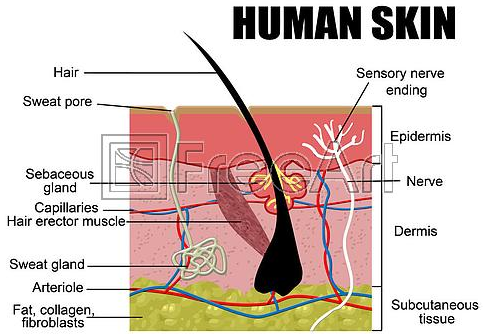
The given diagrams shown some of the features of human skin.

Which part of the brain coordinates the information labeled in the diagram?
  • A
    Medulla.
  • Hypothalamus.
  • C
    Cerebrum.
  • D
    Cerebellum.
Answer
Correct option: B.
Hypothalamus.
View full question & answer
MCQ 201 Mark
The faulty functioning of an endocrine gland can make a person very short or very tall. This gland is :
  • A
    Thyroid.
  • B
    Pineal.
  • C
    Adrenal.
  • Pituitary.
Answer
Correct option: D.
Pituitary.
The pituitary gland secretes a hormone known as growth hormone which controls the growth of the human body.
Deficiency of growth hormone can make the person very short, while excess of this hormone can make a person very tall.
View full question & answer
MCQ 211 Mark
The movement of sunflower in accordance with the path of sun is due to :
  • Phototropism.
  • B
    Geotropism.
  • C
    Chemotropism.
  • D
    Hydrotropism.
Answer
Correct option: A.
Phototropism.
Phototropism is the response of the plants towards light. Thus, sunflower moves in accordance with the path of sun.
View full question & answer
MCQ 221 Mark
To which of the following directional stimulus roots of a plant do not respond?
  • A
    Moisture.
  • B
    Candle light.
  • Touch.
  • D
    Gravity.
Answer
Correct option: C.
Touch.
Roots do not respond to touch.
View full question & answer
MCQ 231 Mark
Which of the following plant part exhibits negative phototropism?
  • Root.
  • B
    Branch.
  • C
    Leaves.
  • D
    Stem.
Answer
Correct option: A.
Root.
Roots bend away from the light source and show negative phototropism.
View full question & answer
MCQ 241 Mark
Myelin sheath is produced by $ ............ ?\ $
  • A
    Neurons
  • B
    Nissl's granules
  • Schwann cells
  • D
    None of the above
Answer
Correct option: C.
Schwann cells
Schwann cells makes myelin in the peripheral nervous system $\ce{(PNS } :$ nerves) and oligodendrocytes in the central nervous system $(\ce{CNS}:$ brain and spinal cord$).$ In the $\ce{PNS},$ one Schwann cell forms a single myelin sheath.
View full question & answer
MCQ 251 Mark
Posture and balance of the body is controlled by :
  • A
    Cerebrum.
  • Cerebellum.
  • C
    Medulla.
  • D
    Pons.
Answer
Correct option: B.
Cerebellum.
Cerebellum controls posture and balance of the body.
View full question & answer
MCQ 261 Mark
Cerbellum, medulla and pons are the parts of :
  • A
    Mid $-$ brain.
  • Hind $-$  brain.
  • C
    Forebrain.
  • D
    Spinal cord.
Answer
Correct option: B.
Hind $-$  brain.
The hindbrain consists of three centres called the pons, the cerebellum and the medulla.
The forebrain consists mainly of the cerebrum.
The midbrain does not have any further divisions.
The spinal cord is a cylindrical structure.
View full question & answer
MCQ 271 Mark
The olfactory receptors in humans are located in :
  • A
    Eyes.
  • B
    Tongue.
  • C
    Ears.
  • Nose.
Answer
Correct option: D.
Nose.
The olfactory receptors which detect smell are located in the nose.
View full question & answer
MCQ 281 Mark
In a synapse, chemical signal is transmitted from :
  • A
    Axon to cell body of the same neuron.
  • B
    Cell body to axon end of the same neuron.
  • C
    Dendrite end of one neuron to axon end of adjacent neuron.
  • Axon end of one neuron to dendrite end of adjacent neuron.
Answer
Correct option: D.
Axon end of one neuron to dendrite end of adjacent neuron.
In a synapse, a chemical signal is transmitted from the axon end of one neuron to the dendrite end of the adjacent neuron.
View full question & answer
MCQ 291 Mark
The contraction of pupil of the eye in the presence of bright light is an example of :
  • A
    Voluntary reflex.
  • B
    Spinal reflex.
  • Cerebral reflex.
  • D
    Adrenal reflex.
Answer
Correct option: C.
Cerebral reflex.
The contraction of the pupil of the eye in the presence of a bright light is an example of cerebral reflex. A reflex action that involves the brain is called cerebral reflex. It is found in the organs present in the head that are directly connected to the brain.
View full question & answer
MCQ 301 Mark
Breathing is controlled by which part of the brain ?
  • A
    Cerebrum
  • B
    Cerebellum
  • C
    Hypothalamus
  • Medulla oblongata
Answer
Correct option: D.
Medulla oblongata
View full question & answer
MCQ 311 Mark
Chemically hormones are derivatives of :
  • A
    Fat.
  • B
    Protein.
  • C
    Steroid.
  • All of these.
Answer
Correct option: D.
All of these.
Hormones can be grouped into three main types : amines, these are simple molecules. proteins and peptides which are made from chains of amino acids. steroids which are derived from cholesterol.
View full question & answer
MCQ 321 Mark
The growth of tendrils in pea plants is due to the :
  • A
    Effect of sunlight on the tendril cells facing the sun.
  • B
    Effect of gravity on the part of tendril hanging down towards the earth.
  • C
    Rapid cell division and elongation in tendril cells that are away from the support.
  • Rapid cell division and elongation in tendril cells in contact with the support.
Answer
Correct option: D.
Rapid cell division and elongation in tendril cells in contact with the support.
The growth of tendrils in pea plants is due to the rapid cell division and elongation in tendril cells in contact with the support.
View full question & answer
MCQ 331 Mark
Which of the following is a mis $-$ matched pair?
  • Adrenaline : pituitary gland.
  • B
    Estrogen : ovary.
  • C
    Pancreas : insulin.
  • D
    Progesterone : ovary.
Answer
Correct option: A.
Adrenaline : pituitary gland.
Adrenaline is secreted by the adrenal glands which are located on top of the kidneys.
View full question & answer
MCQ 341 Mark
Adrenaline hormone is secreted in the body during emergency situations. What would be the effects of increased concentration of adrenaline on body?
Concentration of glycogen in the liver Concentration of glycogen in the blood
$(i)$ Decrease Increase
$(ii)$ Increase Increase
$(iii)$ No effect Decrease
$(iv)$ Increase No effect
  • $(i)$
  • B
    $(ii)$
  • C
    $(iii)$
  • D
    $(iv)$
Answer
Correct option: A.
$(i)$
Concentration of glycogen in the liver Concentration of glycogen in the blood
$(i)$ Decrease Increase
View full question & answer
MCQ 351 Mark
How many pairs of spinal nerves are present in man?
  • A
    $12$
  • B
    $21$
  • $31$
  • D
    $41$
Answer
Correct option: C.
$31$
Spinal nerve, in vertebrates, any one of many paired peripheral nerves that arise from the spinal cord. In humans there are $31$ pairs.
View full question & answer
MCQ 361 Mark
Junction between two neurons is called :
  • A
    Cell junction.
  • B
    Neuro muscular junction.
  • C
    Neural joint.
  • Synapse.
Answer
Correct option: D.
Synapse.
Synapse is the junction between two neurons.
View full question & answer
MCQ 371 Mark
Which statement is incorrect about auxins?
  • They promote the growth of root.
  • B
    They promote the growth of shoot.
  • C
    They influence the formation of flower and ripening of fruit.
  • D
    They inhibit the growth of root.
Answer
Correct option: A.
They promote the growth of root.
View full question & answer
MCQ 381 Mark
One of the following gives the correct sequence of the components in a reflex arc. This is :
  • A
    Receptors $\rightarrow $ Muscle $\rightarrow $ Sensory neuron $\rightarrow $ Motor neuron $\rightarrow $ Spinal cord.
  • B
    Receptors $\rightarrow $ Motor neuron $\rightarrow $ Spinal cord $\rightarrow $ Sensory neuron $\rightarrow $ Muscle.
  • C
    Receptors $\rightarrow $ Spinal cord $\rightarrow $ Sensory neuron $\rightarrow $ Motor neuron $\rightarrow $ Muscle.
  • Receptors $\rightarrow $ Sensory neuron $\rightarrow $ Spinal cord $\rightarrow $ Motor neuron $\rightarrow $ Muscle.
Answer
Correct option: D.
Receptors $\rightarrow $ Sensory neuron $\rightarrow $ Spinal cord $\rightarrow $ Motor neuron $\rightarrow $ Muscle.
The pathway taken by a nerve impulse in a reflex action is called reflex arc. The correct sequence of the components in a reflex arc is given below:
Receptors $\rightarrow $ Sensory neuron $\rightarrow $ Spinal cord $\rightarrow $ Motor neuron $\rightarrow $ Muscle.
View full question & answer
MCQ 391 Mark
The climbing organs of plants like tendrils grow towards any support which they happen to touch and wind around the support. This is an example of :
  • A
    Chemotropism.
  • B
    Nastic movement.
  • Thigmotropism.
  • D
    Geotropism.
Answer
Correct option: C.
Thigmotropism.
This is an example of thigmotropism.
View full question & answer
MCQ 401 Mark
Plant hormone responsible for phototropism is :
  • A
    Gibberellins.
  • B
    Abscisic acid.
  • C
    Cytokinin.
  • Auxin.
Answer
Correct option: D.
Auxin.
The primary function of the auxin hormones is to elongate plant cells in the stem. For instance, auxins are the hormones responsible for phototropism, the growth of a plant toward the light.
View full question & answer
MCQ 411 Mark
Which organ cells produce gastrointestinal hormones?
  • A
    Stomach
  • B
    Pancreas
  • C
    Small Intestine
  • All of the above
Answer
Correct option: D.
All of the above
All of the above are gastrointestinal hormones,
View full question & answer
MCQ 421 Mark
Which hormone regulates the ionic balance in the body?
  • A
    Glucagon
  • B
    Thyroxine
  • C
    Testosterone
  • Vasopressin
Answer
Correct option: D.
Vasopressin
View full question & answer
MCQ 431 Mark
Dwarfism results due to :
  • A
    Excessive secretion of thyroxine hormone.
  • B
    Excessive secretion of growth hormone.
  • C
    Less secretion of adrenaline hormone.
  • Less secretion of growth hormone.
Answer
Correct option: D.
Less secretion of growth hormone.
Dwarfism is characterised by retarded physical growth and a normal brain. It is caused due to the hypo $-$ secretion of growth hormone.
View full question & answer
MCQ 441 Mark
Which area of the brain is responsible for control of the body temperature?
  • A
    Pituitary.
  • B
    Thalamus.
  • Hypothalamus.
  • D
    Hindbrain.
Answer
Correct option: C.
Hypothalamus.
The hypothalamus is the processing centre in the brain that controls body temperature. It does this by triggering changes to effectors, such as sweat glands and muscles controlling body hair.
View full question & answer
MCQ 451 Mark
Directions : In the following questions, the Assertions $(A)$ and Reason $(s)\ (R)$ have been put forward. Read both the statements carefully and choose the correct alternative from the following:
Assertion : On attaining puberty, breast size increases and reproductive organs develop in females.
Reason : Ovaries release hormone proges-terone in female.
  • A
    Both $A$ and $R$ are true and $R$ is the correct explanation of $A.$
  • Both $A$ and $R$ are true but $R$ is not the correct explanation of $A.$
  • C
    $A$ is true but $R$ is false.
  • D
    $A$ is false but $R$ is true.
Answer
Correct option: B.
Both $A$ and $R$ are true but $R$ is not the correct explanation of $A.$
View full question & answer
MCQ 461 Mark
Which of the following is not an involuntary action?
  • A
    Vomiting.
  • B
    Salivation.
  • C
    Heart beat.
  • Chewing.
Answer
Correct option: D.
Chewing.
Chewing is a voluntary action, while actions like vomiting, heart beat and salivation are involuntary.
View full question & answer
MCQ 471 Mark
Visceral nervous system controls and integrates the function of $–$
  • A
    Urinary bladder
  • B
    Blood vessels
  • C
    Heart
  • All of the above
Answer
Correct option: D.
All of the above
View full question & answer
MCQ 481 Mark
One of the following is not caused by the growth related movement of the concerned plant part. This is :
  • A
    Phototropism.
  • B
    Photonasty.
  • Thigmonasty.
  • D
    Thigmotropism.
Answer
Correct option: C.
Thigmonasty.
The rolling up of plant leaves on touching is a thigmonastic movement and it is not related to growth.
View full question & answer
MCQ 491 Mark
The use of iodised salt is recommended to prevent :
  • A
    Diabetes.
  • B
    Gonorrhoea.
  • C
    Dysentery.
  • Goitre.
Answer
Correct option: D.
Goitre.
It is advised to use iodised salt to prevent goitre. It is because the thyroid gland requires iodine to synthesise thyroxine hormone. Deficiency of iodine in the body can lead to the under $-$ secretion of thyroxine hormone which, in turn, can lead to goitre.
View full question & answer
MCQ 501 Mark
The junction between two adjacent neurons is called :
  • A
    Nerve junction.
  • B
    Sensory junction.
  • Synapse.
  • D
    Neuro-muscular joint.
Answer
Correct option: C.
Synapse.
A synapse is a functional junction between the axon of a neuron and the dendrites of the next neuron. It is separated by a small gap known as the synaptic cleft.
View full question & answer