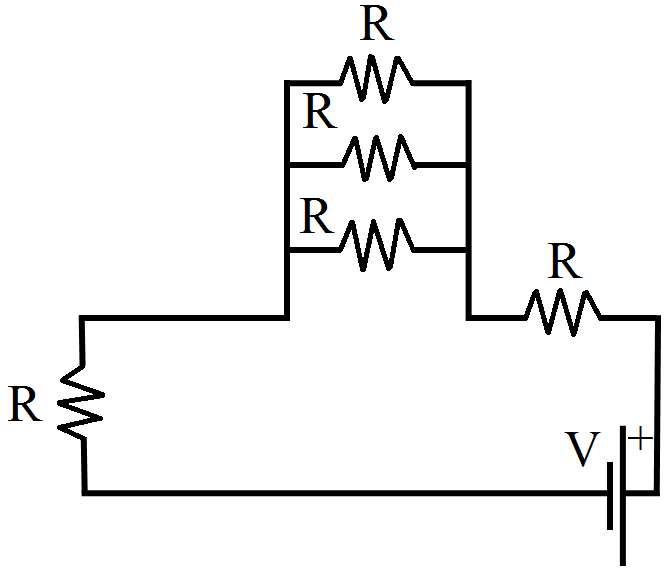
$\text{R}=0.2+0.3+ 0.4 + 0.5 + 12 = 13.4\Omega$
Potential difference, V = 9 V$\text{I} = \frac{9}{13.4} = 0.671 \text{A}$
Therefore. the current that would flow through the $12\Omega$ resistor is 0.671 A.50 questions · timed · auto-graded
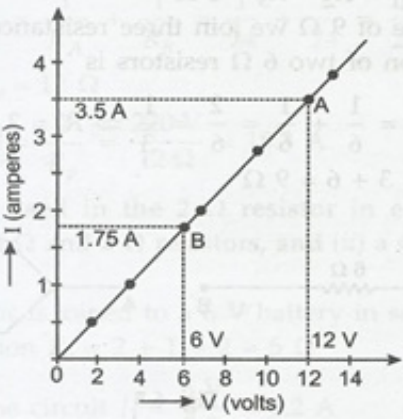
$\text{R}=0.2+0.3+ 0.4 + 0.5 + 12 = 13.4\Omega$
Potential difference, V = 9 V$\text{I} = \frac{9}{13.4} = 0.671 \text{A}$
Therefore. the current that would flow through the $12\Omega$ resistor is 0.671 A.| I (amperes) | 0.5 | 1.0 | 2.0 | 3.0 | 4.0 |
| V (volts) | 1.6 | 3.4 | 6.7 | 10.2 | 13.2 |

$= \frac{6\text{V}}{1.8 \text{A}} = 3.3\Omega$.
Since current flowing is same in both resistors, power used in $2\Omega$ resistor
(P1) = I2R = (2)2 × 2 = 8 W.
$\therefore$ Power used in $2\Omega$ resistor
$(\text{P}_2)=\frac{\text{V}^2}{\text{R}}=\frac{{4}^2}{2}=\frac{16}{2}=8 \ \text{W}$
Comparing between the power used in both cases $=\frac{\text{P}_1}{\text{P}_2}=\frac{8\text{W}}{8\text{W}}=1$.


$\frac{1}{\text{R}}=\frac{1}{176}+\frac{1}{176}\dots\text{times}=\frac{\text{n}}{176} \ \text{or} \ \text{R}=\frac{176}{\text{n}} \ \Omega$
It is given that V = 220 V and I = 5 A$\text{R}=\frac{\text{V}}{\text{I}} \ \text{or} \ \frac{176}{\text{n}}=\frac{220}{5} 44\ \Omega$
$\text{n}=\frac{176}{44}=4$, resistors should be joined in parallel.
$R = \frac{\text{220 V}}{\text{10 A}}$
$\therefore R = \text{22 } \Omega$
Open: An open circuit is one in which current cannot flow through the circuit as the circuit is 'open' or not completely connected.
$\text{R}_{2} = \frac{2 \rho l}{\frac{1}{2}\text{A}}$
$= 4\frac{\rho l}{\text{A}} = 4 \text{R}_{1}$
$\therefore \text{R}_{2} = 4\times 20 = \text{80 }\Omega $
Alternate Answer
Resistance becomes 2 times due to increase in length.
Due to change in area it again becomes 2 times.
$\therefore$ New resistance becomes 4 times of the original resistance.
$\therefore \text{R = 4 }\times \text{20 }\Omega= \text{8 } \Omega$
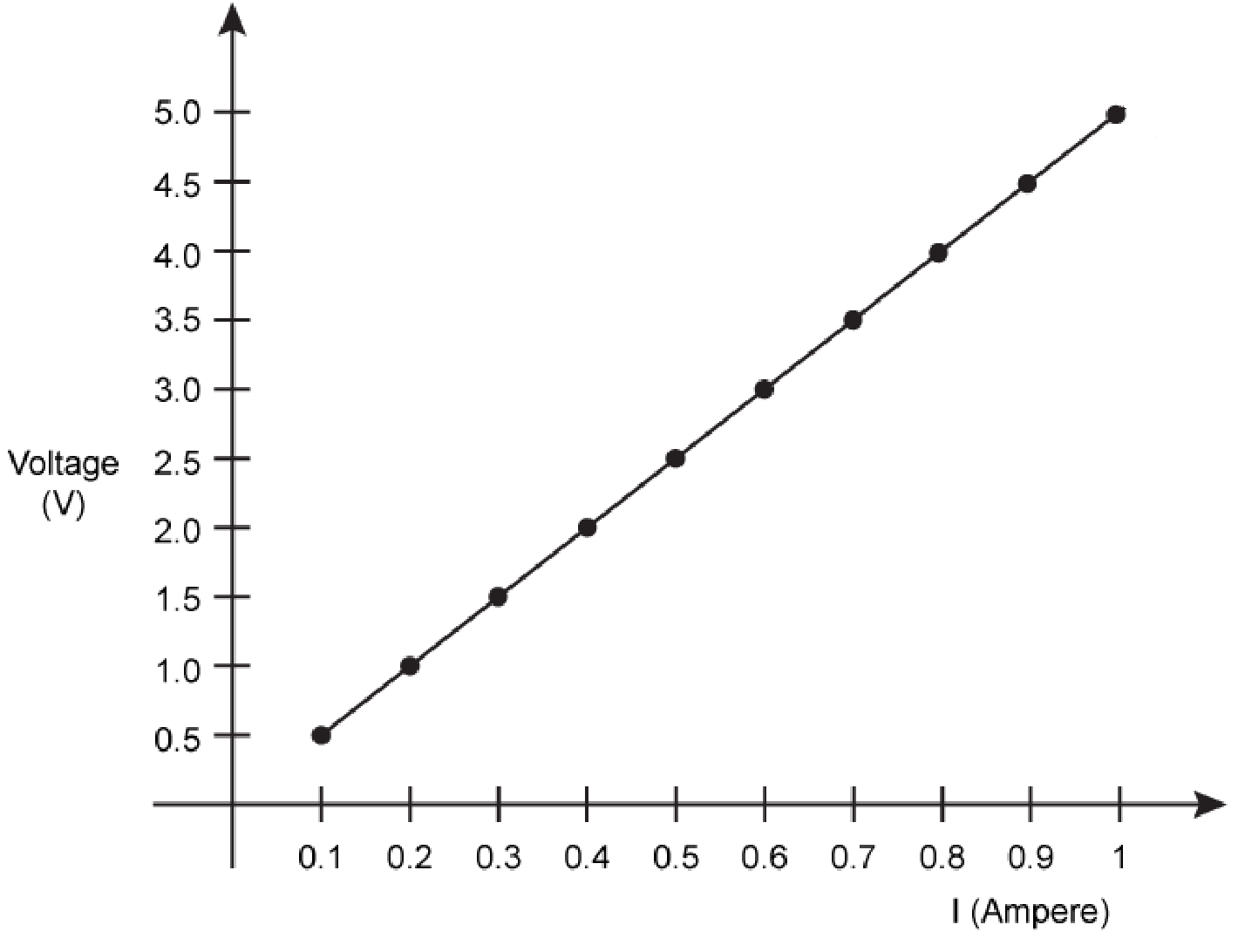
| V (volts) | 0.5 | 1.0 | 1.5 | 2.0 | 2.5 | 3.0 | 4.0 | 5.0 |
| I (amperes) | 0.1 | 0.2 | 0.3 | 0.4 | 0.5 | 0.6 | 0.8 | 1.0 |
Plot a graph between current (I) and potential difference (V) and determine the resistance (R) of the resistor.

Potential difference (V) = 5V
Current (I) = 1A
Resistance (R)
$=\frac{\text{V}}{\text{I}}=5\Omega$Thus, the resistance of given resistor is 5 ohms.
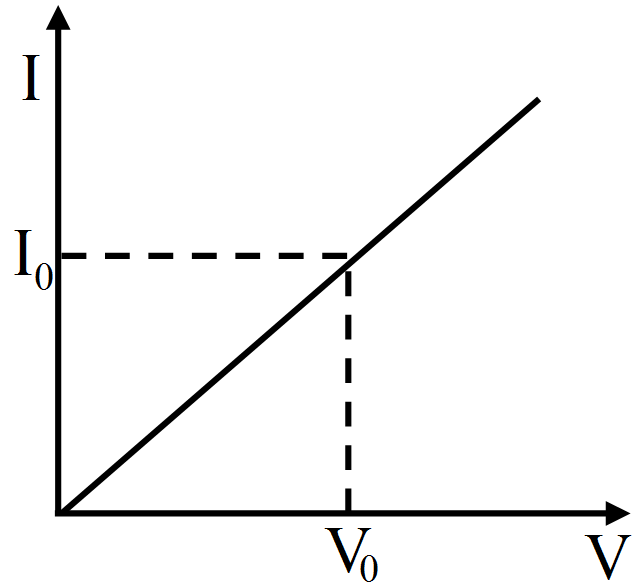
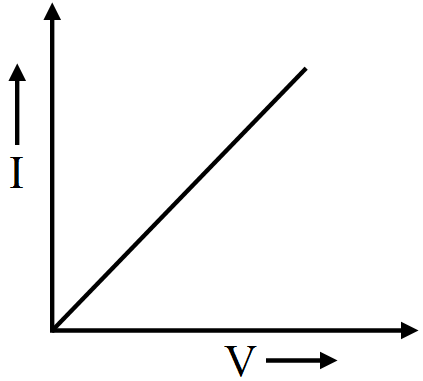
Straight line graph between potential difference (V) and current (I) shows that resistor is a linear element and follows Ohm's Law. Calculation of Resistance: At any point on the graph, resistance is given as, $\text{R}=\frac{\text{V}_0(\text{value of potential difference at that point})}{\text{I}_0(\text{value of current at that point})}$ In other word, the slope of the graph at any point gives the value $\frac{1}{\text{R}}$ Hence, Slope $=\frac{\text{I}_0}{\text{V}_0}=\frac{1}{\text{R}}$ $\Rightarrow\ \text{R}=\frac{1}{\text{slope}}=\frac{\text{V}_0(\text{value of potential difference at that point})}{\text{I}_0(\text{value of current at that point})}$
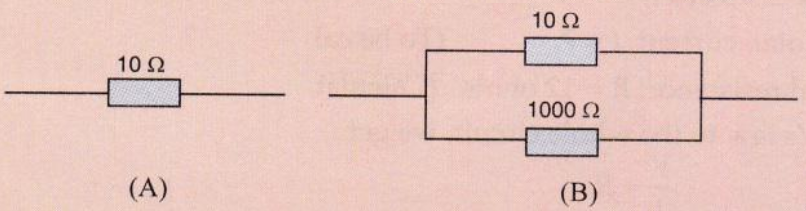
$\frac{1}{\text{R}}=\frac{1}{10}+\frac{1}{1000}=\frac{(100+1)}{1000}$
$\text{R}=\frac{1000}{101}=9.9\ \text{ohm}$
Insulators: Sulphur, Cotton, Air, Paper, Porcelain, Mica, Bakelite, Polythene.
$\text{R}=\frac{\text{V}}{\text{I}}$
$\text{R}=\frac{12}{(2.5\times10^{-3})}$
R = 4.8 × 10³ ohm = 4800 ohm.
we know that,Potential difference
$= \frac{\text{Work done}}{\text{Charge\ moved}}$$=\frac{250}{20}=12.5$
$=1000\times\frac{\text{J}}{\text{S}}\times60\times60\text{s}$
= 3600 × 1000J = 3.6 × 10⁶J$\text{R}=\frac{\text{V}}{\text{I}}$
When an electric current is passed through a high resistance wire, the wire becomes very hot and produces heat. This effect is knows as heating effect of current. This effect is used in room heaters and electric ovens.
E.g., Copper, silver etc.
Insulators: Those substances through which electricity cannot flow are known as insulators.
E.g., Plastic, cotton etc.
Unit of electric potential is volt.