$\text{A}=\pi\times\text{r}^{2}$
wire A must have one-half the radius of wire B and therefore one-half the diameter. Put another way, the diameter of wire B is two times greater than the diameter of wire A.$\text{A}=\pi\times\text{r}^{2}$
wire A must have one-half the radius of wire B and therefore one-half the diameter. Put another way, the diameter of wire B is two times greater than the diameter of wire A.$\frac{1}{\text{R}}= \frac{\text{dI}}{\text{dV}}=$ slop, which is ,maximum for C
So the resis tan ce will maximum for A, so A show the series combination of the B and C because the net resi tan in series combination is always greater than the individual resistors.$\text{r}=\frac{\text{d}}{2}=\frac{0.3}{2}\text{mm}=0.15\text{mm}=0.15\times10^{-3}\text{m}$
$\rho=\frac{\text{R}\times\text{A}}{\text{I}}=\frac{\text{R}\times\pi\text{r}^2}{\text{I}}$
$\frac{26\times3.14\times(0.15\times10^{-3})^2}{1}$
$-1.83\times10^{-6}\Omega\text{m}$
$\text{R}=\frac{240}{5}=48\text{ohm}.$


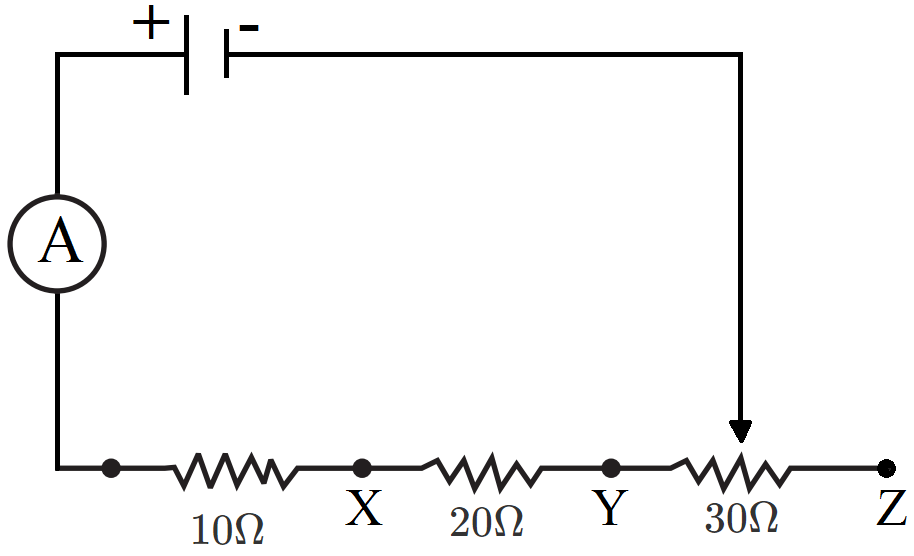
$\text{R}_{\text{net}}=10+20=30\Omega$
As we know by ohms law, V=I R Putting the values in the equation, we get$6\text{V}=1\times30\Omega$
$\text{I}=\frac{6}{30}=0.2\text{A}$ Thus, the reading of ammeter is 0.2A.
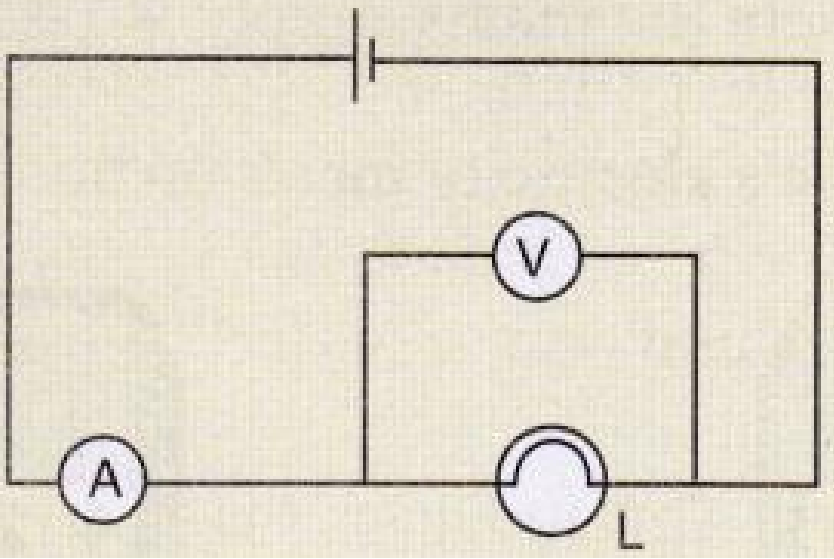
we know that V = IR
3 = 0.5R
R = 6 ohms
3 × 0.5
= 1.5 watt
$\therefore\text{I}=\frac{\text{ne}}{\text{t}}$
Thus, $\text{n}=\frac{\text{I}\times\text{t}}{\text{e}}$$\text{n}=\frac{2\times1}{1.6\times10^{-19}}$
$\therefore\text{n}=1.25\times10^{19}$
$\Rightarrow\text{E}=2\times10\times\text{x}\dots{2}$
Equating equation (1) and (2), we get 2 × 10 × x = 200$\Rightarrow\text{x}=\frac{200}{20}=10\text{m}$
$\text{H}=\text{i}^{2}\text{rt}$
The reason behind the heat produced is the collision of the free electrons with the lattice ions or atoms while accelerating in presence of the external electric field.$\text{V}=\text{I}_{1}\times\text{R}_{1}$
$\text{V}=\text{I}_{2}\times\text{R}_{2}$
$\text{I}_{1}\times\text{R}_{1}=\text{I}_{2}\times\text{R}_{2}=\text{I}_{2}\times\frac{\text{R}_{1}}{2}$
$\text{I}_{2}\frac{\text{I}_{1}\times\text{R}_{1}}{\frac{\text{R}_{1}}{2}}=2\times\text{I}_{1}$
$\therefore\text{I}=2\text{I}$
Thus, from this we can conclude that if the resistance of the circuit is halved then the current gets doubled.
$\text{I}=\frac{\text{V}}{\text{R}}$
keeping V constant, $\text{I}\propto\frac{1}{\text{R}}$ So, when R is double I becomes half.Let R be the equivalent resistance.
$\therefore \ \frac{1}{\text{R}}=\frac{1}{1}+\frac{1}{10^6}$
$\text{R}=\frac{10^6}{1+10^6}\approx\frac{10^6}{10^6}=1\Omega$
Therefore, equivalent resistance $\approx1\Omega$
Let R be the equivalent resistance.
$\frac{1}{\text{R}}=\frac{1}{1}+\frac{1}{10^3}+\frac{1}{10^6}\frac{10^6+10^3+1}{10^6}$
$\text{R}=\frac{1000000}{1001001}=0.999 \ \Omega$
Therefore, equivalent resistance = $0.999\Omega$.

in both the cases.
The ammeter reading will decrease (become shalt). This is because with the increase in length, resistance of the circuit increases, hence current decreases.
The ammeter reading will increase (becomes two times). This is because as area increases, resistance decreases and hence current increases.

$\frac{1}{\text{R}}=\frac{1}{\text{R}_{1}}+\frac{1}{\text{R}_{2}}$
$\frac{1}{\text{R}}=\frac{1}{25}+\frac{1}{25}$
$\text{R}=\frac{25}{2}=12.5\Omega$
Thus the net resistance is $12.5\Omega.$| Potential V (volts) | 1.0 | 2.2 | 3.0 | 4.0 | 6.4 |
| Current I (ampere) | 0.1 | 0.2 | 0.6 | 0.4 | 0.6 |
$R_{1} = \frac{1.0 \text{ V}}{0.1 \text{ A}} = \text{10 }\Omega \text{ ; }$
$ R_{2} = \frac{2.2 \text{ V}}{0.2 \text{ A}} = \text{11 }\Omega \text{ ; }$
$R_{3} = \frac{4.0 \text{ V}}{0.4 \text{ A}} = \text{ 10 } \Omega \text{ ; }$
$R_{4} = \frac{6.4 \text{ V}}{0.6 \text{ A}} = \text{10.6 } \Omega$
$\therefore \text{Mean } R = \text{(10 + 11 + 10 +10.6) } \Omega$
$ = \text{10.4 } \Omega$
$\text{W}=\text{Q}\times\text{V}$
$\therefore\text{V}=\frac{\text{W}}{\text{V}}$
$\text{V}=\frac{15\text{J}}{20\times10^{-3}}$
Since, $\text{Q}=20\text{mC}=20\times10^{-3}\text{C}$
$\text{V}=7.5\times10^{2}\text{C}$

$\frac{1}{\text{R}}=\frac{1}{\text{R}_1}+\frac{1}{\text{R}_2}+\frac{1}{\text{R}_3}$
$=\frac{1}{3}+\frac{1}{3}+\frac{1}{3}=\frac{3}{3}=1$
$\therefore\text{R}=1\Omega$

$\text{I}=\frac{\text{P}}{\text{V}}=\frac{12}{12}=1\text{A}$
V = IR$\text{R}=\frac{\text{V}}{\text{I}}=\frac{12}{1}=12\Omega$
H = I2Rt H = 12 × 12 × 60 H = 720JWe know that,
Work done = Potential difference × charge moved
= 12 × 1 = 12 joules
Since work done on each coulomb of charge is 12 joules, the energy given to each coulomb of charge is also 12 joules.
$\text{I}=\frac{\text{Q}}{\text{t}}$
Q = 1 × t = 5 × 1 = 5C No. of electrons comparing 1.6 × 10⁻¹⁹ C - 1 No. of electrons comparing $5\text{C}=\frac{5}{1.6\times10^{-19}}=31.25\times10^{19}$the conductor will rise. As most conductors have a positive temperature coefficient of resistance, the resistance of the conductor will increase according to the following relation.
R = Rref [1 + a( T - Tref)]
Where
R = Conductor resistance at temperture ''T''
Rref = Conductor resistance at reference temperature.
Tref, usually 20°C, but sometimes 0°C.
$\alpha$ = Temperature cofficient of resistance for the conductor material.
Tref = Reference temperature that a is specified at for the conductor material.
$\frac{1}{\text{R}}=\frac{1}{16}+\frac{1}{16}+\frac{1}{16}+\frac{1}{16}=\frac{4}{16}$
R = 4 ohm For such combination are connected in series, so total resistance = 4 + 4 + 4 + 4 = 16 ohm.
$\text{R}_2=8\Omega$
Potential sifference = V
$\text{I}_1=\frac{\text{V}_1}{\text{R}_1}=\frac{\text{V}}{4\Omega}$
$\text{I}_2=\frac{\text{V}}{\text{R}_2}=\frac{\text{V}}{8\Omega}$
$\frac{\text{I}_1}{\text{I}_2}=\frac{\text{V}}{\text{V}}=\frac{4\Omega}{8\Omega}$
$\Rightarrow\frac{\text{I}_1}{\text{I}_2}= \frac{8}{4}$
$\Rightarrow\frac{\text{I}_1}{\text{I}_2}= \frac{2}{1}$
$\therefore \text{I}_1:\text{I}_?=2:\text{I}$