Questions · Page 3 of 3

Answer the questions.[Phy-2M]

Question 1012 Marks
Electric fuse is an important component of all domestic circuits. Why?
Answer
An electric fuse is a safety device used to limit the current in an electric circuit. The use of a fuse is to safeguard the electric circuit and the electric appliances connected in the electric circuit from being damaged.
A fuse is a short piece of wire made up of a material of high resistivity and of low melting point, So that it may easily melt due to overheating due to the excessive flow of electric current.
View full question & answer
Question 1022 Marks
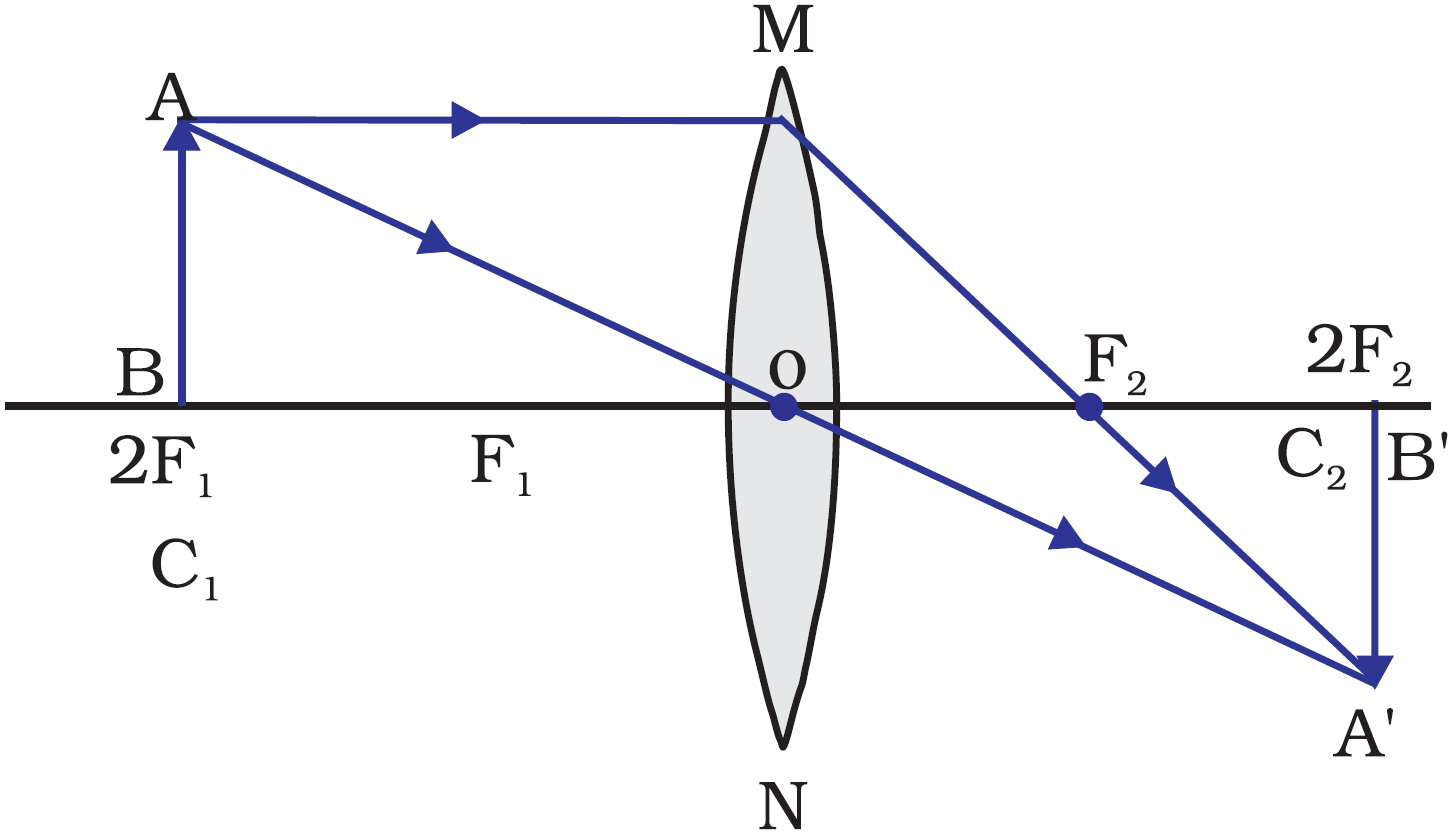
Draw ray diagrams to represent the nature, position and relative size of the image formed by a convex lens for the object placed:
  1. At 2 F1
  2. Between F1 and the optical centre O of lens.
Answer
  1. Object at 2F1: The image formed is at 2F1 and is real inverted. The image formed is same size as that of the object.


Image formed by a convex lens when object is at 2F1.
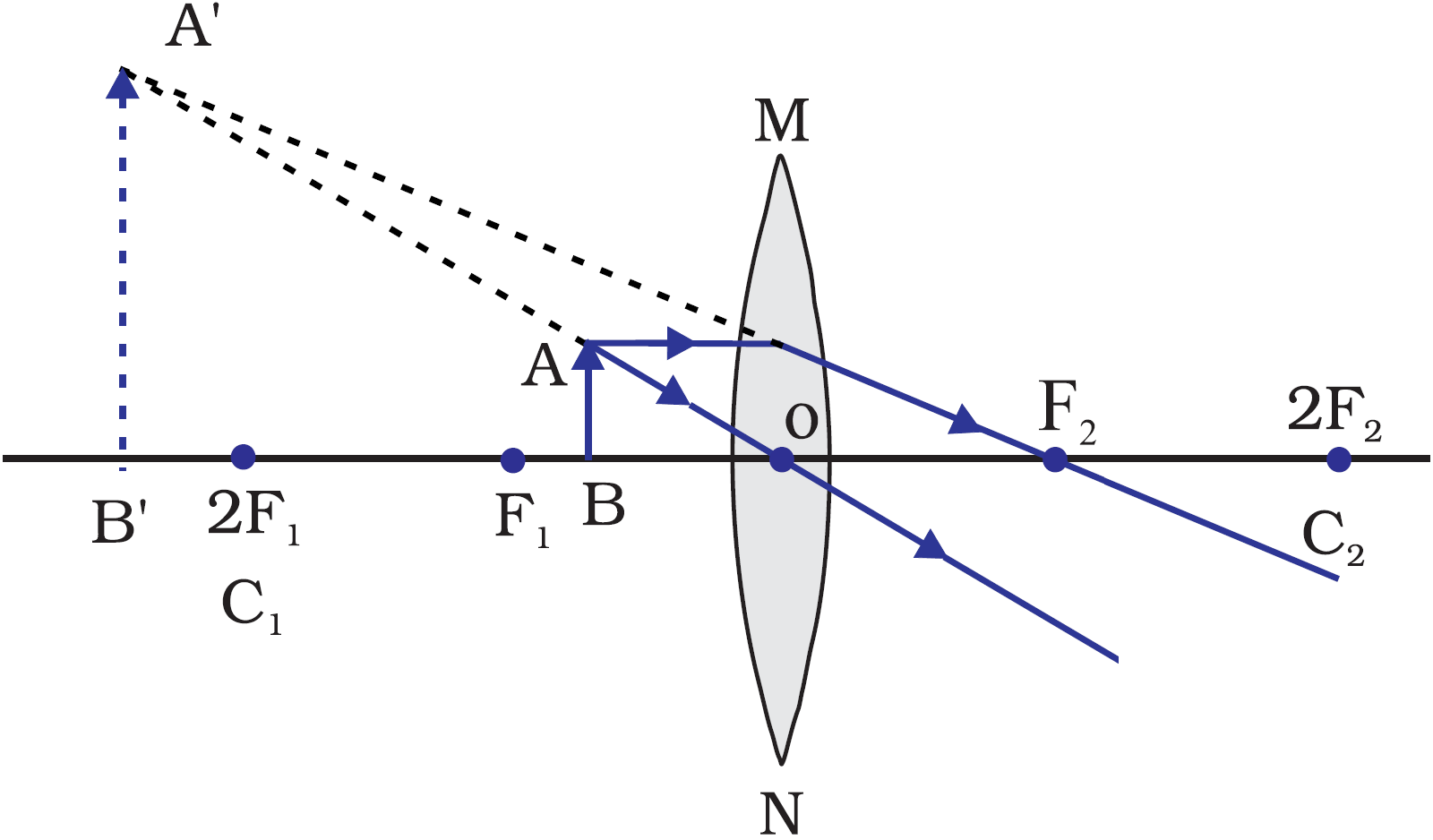
  1. Object betwwen focus F1 and O: The image is formed on the same side as that object and is virtual, erect and enlarged.


Image formed by a convex lens then when object is between F1 and O.
View full question & answer
Question 1032 Marks
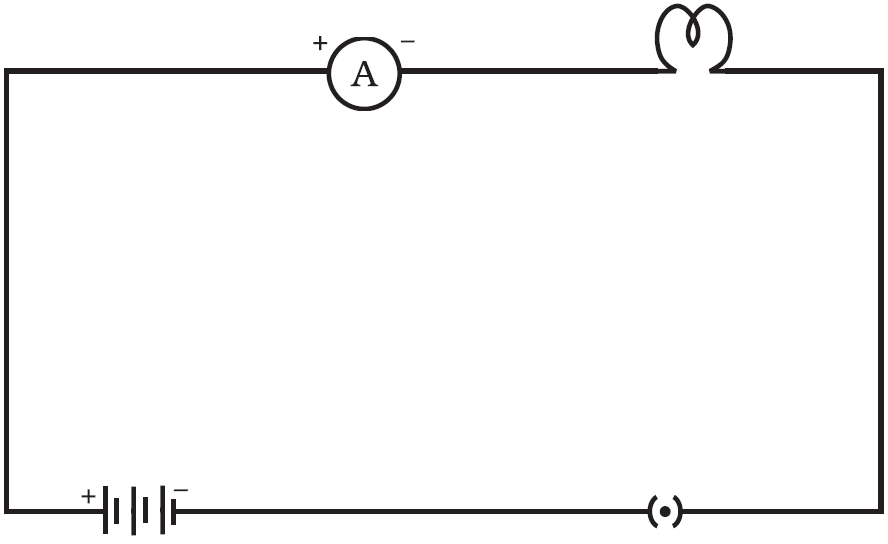
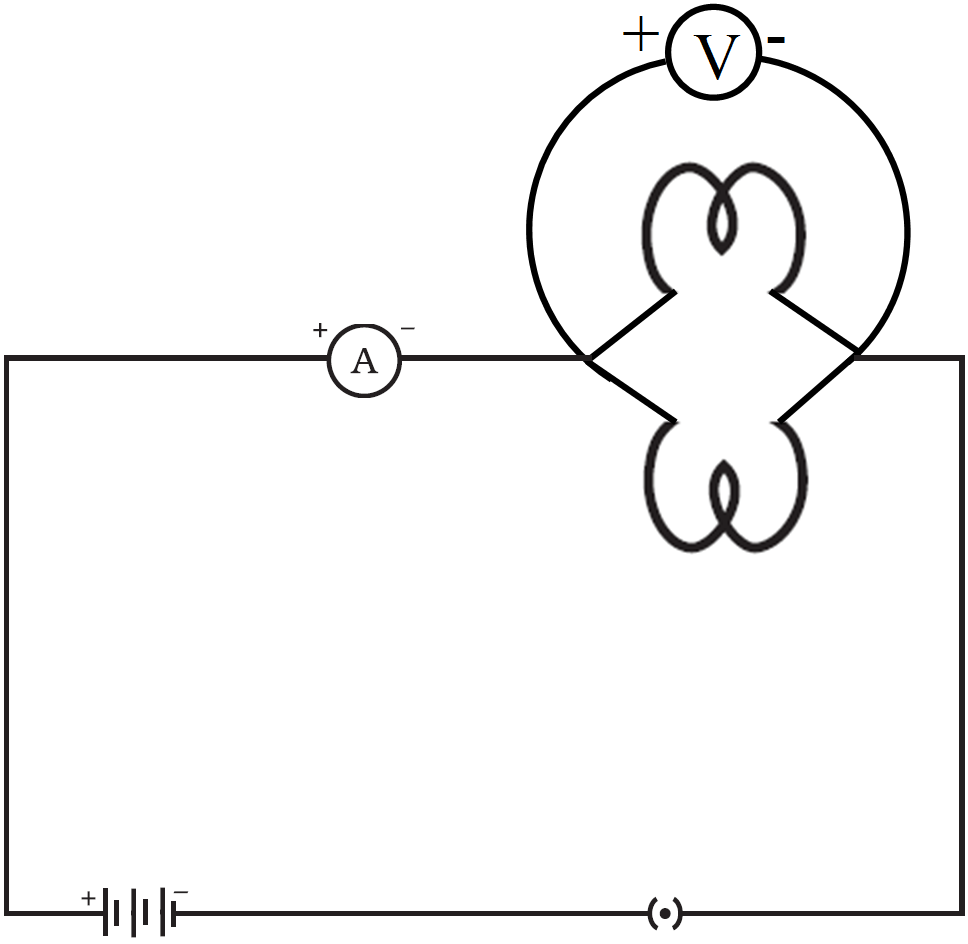
Draw a schematic diagrams of an electric circuit comprising of 3 cells and an electric bulb, ammeter, plug-key in the ON mode and another with same components but with two bulbs in
parallel and a voltmeter across the combination.
Answer
Diagram of an electric circuit comprising of 3 cells and an electric bulb, ammeter, plug-key.

View full question & answer
Question 1042 Marks
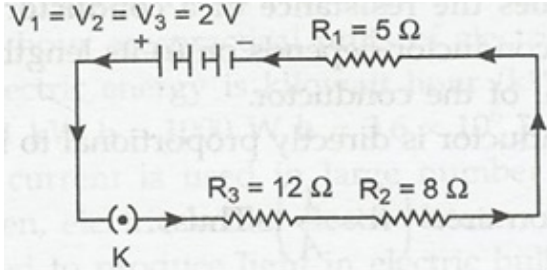
Draw a schematic diagram of a circuit consisting of a battery of three cells of 2 V each, a 5 Ω resistor, an 8 Ω resistor, and a 12 Ω resistor, and a plug key, all connected in series.
Answer
The schematic diagram of circuit is as follows:
View full question & answer
Question 1052 Marks
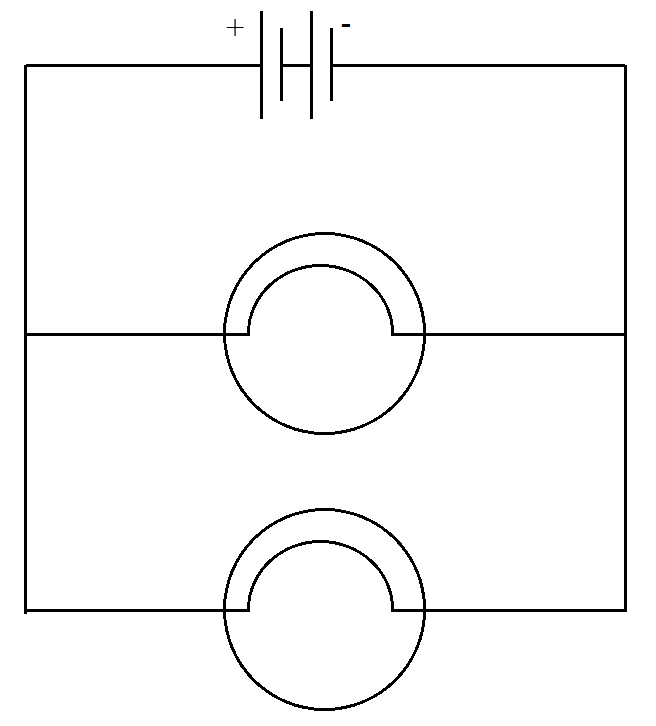
Draw a circuit diagram to show how two 4V electric lamps can be lit brightly from two 2V cells.
Answer
The two lamps (of 4V each) should be arranged in parallel with the two 2V cells.
View full question & answer
Question 1062 Marks
Draw a circuit diagram to show how 3 bulbs can be lit from a battery so that 2 bulbs are controlled by the same switch while the third bulb has its own switch.
View full question & answer
Question 1072 Marks
Define watt. Write down an equation linking watts, volts and amperes.
Answer
When an electrical appliance consumes electrical energy at the rate of 1 joule per second, its power is said to be 1 watt.
1 watt = 1 volt × 1 ampere.
View full question & answer
Question 1082 Marks
Define watt-hour. How many joules are equal to 1 watt-hour?
Answer
One watt hour is the amount of electrical energy consumed when an electrical appliance of 1 watt power is used for 1 hour.
1 watt hour = 3600 joules.
View full question & answer
Question 1092 Marks
Define the unit of resistance (or Define the unit “ohm”).
Answer
1 ohm is the resistance of a conductor such that when a potential difference of 1 volt is applied to its ends, a current of 1 ampere flows through it.
View full question & answer
Question 1102 Marks
Define the unit of electric current (or Define ampere).
Answer
When 1 coulomb of charge flows through any cross-section of a conductor in 1 second, the electric current flowing through it is said to be 1 ampere.
View full question & answer
Question 1112 Marks
Define the electric resistivity of material and also write its SI unit.
Answer
Electrical resistivity (also called specific electrical resistance or volume resistivity) and its inverse, electrical conductivity, is a fundamental property of a material that quantifies how strongly it resists or conducts electric current. The SI unit of electrical resistivity is the ohm-metre $(\Omega.\text{m}).$
View full question & answer
Question 1122 Marks
Define the electric resistance of a wire and also write its SI unit.
Answer
Resistance is the ability of the conductor to resist the flow of electric current through it. SI unit of resistance is Ohms written by symbol $\Omega4.9.$
View full question & answer
Question 1132 Marks
Define resistivity. Write an expression for the resistivity of a substance. Give the meaning of each symbol which occurs in it.
Answer
Resistivity, $\rho=\frac{\text{R}\times\text{A}}{\text{I}}$
Where, R is the resistance of the conductor.
A is the area of cross section of the conductor.
I is the length of the conductor.
View full question & answer
Question 1142 Marks
Define kilowatt-hour. How many joules are there in one kilowatt-hour?
Answer
One kilowatt hour is the amount of electrical energy consumed when an electrical appliance having a power rating of 1 Kilowatt is used for 1 hour.
1KWh = 3.6 × 106J
View full question & answer
Question 1152 Marks
Define electric current. What is the SI unit of electric current.
Answer
Electric current is the flow of electric charges (electrons) in a conductor such as a metal wire.
SI unit of electric current is ampere.
View full question & answer
Question 1162 Marks
Compute the heat generated while transferring 96000 coulomb of charge in one hour through a potential difference of 50 V.
Answer
Given Charge, Q $$= 96000 C

Time, t = 1 hr = 60 × 60 = 3600 s

Potential difference, V = 50 volts

Now we have that H = Vlt

So we have to calculate I first

As I = Q/t

$\therefore \ \text{I}=\frac{96000}{3600}=\frac{80}{3} \ \text{A}$

$\text{H}=50\times\frac{80}{3}\times60\times60=4.8\times10^6 \ \text{J}$

Therefore, the heat generated is 4.8 x 10⁶ J.

View full question & answer
Question 1172 Marks
Classify the following into good conductors, resistors and insulators:
Rubber, Mercury, Nichrome, Polythene, Aluminium, Wood, Manganin, Bakelite, Iron, Paper, Thermocol, Metal coin.
Answer
Conductor: Mercury, Aluminum, Iron, Metal Coin.
Resistor: Manganin, Nichrome.
Insulator: Rubber, Polythene, Wood, Bakelite, Paper, Thermocol.
View full question & answer
Question 1182 Marks
Calculate the work done in moving a charge of 5 coulombs from a point at 20 to another at 30V.
Answer
$\text{V} = \frac{\text{W}}{\text{Q}}$

$\text{W} = \text{V} \times \text{Q}$

$\text{w} = 20\times5 =100$

$\text{V} = \frac{\text{W}}{\text{Q}}$

$\text{W} = \text{V} \times \text{Q}$

$\text{W} = 30\times5 = 150$

View full question & answer
Question 1192 Marks
Calculate the ratio of the equivalent resistance of the above two wires in parallel combination to that in series combination.
Answer
For series

(Req)1 = nr.

For parollel.

$\frac{1}{\text{Req}}=\frac{1}{\text{R}}+\frac{1}{\text{R}}+\frac{1}{\text{R}}........\text{N time}$

$\frac{1}{\text{Req}}=\frac{\text{N}}{\text{R}}$

$\therefore\bigg(\text{Req}\bigg)_2=\frac {\text{R}}{\text{N}}$

$\therefore\frac{(\text{Req})}{(\text{Req})_2}=\frac{\text{NR}\times\text{N}}{\text{R}}=\text{N}^2$

View full question & answer
Question 1202 Marks
Calculate the number of electrons constituting one coulomb of charge.
Answer
Charge on one electron = 1.6 × 10⁻¹⁹ coulomb.
No of electron in one coulomb of charge = 1/1.6 × 10-19 = 6.25 × 10¹⁸ electrons.
View full question & answer
Question 1212 Marks
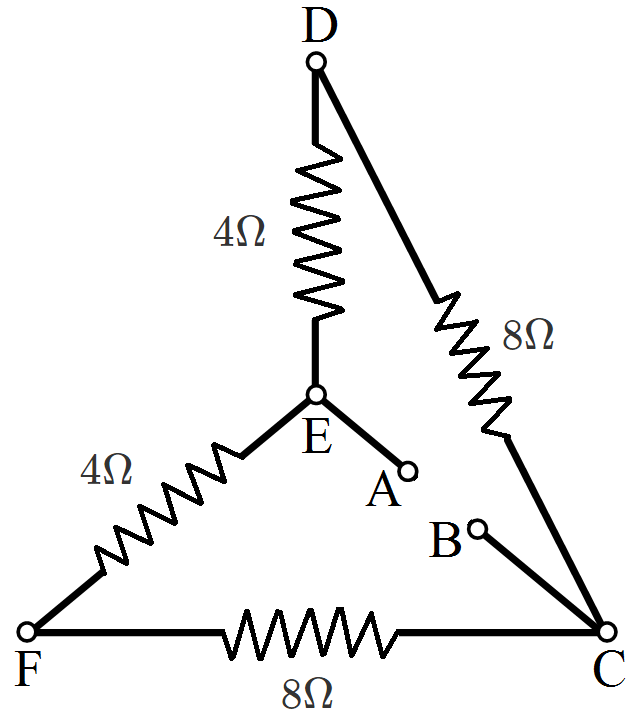
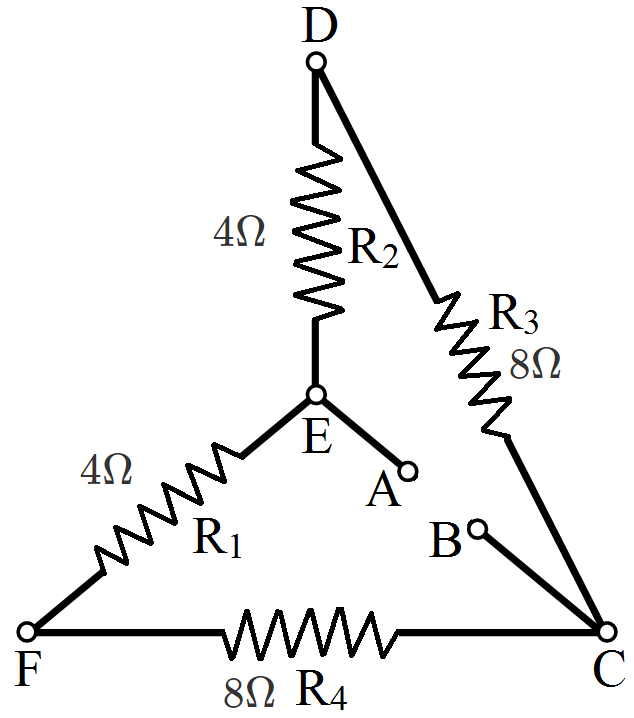
Calculate the equivalent resistance of the network across the points A and B shown in figure.
Answer


Since R1 and Rare in series.

So, Rs1 = 4 + 8 = 12

Similary R2 and R3 are in series

Rs2 = Q + 4 = 12

Now Rs1 and Rs2 are in || combination

So, $\frac{1}{\text{RP}}=\frac{1}{\text{12}}+\frac{1}{\text{12}}=\frac{1}{\text{12}}=\frac{1}{\text{6}}$

RP = 6

So, Req$6\Omega$

View full question & answer
Question 1222 Marks
Calculate the amount of work done in shifting of charge of 2 C from a point A to B having potentials +10V and -5V respectively.
Answer
Given that,

V = IRV = IR

VA = +10V

VB = -5V

We Know that,

At Point B,

$\text{W}_\text{B}= -\frac{2\text{C}}{5}\text{C}-\frac{1}{5}\text{C}=-\frac{3}{5}\text{C}$

Total Work Done is

W = WA - WB

$\text{W} = -\frac{2}{5}\text{C} - \frac{1}{5}\text{C} = -\frac{3}{5}\text{C}$

$\text{W} = \frac{\text{q}}{\text{v}}$

At Point A,

$\text{WA} = \frac{2\text{C}}{10} = \frac{1}{5}\text{C}$

View full question & answer
Question 1232 Marks
A wire that has resistance R is cut into two equal pieces. The two parts are joined in parallel. What is the resistance of the combination?
Answer
Resistance of each part is $\frac{\text{R}}{2}.$

Resultant resistance R’ is given by

$\frac{1}{\text{R}'}=\frac{2}{\text{R}} +\frac{2}{\text{R}}$

$\text{R’}=\frac{\text{R}}{4}.$

View full question & answer
Question 1242 Marks
A wire of resistance $20\Omega$ is bent to form a closed square. What is the resistance across a diagonal of the square?
Answer
On bending 20 ohms resistance into the square. At the ends of the opposite vertexes/ diagonal, thise two points will devide the resistance into 2 equal resistances of 10 ohms each. These

are the now in the parallel order. The total/ final resistance will be 5 ohms.

$\frac{1}{\text{R}}=\frac{1}{\text{R}1}+\frac{1}{\text{R}1}$

$=\frac{1}{10}+\frac{1}{10}$

$=\frac {2}{10} \text{ohms,}$

$\text{R} = 5 \text{ohms.}$

View full question & answer
Question 1252 Marks
A resistance of $25Ω$ is connected to a 12V battery. Calculate the heat energy in joules generated per minute.
Answer
Given: R = 25 ohms, V = 12V, H = ?, t = 60 Sec
V = IR
12 = 25 × I
I = 0.48 amp
We have
H = I2RT
H = 0.48× 25 × 60
H = 345.6J
View full question & answer
Question 1262 Marks
A radio set draws a current of 0.36A for 15 minutes. Calculate the amount of electric charge that flows through the circuit.
Answer
I = 0.36A, t = 15min = 900 seconds.
Q = I × t
= 0.36 × 900
= 324C.
View full question & answer
Question 1272 Marks
An electric room heater draws a current of 2.4A from the 120V supply line. What current will this room heater draw when connected to 240V supply line?
Answer
In first case,

I = 2.4 amp, V = 120 volt

V = IR

120 = 2.4 × R

$\text{R}=\frac{120}{2.4}=50\ \text{ohm}$

In second case,

V = 240 volt, R = 50 ohm

V = IR

240 = I × 50

I = 4.8amp.

View full question & answer
Question 1282 Marks
An electric motor takes 5 amperes current from a 220 volt supply line. Calculate the power of the motor and electrical energy consumed by it in 2.
Answer
I = 5amp, V = 220 Volt, t = 2h
P = ?, E = ?
P = V × I
= 220 × 5
= 1100 watt
= 1.1KW
Energy consumed, E = P × t
= 1.1 × 2
= 2.2KWh
View full question & answer
Question 1292 Marks
An electric motor takes 5 A from a 220 V line. Determine the power of the motor and the energy consumed in 2 h.
Answer
Power (P) is given by the expression, P = VI
Where,
Voltage, V = 220 V
Current, I = 5 A
P = 220 × 5 = 1100 W
Energy consumed by the motor = Pt
Where,
Time, t = 2 h = 2 × 60 × 60 = 7200 s
$\therefore$ P = 1100 × 7200 = 7.92 × 10⁶ J
Therefore, power of the motor = 1100 W
Energy consumed by the motor = 7.92 × 10⁶ J.
View full question & answer
Question 1302 Marks
An electric kettle rated at 220V, 2.2kW, works for 3 hours. Find the energy consumed and the current drawn.
Answer
V = 220V, P = 2.2kW = 2200W, t = 3h
We know that
Electrical energy consumed = P × t = 2.2 × 3 = 6.6kWh
We have, P = V × I
2200 = 220 × I
I = 10amp
View full question & answer
Question 1312 Marks
An electric kettle connected to the 230V mains supply draws a current of 10A. Calculate:
  1. The power of the kettle.
  2. The energy transferred in 1 minute.
Answer
Given V = 230V, I = 10 amp
P = VI
P = 230 × 10
P = 2300 Watt = 2300 J/s
Energy consumed in min 
$=\text{P}\times\text{T}=2300\ \text{J}/\text{s}\times60\text{s}=138000\text{J}$
View full question & answer
Question 1322 Marks
An electric iron of resistance 20 Ω takes a current of 5A. Calculate the heat developed in 30 s.
Answer
Resistance of electric iron (R) = 20 Ω, current (I) = 5A and time = 30 s.
Heat generated (H) = I2 RT = 52 x 20 x 30 = 15000 j.
View full question & answer
Question 1332 Marks
An electric iron of resistance 20 ohms draws a current of 5 amperes. Calculate the heat produced in 30 seconds.
Answer
Given: R = 20 ohm, I = 5amp, t = 30s
We know that H = I2 Rt
H = 52 × 20 × 30
H = 15000J
View full question & answer
Question 1342 Marks
An electric heater of resistance $8Ω,$ takes a current of 15A from the mains supply line. Calculate the rate at which heat is developed in the heater.
Answer
Given: R = 8 ohms, I = 15 amp, t = 1sec
We know that
H = I2RT
H = 152 × 8 × 1
H = 1800J/ s
View full question & answer
Question 1352 Marks
An electric heater of resistance $500\Omega$ is connected to a mains supply for 30min. If 15A current flows through the filament of the heater, then calculate the heat energy produced in the heater.
Answer
We know that the formula of heat is given by:
Heat, H = I2 Rt

Where;

t = 30 min = 30×60 sec = 1800sec

I = 15A

$\therefore\text{H}=(15)^{2}\times500\times1800\text{J}$

$\text{H}=225\times500\times1800\text{J}$

$\therefore\text{H}=20.25\times10^{7}\text{J}$

Thus Total heat produced by the heater is 20.25 × 10⁷ J in 30min due to flow of 15A current

View full question & answer
Question 1362 Marks
An electric heater of resistance 8 Ω draws 15 A from the service mains 2 hours. Calculate the rate at which heat is developed in the heater.
Answer
$\text{R}=8 \ \Omega, \ \text{I}=15 \ \text{A}, \ \text{t}=2 \ \text{h}$

Rate of heat developed  $=\frac{\text{H}}{\text{t}}=\frac{\text{I}^2\text{Rt}}{\text{t}}$

= 152 × 8 = 225 ×  8 = 1800 Js-1.

View full question & answer
Question 1372 Marks
An electric fan runs from the 230V mains. The current flowing through it is 0.4A. At what rate is electrical energy transferred by the fan?
Answer
Given: V = 230V, I = 0.4 amp
Rate at which electric energy is transformed = Power
Power = V × I
= 230 × 0.4
= 92W = 92J/s
View full question & answer
Question 1382 Marks
An electric bulb is connected to a 220V power supply line. If the bulb draws a current of 0.5A, calculate the power of the bulb.
Answer
V =220V, I = 0.5amp, P = ?
We know that
P = VI = 220 × 0.5
P = 110 watt.
View full question & answer
Question 1392 Marks
A fuse wire consists of an alloy of lead and tin. Why?
Answer
Fuse wires are made of Tin-lead alloy instead of copper due to various reasons. This wire is consist of low melting point as well as the have the high resistance. The alloy result in good functioning of the fuse. As the tin cause the good conductivity property.
View full question & answer
Question 1402 Marks
A current of 200mA flows through a $4\text{k}\ Ω$ resistor. What is the p.d. across the resistor?
Answer
I = 200mA = 0.2A
R = 4 × 10³ohm = 4000 ohm
We know that
V = IR
V = 0.2 × 4000
V = 800 volt.
View full question & answer
Question 1412 Marks
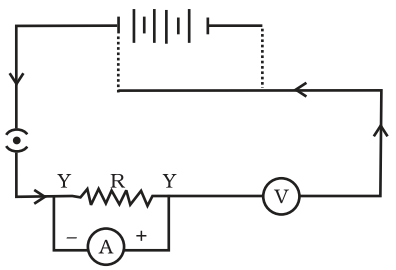
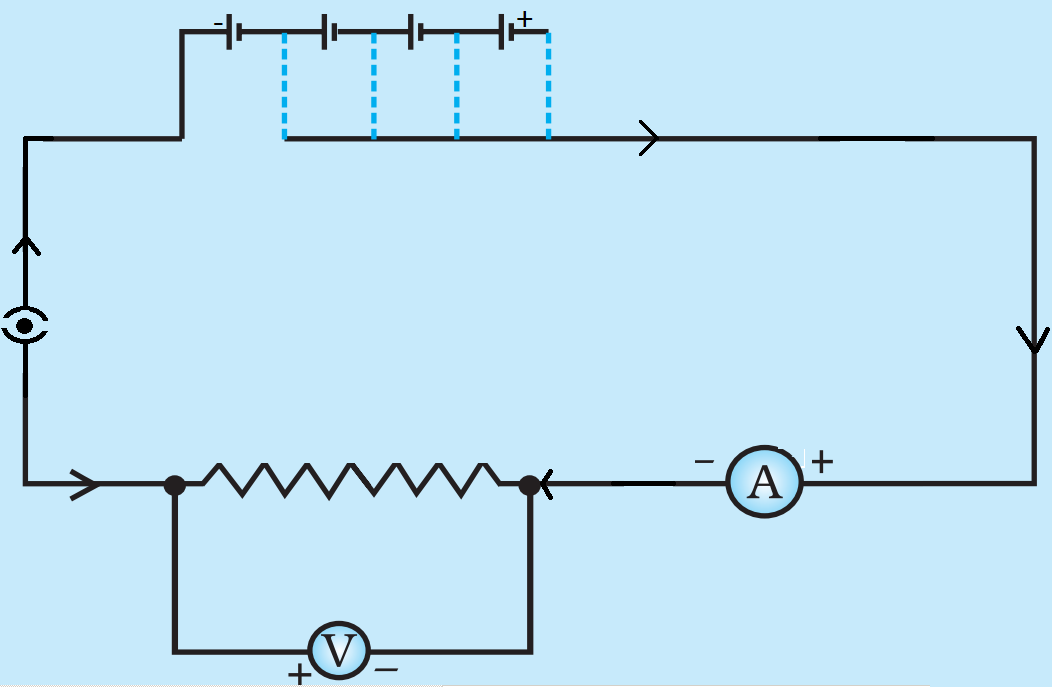
A child has drawn the electric circuit to study Ohm’s law as shown in Figure. His teacher told that the circuit diagram needs correction. Study the circuit diagram and redraw it after making all corrections.
Answer
Correct diagram is as follows.
View full question & answer
Question 1422 Marks
A bulb is rated as 250V; 0.4A. Find its : (i) power, and (ii) resistance.
Answer
V = 250V, I = 0.4amp
We know that
Power = VI = 250 × 0.4 = 100 watt
we have
P = I2R
100 = 0.42 × R
R = 625 ohm
View full question & answer
Question 1432 Marks
A battery of 9 V is connected in series with resistors of $0.2 Ω, 0.3 Ω, 0.4 Ω, 0.5 Ω\ \text{and}\ 12 Ω.$ How much current would flow through the $12 Ω$ resistor?
Answer
R1 = 0.2 ohm, R2 = 0.4 ohm, R3 = 0.3 ohm, R4 = 0.5 ohm, R5 = 12 ohm V = 9V

Resultant resistance = R1 + R2 + R3 + R4 + R5

R = 0.2 + 0.4 + 0.3 + 0.5 + 12 + 13.4 ohm

Thus the current flows through 12 ohm resistance will be $=\frac{\text{V}}{\text{R}}$

$\text{I}=\frac{9}{13.4}$

$\text{I}=0.67\ \text{amp}$

View full question & answer
Question 1442 Marks
100 joules of heat is produced per second in a 4 ohm resistor. What is the potential difference across the resistor?
Answer
Given: H = 100J, t = 1 sec, R = 4 ohms,

We know that

H = I2RT

100 = I2 × 4 × 1

$\frac{100}{4}=\text{I}^2$

I = 5 amp

V = IR

V = 5 × 4

= 20V

View full question & answer
Answer the questions.[Phy-2M] - Page 3 - Science STD 10 Questions - Vidyadip