Questions · Page 4 of 4

M.C.Q-[Phy-1M]

MCQ 1511 Mark
An electric heater is rated 100W and 220V. If it is operated on 110V. The power consumption will be:
  • A
    10W
  • B
    25W
  • C
    15W
  • D
    100W
Answer
  1. 25W

Explanation:

$\text{R}=\frac{\text{V}^{2}}{\text{P}}=\frac{(220)^{2}}{100}=484\Omega$

The resistance of the bulb remains constant

if the supply voltage is reduced to 110V then V $=110\text{V}$

 the power consumed by it is given by the expression $=\frac{\text{V}^{2}}{\text{R}}=\frac{(110)^{2}}{484}=25\text{W}$
View full question & answer
MCQ 1521 Mark
An electric heater converts electrical energy into:
  • A
    Chemical energy
  • B
    Heat energy
  • C
    Muscular energy
  • D
    None of the above
Answer
  1. Heat energy

Explanation:

When a current passes through an electric heater, it becomes hot.

Therefore, in an electric heater, electrical energy is converted into heat energy.

View full question & answer
MCQ 1531 Mark
An electric fuse works on the:
  • A
    Chemical effect of current.
  • B
    Magnetic effect of current.
  • C
    Lighting effect of current.
  • D
    Heating effect of current.
Answer
  1. Heating effect of current.

Explanation:

An electric fuse works on the heating effect of current.

View full question & answer
MCQ 1541 Mark
An electric fuse works on the ______effect of current:
  • A
    Heating
  • B
    Magnetic
  • C
    Chemical
  • D
    None of these
Answer
  1. Heating

Explanation:

Electric fuse work on the principal of heating effect of current.

Fuse wire is a wire of high resistance and low melting point.

When very large current will pass through it, heat will be generated which will melt the fuse wire and break the circuit.

By using electric fuses in home we can protect the home appliances from damaging by large amount of current.

View full question & answer
MCQ 1551 Mark
An electric bulb is rated 220V and 100W. When it is operated on 110V, the power consumed will be:
  • A
    100W
  • B
    75W
  • C
    50W
  • D
    25W
Answer
  1. 25W
View full question & answer
MCQ 1561 Mark
An electric bulb is connected to a 220V generator. The current is 0.50A. What is the power of the bulb?
  • A
    440W
  • B
    110W
  • C
    55W
  • D
    0.0023W
Answer
  1. 110W
View full question & answer
MCQ 1571 Mark
An electrical appliance has a resistance of $25 Ω.$ When this electrical appliance is connected to a 230V supply line, the current passing through it will be:
  • A
    0.92A.
  • B
    2.9A.
  • C
    9.2A.
  • D
    92A.
Answer
  1. 9.2A.

Explanation:

Resistance = $25Ω$

Voltage = 230V

$\text{Current}=\frac{\text{Voltage}}{\text{Resistance}}$

$\text{I}=\frac{\text{V}}{\text{R}}$

$\text{I}=\frac{230}{25}$

$\text{I}=9.2\text{A}$

Thus, if an electrical appliance has a resistance of $25Ω$ and when that electrical appliance is connected to a 230V supply line, the current passing through it will be 9.2A.

View full question & answer
MCQ 1581 Mark
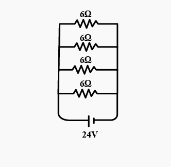
A 24V potential difference is applied across a parallel combination of four 6Ω resistor. The current in each resistor is:
  • A
    1A
  • B
    4A
  • C
    16A
  • D
    36A
Answer
  1. 4A

Explanation:

Since the resistors are connected in parallel,the voltage across each resistor is the same ,i.e 24V.

Therefore, current in each resistor can now simply be calculated using the relation,

$\text{I}=\frac{\text{V}}{\text{R}}\Rightarrow\text{I}=\frac{24}{6.0}=4.0\text{ A}$


View full question & answer
MCQ 1591 Mark
A metallic conductor has loosely bound electrons called free electrons. The metallic conductor is:
  • A
    Negatively charged
  • B
    Positively charged
  • C
    Neutral
  • D
    Either positively charged or negatively charged
Answer
  1. Neutral
View full question & answer
MCQ 1601 Mark
A material that lets electricity to pass through it is called a/ an:
  • A
    Electrical conductor
  • B
    Electrical insulator
  • C
    Electrical appliance
  • D
    Key
Answer
  1. Electrical conductor

Explanation:

A material that lets electricity to pass through it is called an electrical conductor.

View full question & answer
MCQ 1611 Mark
A fuse wire repeatedly gets burnt when used with a good heater. It is advised to use a fuse wire of:
  • A
    More length
  • B
    Less radius
  • C
    Less length
  • D
    More radius
Answer
  1. More radius
View full question & answer
MCQ 1621 Mark
A dynamo develops 0.5A at 6V.The energy which is generated in one second is:
  • A
    0.083J
  • B
    3J
  • C
    12J
  • D
    none of these
Answer
  1. 3J

Explanation:

Voltage(V) = 6V

Current(I) = 0.5A

Time(t) = 1sec

Energy generated = VIt

⇒ Energy = 6 × 0.5 × 1 = 3J

View full question & answer
MCQ 1631 Mark
A cylindrical conductor of length l and uniform area of crosssection A has resistance R. Another conductor of length 2l and resistance R of the same material has area of cross section:
  • A
    $\frac{\text{A}}{2}$
  • B
    $\frac{3\text{A}}{2}$
  • C
    $2\text{A}$
  • D
    $3\text{A}$
Answer
  1. $2\text{A}$

Explanation: $\text{R}=\rho\frac{\text{l}}{\text{A}}\ ....(\text{i})$

Also, $\text{R}=\frac{\rho(2\text{l})}{\text{A}'}\ ....(\text{ii})$

From eq. (i) and (ii)

$\frac{1}{\text{A}}=\frac{2}{\text{A}'}\text{ or A}'=2\text{A}$

View full question & answer
MCQ 1641 Mark
A current of 1A is drawn by a filament of an electric bulb. Number of electrons passing through a cross-section of the filament in 16 seconds would be roughly:
  • A
    1020
  • B
    1016
  • C
    1018
  • D
    1023
Answer
  1. 1020
View full question & answer
MCQ 1651 Mark
A current of 1A is drawn by a filament of an electric bulb. Number of electrons passing through a cross section of the filament in 16 seconds would be roughly:
  • A
    1020
  • B
    1016
  • C
    1018
  • D
    1023
Answer
  1. 1020

Explanation: $\text{I}=\frac{\text{Q}}{\text{t}}=\frac{\text{ne}}{\text{t}}$

$\text{n}=\frac{\text{It}}{\text{e}}=\frac{1\times16}{1.6\times10^{-19}}=10^{20}$​​​​​​​

View full question & answer
MCQ 1661 Mark
A coil in the heater consume power P on passing current. If it is cut into halves and joined in parallel, it will consume power:
  • A
    P
  • B
    $\frac{\text{P}}{2}$
  • C
    2P
  • D
    4P
Answer
  1. 4P
View full question & answer
MCQ 1671 Mark
A car headlight bulb working on a 12V car battery draws a current of 0.5A. The resistance of the light bulb is:
  • A
    $0.5Ω$
  • B
    $6Ω$
  • C
    $12Ω$
  • D
    $24Ω$
Answer
  1. $24Ω$

Explanation:

Voltage, V = 12V

Current, I = 0.5A
Resistance, $\text{R}=\frac{\text{Voltage}}{\text{Current}}$ 

$\text{R}=\frac{12}{0.5}$

$\text{R} = 24Ω$

Thus, if a car's headlight bulb working on a 12V car battery draws a current of 0.5A, the resistance of the light bulb will be $ 24Ω$

View full question & answer
MCQ 1681 Mark
A boy records that 4000 joule of work is required to transfer 10 coulomb of charge between two points of a resistor of 50 Ω. The current passing through it is:
  • A
    2A
  • B
    4A
  • C
    8A
  • D
    16A
Answer
  1. 8A
View full question & answer
MCQ 1691 Mark
A battery of 10 volt carries 20,000C of charge through a resistance of 20 Ω. The work done in 10 seconds is:
  • A
    2 × 10³ joule
  • B
    2 × 10joule
  • C
    2 × 10⁴ joule
  • D
    2 × 10² joule
Answer
  1. 2 × 10joule
View full question & answer
MCQ 1701 Mark
A battery and three lamps are connected as shown?


Which of the following statements about the currents at X, Y and Z is correct?

  • A
    The current at Z is greater than that at Y.
  • B
    The current at Y is greater than that at Z.
  • C
    The current at X equals the current at Y.
  • D
    The current at X equals the current at Z.
Answer
  1. The current at Y is greater than that at Z.

Explanation:

This is so because Y alone will offer less resistance.

View full question & answer
MCQ 1711 Mark
100J of heat is produced each second in a 4Ω resistor. The potential difference across the resistor will be:
  • A
    30V
  • B
    10V
  • C
    20V
  • D
    25V
Answer
  1. 10V
View full question & answer
M.C.Q-[Phy-1M] - Page 4 - Science STD 10 Questions - Vidyadip