Questions · Page 3 of 4

M.C.Q-[Phy-1M]

MCQ 1011 Mark
In an electrical circuit three incandescent bulbs A, B and C of rating 40W, 60W and 100W respectively are connected in parallel to an electric source of the following is likely to happen regarding brightness?
  • A
    Brightness of all the bulbs will be the same.
  • B
    Brightness of bulb A will the maximum.
  • C
    Brightness of bulb B will be more than that of A.
  • D
    Brightness of bulb C will be less than that of B.
Answer
  1. Brightness of bulb B will be more than that of A.

Explanation:

We know that power is defined as rate of doing work. A bulb consumes electric energy and produces heat and light. Now, bulb with more power rating will produce more heat and

light or we can say that Power rating of bulb is directly proportional to the brightness produced by bulb.
View full question & answer
MCQ 1021 Mark
In a filament type light bulb, most of the electric power consumed appears as:
  • A
    Visible light.
  • B
    Infra-red-rays.
  • C
    Ultraviolet rays.
  • D
    Fluorescent light.
Answer
  1. Infra-red rays

Explanation:

This is so because of the heat produced when a filament type light bulb glows.

View full question & answer
MCQ 1031 Mark
If two resistors of $25 Ω$ and $15 Ω$ are joined together in series and then placed in parallel with a $15 Ω$ resistor, the effective resistance of the combination is:
  • A
    $0.1\Omega$
  • B
    $10\Omega$
  • C
    $20\Omega$
  • D
    $40\Omega$
Answer
  1. $20\Omega$

Explanation:

When $25 Ω$ and $15 Ω$ are connected in series, then:

Total resistance, R = 25 + 15 = 40I

This 40I is connected in parallel with the 40I resistor.

Therefore, the net resistance $=\frac{40}{2}=20\text{I}$

View full question & answer
MCQ 1041 Mark
If three resistors 2 ohm, 3 ohm and 4 ohm are connected in series, then effective resistance in a circuit will be _______ ohm:
  • A
    9
  • B
    6
  • C
    1
  • D
    5
Answer
  1. 9
View full question & answer
MCQ 1051 Mark
If the resistance of a certain copper wire is $1 Ω,$ then the resistance of a similar nichrome wire will be about:
  • A
    $25 Ω$
  • B
    $30 Ω$
  • C
    $60 Ω$
  • D
    $45 Ω$
Answer
  1. $60 Ω$

Explanation:

If the resistance of a certain copper wire is $1 Ω,$ the resistance of a similar nichrome wire will be about $60 Ω$ because the resistivity of nichrome is 60 times the resistivity of copper.

View full question & answer
MCQ 1061 Mark
If the potential difference between the ends of a fixed resistor is halved, the electric power will become:
  • A
    Double.
  • B
    Half.
  • C
    Four times.
  • D
    One-fourth.
Answer
  1. One-fourth.

Explanation:

Since $\text{P}=\frac{\text{V}^2}{\text{R}}, $ when the potential difference is halved, the power becomes one-fourth.

View full question & answer
MCQ 1071 Mark
If the diameter of a resistance wire is halved, then its resistance becomes:
  • A
    Four times.
  • B
    Half.
  • C
    One-fourth.
  • D
    Two times.
Answer
  1. Four times.

Explanation:

Resistance of the wire is given by:

$\text{R}=\rho\frac{\text{I}}{\text{A}}$

When the diameter is halved:

$\text{d}'=\frac{\text{d }}{2}$

Radius:

$\text{r}'=\frac{\text{r}}{2}$

Area of cross-section:

$\text{A}'=\pi\text{r}'^2=\pi\Big(\frac{\text{r}}{2}\Big)^2=\frac{\pi\text{r}}{4}=\frac{\text{A}}{4}$

Area of cross-section will get reduced by four times.

Then the new resistance:

$\text{R}'=\frac{\rho\text{I}}{\text{A}}$

$\text{R}'=\frac{4\rho\text{I}}{\text{A}}$

$\text{R}'=4\text{R}$

Thus, the resistance will increase by four times.

View full question & answer
MCQ 1081 Mark
If the current through a floodlamp is 5A, what charge passed in 10 seconds?
  • A
    0.5C.
  • B
    2C.
  • C
    5C.
  • D
    50C.
Answer
  1. 50C.

Explanation:

Here, current, I = 5A

Time, t = 10s

So, using the relation, $\text{I} =\frac{\text{Q}}{\text{t}}$

Q = I × t

Charge, Q = 5 × 10 = 50C

Thus, a charge of 50C is passed in 10s.

View full question & answer
MCQ 1091 Mark
If the current I through a resistor is increased by 100% the increased in power dissipation will be (assume temperature remain unchanged):
  • A
    100%
  • B
    200%
  • C
    300%
  • D
    400%
Answer
  1. 300%
View full question & answer
MCQ 1101 Mark
If the current I through a resistor is increased by 100% (assume that temperature remains unchanged), the increase in power dissipated will be:
  • A
    100%
  • B
    200%
  • C
    300%
  • D
    400%
Answer
  1. 300%

Explanation: The heat generated by a resistor is directly proportional to square of current. Hence, when current becomes double, dissipation of heat will multiply by 22 = 4. This means there will be an increase of 300%.

View full question & answer
MCQ 1111 Mark
If the current flowing through a fixed resistor is halved, the heat produced in it will become:
  • A
    Double.
  • B
    One-half.
  • C
    One-fourth.
  • D
    Four times.
Answer
  1. One-fourth.

Explanation:

This is so because heat produced is directly proportional to the square of the current passing through the resistor.

View full question & answer
MCQ 1121 Mark
If the area of cross-section of a resistance wire is halved, then its resistance becomes:
  • A
    One-half.
  • B
    2 times.
  • C
    One-fourth.
  • D
    4 times.
Answer
  1. 2 times.

Explanation:

The resistance of a conductor is inversely proportional to its area of cross-section, i.e. R α 1/ A. So, whenthe area of cross-section of a resistance wire is halved, its resistance will increase by two times.

View full question & answer
MCQ 1131 Mark
If R1 and R2 be the resistance of the filament of 40W and 60W respectively operating 220V, then:
  • A
    R1 < R2
  • B
    R2 < R1
  • C
    R1 = R2
  • D
    R1 ≥ R2
Answer
  1. R2 < R1
View full question & answer
MCQ 1141 Mark
If a fuse is rated as 8 A, and current more than 8 A passes through it then
  • A
    It would melt
  • B
    Circuit gets broken
  • C
    Both A and B
  • D
    None
Answer
  1. Both A and B
View full question & answer
MCQ 1151 Mark
How much energy does a 100W electric bulb transfer in 1 minute?
  • A
    100J.
  • B
    600J.
  • C
    3600J.
  • D
    6000J.
Answer
  1. 600J.

Explanation:

Energy transferred, E = power × time = 100W × 60s = 6000J

View full question & answer
MCQ 1161 Mark
How many joules of electrical energy are transferred per second by a 6V; 0.5A lamp?
  • A
    30J/ s
  • B
    12J/ s
  • C
    0.83J/ s
  • D
    3J/ s
Answer
  1. 30J/ s

Explanation:

Electrical energy transferred per second, E = V × I × t = 6V × 0.5A × 1s 6V × 0.5A × 1s = 3J/ s

View full question & answer
MCQ 1171 Mark
he insulator of electricity is:
  • A
    Copper
  • B
    Silk
  • C
    Human body
  • D
    Acidulated water
Answer
  1. Silk

Explanation:

Silk does not allow electric current to pass through it.

View full question & answer
MCQ 1181 Mark
Heat produced in a resistor when current is passed through it depends upon:
  • A
    Current only
  • B
    Time only
  • C
    Current and time
  • D
    None of these
Answer
  1. Current and time
View full question & answer
MCQ 1191 Mark
f the amount of electric charge passing through a conductor in 10 minutes is 300C, the current flowing is:
  • A
    30A.
  • B
    0.3A.
  • C
    0.5A.
  • D
    5A.
Answer
  1. 0.5A.

Explanation:

Here, charge, Q = 300C

Time, t = 10 minutes = (10 × 60)s = 600s

Then, current, $\text{I}=\frac{\text{Q}}{\text{t}}$

$=\frac{300}{600}=0.5\text{A}.$

View full question & answer
MCQ 1201 Mark
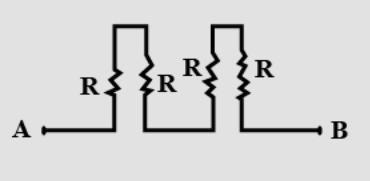
Four identical wires each having resistance R are connected as shown in the figure. Equivalent resistance between A and B is:
  • A
    $\frac{\text{R}}{4}$
  • B
    $\frac{\text{R}}{2}$
  • C
    4R
  • D
    R
Answer
  1. 4R

Explanation:

Simplified circuit is drawn.It is the series combination of the four resistances.

RAB​ = 4R


View full question & answer
MCQ 1211 Mark
Find the odd man out.Copper, Aluminium, Iron, Wood, Brass:
  • A
    Wood
  • B
    Aluminium
  • C
    Iron
  • D
    Brass
Answer
  1. Wood

Explanation:

Wood is a bad conductor of electricity.Rest are good conductors of electricity.

View full question & answer
MCQ 1241 Mark
Electricians wear rubber gloves because:
  • A
    It is soft
  • B
    It is water proof
  • C
    It is an insulator
  • D
    It is inexpensive
Answer
  1. It is an insulator

Explanation:

Rubber is an insulator and does not allow the passage of electric current through it, so when electricians wear rubber gloves electric current cannot pass through them, so they don't get electric shock.

View full question & answer
MCQ 1251 Mark
Electric heaters used for cooking have the filament or the heating coil on a plate made up of clay because
  • A
    Clay is a bad conductor of heat
  • B
    Clay is a bad conductor of electricity
  • C
    Both A & B
  • D
    None of these
Answer
  1. Both A & B
View full question & answer
MCQ 1261 Mark
Electric current is to be passed from one body to another.For this purpose the two bodies must be joined by:
  • A
    Cotton thread
  • B
    Plastic string
  • C
    Copper wire
  • D
    Rubber band
Answer
  1. Copper wire

Explanation:

Copper wire being a conductor can conduct.

View full question & answer
MCQ 1271 Mark
Electric current is a ________?
  • A
    Scalar quantity
  • B
    Vector quantity
  • C
    Vector quantity when it is due to the flow of positive charges
  • D
    Vector quantity when it is due to electrons
Answer
  1. Scalar quantity
View full question & answer
MCQ 1291 Mark
Electrical resistivity of any given metallic wire depends upon:
  • A
    Its thickness
  • B
    Its shape
  • C
    Nature of the material
  • D
    Its length
Answer
  1. Nature of the material
View full question & answer
MCQ 1311 Mark
Current in circuit, which makes bulb glow or heats up the wire, is:
  • A
    Motion of charges
  • B
    Motion of atoms
  • C
    Motion of molecules
  • D
    Mone of the above
Answer
  1. Motion of charges

Explanation:

An electric current is a stream of charged particles, such as electrons or ions, moving through an electrical conductor .It is often defined as rate of flow of charges.

Hence motion of charges through a conductor causes electric current.

View full question & answer
MCQ 1321 Mark
Current in a circuit flows:
  • A
    In direction from high potential to low potential.
  • B
    In direction from low potential to high potential.
  • C
    In direction of flow of electrons.
  • D
    In any direction.
Answer
  1. In direction from high potential to low potential.

Explanation:

Electric current flows from positive electrode of cell to negative electrode of cell, i.e., from high potential to low potential.

View full question & answer
MCQ 1341 Mark
Connecting wires in a electric circuit are made of .......?
  • A
    Copper
  • B
    Silicon
  • C
    Tin
  • D
    Lead
Answer
  1. Copper

Explanation:

Copper and aluminium offer a low resistance to the flow of current and hence they are good conductors of electricity.

Copper and aluminium are highly ductile and hence can be used for preparing the wire.

Copper being more ductile, it is used in making thin wires, and aluminium is used for making thicker wires.

Thus, they are suitable for making wires used in electrical circuit.

View full question & answer
MCQ 1351 Mark
A wire of resistance R1 is cut into five equal pieces. These five pieces of wire are then connected in parallel. If the resultant resistance of this combination be R2, then the ratio $\frac{\text{R}_1}{\text{R}_2}$ is:
  • A
    $\frac{1}{25}$
  • B
    $\frac{1}{5}$
  • C
    5
  • D
    25
Answer
  1. 25

Explanation:

If the resistance wire is cut into five pieces, the resistance of each wire is $\frac{\text{R}}{5}.$ If we connected the pieces in parallel, we will get the net resistance as $\frac{\text{R}}{25}$ Therefore, the ratio will be 25.

View full question & answer
MCQ 1361 Mark
At the time of short circuit, the electric current in the circuit:
  • A
    Vary continuously.
  • B
    Does not change.
  • C
    Reduces substantially.
  • D
    Increases heavily.
Answer
  1. Increases heavily.

Explanation:

A short circuit is an electrical circuit that allows a current to travel along an unintended path, often where essentially no (or a very low) electrical impedance is encountered.

For example, a common type of short circuit occurs when the positive and negative terminals of a battery are connected with a low-resistance conductor, like a wire.

With low resistance in the connection, a high current exists, causing the cell to deliver a large amount of energy in a short time.

View full question & answer
MCQ 1371 Mark
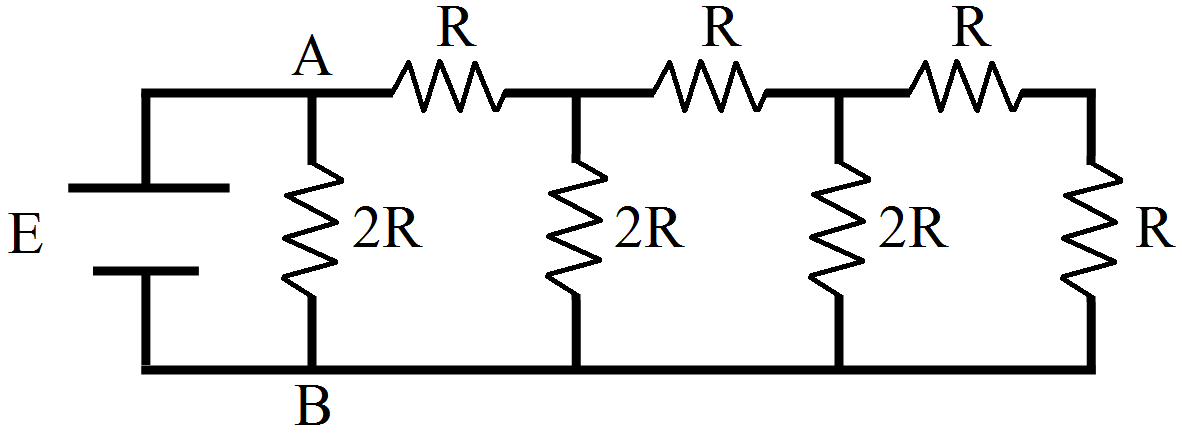
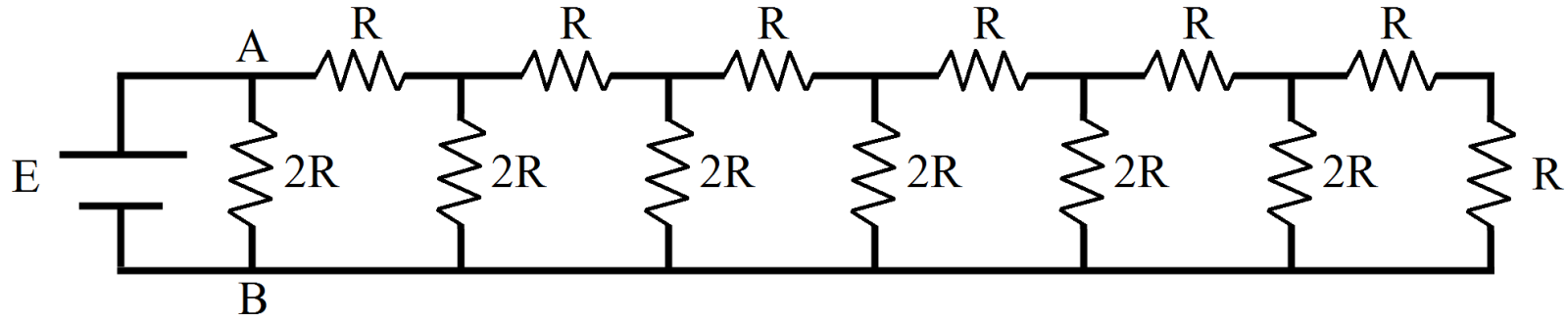
Three different circuits (I, II and III) are constructed using identical batteries and resistors of R and 2R ohm. What can be said about current I in arm AB of each circuit.


  • A
    II > III > IIII
  • B
    II < III < IIII
  • C
    III < II < IIII
  • D
    II = III = IIII
Answer
  1. II = III = IIII
View full question & answer
MCQ 1381 Mark
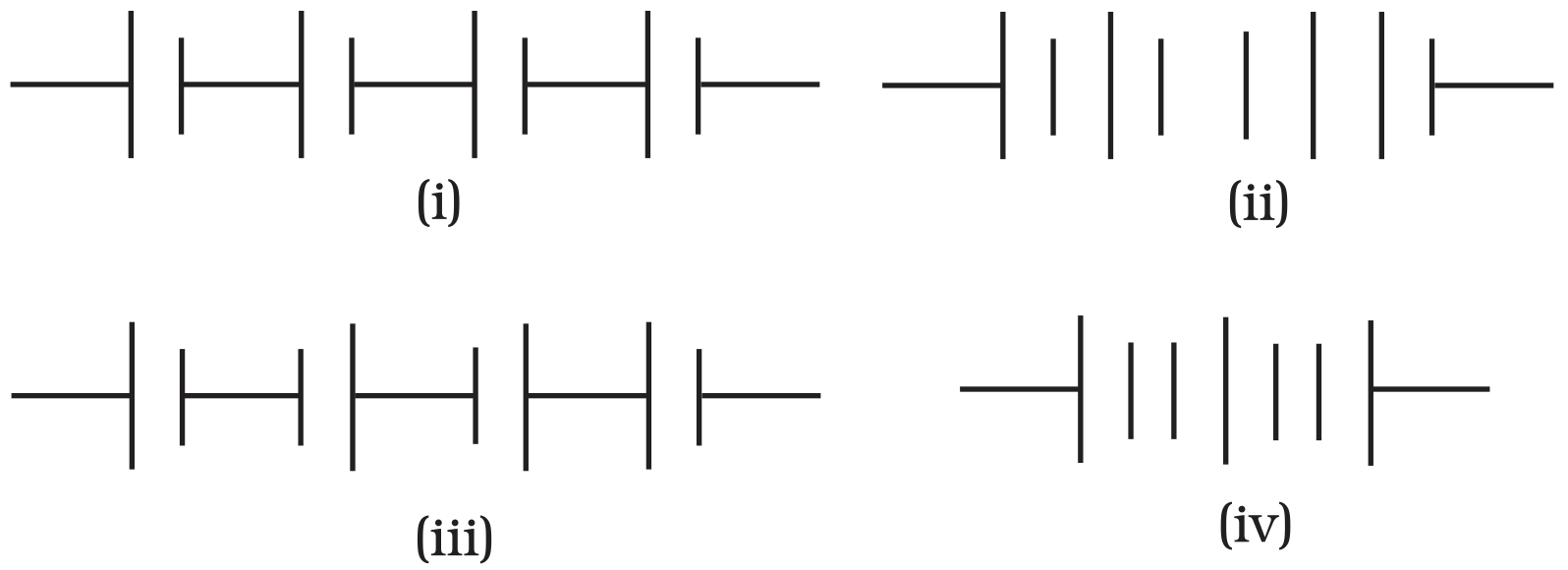
The proper representation of series combination of cells (Figure) obtaining maximum potential is:
  • A
    (i)
  • B
    (ii)
  • C
    (iii)
  • D
    (iv)
Answer
  1. (iv)

Explanation: Cells are connected in series if -ve terminal of one cell is connected to the +ve terminal of other cell.

View full question & answer
MCQ 1391 Mark
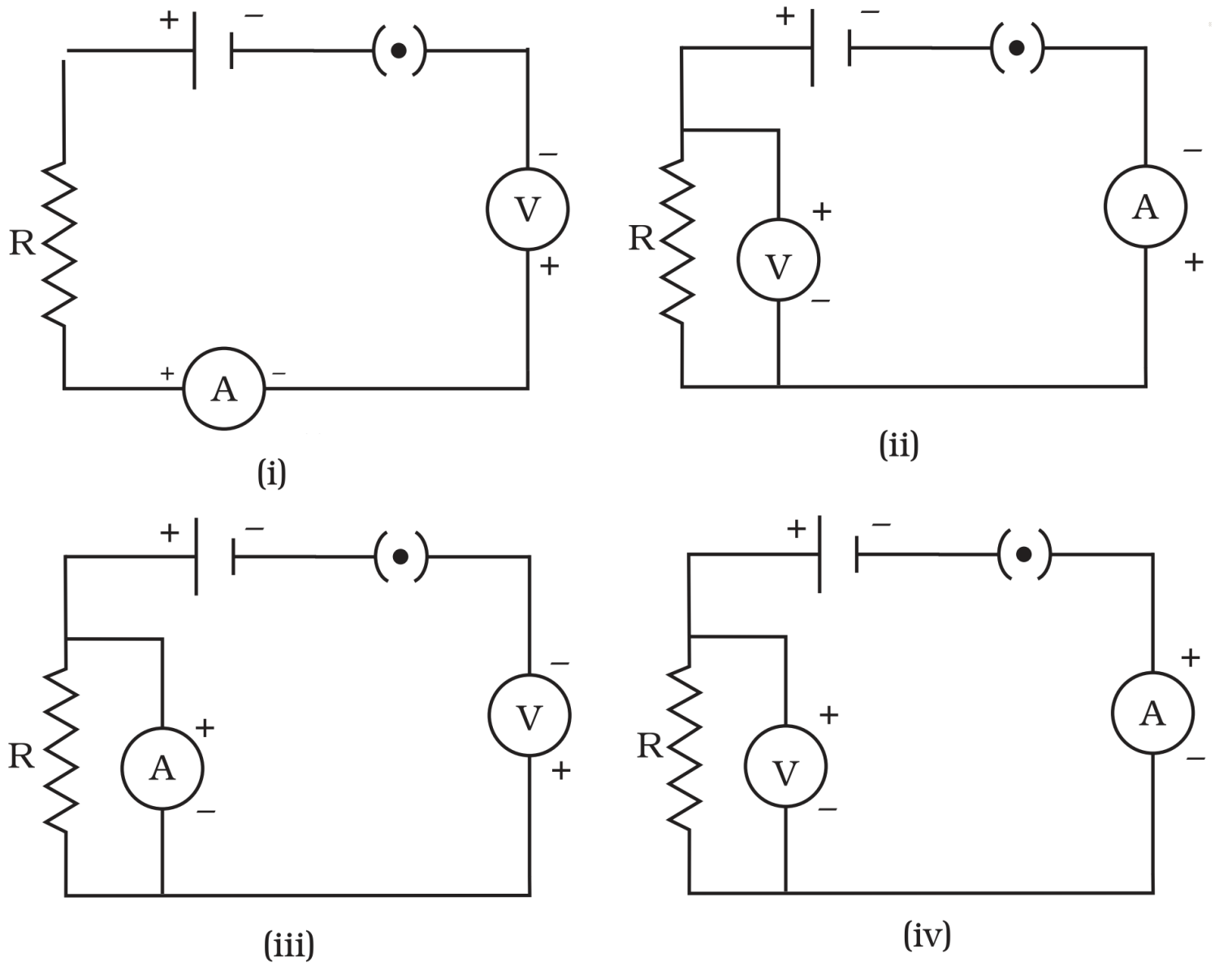
Identify the circuit (Figure) in which the electrical components have been properly connected.
  • A
    (i)
  • B
    (ii)
  • C
    (iii)
  • D
    (iv)
Answer
  1. (ii)

Explanation: Essential conditions are necessary when electrical components are connected:

  • Voltmeter should be connected in parallel.
  • Ammeter is always connected in series.
  • Positive terminals of voltmeter and ammeter should be connected to positive terminal of the cell and their negative terminals should be joined to the negative terminal of the cell.

Thus, the above conditions are satisfied in case (ii).​​​​​​​

View full question & answer
MCQ 1401 Mark
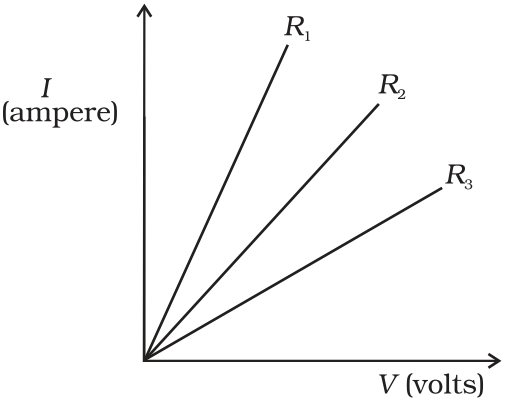
A student carries out an experiment and plots the V-I graph of three samples of nichrome wire with resistances R1, R2 and R3 respectively (Figure). Which of the following is true?
  • A
    R1 = R2 = R3
  • B
    R1 > R2 > R3
  • C
    R3 > R2 > R1
  • D
    R2 > R3 > R1
Answer
  1. R3 > R2 > R1

Explanation: Slope of VI graph is proportional to $\frac{1}{\text{Resistance}}.$

It means when slope will be maximum, then resistance will be minimum.

From the figure, we can see that, slope of R1 is maximum; hence its resistance will be minimum.

As, slope of R3 is minimum so, its resistance will be maximum.

Therefore, R3 > R2 > R1.

View full question & answer
MCQ 1411 Mark
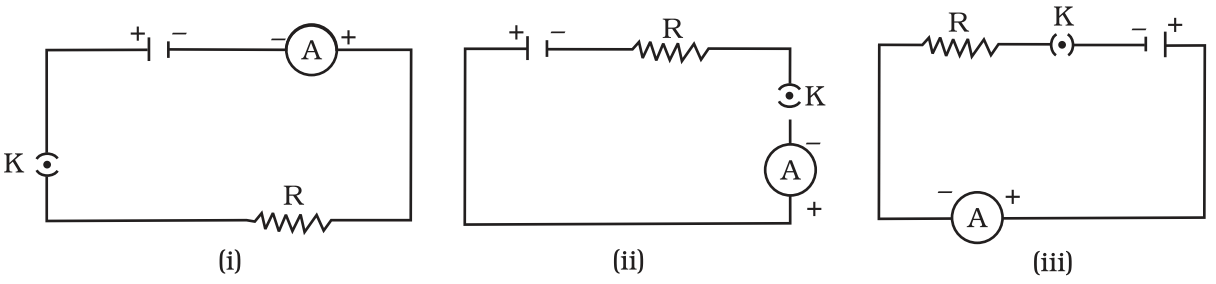
A cell, a resistor, a key and ammeter are arranged as shown in the circuit diagrams of Figure. The current recorded in the ammeter will be:
  • A
    Maximum in (i).
  • B
    Maximum in (ii).
  • C
    Maximum in (iii).
  • D
    The same in all the cases.
Answer
  1. The same in all the cases.

Explanation: Same current flows through every part of the circuit having resistance connected in series to a cell or battery.

View full question & answer
MCQ 1421 Mark
At a given time, a house is supplied with 100A at 220V. How many 75W, 220V light bulb could be switched on in the house at the same time (if they are all connected in parallel)?
  • A
    93
  • B
    193
  • C
    293
  • D
    393
Answer
  1. 293

Explanation:

El Total power provided in the house, P = VI = 100A × 220V = 22000W

This is the maximum power that can be drawn in the house.

Total power drawn by x bulbs = 75 x W

Maximum power x bulbs can draw = 22000W.

$\Rightarrow75\text{x}=22000$

$\Rightarrow \text{x}=\frac{22000}{75}\approx293$

View full question & answer
MCQ 1431 Mark
A substance that allows electricity to pass through it, is called ______?
  • A
    Electrical conductor
  • B
    Electrical insulator
  • C
    Electrical semiconductor
  • D
    None of these
Answer
  1. Electrical conductor

Explanation:

Electrical conductors have free electrons in there outermost shell giving them the property of movement of electrons within the conductor structure and that movement of electrons is also called as current Hence, Electrical conductors provides easy passage to the electrons.

View full question & answer
MCQ 1441 Mark
A student says that the resistance of two wires of same length and same area of cross section is same. This statement is correct if
  • A
    Both wires are of different materials.
  • B
    Both wires are made of same material and are at different temperature.
  • C
    Both wires are made of same material and are at same temperature.
  • D
    Both wires are made of different materials and are at the same temperature.
Answer
  1. Both wires are made of same material and are at same temperature.
View full question & answer
MCQ 1451 Mark
________are substances which do not allow electricity to pass through them:
  • A
    Insulators
  • B
    Conductors
  • C
    Semi-conductors
  • D
    None of these
Answer
  1. Insulators

Explanation:

The substance which do not allow electricity to pass through them are called insulators.

View full question & answer
MCQ 1461 Mark
A piece of wire of resistance R is drawn to double its length. The new resistance is.
  • A
    R.
  • B
    2R.
  • C
    4R.
  • D
    $\frac{\text{R}}{4}$.
Answer
  1. 4R.

Explanation:

Resistance R is drawn to double its length. resistance is resistance of the wire is 4 R.

View full question & answer
MCQ 1471 Mark
An electric refrigerator rated 400W operates 8 hours/ day. The cost of the energy to operate it for 30 days at Rs. 3 per kWh is:
  • A
    Rs. 288
  • B
    Rs. 3200
  • C
    Rs. 430
  • D
    Rs. 190
Answer
  1. Rs. 288

Explanation: Given, 

Power $=\text{p}=400\text{w}=\frac{400}{1000}\text{kw}=0.4\text{kw}$

Total time for which the refrigerator operated = t = 8hours × 30days = 240h

Since, Energy consumed = P × TE = 0.4 × 240kWh = 96kWh

Therefore, total cost required to operate the refrigerator for the month 

cost of 96kWh = 96 × 3 = Rs. 288

View full question & answer
MCQ 1481 Mark
An electric kettle for use on a 230V supply is rated 3000W. For safe working, the cable connected to it should be able to carry at least:
  • A
    2A.
  • B
    5A.
  • C
    10A.
  • D
    15A.
Answer
  1. 15A.

Explanation:

Current drawn by the kettle, $\text{I}=\frac{\text{P}}{\text{V}}=\frac{3000}{230}=13\text{A}$

So the cable should be able to carry more current than this and hence the answer is 15A.

View full question & answer
MCQ 1491 Mark
An electric kettle consumes 1kW of electric power when operated at 220V. A fuse wire of what rating must be used for it?
  • A
    1A
  • B
    2A
  • C
    4A
  • D
    5A
Answer
  1. 5A

Explanation: $\text{P}=\text{VI}$

$\text{or I }=\frac{\text{P}}{\text{V}}=\frac{1\text{kW}}{220\text{V}}$

$=\frac{1000\text{W}}{220\text{A}}=4.55\Omega=5\text{A}$​​​​​​​

View full question & answer
MCQ 1501 Mark
An electric heater is rated at 2kW. Electrical energy costs Rs 4 per kWh. What is the cost of using the heater for 3 hours?
  • A
    Rs 12.
  • B
    Rs 24.
  • C
    Rs 36.
  • D
    Rs 48.
Answer
  1. Rs 24.

Explanation:

Electrical energy consumed in three hours = P × t = 2kW × 3 hour = 6kWh

Unit cost = Rs. 4 = per kWh

Therefore, the cost of energy used for three hours = 4 × 6 = Rs. 24

View full question & answer
M.C.Q-[Phy-1M] - Page 3 - Science STD 10 Questions - Vidyadip