MCQ 11 Mark
Why is electrical wiring usually made from copper :
- A
- ✓
Because copper conducts electricity.
- C
Because copper is not magnetic
- D
AnswerCorrect option: B. Because copper conducts electricity.
View full question & answer→MCQ 21 Mark
Which of the following option has no effect on an electric fuse wire?
- A
- B
- ✓
- D
Current flowing through it
AnswerA fuse is a safety device that provides overcurrent protection, to an electrical circuit.
Its essential component is a metal wire or strip that melts when too much current flows through it, interrupting the current that it connects.
Therefore the working of the fuse depends upon its resistance and current flowing through it.
View full question & answer→MCQ 31 Mark
The amount of heat produced in a wire depends on its material $-$
View full question & answer→MCQ 41 Mark
The unit for expressing electric power is :
AnswerWatt is the unit of electric power.
View full question & answer→MCQ 51 Mark
Which of the following gases are filled in electric bulbs?
MCQ 61 Mark
Electricians wear rubber gloves because :
AnswerRubber is an insulator and does not allow the passage of electric current through it, so when electricians wear rubber gloves electric current cannot pass through them, so they don't get electric shock.
View full question & answer→MCQ 71 Mark
When a $4 \Omega $ resistor is connected across the terminals of a $12V$ battery, the number of coulombs passing through the resistor per second is :
AnswerThe number of coulombs passing through the resistor is the current passing through it.
$\text{Current}=\frac{\text{Voltage}}{\text{Resistance}}$
$\text{I}=\frac{\text{V}}{\text{R}}$
$\text{I}=\frac{12}{4}$
$\text{I}={3\text{A}}$
Thus, when a $4 \Omega $ resistor is connected across the terminals of a $12V$ battery, the number of coulombs passing through the resistor per second will be $3.$
View full question & answer→MCQ 81 Mark
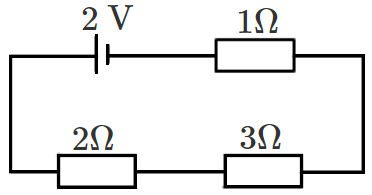
In the circuit shown below : The potential difference across the $3 \Omega $ resistor is :
- A
$\frac{1}{9}\text{V}$
- B
$\frac{1}{2}\text{V}$
- ✓
$1V$
- D
$2V$
AnswerThe resistors of $1 \Omega , 2 \Omega $ and $3 \Omega $ are connected in series. Therefore, the net resistance,
$\text{R} = \text{R}_1 + \text{R}_2 +\text{R}_3$
$\text{R}=1\Omega+2\Omega+3\Omega=6\Omega$
Current in the circuit will be,
$\text{I}=\frac{\text{V}}{\text{R}}$
or $\text{I}=\frac{2}{6}=\frac{1}{3}\text{A}$
Current $=\frac{1}{3}\text{A}$
Therefore, the voltage across the $3I$ resistor,
$V = IR$
or $\text{V}=\frac{1}{3}\times3=1\text{V}$
View full question & answer→MCQ 91 Mark
The current passing through an electric kettle has been doubled. The heat produced will become :
AnswerCorrect option: D. One $-$ fourth.
Heat produced is directly proportional to the square of the current.
View full question & answer→MCQ 101 Mark
Name the material used for making the connection wires :
AnswerCopper is a good conductor of electricity as it allows the electricity to flow through it easily.
Copper as a connecting wire has very low electrical resistance.
Copper combines several properties that have traditionally made it preferred for most electrical wiring.
It provides good contact surface, is ductile $($is easily bent repeatedly without breaking$)$ and it is not very expensive and is easy to manufacture.
View full question & answer→MCQ 111 Mark
What is the maximum resistance which can be made using five resistors each of $\frac{1}{5}\Omega\ ?$
- A
$\frac{1}{5}\Omega$
- B
$10\Omega$
- C
$5\Omega$
- ✓
$1\Omega$
AnswerCorrect option: D. $1\Omega$
When resistors are connected in series then we get the maximum resistance out of the combination. When the given resistors are connected in series, the resistance of combination can be calculated as follows:
$\text{R}=\frac{1}{5}+\frac{1}{5}+\frac{1}{5}+\frac{1}{5}+\frac{1}{5}=\frac{5}{5}=1\Omega$
View full question & answer→MCQ 121 Mark
A battery and three lamps are connected as shown? Which of the following statements about the currents at $X, Y$ and $Z$ is correct?
- A
The current at $Z$ is greater than that at $Y.$
- ✓
The current at $Y$ is greater than that at $Z.$
- C
The current at $X$ equals the current at $Y.$
- D
The current at $X$ equals the current at $Z.$
AnswerCorrect option: B. The current at $Y$ is greater than that at $Z.$
This is so because $Y$ alone will offer less resistance.
View full question & answer→MCQ 131 Mark
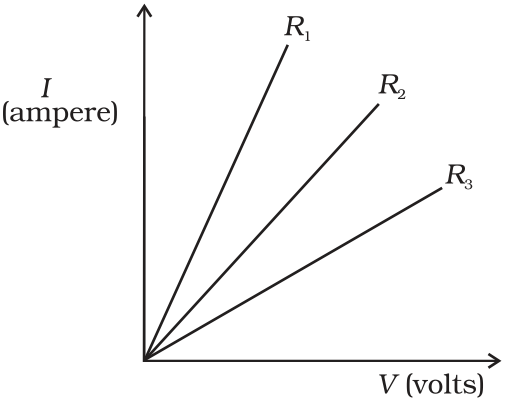
A student carries out an experiment and plots the $V-I$ graph of three samples of nichrome wire with resistances $\mathrm{R}_1, \mathrm{R}_2$ and $\mathrm{R}_3$ respectively $($Figure$).$ Which of the following is true?
- A
$R_1=R_2=R_3$
- B
$R_1 > R_2 > R_3$
- ✓
$R_3 > R_2 > R_1$
- D
$R_2 > R_3 > R_1$
AnswerCorrect option: C. $R_3 > R_2 > R_1$
Slope of $\ce{VI}$ graph is proportional to $\frac{1}{\text{Resistance}}.$
It means when slope will be maximum, then resistance will be minimum.
From the figure, we can see that, slope of $R_1$ is maximum; hence its resistance will be minimum.
As, slope of $R_3$ is minimum so, its resistance will be maximum.
Therefore, $R_3 > R_2 > R_1$.
View full question & answer→MCQ 141 Mark
Which of the following characteristic is not suitable for a fuse wire?
- A
- ✓
- C
- D
Higher resistance than rest of wiring.
AnswerThis is so because in this case, the resistance of the wire will be low.
View full question & answer→MCQ 151 Mark
The lamps in a house hold circuit are connected in parallel because :
- A
This way they required less current.
- ✓
If one lamp fails the others remain lit.
- C
This way they require less power.
- D
If one lamp fails the other also fail.
AnswerCorrect option: B. If one lamp fails the others remain lit.
This is so because in a parallel circuit, if one device fails, it does not affect the working of the other devices.
View full question & answer→MCQ 161 Mark
A material that does not allow electricity to flow through it is called a/ an :
AnswerAn electrical insulator is a material whose internal electric charges do not flow freely and therefore make it very hard to conduct an electric current under the influence of an electric field.
View full question & answer→MCQ 171 Mark
A current of $1A$ is drawn by a filament of an electric bulb. Number of electrons passing through a cross $-$ section of the filament in $16$ seconds would be roughly :
- ✓
$10_{20}$
- B
$10_{16}$
- C
$10_{18}$
- D
$10_{23}$
AnswerCorrect option: A. $10_{20}$
View full question & answer→MCQ 181 Mark
Two wires of same metal have the same length but their cross-sectional area in the ratio $3 : 1$. They are joined in series. The resistance of the thicker wire is $10\Omega$. The total resistance of the combination will be.
- ✓
$40\Omega$
- B
$\frac{40}{3}\Omega$
- C
$\frac{5}{2}\Omega$
- D
$100\Omega$
AnswerCorrect option: A. $40\Omega$
Ratio of cross $-$ sectional areas of the wires $= 3 : 1$ and resistance of thick wire $(\text{R}_{1})10\Omega$
Resistance $(\text{R})=\rho\frac{1}{\text{A}}\propto$
Therefore $\frac{\text{R}_{1}}{\text{R}_{2}}=\frac{\text{A}_{2}}{\text{A}_{1}}=\frac{1}{3}$
or $\text{R}_{2}=3\text{R}_{1}=3\times10=30\Omega$
and equivalent resistance of these two resistances in series combination
$=\text{R}_{1}=\text{R}_{2}=30+10=30\Omega$
View full question & answer→MCQ 191 Mark
Keeping the $p.d$. constant, the resistance of a circuit is halved. The current will become :
AnswerAs we know from Ohm’s law :
Voltage $=$ Current $\times $ Resistance
$V = IR$
If the voltage is constant, the resistance of the circuit is halved. That is, it becomes $\frac{\text{R}}{2}$
Current, $\text{I}=\frac{\text{V}}{\text{R}}$
$\text{I}=\frac{\text{V}}{\text{R}}$
$\text{I}=\frac{\frac{\text{V}}{\text{R}}}{2}=2\text{I}$
Thus by keeping the $p.d$. constant, the resistance of a circuit is halved and the current is doubled.
View full question & answer→MCQ 201 Mark
Which of the following statements correctly defines a volt?
- A
A volt is a joule per ampere.
- ✓
A volt is a joule per coulomb.
AnswerCorrect option: B. A volt is a joule per coulomb.
A volt is a joule per coulomb.
View full question & answer→MCQ 211 Mark
Electrical resistivity of a given metallic wire depends upon.
AnswerElectrical resistivity of a given metallic wire depends on number density of free electrons in the conductor which is the nature of material, i.e. $,\text{p}\propto\frac{1}{\text{n}},\text{n}=$ number of free electrons per unit volume. It also depends on the temperature of conductor.
View full question & answer→MCQ 221 Mark
An electric fuse works on the $ .......... $ effect of current:
AnswerElectric fuse work on the principal of heating effect of current.
Fuse wire is a wire of high resistance and low melting point.
When very large current will pass through it, heat will be generated which will melt the fuse wire and break the circuit.
By using electric fuses in home we can protect the home appliances from damaging by large amount of current.
View full question & answer→MCQ 231 Mark
In an electrical circuit three incandescent bulbs $A, B$ and $C$ of rating $40W, 60W$ and $100W$ respectively are connected in parallel to an electric source. Which of the following is likely to happen regarding their brightness?
- A
Brightness of all the bulbs will be the same.
- B
Brightness of bulb $A$ will be the maximum.
- ✓
Brightness of bulb $B$ will be more than that of $A.$
- D
Brightness of bulb $C$ will be less than that of $B.$
AnswerCorrect option: C. Brightness of bulb $B$ will be more than that of $A.$
Since bulbs are connected in parallel so resistance of combination would be less than arithmetic sum of resistance of all the bulbs. So, there will be no negative effect on flow of current. As a result, bulbs would glow according to their wattage.
View full question & answer→MCQ 241 Mark
An electric bulb works on the principle of :
- A
- ✓
Heating effect of current
- C
Magnetic effect of current
- D
AnswerCorrect option: B. Heating effect of current
View full question & answer→MCQ 251 Mark
When the diameter of a wire is doubled, its resistance becomes :
- A
- B
- C
One $-$ half.
- ✓
One $-$ fourth.
AnswerCorrect option: D. One $-$ fourth.
$\text{R}=\rho\frac{\text{I}}{\text{A}}$
When the diameter is doubled $, d = 2d$
Radius $, r\ ' = 2r$
Area of cross section, $\text{A}'=\pi\text{r}'^2=\pi(2\text{r})=4\pi\text{r}^2=4\text{A}$
The area of cross-section will increase by four times.
Then the new resistance, $\text{R}'=\frac{\rho\text{I}}{\text{A}'}$
$\text{R}'=\frac{\rho\text{I}}{4\text{A}}$
$\text{R}'=\frac{\text{R}}{4}$
Thus, the resistance will get reduced by four times.
View full question & answer→MCQ 261 Mark
- A
- ✓
Do not conduct electricity
- C
Conduct electricity only at low temperatures
- D
Conduct electricity at room temperature
AnswerCorrect option: B. Do not conduct electricity
Insulators have tightly bound electrons which cannot move freely and hence cannot conduct electricity.
View full question & answer→MCQ 271 Mark
Electric heaters used for cooking have the filament or the heating coil on a plate made up of clay because
- A
Clay is a bad conductor of heat
- B
Clay is a bad conductor of electricity
- ✓
Both $A$ and $ B$
- D
AnswerCorrect option: C. Both $A$ and $ B$
View full question & answer→MCQ 281 Mark
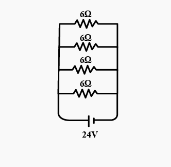
A $24V$ potential difference is applied across a parallel combination of four $6\Omega$ resistor. The current in each resistor is :
AnswerSince the resistors are connected in parallel,the voltage across each resistor is the same ,i.e $24V.$
Therefore, current in each resistor can now simply be calculated using the relation,
$\text{I}=\frac{\text{V}}{\text{R}}\Rightarrow\text{I}=\frac{24}{6.0}=4.0\text{ A}$
View full question & answer→MCQ 291 Mark
Which of the following is likely to be the correct wattage for an electric iron used in our homes?
- A
$60W.$
- B
$250W.$
- ✓
$850W.$
- D
$2000W.$
AnswerCorrect option: C. $850W.$
An electric iron may use a power of $850$ watts.
View full question & answer→MCQ 301 Mark
A car headlight bulb working on a $12V$ car battery draws a current of $0.5A$. The resistance of the light bulb is :
- A
$0.5\Omega $
- B
$6\Omega $
- C
$12\Omega $
- ✓
$24\Omega $
AnswerCorrect option: D. $24\Omega $
Voltage $, V = 12V$
Current $, I = 0.5A$
Resistance, $\text{R}=\frac{\text{Voltage}}{\text{Current}}$
$\text{R}=\frac{12}{0.5}$
$\text{R} = 24\Omega $
Thus, if a car's headlight bulb working on a $12V$ car battery draws a current of $0.5A,$ the resistance of the light bulb will be $ 24\Omega $
View full question & answer→MCQ 311 Mark
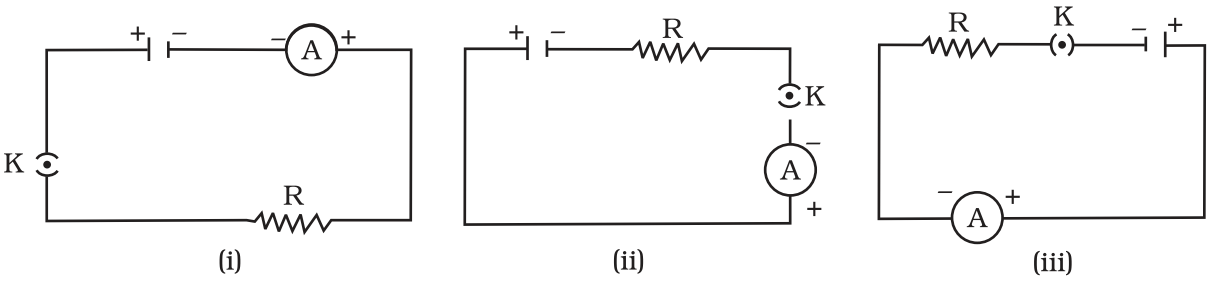
A cell, a resistor, a key and ammeter are arranged as shown in the circuit diagrams of Figure. The current recorded in the ammeter will be :
- A
Maximum in $(i).$
- B
Maximum in $(ii).$
- C
Maximum in $(iii).$
- ✓
The same in all the cases.
AnswerCorrect option: D. The same in all the cases.
Same current flows through every part of the circuit having resistance connected in series to a cell or battery.
View full question & answer→MCQ 321 Mark
Find odd man out Plastic, Rubber, Glass, Silver
MCQ 331 Mark
One kilowatt hour is equal to.
- A
$36 \times 10^6 \mathrm{~J}$
- B
$36 \times 10^{-5} \mathrm{~J}$
- ✓
$3.6 \times 10^6 \mathrm{~J}$
- D
$0.36 \times 10^6 \mathrm{~J}$
AnswerCorrect option: C. $3.6 \times 10^6 \mathrm{~J}$
One kilowatt $-$ hour is equal to $3.6 \cdot 10^6$ joules :
View full question & answer→MCQ 341 Mark
What is the resistance of a wire if its length is doubled,
AnswerThe total length of the wires will affect the amount of resistance.
The longer the wire, the more resistance that there will be.
There is a direct relationship between the amount of resistance encountered by charge and the length of wire it must traverse.
After all, if resistance occurs as the result of collisions between charge carriers and the atoms of the wire, then there is likely to be more collisions in a longer wire.
More collisions mean more resistance.
Hence, when the length of the wire is doubled, the resistance of the wire is increased twice.
View full question & answer→MCQ 351 Mark
The commercial unit of energy is :
- A
- B
Watt $-$ hour.
- ✓
Kilowatt $-$ hour.
- D
Kilo $-$ joule.
AnswerCorrect option: C. Kilowatt $-$ hour.
Kilowatt $-$ hour is the commercial unit of electrical energy.
View full question & answer→MCQ 361 Mark
Three $2\Omega$ resistances are connected so as to make a triangle. The resistance between any two vertices is :
- A
$6\Omega$
- B
$2\Omega$
- C
$\frac{3}{4}\Omega$
- ✓
$\frac{4}{3}\Omega$
AnswerCorrect option: D. $\frac{4}{3}\Omega$
$2+2=4\Omega$
this combination is parallel to the third resistance.
Hence effective resistance is
$4\times\frac{2}{4}+2=\frac{8}{6}=\frac{4}{3}$
View full question & answer→MCQ 371 Mark
Which of the following represents voltage?
- ✓
$\frac{\text{Work done}}{\text{Current}\times\text{Time}}$
- B
$\text{Work done}\times\text{Charge}$
- C
$\frac{\text{Work done}\times\text{Time}}{\text{Current}}$
- D
$\text{Work done}\times\text{Charge}\times\text{Time}$
AnswerCorrect option: A. $\frac{\text{Work done}}{\text{Current}\times\text{Time}}$
Work done $\times $ Charge $\times $ Potential difference
$\Rightarrow $ Work done $= \ ($Current $\times $ Time$)\ \times $ Potential difference $[\because$ Charge $=$ Current $\times $ Time$]$
$\Rightarrow $ Potential difference $=\frac{\text{Work done}}{\text{Current}\times\text{Time}}$
View full question & answer→MCQ 381 Mark
The nature of the graph between potential difference and the electric current flowing through a conductor is :
MCQ 391 Mark
Motion of charges is nothing but :
- ✓
- B
Magnetic effect of current
- C
Heating effect of current
- D
View full question & answer→MCQ 401 Mark
A piece of wire of resistance $R$ is cut into five equal parts. These parts are then connected in parallel. If the equivalent resistance of this combination is $R\ ',$ then the ratio $R/R\ '$ is $–$
- A
$\frac{1}{25}$
- B
$\frac{1}{5}$
- C
$5$
- ✓
$25$
View full question & answer→MCQ 411 Mark
Heat produced in a resistor when current is passed through it depends upon :
MCQ 421 Mark
In an electrical circuit three incandescent bulbs $A, B$ and $C$ of rating $40W, 60W$ and $100W$ respectively are connected in parallel to an electric source of the following is likely to happen regarding brightness?
- A
Brightness of all the bulbs will be the same.
- B
Brightness of bulb $A$ will the maximum.
- ✓
Brightness of bulb $B$ will be more than that of $A.$
- D
Brightness of bulb $C$ will be less than that of $B.$
AnswerCorrect option: C. Brightness of bulb $B$ will be more than that of $A.$
We know that power is defined as rate of doing work. A bulb consumes electric energy and produces heat and light. Now, bulb with more power rating will produce more heat and
light or we can say that Power rating of bulb is directly proportional to the brightness produced by bulb.
View full question & answer→MCQ 431 Mark
To get $2 \Omega$ resistance using only $6 \Omega$ resistors, the number of them required is :
View full question & answer→MCQ 441 Mark
Unit of electric power may also be expressed as :
AnswerElectric power $=$ voltage $\times $ current
$\ce{SI}$ Unit of voltage $=$ Volt
$\ce{SI}$ Unit of current $=$ Ampere
So, unit of electric power is also given by, volt ampere.
View full question & answer→MCQ 451 Mark
Work done to move $1$ coulomb charge from one point to another point on a charged conductor having potential $10$ volt is :
- A
$1$ Joule
- B
$10$ Joule
- ✓
- D
$100$ Joule
View full question & answer→MCQ 461 Mark
In an electrical circuit two resistors of $2\Omega $ and $4\Omega $ respectively are connected in series to a $6V$ battery. The heat dissipated by the $4\Omega $ resistor in $5s$ will be :
- A
$5J.$
- B
$10J.$
- ✓
$20J.$
- D
$30J.$
AnswerCorrect option: C. $20J.$
Total resistance of combination $2\Omega+4\Omega=6\Omega$
Current through the circuit can be calculated as $\text{I}=\frac{\text{V}}{\text{R}}=\frac{6\text{V}}{6\Omega}=1\text{A}$
Heat dissipation by can be calculated as follows : $\text{H}=\text{I}^2\text{Rt}=(1\text{A})^2\times4\Omega\times5\text{s}=20\text{J}$
View full question & answer→MCQ 471 Mark
What is the commercial unit of electrical energy?
- A
- B
- ✓
Kilowatt $-$ hour
- D
Watt $-$ hour
AnswerCorrect option: C. Kilowatt $-$ hour
View full question & answer→MCQ 481 Mark
One coulomb charge is equivalent to the charge contained in :
- A
$2.6 \times 10^{19}$ electrons
- B
$6.2 \times 10^{19}$ electrons.
- C
$2.65 \times 10^{18}$ electrons.
- ✓
$6.25 \times 10^{18}$ electrons
AnswerCorrect option: D. $6.25 \times 10^{18}$ electrons
The coulomb is the $SI$ unit of electric charge. It is the charge transported by a constant current of one ampere in one second. It is equivalent to the charge of approximately $6.25 \times 10^{18}$ protons or electrons.
View full question & answer→MCQ 491 Mark
A cooler of $1500W, 200$ volt and a fan of $500W, 200$ volt are to be used from a household supply. The rating of fuse to be used is :
- A
$2.5A$
- B
$5.0A$
- C
$7.5A$
- ✓
$10A$
View full question & answer→MCQ 501 Mark
A wire of resistance $R_1$ is cut into five equal pieces. These five pieces of wire are then connected in parallel. If the resultant resistance of this combination be $R_2$, then the ratio $\frac{\text{R}_1}{\text{R}_2}$ is :
- A
$\frac{1}{25}$
- B
$\frac{1}{5}$
- C
$5$
- ✓
$25$
AnswerIf the resistance wire is cut into five pieces, the resistance of each wire is $\frac{\text{R}}{5}.$ If we connected the pieces in parallel, we will get the net resistance as $\frac{\text{R}}{25}$ Therefore, the ratio will be $25.$
View full question & answer→