MCQ 511 Mark
AnswerCurrent is measured in Coulomb $\sec$ or Ampere.
View full question & answer→MCQ 521 Mark
Why is the fuse wire fitted in a porcelain casing?
- ✓
Porcelian is an insulator of electricity
- B
Porcelian is a conductor of electricity
- C
Porcelian is a semiconductor of electricity
- D
AnswerCorrect option: A. Porcelian is an insulator of electricity
View full question & answer→MCQ 531 Mark
The resistivity of copper metal depends on only one of the following factors. This factor is :
AnswerThe resistivity of copper depends only on temperature.
View full question & answer→MCQ 541 Mark
A boy records that 4000 joule of work is required to transfer 10 coulomb of charge between two points of a resistor of 50 Ω. The current passing through it is:
MCQ 551 Mark
A substance that allows electricity to pass through it, is called ______?
Answera. Electrical conductor
Explanation:
Electrical conductors have free electrons in there outermost shell giving them the property of movement of electrons within the conductor structure and that movement of electrons is also called as current Hence, Electrical conductors provides easy passage to the electrons.
View full question & answer→MCQ 561 Mark
The amount of charges that pass any section of the conductors in one second is called :
MCQ 571 Mark
If a fuse is rated as $8 A,$ and current more than $8 A$ passes through it then
AnswerCorrect option: C. Both $A$ and $B$
View full question & answer→MCQ 581 Mark
A piece of wire of resistance $R$ is drawn to double its length. The new resistance is.
- A
$R.$
- B
$2R.$
- ✓
$4R.$
- D
$\frac{\text{R}}{4}$.
AnswerResistance $R$ is drawn to double its length. resistance is resistance of the wire is $4 R.$
View full question & answer→MCQ 591 Mark
Which among the following is the commercial unit of electrical energy :
MCQ 601 Mark
When three identical bulb of $60 W- 220V$ rating are connected in series to a $220V$ supply, the power drawn by them will be.
- ✓
$20W$
- B
$40W$
- C
$180W$
- D
$60W$
AnswerThe resistance of each bulb
$=\frac{\text{v}^2}{\text{p}}=\frac{(200)^2}{60}\Omega$
When three bulbs are connected in series their resultant resistance
$= 3\text{x} (200)^2/60$
Thus power drawn by bulb when connected across $200V$ supply
$\text{p}=\frac{\text{v}^2}{\text{R}_\text{re}}=\frac{(200)^2}{3\times(200)^2/60}=20\text{w.}$
View full question & answer→MCQ 611 Mark
Presence of charge can be correctly identified by.
- ✓
Repulsion between like charges.
- B
Attraction between neutral and positive charge.
- C
Attraction between neutral and negative charge.
- D
Repulsion between unlike charges.
AnswerCorrect option: A. Repulsion between like charges.
The interaction between two like-charged objects isrepulsive. The interaction between two oppositely charged objects is attractive.
View full question & answer→MCQ 621 Mark
An electric bulb is connected to a $220V$ generator. The current is $0.50A$. What is the power of the bulb?
- A
$440W$
- ✓
$110W$
- C
$55W$
- D
$0.0023W$
AnswerCorrect option: B. $110W$
View full question & answer→MCQ 631 Mark
If two resistors of $25 \Omega $ and $15 \Omega $ are joined together in series and then placed in parallel with a $15 \Omega $ resistor, the effective resistance of the combination is :
- A
$0.1\Omega$
- B
$10\Omega$
- ✓
$20\Omega$
- D
$40\Omega$
AnswerCorrect option: C. $20\Omega$
When $25 \Omega $ and $15 \Omega $ are connected in series, then:
Total resistance $,R = 25 + 15 = 40I$
This $40I$ is connected in parallel with the $40I$ resistor.
Therefore, the net resistance $=\frac{40}{2}=20\text{I}$
View full question & answer→MCQ 641 Mark
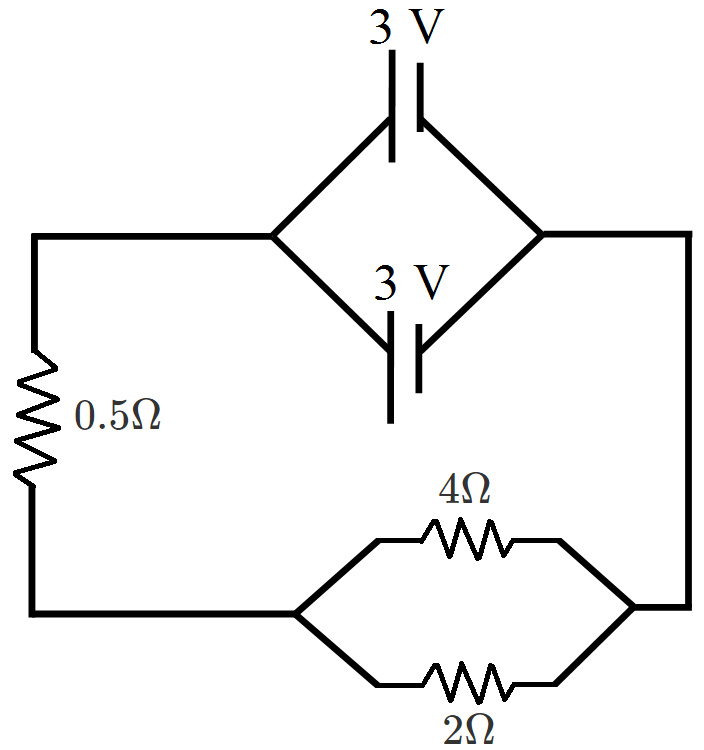
Two cells of 3V each are connected in parallel. An external resistance of $0.5\Omega$ is connected is series to the junction of two parallel resistors of $4\Omega$ and $\ 2\Omega$ and then to common terminal of battery through each resistor as shown in figure. What is the current flowing through $4\Omega$ resistor?
- A
$0.25A$
- ✓
$0.55A$
- C
$0.35A$
- D
$1.50A$
AnswerCorrect option: B. $0.55A$
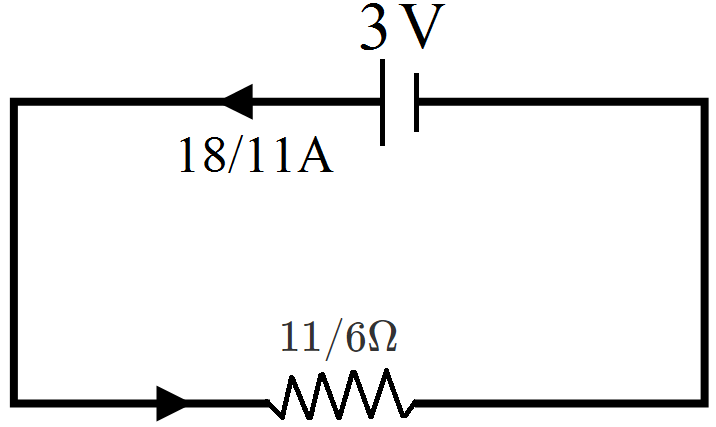
The given circuit can be reduced to.
The equivalent resistance can be calculated as.
$\text{R}_{\text{eq}}=\frac{4.2}{4+2}+0.5=\frac{11}{6}\Omega$
$\text{R}_{\text{eq}}=\frac{11}{6}\Omega$
The net current in the circuit is given as $\text{I}=\frac{\text{V}}{\text{R}}$
$=\frac{3}{\big(\frac{11}{6}\big)}$
$=\frac{18}{11}\text{A}, \text{so},$
$\text{I}_{\text{net}}=\frac{18}{11\text{A}}$
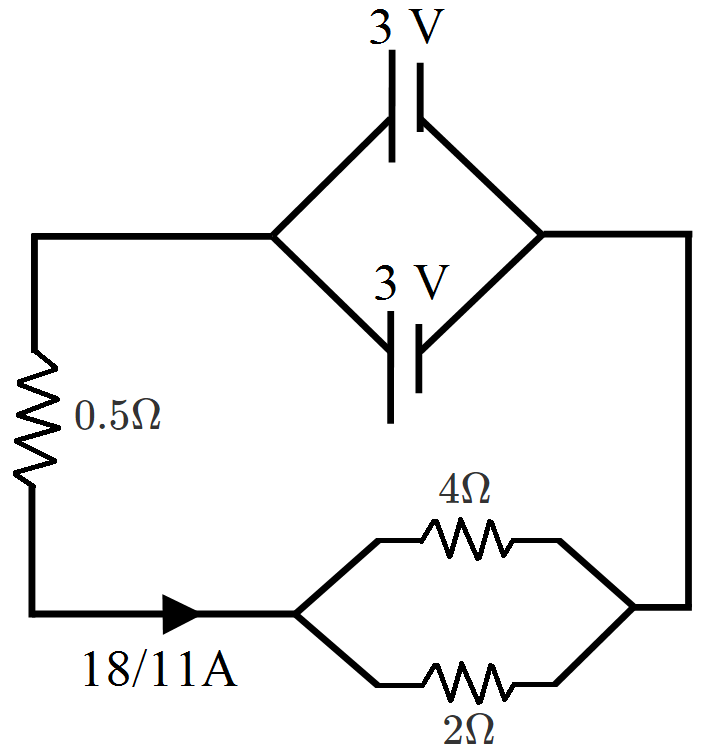
The circuit can be drawn as shown aside,
The voltage drop across the parallel resistance combination is $\frac{24}{11\text{V}}$ so net current in the $4\Omega$ resistor is $\frac{6}{11\text{A}}=0.55\text{A}$ View full question & answer→MCQ 651 Mark
Electric potential is a :
- ✓
- B
- C
Neither scalar nor vector
- D
Sometimes scalar and sometimes vector
View full question & answer→MCQ 661 Mark
An electric refrigerator rated $400W$ operates $8$ hours/ day. The cost of the energy to operate it for $30$ days at $Rs. 3$ per $kWh$ is :
- ✓
$Rs. 288$
- B
$Rs. 3200$
- C
$Rs. 430$
- D
$Rs. 190$
AnswerCorrect option: A. $Rs. 288$
aGiven,
Power $=\text{p}=400\text{w}=\frac{400}{1000}\text{kw}=0.4\text{kw}$
Total time for which the refrigerator operated $= t = 8 \text{ hours} \times 30 \text{ days} = 240h$
Since, Energy consumed $= P \times TE = 0.4 \times 240kWh = 96kWh$
Therefore, total cost required to operate the refrigerator for the month
cost of $96kWh = 96 \times 3 = Rs. 288$
View full question & answer→MCQ 671 Mark
Using the circuit given below, state which of the following statement is correct? img $..............$
- A
When $S_1$ and $S_2$ are closed, lamps $A$ and $B$ are lit. $2^2$
- B
With $\mathrm{S}_1$ open and $\mathrm{S}_2$ closed $,A$ is lit and $B$ is not lit.
- ✓
With $S_2$ open and $S_1$ closed $A$ and $B$ are lit.
- D
With $\mathrm{S}_1$ closed and $\mathrm{S}_2$ open, lamp $A$ remains lit even if lamp $B$ gets fused.
AnswerCorrect option: C. With $S_2$ open and $S_1$ closed $A$ and $B$ are lit.
This is so because if the switch, $S_2$ is open, the current will flow through lamp $A$ because it is a parallel circuit.
View full question & answer→MCQ 681 Mark
Resistivity of a metallic wise depends on :
MCQ 691 Mark
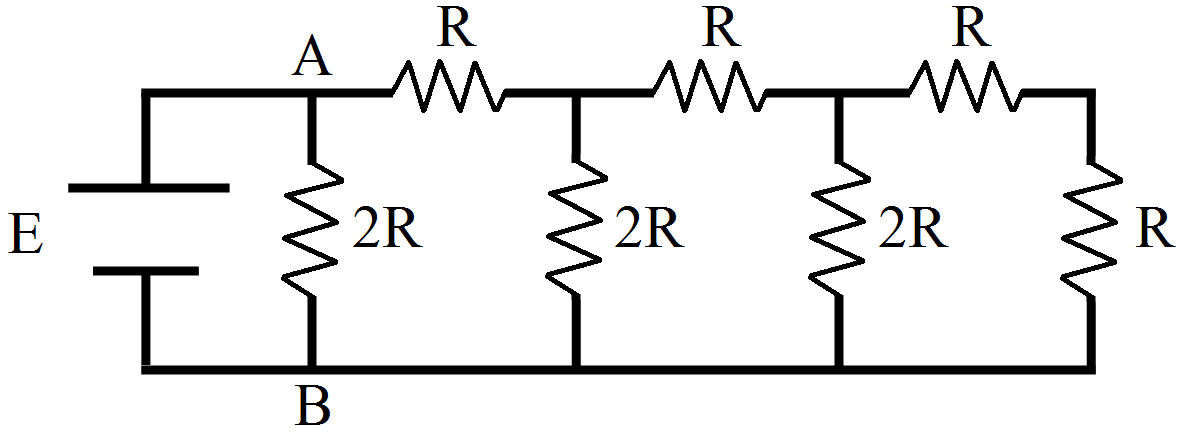
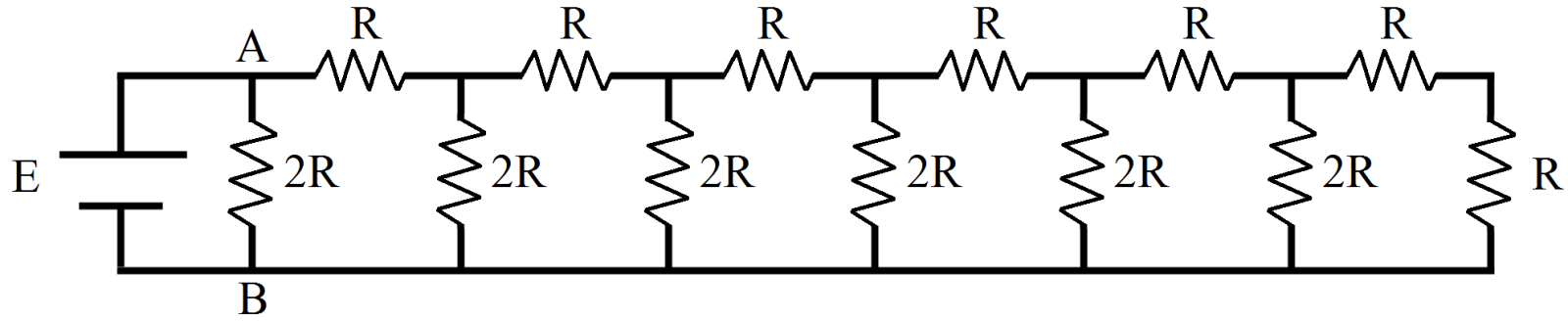
Three different circuits $(\ce{I, II}$ and $\ce{III})$ are constructed using identical batteries and resistors of $R$ and $2R$ ohm. What can be said about current $\ce{I}$ in arm $AB$ of each circuit.

- A
$\mathrm{I}_{\mathrm{I}}>\mathrm{I}_{\mathrm{II}}>\mathrm{I}_{\mathrm{III}}$
- B
$\mathrm{I}_{\mathrm{I}}<\mathrm{I}_{\mathrm{II}}<\mathrm{I}_{\mathrm{III}}$
- C
$\mathrm{I}_{\mathrm{II}}<\mathrm{I}_{\mathrm{I}}<\mathrm{I}_{\mathrm{III}}$
- ✓
$\mathrm{I}_{\mathrm{I}}=\mathrm{I}_{\mathrm{II}}=\mathrm{I}_{\mathrm{III}}$
AnswerCorrect option: D. $\mathrm{I}_{\mathrm{I}}=\mathrm{I}_{\mathrm{II}}=\mathrm{I}_{\mathrm{III}}$
View full question & answer→MCQ 701 Mark
At a given time, a house is supplied with $100A$ at $220V.$ How many $75W, 220V$ light bulb could be switched on in the house at the same time $($if they are all connected in parallel$)\ ?$
Answer$El$ Total power provided in the house $, P = VI = 100A \times 220V = 22000W$
This is the maximum power that can be drawn in the house.
Total power drawn by $x$ bulbs $= 75 \times W$
Maximum power $x$ bulbs can draw $= 22000W.$
$\Rightarrow75\text{x}=22000$
$\Rightarrow \text{x}=\frac{22000}{75}\approx293$
View full question & answer→MCQ 711 Mark
- A
- ✓
Do not conduct electricity.
- C
Conduct electricity only at low temperatures.
- D
Conduct electricity at room temperature.
AnswerCorrect option: B. Do not conduct electricity.
View full question & answer→MCQ 721 Mark
The resistance of hot filament of the bulb is about $10$ times the cold resistance. What will be the resistance of $100W - 220V$ lamp, when not in use?
- A
$48\Omega$
- B
$400\Omega$
- ✓
$484\Omega$
- D
$48.4\Omega$
AnswerCorrect option: C. $484\Omega$
View full question & answer→MCQ 731 Mark
Which of the following terms does not represent electrical power in a circuit?
- A
$I^2 R$
- ✓
$I R^2$
- C
$VI$
- D
$V^2 / R$
AnswerCorrect option: B. $I R^2$
$\ce{P=v^2 / R=I^2 R=VI}$ Option $(b)$ does not represent electrical power.
View full question & answer→MCQ 741 Mark
An electric kettle consumes $1kW$ of electric power when operated at $220V$. A fuse wire of what rating must be used for it?
Answer$\text{P}=\text{VI}$
or ${I }=\frac{\text{P}}{\text{V}}=\frac{1\text{kW}}{220\text{V}}$
$=\frac{1000\text{W}}{220\text{A}}=4.55\Omega=5\text{A}$
View full question & answer→MCQ 751 Mark
A student says that the resistance of two wires of same length and same area of cross section is same. This statement is correct if
- A
Both wires are of different materials.
- B
Both wires are made of same material and are at different temperature.
- ✓
Both wires are made of same material and are at same temperature.
- D
Both wires are made of different materials and are at the same temperature.
AnswerCorrect option: C. Both wires are made of same material and are at same temperature.
View full question & answer→MCQ 761 Mark
he insulator of electricity is :
AnswerSilk does not allow electric current to pass through it.
View full question & answer→MCQ 771 Mark
An electric bulb is rated $220 V$ and $100 W$. When it is operated on $110 V,$ the power consumed will be $–$
- A
$100 W$
- B
$75 W$
- C
$50 W$
- ✓
$25 W$
AnswerCorrect option: D. $25 W$
View full question & answer→MCQ 781 Mark
Electrical resistivity of any given metallic wire depends upon :
MCQ 791 Mark
Ohm's law gives a relationship between :
- A
- B
Resistance and potential difference.
- C
Potential difference and electric charge.
- ✓
Current and potential difference.
AnswerCorrect option: D. Current and potential difference.
Ohm's law gives the relationship between current and potential difference.
View full question & answer→MCQ 801 Mark
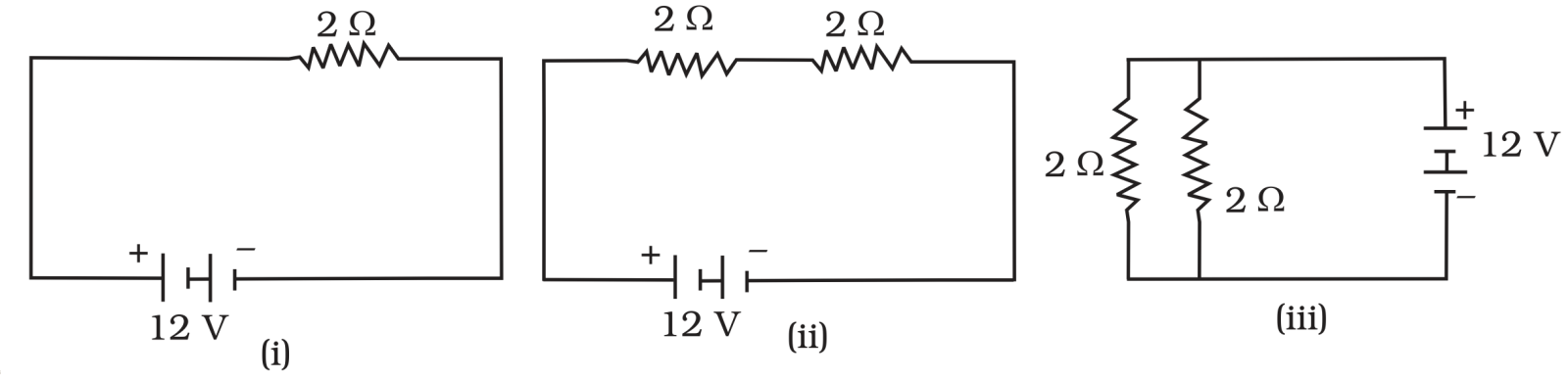
In the following circuits $($Figure$),$ heat produced in the resistor or combination of resistors connected to a $12V$ battery will be :
- A
- B
Minimum in case $(i).$
- ✓
Maximum in case $(ii).$
- D
Maximum in case $(iii).$
AnswerCorrect option: C. Maximum in case $(ii).$
In this case, two resistors are in series. Hence, their sum will be equal to their arithmetic sum. In figure $(iii)$ the total resistance will be less than individual resistances because they are connected in parallel. A higher resistance produces more heat so option $(c)$ is correct.
View full question & answer→MCQ 811 Mark
Keeping the potential difference constant, the resistance of a circuit is doubled. The current will become :
AnswerAs we know from Ohm’s law:
Voltage $=$ Current $\times$ Resistance
$V = IR$
If the voltage is constant, the resistance is doubled and the current becomes half.
View full question & answer→MCQ 821 Mark
When does two elements are said to be in series?
- ✓
When same current physically flows through both elements
- B
When different current physically flows through both elements
- C
When no current physically flows through both elements
- D
AnswerCorrect option: A. When same current physically flows through both elements
View full question & answer→MCQ 831 Mark
Two conducting wires of the same material and of equal lengths and equal diameters are first connected in series and then parallel in a circuit across the same potential difference. The ratio of heat produced in series and parallel combinations would be $–$
- A
$1 : 2$
- B
$2 : 1$
- ✓
$1 : 4$
- D
$4 : 1$
AnswerCorrect option: C. $1 : 4$
View full question & answer→MCQ 841 Mark
A cylindrical conductor of length $l$ and uniform area of crosssection $A$ has resistance $R$. Another conductor of length $2l$ and resistance $R$ of the same material has area of cross section :
- A
$\frac{\text{A}}{2}$
- B
$\frac{3\text{A}}{2}$
- ✓
$2\text{A}$
- D
$3\text{A}$
AnswerCorrect option: C. $2\text{A}$
$\text{R}=\rho\frac{\text{l}}{\text{A}}\ ....(\text{i})$
Also, $\text{R}=\frac{\rho(2\text{l})}{\text{A}'}\ ....(\text{ii})$
From eq. $(i)$ and $(ii)$
$\frac{1}{\text{A}}=\frac{2}{\text{A}'}$ or ${A}'=2\text{A}$
View full question & answer→MCQ 851 Mark
$V_1, V_2$ and $V_3$ are the p.ds. across the $1\Omega , 2\Omega $ and $3\Omega $ resistors in the following diagram, and the current is $5A.$
- A
| |
$V_1$ |
$V_2$ |
$V_3$ |
| $(a)$ |
$1.0$ |
$2.0$ |
$3.0$ |
- ✓
- C
- D
AnswerBecause $V = IR$, the net voltage can be obtained by multiplying current with resistance.
View full question & answer→MCQ 861 Mark
$ .......... $ are substances which do not allow electricity to pass through them :
AnswerThe substance which do not allow electricity to pass through them are called insulators.
View full question & answer→MCQ 871 Mark
Metals are good conductors because :
- A
outer electrons are strongly bound to the atom
- ✓
outer electrons are loosely bound to the atom
- C
inner electrons are loosely bound to the atom
- D
protons can detach from the nucleus and conduct electricity
AnswerCorrect option: B. outer electrons are loosely bound to the atom
View full question & answer→MCQ 881 Mark
The $p.d.$ across a $ 3\Omega $ resistor is $6V$. The current flowing in the resistor will be :
- A
$\frac{1}{2}\text{A}$
- B
$1A.$
- ✓
$2A.$
- D
$6A.$
AnswerIf the $p.d$. across a $3\Omega$ resistor is $6V,$ the current flowing in the resistor will be $2A$ as current $(I)$ is given by the equation, $\text{I}=\frac{\text{V} (\text{Voltage})}{\text{R}(\text{Resistance})}.$
or $\text{I}=\frac{\text{V}}{\text{R}}$
$\text{I}=6\ \frac{\text{V}}{3}\ \Omega $
$\text{I} = 2\text{A.}$
View full question & answer→MCQ 891 Mark
An electrical appliance has a resistance of $25 \Omega .$ When this electrical appliance is connected to a $230V$ supply line, the current passing through it will be :
- A
$0.92A.$
- B
$2.9A.$
- ✓
$9.2A.$
- D
$92A.$
AnswerCorrect option: C. $9.2A.$
Resistance = $25\Omega $
Voltage $= 230V$
$\text{Current}=\frac{\text{Voltage}}{\text{Resistance}}$
$\text{I}=\frac{\text{V}}{\text{R}}$
$\text{I}=\frac{230}{25}$
$\text{I}=9.2\text{A}$
Thus, if an electrical appliance has a resistance of $25\Omega $ and when that electrical appliance is connected to a $230V$ supply line, the current passing through it will be $9.2A.$
View full question & answer→MCQ 901 Mark
A fuse wire repeatedly gets burnt when used with a good heater. It is advised to use a fuse wire of :
MCQ 911 Mark
A material that does not allow electricity to flow through it is called a/ an :
MCQ 921 Mark
Resistivity of a metallic wise depends on :
MCQ 931 Mark
Which of the following does not belong to the group formed by the others :
MCQ 941 Mark
A current of $1A$ is drawn by a filament of an electric bulb. Number of electrons passing through a cross section of the filament in $16$ seconds would be roughly :
- ✓
$10^{20}$
- B
$10^{16}$
- C
$10^{18}$
- D
$10^{23}$
AnswerCorrect option: A. $10^{20}$
$\text{I}=\frac{\text{Q}}{\text{t}}=\frac{\text{ne}}{\text{t}}$
$\text{n}=\frac{\text{It}}{\text{e}}=\frac{1\times16}{1.6\times10^{-19}}=10^{20}$
View full question & answer→MCQ 951 Mark
The $SI$ unit of energy is :
AnswerJoule is the $SI$ unit of energy.
View full question & answer→MCQ 961 Mark
The device used for measuring potential difference is known as :
AnswerA voltage meter is an instrument used for measuring the potential difference, or voltage, between two points in an electrical or electronic circuit.
View full question & answer→MCQ 971 Mark
Which of the following does not belong to the group formed by the others?
AnswerWood is a good insulator of electricity. Copper, steel, and iron are metals that are good conductors of electricity.
Therefore, the wooden ruler is an electrical insulator, and all the other options in the question are electrical conductors.
View full question & answer→MCQ 981 Mark
An electric heater is rated at $2kW$. Electrical energy costs $Rs. 4$ per $\text{kWh}$. What is the cost of using the heater for $3$ hours?
- A
$Rs. 12.$
- ✓
$Rs. 24.$
- C
$Rs. 36.$
- D
$Rs. 48.$
AnswerCorrect option: B. $Rs. 24.$
Electrical energy consumed in three hours $= P \times t = 2kW \times 3 \text{ hour} = 6 \text{kWh}$
Unit cost $= Rs. 4 =$ per $\text{kWh}$
Therefore, the cost of energy used for three hours $= 4 \times 6 = Rs. 24$
View full question & answer→MCQ 991 Mark
The flow of the electric current through a metallic conductor is :
AnswerProtons and neutrons are strongly bound to the atoms $($in the nucleus$).$
Only electrons can be free from atoms.
The systematic flow of these free electrons constitutes a current.
Therefore, the electric current is only due to the flow of electrons.
View full question & answer→MCQ 1001 Mark
Two resistors of resistance $2\Omega$ and $4\Omega$ when connected to a battery will have :
- A
Same current flowing through them when connected in parallel.
- ✓
Same current flowing through them when connected in series.
- C
Same potential difference across them when connected in series.
- D
Different potential difference across them when connected in parallel.
AnswerCorrect option: B. Same current flowing through them when connected in series.
In series combination of resistor, the current through both the resistor are same but potential difference across each will be different.
In parallel combination current across each resistor will be different but the potential difference will be same.
View full question & answer→