Questions · Page 4 of 4

M.C.Q

MCQ 1511 Mark
An electric kettle for use on a $230V$ supply is rated $3000W$. For safe working, the cable connected to it should be able to carry at least :
  • A
    $2A.$
  • B
    $5A.$
  • C
    $10A.$
  • $15A.$
Answer
Correct option: D.
$15A.$
Current drawn by the kettle, $\text{I}=\frac{\text{P}}{\text{V}}=\frac{3000}{230}=13\text{A}$
So the cable should be able to carry more current than this and hence the answer is $15A.$
View full question & answer
MCQ 1521 Mark
Find the odd man out. Copper, Aluminium, Iron, Wood, Brass :
  • Wood
  • B
    Aluminium
  • C
    Iron
  • D
    Brass
Answer
Correct option: A.
Wood
Wood is a bad conductor of electricity. Rest are good conductors of electricity.
View full question & answer
MCQ 1531 Mark
If the current $I$ through a resistor is increased by $100\%$ the increased in power dissipation will be $($assume temperature remain unchanged$)\ :$
  • A
    $100\%$
  • B
    $200\%$
  • $300\%$
  • D
    $400\%$
Answer
Correct option: C.
$300\%$
View full question & answer
MCQ 1541 Mark
When a current flows through a conductor its temperature :
  • A
    May increase or decrease
  • B
    Remains same
  • C
    Decreases
  • Increases
Answer
Correct option: D.
Increases
According to Joule's heating effect of current, heat energy is generated across a conductor due to the current flowing through it and hence its temperature increases.
View full question & answer
MCQ 1551 Mark
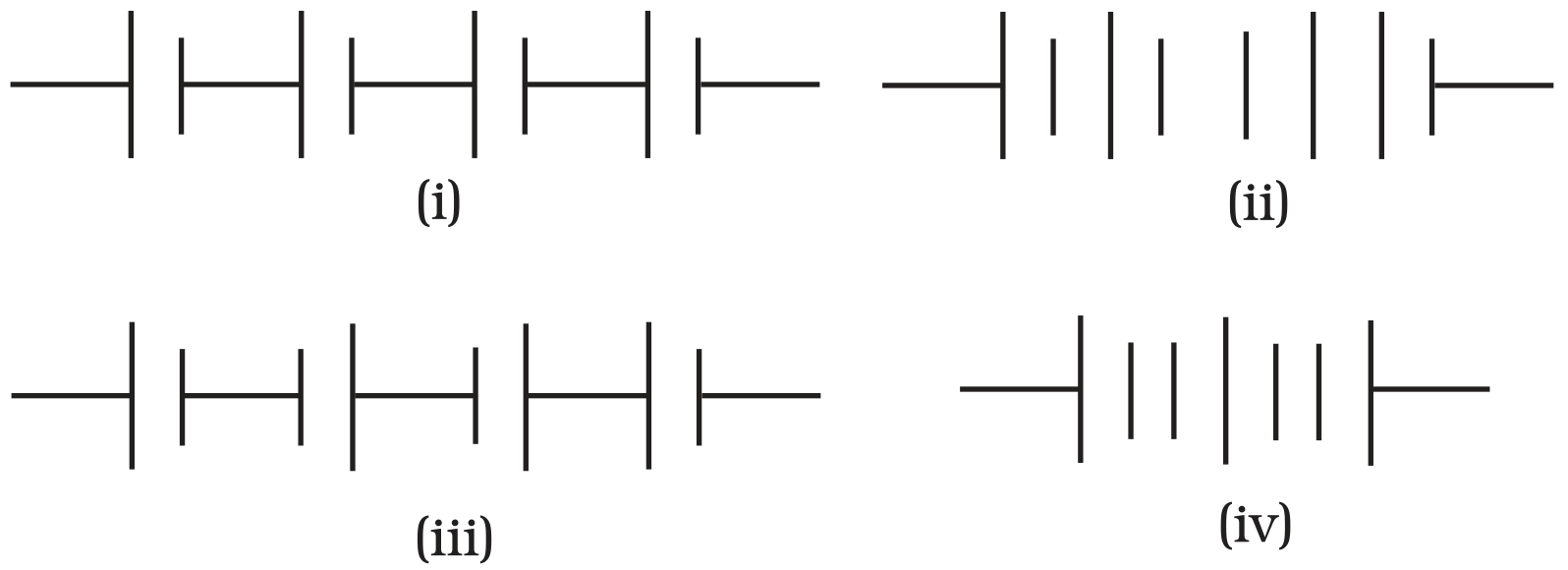
The proper representation of series combination of cells $($Figure$)$ obtaining maximum potential is :
  • A
    $(i)$
  • B
    $(ii)$
  • C
    $(iii)$
  • $(iv)$
Answer
Correct option: D.
$(iv)$
Cells are connected in series if $-\ce{ve}$ terminal of one cell is connected to the $+\ce{ve}$ terminal of other cell.
View full question & answer
MCQ 1561 Mark
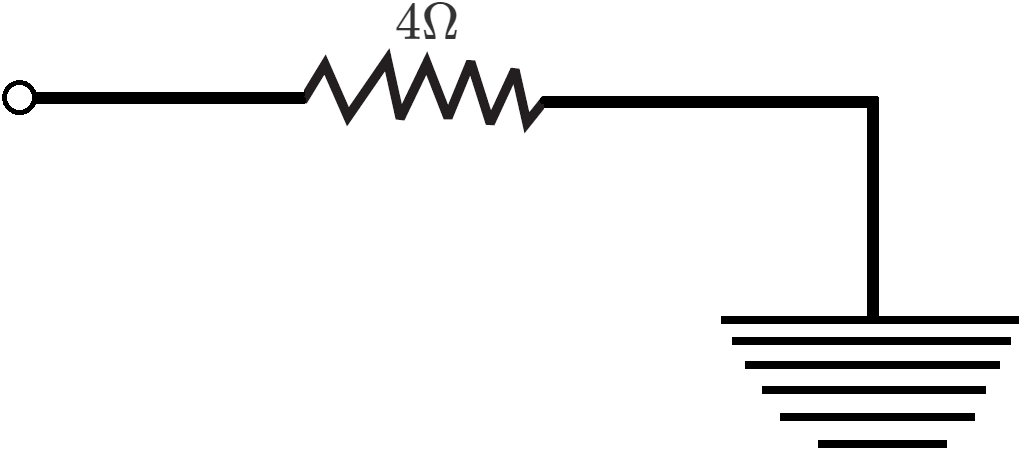
The current through the $4\Omega$ resistor in the portion of the circuit given is.
  • A
    $40 A.$
  • B
    $2 A.$
  • C
    $0.4 A.$
  • $2.5 A.$
Answer
Correct option: D.
$2.5 A.$
$\text{R} = 4\Omega$
$\text{V} = 10\text{V}$
$\text{I} = ?$
We know that
$\text{I} = \frac{\text{V}}{\text{R}}$
$\text{I} = \frac{10}{4}$
$\text{I} = 2.5 \text{A}$
View full question & answer
MCQ 1571 Mark
The unit of electrical resistance is :
  • A
    Ampere.
  • B
    Volt.
  • C
    Coulomb.
  • Ohm.
Answer
Correct option: D.
Ohm.
The unit of electrical resistance is ohm.
View full question & answer
MCQ 1581 Mark
When we pay for our electricity bill, we are paying for the :
  • A
    Charge used.
  • B
    Current used.
  • C
    Power used.
  • Energy used.
Answer
Correct option: D.
Energy used.
Electricity bill is measured in units where $1$ unit is equal to kWh which is the unit of energy.
Hence, when we pay for our electricity bill, we pay for the amount of electrical energy consumed by us.
View full question & answer
MCQ 1591 Mark
The elements of electrical heating devices are usually made of :
  • A
    Tungsten.
  • B
    Bronze.
  • Nichrome.
  • D
    Argon.
Answer
Correct option: C.
Nichrome.
Nichrome has a high resistance.
View full question & answer
MCQ 1601 Mark
Which of the follwing does not belong to the group formed by the others :
  • A
    Iron
  • B
    Tin
  • Glass
  • D
    Steel
Answer
Correct option: C.
Glass
In the given group, iron, tin and steel are electric conductors while glass is an electric insulator.
Hence, glass does not belong to the group formed by others.
View full question & answer
MCQ 1611 Mark
If the diameter of a resistance wire is halved, then its resistance becomes:
  • Four times.
  • B
    Half.
  • C
    One-fourth.
  • D
    Two times.
Answer
Correct option: A.
Four times.
a. Four times.
Explanation:
Resistance of the wire is given by:
$\text{R}=\rho\frac{\text{I}}{\text{A}}$
When the diameter is halved:
$\text{d}'=\frac{\text{d }}{2}$
Radius:
$\text{r}'=\frac{\text{r}}{2}$
Area of cross-section:
$\text{A}'=\pi\text{r}'^2=\pi\Big(\frac{\text{r}}{2}\Big)^2=\frac{\pi\text{r}}{4}=\frac{\text{A}}{4}$
Area of cross-section will get reduced by four times.
Then the new resistance:
$\text{R}'=\frac{\rho\text{I}}{\text{A}}$
$\text{R}'=\frac{4\rho\text{I}}{\text{A}}$
$\text{R}'=4\text{R}$
Thus, the resistance will increase by four times.
View full question & answer
MCQ 1621 Mark
An electric bulb is rated $220V$ and $100W$. When it is operated on $110V,$ the power consumed will be :
  • A
    $100W$
  • B
    $75W$
  • C
    $50W$
  • $25W$
Answer
Correct option: D.
$25W$
View full question & answer
MCQ 1631 Mark
Current in circuit, which makes bulb glow or heats up the wire, is :
  • Motion of charges
  • B
    Motion of atoms
  • C
    Motion of molecules
  • D
    Mone of the above
Answer
Correct option: A.
Motion of charges
An electric current is a stream of charged particles, such as electrons or ions, moving through an electrical conductor .It is often defined as rate of flow of charges.
Hence motion of charges through a conductor causes electric current.
View full question & answer
MCQ 1641 Mark
What is the minimum resistance which can be made using five resistors each of $\frac{1}{5}\Omega$.
  • A
    $\frac{1}{5\Omega}$
  • $\frac{1}{25\Omega}$
  • C
    $\frac{1}{10\Omega}$
  • D
    $25\Omega$
Answer
Correct option: B.
$\frac{1}{25\Omega}$
Put them all in parallel $-$
$\frac{1}{\text{R}} = 1\frac{1}{5} + 1\frac{1}{5} + 1\frac{1}{5} + 1\frac{1}{5} + 1\frac{1}{5}$
$= 5 + 5 + 5 + 5 + 5 = 25 $
$\text{R} = \frac{1}{25}\text{Omhs}$
View full question & answer
MCQ 1651 Mark
Which of the following units could be used to measure electric charge?
  • A
    Ampere.
  • B
    Joule.
  • C
    Volt.
  • Coulomb.
Answer
Correct option: D.
Coulomb.
The coulomb $($symbol : $C)$ is the International System of Units $(SI)$ unit of electric charge. It is the charge $($symbol: $Q$ or $q)$ transported by a constant current of one ampere in one second.
View full question & answer
MCQ 1661 Mark
The electrical resistance of insulators is :
  • A
    high
  • B
    low
  • C
    zero
  • infinitely high
Answer
Correct option: D.
infinitely high
View full question & answer
MCQ 1671 Mark
An electric heater is rated $100W$ and $220V$. If it is operated on $110V$. The power consumption will be :
  • A
    $10W$
  • $25W$
  • C
    $15W$
  • D
    $100W$
Answer
Correct option: B.
$25W$
$\text{R}=\frac{\text{V}^{2}}{\text{P}}=\frac{(220)^{2}}{100}=484\Omega$
The resistance of the bulb remains constant
if the supply voltage is reduced to $110V$ then $V =110\text{V}$
the power consumed by it is given by the expression $=\frac{\text{V}^{2}}{\text{R}}=\frac{(110)^{2}}{484}=25\text{W}$
View full question & answer
MCQ 1681 Mark
Which unit could be used to measure current?
  • A
    Watt.
  • B
    Coulomb.
  • C
    Volt.
  • Ampere.
Answer
Correct option: D.
Ampere.
It is the $SI$ unit of electric current.
View full question & answer
MCQ 1691 Mark
Which of the following does not belong to the group formed by the others :
  • A
    Iron coin
  • Wooden ruler
  • C
    Silver cup
  • D
    Copper wire
Answer
Correct option: B.
Wooden ruler
Except wood all are good conductors whereas wood is an insulator.
Good conductors are those materials that allow electricity to pass through them easily.
Bad conductors are those materials that do not allow electricity to pass through them easily.
View full question & answer
MCQ 1701 Mark
The resistance of a wire of length $300m$ and cross $-$ section area $1.0 \mathrm{~mm}^2$ made of material of resistivity $1.0\times10−7 \Omega \ \text{m}$ is :
  • A
    $2 \Omega $
  • B
    $3 \Omega $
  • C
    $20 \Omega $
  • $30 \Omega $
Answer
Correct option: D.
$30 \Omega $
Resistance, $\text{R}=\frac{\rho\text{I}}{\text{A}}$
Length $, I =300 \mathrm{~m}$
Cross section area $,A=1.0 \mathrm{~mm}^2=10^{-6} \mathrm{~m}^2$
Resistivity $,\rho=1.0\times10^{-7}\Omega\ \text{m}$
Resistance $,\text{R}=\frac{10^{-7}\times300}{10^{-6}}$
$\text{R}=30\Omega$
View full question & answer
MCQ 1711 Mark
How many joules of electrical energy are transferred per second by a $6V; 0.5A$ lamp?
  • $30J/ s$
  • B
    $12J/ s$
  • C
    $0.83J/ s$
  • D
    $3J/ s$
Answer
Correct option: A.
$30J/ s$
Electrical energy transferred per second $, E = V \times I \times t = 6V \times 0.5A \times 1s , 6V \times 0.5A \times 1s = 3J/ s$
View full question & answer
MCQ 1721 Mark
The resistivity does not change if :
  • A
    The material is changed.
  • B
    The temperature is changed.
  • The shape of the resistor is changed.
  • D
    Both material and temperature are changed.
Answer
Correct option: C.
The shape of the resistor is changed.
Resistivity of material does not depend on its dimensions and shape. However, resistivity depends upon the temperature and the nature of material.
View full question & answer
MCQ 1731 Mark
Electric power is inversely proportional to :
  • Resistance
  • B
    Voltage
  • C
    Current
  • D
    Temperature
Answer
Correct option: A.
Resistance
View full question & answer
MCQ 1741 Mark
The current which is assumed to be flowing in a circuit from positive terminal to negative, is called :
  • A
    Direct current
  • B
    Pulsating current
  • Conventional current
  • D
    Alternating current
Answer
Correct option: C.
Conventional current
The current flowing from positive terminal to negative terminal is due to flow of positive charge, which is the conventional current.
View full question & answer
MCQ 1751 Mark
A material that lets electricity to pass through it is called a/ an :
  • Electrical conductor
  • B
    Electrical insulator
  • C
    Electrical appliance
  • D
    Key
Answer
Correct option: A.
Electrical conductor
A material that lets electricity to pass through it is called an electrical conductor.
View full question & answer
MCQ 1761 Mark
If the resistance of a certain copper wire is $1 \Omega ,$ then the resistance of a similar nichrome wire will be about :
  • A
    $25 \Omega $
  • B
    $30 \Omega $
  • $60 \Omega $
  • D
    $45 \Omega $
Answer
Correct option: C.
$60 \Omega $
If the resistance of a certain copper wire is $1 \Omega ,$ the resistance of a similar nichrome wire will be about $60 \Omega $ because the resistivity of nichrome is $60$ times the resistivity of copper.
View full question & answer
MCQ 1771 Mark
A metallic conductor has loosely bound electrons called free electrons. The metallic conductor is :
  • A
    Negatively charged
  • B
    Positively charged
  • Neutral
  • D
    Either positively charged or negatively charged
Answer
Correct option: C.
Neutral
View full question & answer
MCQ 1781 Mark
$f$ the amount of electric charge passing through a conductor in $10$ minutes is $300C,$ the current flowing is :
  • A
    $30A.$
  • B
    $0.3A.$
  • $0.5A.$
  • D
    $5A.$
Answer
Correct option: C.
$0.5A.$
Here, charge $, Q = 300C$
Time $, t = 10$ minutes $= (10 \times 60)s = 600s$
Then, current $,\text{I}=\frac{\text{Q}}{\text{t}}$
$=\frac{300}{600}=0.5\text{A}.$
View full question & answer
MCQ 1801 Mark
At the time of short circuit, the electric current in the circuit :
  • A
    Vary continuously.
  • B
    Does not change.
  • C
    Reduces substantially.
  • Increases heavily.
Answer
Correct option: D.
Increases heavily.
A short circuit is an electrical circuit that allows a current to travel along an unintended path, often where essentially no $($or a very low$)$ electrical impedance is encountered.
For example, a common type of short circuit occurs when the positive and negative terminals of a battery are connected with a low $-$ resistance conductor, like a wire.
With low resistance in the connection, a high current exists, causing the cell to deliver a large amount of energy in a short time.
View full question & answer
MCQ 1811 Mark
The heat produced in a wire of resistance $'x\ '$ when a current $'y\ '$ flows through it in time $'z\ '$ is given by :
  • A
    $x^2 \times \mathrm{y} \times \mathrm{z}$
  • $\mathrm{x} \times \mathrm{z} \times \mathrm{y}^2$
  • C
    $\mathrm{y} \times \mathrm{z}^2 \times x$
  • D
    $\mathrm{y} \times \mathrm{z} \times \mathrm{x}$
Answer
Correct option: B.
$\mathrm{x} \times \mathrm{z} \times \mathrm{y}^2$
This is so because heat, $\mathrm{H}=I^2 \mathrm{Rt}$.
View full question & answer
M.C.Q - Page 4 - Science STD 10 Questions - Vidyadip