MCQ 1011 Mark
If the current $I$ through a resistor is increased by $100\% \ ($assume that temperature remains unchanged$), $ the increase in power dissipated will be :
- A
$100\%$
- B
$200\%$
- ✓
$300\%$
- D
$400\%$
AnswerCorrect option: C. $300\%$
The heat generated by a resistor is directly proportional to square of current. Hence, when current becomes double, dissipation of heat will multiply by $2^2 = 4$. This means there will be an increase of $300\%.$
View full question & answer→MCQ 1021 Mark
Your are given three equal resistances. In how many combinations can they be arranged :
MCQ 1031 Mark
When electric current is passed, electrons move from :
- A
high potential to low potential.
- ✓
low potential to high potential.
- C
in the direction of the current.
- D
against the direction of the current.
AnswerCorrect option: B. low potential to high potential.
View full question & answer→MCQ 1041 Mark
If the current flowing through a fixed resistor is halved, the heat produced in it will become :
- A
- B
One $-$ half.
- ✓
One $-$ fourth.
- D
AnswerCorrect option: C. One $-$ fourth.
This is so because heat produced is directly proportional to the square of the current passing through the resistor.
View full question & answer→MCQ 1051 Mark
An electric heater converts electrical energy into :
AnswerWhen a current passes through an electric heater, it becomes hot.
Therefore, in an electric heater, electrical energy is converted into heat energy.
View full question & answer→MCQ 1061 Mark
If the area of cross $-$ section of a resistance wire is halved, then its resistance becomes :
- A
One $-$ half.
- ✓
$2$ times.
- C
One $-$ fourth.
- D
$4$ times.
AnswerCorrect option: B. $2$ times.
The resistance of a conductor is inversely proportional to its area of cross $-$ section, i.e. $R\ \alpha \ 1/ A$. So, whenthe area of cross $-$ section of a resistance wire is halved, its resistance will increase by two times.
View full question & answer→MCQ 1071 Mark
If three resistors $2$ ohm $,3$ ohm and $4$ ohm are connected in series, then effective resistance in a circuit will be $ ........ $ ohm :
View full question & answer→MCQ 1081 Mark
Electric current is to be passed from one body to another. For this purpose the two bodies must be joined by :
AnswerCopper wire being a conductor can conduct.
View full question & answer→MCQ 1091 Mark
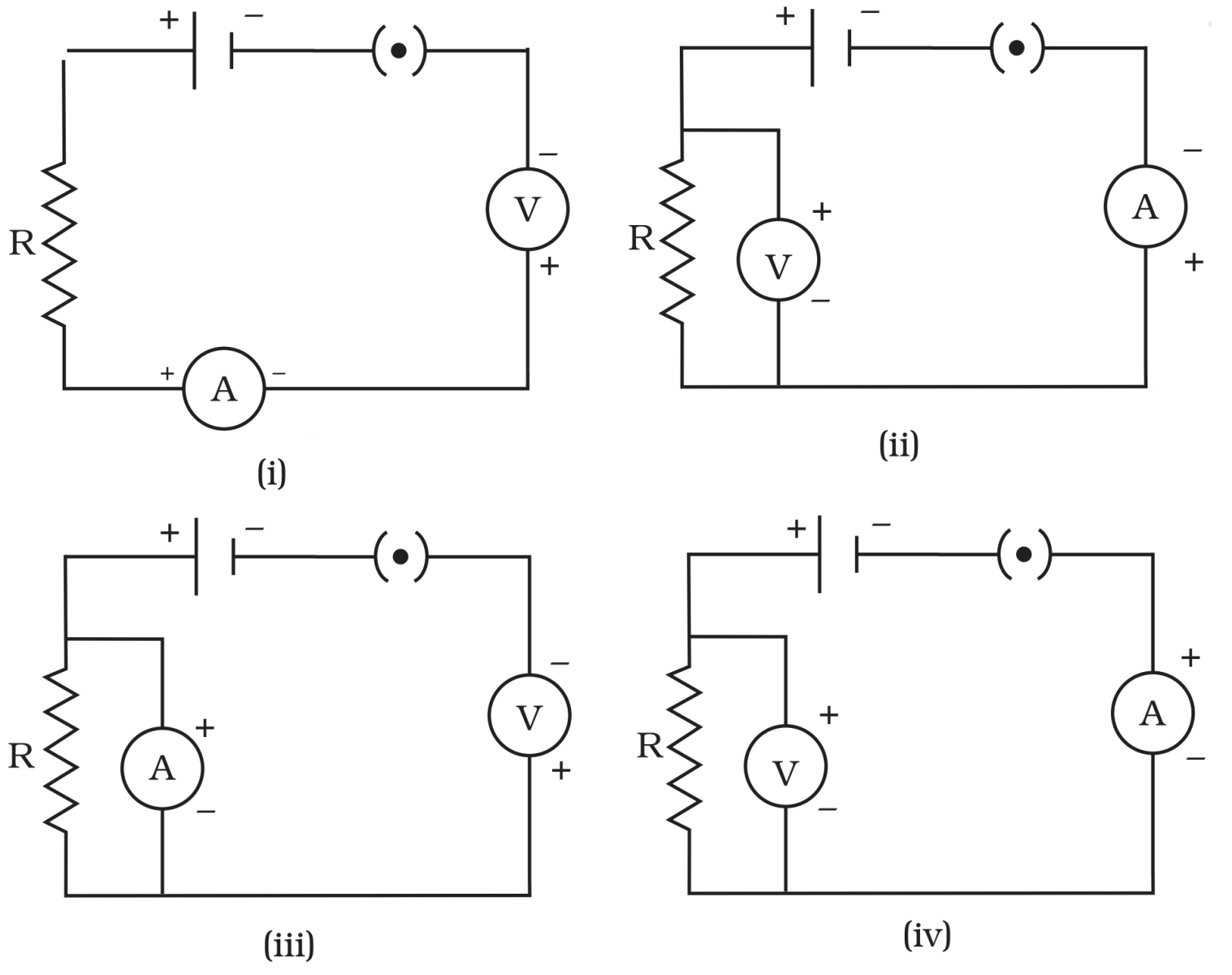
Identify the circuit $($Figure$)$ in which the electrical components have been properly connected.
- A
$(i)$
- ✓
$(ii)$
- C
$(iii)$
- D
$(iv)$
AnswerCorrect option: B. $(ii)$
Essential conditions are necessary when electrical components are connected:
- Voltmeter should be connected in parallel.
- Ammeter is always connected in series.
- Positive terminals of voltmeter and ammeter should be connected to positive terminal of the cell and their negative terminals should be joined to the negative terminal of the cell.
Thus, the above conditions are satisfied in case $(ii).$ View full question & answer→MCQ 1101 Mark
The figure given below shows three resistors ? Their combined resistance is :
- A
$1\frac{5}{7}\Omega$
- B
$14\Omega$
- C
$6\frac{2}{3}\Omega$
- ✓
$7\frac{1}{2}\Omega$
AnswerCorrect option: D. $7\frac{1}{2}\Omega$
The resistors of $6I$ and $2I$ are connected in parallel.
$\therefore\frac{1}{\text{R}}=\frac{1}{\text{R}_1}+\frac{1}{\text{R}_2}$ Here,
$\text{R}_1=6\Omega$
$\text{R}_2=2\Omega\ \frac{1}{\ \text{R}}$
$=\frac{1}{6}+\frac{1}{2}\frac{1}{\text{R}}=\frac{4}{6}\ \text{R}=\frac{6}{4}$
This arrangement is further connected in series with the $6I$ resistor.
$\therefore$ Net resistance $=\frac{6}{4}+6=7\frac{1}{2}\Omega$
View full question & answer→MCQ 1111 Mark
Two wires of equal length made of materials of resistivity ratio $1 : 2$ and area of cross $-$ section $3 : 2 $ have the potential drop across them in the ratio $X : Y$ when connected in series. The ratio $X : Y$ is:
- A
$3 : 1$
- B
$2 : 5$
- C
$5 : 2$
- ✓
$1 : 3$
AnswerCorrect option: D. $1 : 3$
$1 : 3$
View full question & answer→MCQ 1121 Mark
If the potential difference between the ends of a fixed resistor is halved, the electric power will become :
AnswerCorrect option: D. One $-$ fourth.
Since $\text{P}=\frac{\text{V}^2}{\text{R}}, $ when the potential difference is halved, the power becomes one $-$ fourth.
View full question & answer→MCQ 1131 Mark
$100J$ of heat is produced each second in a $4\Omega $ resistor. The potential difference across the resistor will be :
View full question & answer→MCQ 1141 Mark
Materials that allow electrons to flow through them are known as :
MCQ 1151 Mark
The substance having infinitely high electrical resistance is called :
AnswerA substance having infinitely high electrical resistance is called an insulator.
View full question & answer→MCQ 1161 Mark
When the area of cross $-$ section of a conductor is doubled, its resistance becomes :
AnswerWe know that the resistance of a conductor is given by :
$\text{R}=\rho\frac{\text{I}}{\text{A}}$
where $\rho=\text{resistivity}$
$l =$ length of the conductor
$A =$ area of the cross-section of the conductor
Let the new resistance be $R\ '$ when the area of cross-section of the conductor is doubled
$\text{R}'=\rho\frac{\text{I}}{2\text{A}}$
View full question & answer→MCQ 1171 Mark
The current flowing through a wire of resistance $2\Omega$ varies with time as shown in figure alongside. The amount of heat produced $($in $J)$ in $3$ would be.
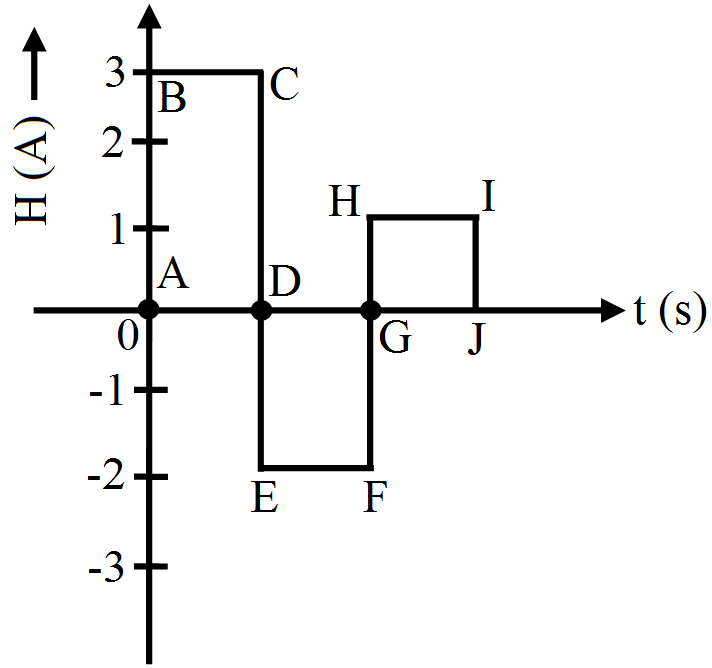
AnswerAssuming that each interval is of $1$ seconds, we can calculate the heat for each interval and just sum it up to find the net heat produced,
Heat, $H=I^2 R T$
Where,
$I$ is the current,
$R$ is the resistance,
$T$ is the time taken
For $AD,$
$\text{I}=3, \text{R}=2\Omega,\text{T}=1\text{sec}$
Putting the values in the above formula, we get
$\text{H}_{\text{AD}}=3^{2}.2.1=18\text{J}$
For $DG,$
$\text{I}=-2\text{A},\text{R}=2\Omega,\text{T}=1\text{sec}$
Putting the values in the above formula, we get
$\text{H}_{\text{DG}}=3^{2}.2.1=18\text{J}$
For $GJ,$
$\text{I}=-2\text{A},\text{R}=2\Omega,\text{T}=1\text{sec}$
Putting the values in the above equation, we get
$\text{H}_{\text{GJ}}=1^{2}.2.1=2\text{J}$
So Total amount of heat generated in $3\sec$
$\text{H}_{\text{NET}}=18+8+2=28\text{J}$
View full question & answer→MCQ 1181 Mark
A battery of $10$ volt carries $20,000\ C$ of charge through a resistance of $20 \Omega $. The work done in $10$ seconds is :
- A
$2 \times 10^3$ joule
- ✓
$2 \times 10^5$ joule
- C
$2 \times 10^4$ joule
- D
$2 \times 10^2$ joule
AnswerCorrect option: B. $2 \times 10^5$ joule
View full question & answer→MCQ 1191 Mark
Coulomb is the $SI$ unit of :
View full question & answer→MCQ 1201 Mark
If $\mathrm{R}_1$ and $\mathrm{R}_2$ be the resistance of the filament of $40W$ and $60W$ respectively operating $220V,$ then :
- A
$\mathrm{R}_1 < \mathrm{R}_2$
- ✓
$\mathrm{R}_2 < \mathrm{R}_1$
- C
$\mathrm{R}_1=\mathrm{R}_2$
- D
$\mathrm{R}_1 \geq \mathrm{R}_2$
AnswerCorrect option: B. $\mathrm{R}_2 < \mathrm{R}_1$
View full question & answer→MCQ 1211 Mark
Electric current is a $ ........... ?$
- ✓
- B
- C
Vector quantity when it is due to the flow of positive charges
- D
Vector quantity when it is due to electrons
View full question & answer→MCQ 1221 Mark
An electric fuse works on the :
- A
Chemical effect of current.
- B
Magnetic effect of current.
- C
Lighting effect of current.
- ✓
Heating effect of current.
AnswerCorrect option: D. Heating effect of current.
An electric fuse works on the heating effect of current.
View full question & answer→MCQ 1231 Mark
$A$ is false, but $R$ is true.
Assertion : If $10$ bulbs are connected in series and one bulb fused, then the remaining $9$ bulbs will not work. Reason : Bulb of higher wattage will give less bright light.
- A
Both $A$ and $R$ are true, and $R$ is correct explanation of the assertion.
- ✓
Both $A$ and $R$ are true, but $R$ is not the correct explanation of the assertion.
- C
$A$ is true, but $R$ is false.
- D
$A$ false but $R$ is true
AnswerCorrect option: B. Both $A$ and $R$ are true, but $R$ is not the correct explanation of the assertion.
When bulbs are connected in series and out of that one get fused then due to this there will be no continuity in the circuit $($or resistance offered by fused bulb is infinite$)$ and no current will flow through the remaining bulbs.
For two statements are given $-$ one labelled
Assertion $(A)$ and the other labelled
Reason $(R)$. Select the correct answer to these questions from the codes $(a), (b), (c)$ and $(d)$ as given below :
View full question & answer→MCQ 1241 Mark
A dynamo develops $0.5A$ at $6V$.The energy which is generated in one second is :
AnswerVoltage $(V) = 6V$
Current $(I) = 0.5A$
Time $(t) = 1\sec$
Energy generated $= VIt$
$\Rightarrow $ Energy $= 6 \times 0.5 \times 1 = 3J$
View full question & answer→MCQ 1251 Mark
Two bulbs of $100W$ and $40W$ are connected in series. The current through the $100W$ bulb is $1A$. The current through the $40W$ bulb will be :
- A
$0.4A.$
- B
$0.6A.$
- C
$0.8A.$
- ✓
$1A.$
AnswerIn a series connection, the current through each device remains the same. Therefore, the current through the $40W$ bulb will also be $1A.$
View full question & answer→MCQ 1261 Mark
$SI$ unit of electrical energy is :
Answer$SI$ unit of electrical energy is Joule.
$1$ Joule $= 1$ Volt $\times\ 1$ ampere $\times\ 1$ second.
View full question & answer→MCQ 1271 Mark
Which one of the following substances are used to make electric switches and switch boards :
MCQ 1281 Mark
Which is represented by the electric current :
AnswerAn electric current is a flow of electric charge. In electric circuits, this charge is often carried by moving electrons in a wire.
It can also be carried by ions in an electrolyte, or by both ions and electrons such as in a plasma.
It is the rate of charge flow past a given point in an electric circuit, measured in Coulombs/ second which is named Amperes.It is the charge per unit time.
View full question & answer→MCQ 1291 Mark
Electric current can flow through :
MCQ 1301 Mark
The heat produced by passing an electric current through a fixed resistor is proportional to the square of :
- A
Magnitude of resistance of the resistor.
- B
Temperature of the resistor.
- ✓
- D
Time for which current is passed.
AnswerWe know that :
$\mathrm{H}=I^2 \mathrm{Rt}$
It shows that the heat produced is proportional to the square of the current.
View full question & answer→MCQ 1311 Mark
How much energy does a $100W$ electric bulb transfer in $1$ minute ?
- A
$100J.$
- ✓
$600J.$
- C
$3600J.$
- D
$6000J.$
AnswerCorrect option: B. $600J.$
Energy transferred $, E =$ power $\times $ time $= 100W \times 60s = 6000J$
View full question & answer→MCQ 1321 Mark
The other name of potential difference is :
AnswerThe term voltage came from volt, which is the $SI$ unit of potential difference.
View full question & answer→MCQ 1331 Mark
A coil in the heater consume power $P$ on passing current. If it is cut into halves and joined in parallel, it will consume power :
- A
$P$
- B
$\frac{\text{P}}{2}$
- C
$2P$
- ✓
$4P$
View full question & answer→MCQ 1341 Mark
Which of the following is the most likely temperature of the filament of an electric light bulb when it is working on the normal $220V$ supply line?
- A
$500^\circ C$
- B
$1500^\circ C$
- ✓
$2500^\circ C$
- D
$4500^\circ C$
AnswerCorrect option: C. $2500^\circ C$
It is the temperature of an electric bulb filament when it glows.
View full question & answer→MCQ 1351 Mark
The resistivity of a certain material is $0.6 \Omega \ \text{m}. $ The material is most likely to be :
AnswerThe resistivity of a certain material is $0.6 \Omega \ \text{m}. $The material is most likely to be a semiconductor because it has moderate resistivity.
View full question & answer→MCQ 1361 Mark
The diagram below shows part of a circuit : If this arrangement of three resistors was to be replaced by a single resistor, its resistance should be :
- ✓
$9\Omega$
- B
$4\Omega$
- C
$6\Omega$
- D
$18\Omega$
AnswerCorrect option: A. $9\Omega$
The two resistors of $6I$ are connected in parallel with each other. So, their net resistance $3I$ is connected in series with a resistance of $6I$. So, the net resistance of the complete arrangement is $9 \Omega .$
View full question & answer→MCQ 1371 Mark
In a filament type light bulb, most of the electric power consumed appears as:
- A
- ✓
Infra $-$ red $-$ rays.
- C
- D
AnswerCorrect option: B. Infra $-$ red $-$ rays.
This is so because of the heat produced when a filament type light bulb glows.
View full question & answer→MCQ 1381 Mark
When an electric lamp is connected to $12V$ battery, it draws a current of $0.5A$. The Power of the lamp is :
- A
$0.5W.$
- ✓
$6W.$
- C
$12W.$
- D
$24W.$
AnswerPower $, P = VI = 12V \times 0.5A = 6W$
View full question & answer→MCQ 1391 Mark
Which statement/statement is/ are correct?
- An ammeter is connected in series in a circuit and a voltmeter is connected in parallel.
- An ammeter has a high resistance.
- A voltmeter has a low resistance.
- A
$\{1, 2, 3\}$
- B
$\{1, 2\}$
- C
$\{2, 3\}.$
- ✓
$\{1\}.$
AnswerCorrect option: D. $\{1\}.$
An ammeter is connected in series in a circuit and voltmeter is connected in parallel.
View full question & answer→MCQ 1401 Mark
Two resistors of resistance $2\Omega$ and $4\Omega$ when connected to a battery will have.
- A
Same current flowing through them when connected in parallel.
- ✓
Same current flowing through them when connected in series.
- C
Same potential difference across them when connected in series.
- D
Different potential difference across them when connected in parallel.
AnswerCorrect option: B. Same current flowing through them when connected in series.
In series combination of resistor, the current through both the resistor are same but potential difference across each will be different. In parallel combination current across each resistor will be different but the potential difference will be same.
View full question & answer→MCQ 1411 Mark
When a $1$ ohm resistor is connected across the potential difference of $20V,$ what will be power dissipation in it :
- A
$200W$
- B
$20W$
- ✓
$400W$
- D
$10W$
AnswerCorrect option: C. $400W$
$V = 20$ volts
$R = 1 \Omega$
Power dissipated in it $\text{P}=\frac{\text{V}^2}{\text{R}}=\frac{20^2}{1}=400\text{w}$
View full question & answer→MCQ 1421 Mark
Two resistors are connected in series gives an equivalent resistance of $10\Omega$ . When connected in parallel, gives $2.4\Omega$ . Then the individual resistance are :
- A
each of $5\Omega $
- ✓
$6\Omega $ and $4\Omega $
- C
$7\Omega $ and $4\Omega $
- D
$8\Omega $ and $2\Omega $
AnswerCorrect option: B. $6\Omega $ and $4\Omega $
View full question & answer→MCQ 1431 Mark
Two devices are connected between two points say $A$ and $B$ in parallel. The physical quantity that will remain the same between the two points is :
View full question & answer→MCQ 1441 Mark
The unit for measuring potential difference is :
AnswerIt is the $SI$ unit of potential difference.
View full question & answer→MCQ 1451 Mark
If the current through a floodlamp is $5A,$ what charge passed in $10$ seconds?
- A
$0.5C.$
- B
$2C.$
- C
$5C.$
- ✓
$50C.$
AnswerCorrect option: D. $50C.$
Here, current $, I = 5A$
Time $, t = 10s$
So, using the relation, $\text{I} =\frac{\text{Q}}{\text{t}}$
$Q = I \times t$
Charge $, Q = 5 \times 10 = 50C$
Thus, a charge of $50C$ is passed in $10s.$
View full question & answer→MCQ 1461 Mark
Current in a circuit flows :
- ✓
In direction from high potential to low potential.
- B
In direction from low potential to high potential.
- C
In direction of flow of electrons.
- D
AnswerCorrect option: A. In direction from high potential to low potential.
Electric current flows from positive electrode of cell to negative electrode of cell, i.e., from high potential to low potential.
View full question & answer→MCQ 1471 Mark
Find odd one out : Copper, Salt water, Cotton, Human body.
AnswerCotton is an insulator, rest are good conductors.
View full question & answer→MCQ 1481 Mark
Connecting wires in a electric circuit are made of $.......?$
AnswerCopper and aluminium offer a low resistance to the flow of current and hence they are good conductors of electricity.
Copper and aluminium are highly ductile and hence can be used for preparing the wire.
Copper being more ductile, it is used in making thin wires, and aluminium is used for making thicker wires.
Thus, they are suitable for making wires used in electrical circuit.
View full question & answer→MCQ 1491 Mark
Four identical wires each having resistance $R$ are connected as shown in the figure. Equivalent resistance between $A$ and $B$ is : 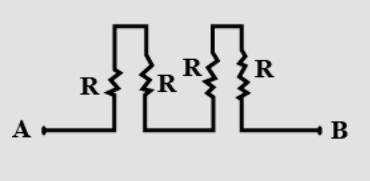
- A
$\frac{\text{R}}{4}$
- B
$\frac{\text{R}}{2}$
- ✓
$4R$
- D
$R$
AnswerSimplified circuit is drawn. It is the series combination of the four resistances.
$R_{A B}=4 R$

View full question & answer→MCQ 1501 Mark
The work done in moving a unit charge across two points in an electric circuit is a measure of :
AnswerThe difference in potential between two points that represents the work involved or the energy released in the transfer of a unit quantity of electricity from one point to the other.
View full question & answer→