Questions

M.C.Q-[Phy-1M]

🎯

Test yourself on this topic

18 questions · timed · auto-graded

Question 11 Mark
Which of the following represents voltage?

  1. $\frac{\text{Work done}}{\text{Current}\times\text{Time}}$
  2. $\text{Work done}\times\text{Charge}$

  3. $\frac{\text{Work done}\times\text{Time}}{\text{Current}}$

  4. $\text{Work done}\times\text{Charge}\times\text{Time}$

Answer
  1. $\frac{\text{Work done}}{\text{Current}\times\text{Time}}$
Explanation: Work done × Charge × Potential difference

⇒ Work done = (Current × Time) × Potential difference $[\because$ Charge = Current × Time$]$

⇒ Potential difference $=\frac{\text{Work done}}{\text{Current}\times\text{Time}}$​​​​​​​

View full question & answer
Question 21 Mark
What is the minimum resistance which can be made using five resistors each of $\frac{1}{5}\Omega$?

  1. $\frac{1}{5}\Omega$

  2. $\frac{1}{25}\Omega$

  3. $\frac{1}{10}\Omega$

  4. $25\Omega$

Answer
  1. $\frac{1}{25}\Omega$

Explanation: When resistors are connected in parallel then we get the minimum resistance out of the combination. When given resistors are connected in parallel, the resistance of combination can be calculated as follows:

$\frac{1}{\text{R}}=5+5+5+5+5=25\Omega$

Or $\text{R}=\frac{1}{25}\Omega$

View full question & answer
Question 31 Mark
What is the maximum resistance which can be made using five resistors each of $\frac{1}{5}\Omega$?

  1. $\frac{1}{5}\Omega$

  2. $10\Omega$

  3. $5\Omega$

  4. $1\Omega$

Answer
  1. $1\Omega$

Explanation: When resistors are connected in series then we get the maximum resistance out of the combination. When the given resistors are connected in series, the resistance of combination can be calculated as follows:

$\text{R}=\frac{1}{5}+\frac{1}{5}+\frac{1}{5}+\frac{1}{5}+\frac{1}{5}=\frac{5}{5}=1\Omega$​​​​​​​

View full question & answer
Question 41 Mark
Unit of electric power may also be expressed as:
  1. Volt ampere.
  2. Kilowatt hour.
  3. Watt second.
  4. Joule second.
Answer
  1. Volt ampere.

Explanation: Electric power = voltage × current

SI Unit of voltage = Volt

SI Unit of current = Ampere

So, unit of electric power is also given by, volt ampere.

View full question & answer
Question 51 Mark
Two resistors of resistance 2Ω and 4Ω when connected to a battery will have:
  1. Same current flowing through them when connected in parallel.
  2. Same current flowing through them when connected in series.
  3. Same potential difference across them when connected in series.
  4. Different potential difference across them when connected in parallel.
Answer
  1. Same current flowing through them when connected in series.

Explanation: In series combination of resistor, the current through both the resistor are same but potential difference across each will be different.

In parallel combination current across each resistor will be different but the potential difference will be same.

View full question & answer
Question 61 Mark
The resistivity does not change if:
  1. The material is changed.
  2. The temperature is changed.
  3. The shape of the resistor is changed.
  4. Both material and temperature are changed.
Answer
  1. The shape of the resistor is changed.

Explanation: Resistivity of material does not depend on its dimensions and shape. However, resistivity depends upon the temperature and the nature of material.

View full question & answer
Question 71 Mark
In an electrical circuit two resistors of 2Ω and 4Ω respectively are connected in series to a 6V battery. The heat dissipated by the 4Ω resistor in 5s will be:
  1. 5J.
  2. 10J.
  3. 20J.
  4. 30J.
Answer
  1. 20J.

Explanation: Total resistance of combination $2\Omega+4\Omega=6\Omega$

Current through the circuit can be calculated as $\text{I}=\frac{\text{V}}{\text{R}}=\frac{6\text{V}}{6\Omega}=1\text{A}$

Heat dissipation by can be calculated as follows: $\text{H}=\text{I}^2\text{Rt}=(1\text{A})^2\times4\Omega\times5\text{s}=20\text{J}$

View full question & answer
Question 81 Mark
In an electrical circuit three incandescent bulbs A, B and C of rating 40W, 60W and 100W respectively are connected in parallel to an electric source. Which of the following is likely to happen regarding their brightness?
  1. Brightness of all the bulbs will be the same.
  2. Brightness of bulb A will be the maximum.
  3. Brightness of bulb B will be more than that of A.
  4. Brightness of bulb C will be less than that of B.
Answer
  1. Brightness of bulb B will be more than that of A.

Explanation: Since bulbs are connected in parallel so resistance of combination would be less than arithmetic sum of resistance of all the bulbs. So, there will be no negative effect on flow of current. As a result, bulbs would glow according to their wattage.

View full question & answer
Question 91 Mark
If the current I through a resistor is increased by 100% (assume that temperature remains unchanged), the increase in power dissipated will be:
  1. 100%
  2. 200%
  3. 300%
  4. 400%
Answer
  1. 300%

Explanation: The heat generated by a resistor is directly proportional to square of current. Hence, when current becomes double, dissipation of heat will multiply by 22 = 4. This means there will be an increase of 300%.

View full question & answer
Question 101 Mark
Electrical resistivity of a given metallic wire depends upon:
  1. Its length.
  2. Its thickness.
  3. Its shape.
  4. Nature of the material.
Answer
  1. Nature of the material.

Explanation: The resistivity of a material is constant for a particular temperature at a constant temperature.

Resistivity of material does not depend on length, thickness and shape of the material. It only depends on the temperature.

View full question & answer
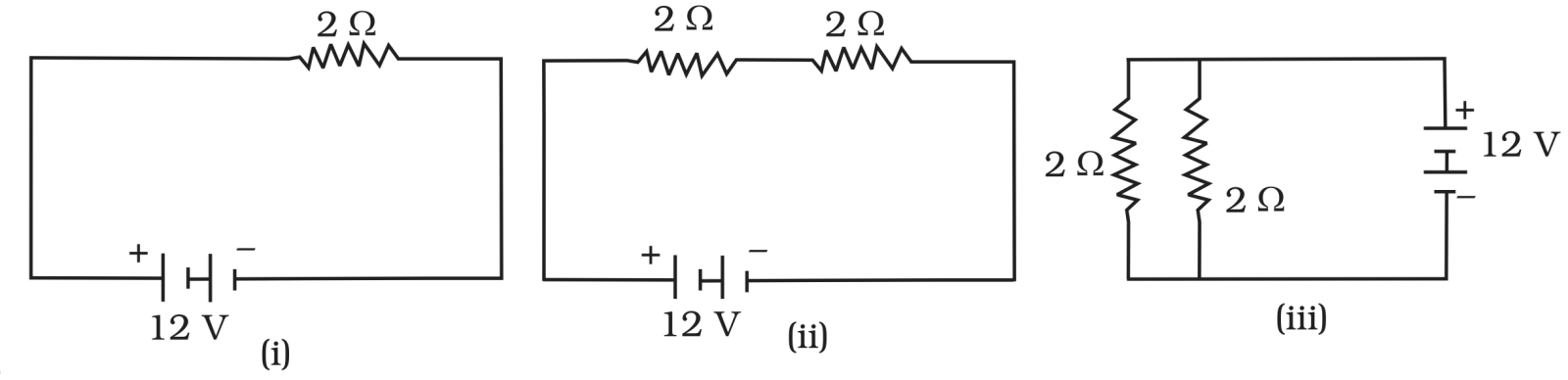
Question 121 Mark
Answer
  1. Maximum in case (ii).

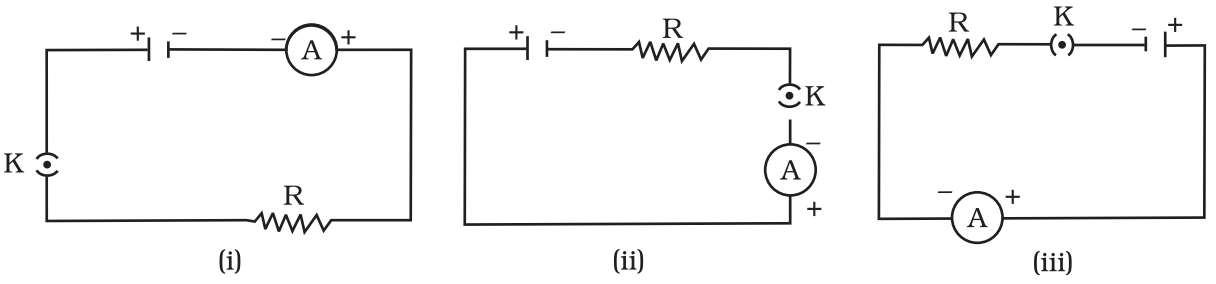
Explanation: In this case, two resistors are in series. Hence, their sum will be equal to their arithmetic sum. In figure (iii) the total resistance will be less than individual resistances because they are connected in parallel. A higher resistance produces more heat so option (c) is correct.

View full question & answer
Question 131 Mark
Answer
  1. (ii)

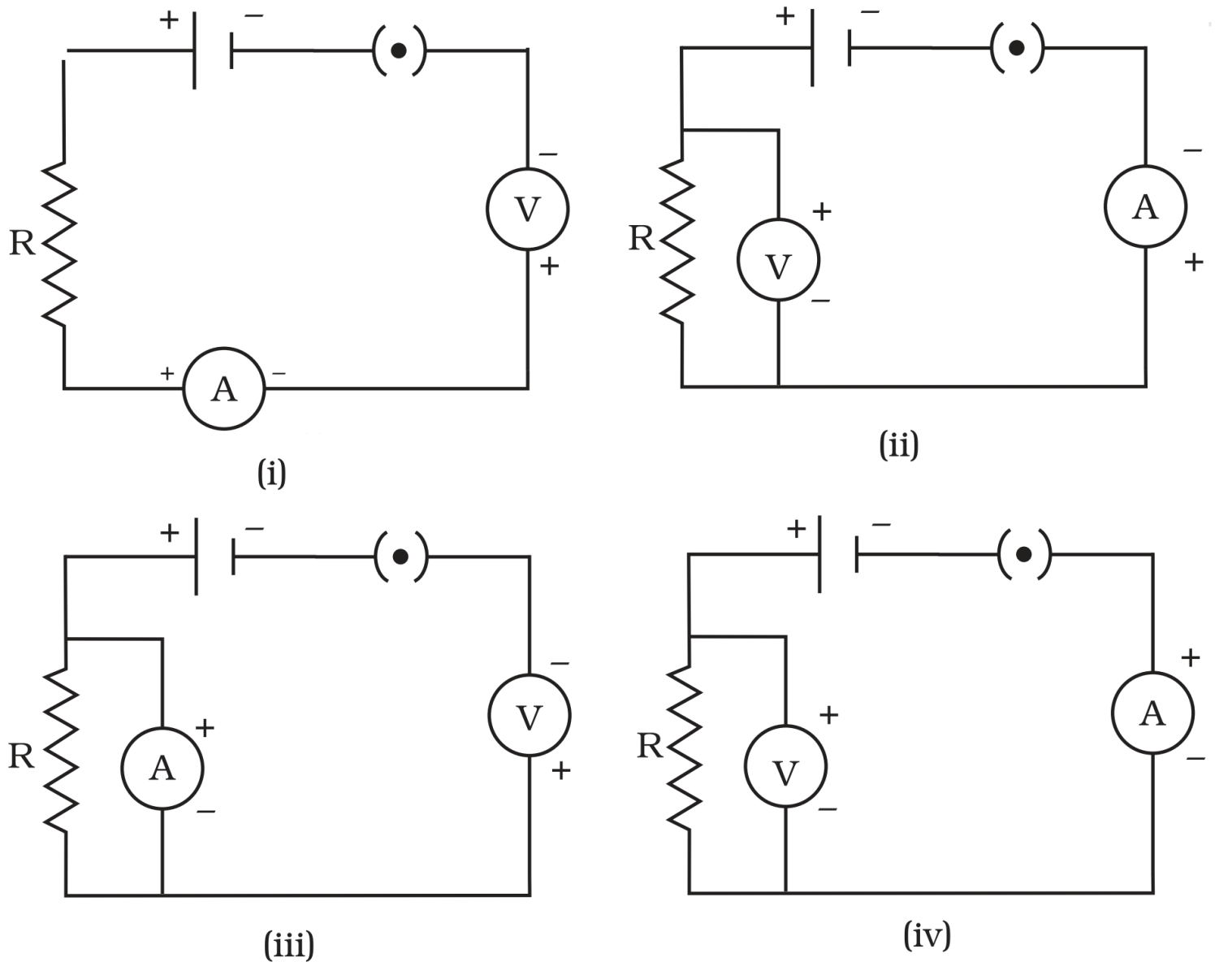
Explanation: Essential conditions are necessary when electrical components are connected:

  • Voltmeter should be connected in parallel.
  • Ammeter is always connected in series.
  • Positive terminals of voltmeter and ammeter should be connected to positive terminal of the cell and their negative terminals should be joined to the negative terminal of the cell.

Thus, the above conditions are satisfied in case (ii).​​​​​​​

View full question & answer
Question 151 Mark
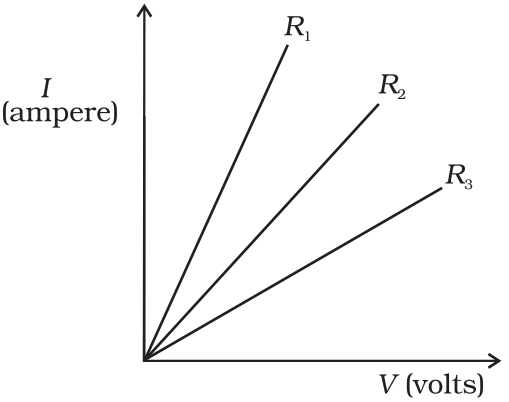
A student carries out an experiment and plots the V-I graph of three samples of nichrome wire with resistances R1, R2 and R3 respectively (Figure). Which of the following is true?

  1. R1 = R2 = R3
  2. R1 > R2 > R3
  3. R3 > R2 > R1
  4. R2 > R3 > R1
Answer
  1. R3 > R2 > R1

Explanation: Slope of VI graph is proportional to $\frac{1}{\text{Resistance}}.$

It means when slope will be maximum, then resistance will be minimum.

From the figure, we can see that, slope of R1 is maximum; hence its resistance will be minimum.

As, slope of R3 is minimum so, its resistance will be maximum.

Therefore, R3 > R2 > R1.

View full question & answer
Question 161 Mark
An electric kettle consumes 1kW of electric power when operated at 220V. A fuse wire of what rating must be used for it?
  1. 1A
  2. 2A
  3. 4A
  4. 5A
Answer
  1. 5A

Explanation: $\text{P}=\text{VI}$

$\text{or I }=\frac{\text{P}}{\text{V}}=\frac{1\text{kW}}{220\text{V}}$

$=\frac{1000\text{W}}{220\text{A}}=4.55\Omega=5\text{A}$​​​​​​​

View full question & answer
Question 171 Mark
A cylindrical conductor of length l and uniform area of crosssection A has resistance R. Another conductor of length 2l and resistance R of the same material has area of cross section:

  1. $\frac{\text{A}}{2}$

  2. $\frac{3\text{A}}{2}$

  3. $2\text{A}$

  4. $3\text{A}$

Answer
  1. $2\text{A}$

Explanation: $\text{R}=\rho\frac{\text{l}}{\text{A}}\ ....(\text{i})$

Also, $\text{R}=\frac{\rho(2\text{l})}{\text{A}'}\ ....(\text{ii})$

From eq. (i) and (ii)

$\frac{1}{\text{A}}=\frac{2}{\text{A}'}\text{ or A}'=2\text{A}$

View full question & answer
Question 181 Mark
A current of 1A is drawn by a filament of an electric bulb. Number of electrons passing through a cross section of the filament in 16 seconds would be roughly:
  1. 1020
  2. 1016
  3. 1018
  4. 1023
Answer
  1. 1020

Explanation: $\text{I}=\frac{\text{Q}}{\text{t}}=\frac{\text{ne}}{\text{t}}$

$\text{n}=\frac{\text{It}}{\text{e}}=\frac{1\times16}{1.6\times10^{-19}}=10^{20}$​​​​​​​

View full question & answer
M.C.Q-[Phy-1M] - Science STD 10 Questions - Vidyadip