Questions · Page 1 of 4

M.C.Q

🎯

Test yourself on this topic

50 questions · timed · auto-graded

MCQ 11 Mark
Height of a plant is regulated by :
  • A
    DNA which is directly influenced by growth hormone.
  • B
    Genes which regulate the proteins directly.
  • Growth hormones under the influence of the enzymes coded by a gene.
  • D
    Growth hormones directly under the influence a gene.
Answer
Correct option: C.
Growth hormones under the influence of the enzymes coded by a gene.
(C) Growth hormones under the influence of the enzymes coded by a gene.
View full question & answer
MCQ 21 Mark
If the ratio of each phenotype of the seeds of pea plants in the $F_2$ generation is $\{9 : 3 : 3 : 1\},$ it is known as :
  • A
    Tetrahybrid ratio.
  • B
    Monohybrid ratio.
  • Dihybrid ratio.
  • D
    Trihybrid ratio.
Answer
Correct option: C.
Dihybrid ratio.
The ratio $\{9 : 3 : 3 : 1\}$ is known as the dihybrid ratio.
View full question & answer
MCQ 31 Mark
The two versions of a trait $($character$)$ which are brought in by the male and female gametes are situated on :
  • Copies of the same chromosome.
  • B
    Sex chromosomes.
  • C
    Two different chromosomes.
  • D
    Any chromosomes.
Answer
Correct option: A.
Copies of the same chromosome.
The two versions of a trait, which are brought in by the female and male gametes are situated on the copies of the same chromosome.
View full question & answer
MCQ 41 Mark
The dwarf trait of the $F_1$ generation pea plants observed in Mendel's experiments is a $ ........... $ character :
  • Recessive
  • B
    Dominant
  • C
    Incomplete dominant
  • D
    Codominant
Answer
Correct option: A.
Recessive
Mendel, in his experiments, observed seven characters, tall and dwarf were one of them.
Among those seven characters, he observed the dominant and recessive alleles.
He found that tall was dominant over dwarf i.e. phenotype was Tall with the $Tt$ in which $'T\ '$ represents tall $'t\ '$ represents dwarf.
View full question & answer
MCQ 51 Mark
A cross between a tall plant $(TT)$ and short pea plant $(tt)$ resulted in progeny that were all tall plants because :
  • Tallness is the dominant trait.
  • B
    Shortness is the dominant trait.
  • C
    Tallness is the recessive trait.
  • D
    Height of pea plant is not governed by gene $'T\ ’$ or $'t\ ’.$
Answer
Correct option: A.
Tallness is the dominant trait.
According to law of dominance, a trait is represented by two contrasting factors of a gene in a heterozygous individual; the allele/ factor that can express itself in heterozygous individual is called as dominant trait. The other factor whose effect is masked by presence of dominant factor, is called recessive factor.
View full question & answer
MCQ 61 Mark
From the list given below, select the character which can be acquired but not inherited :
  • A
    Colour of eye.
  • B
    Colour of skin.
  • Size of body.
  • D
    Nature of hair.
Answer
Correct option: C.
Size of body.
Environmentally determined traits are acquired. Size of body depends on nutritional status, health conditions etc.
View full question & answer
MCQ 71 Mark
Select the correct statement :
  • A
    Tendril of a pea plant and phylloclade of Opuntia are homologous.
  • B
    Tendril of a pea plant and phylloclade of Opuntia are analogous.
  • C
    Wings of birds and limbs of lizards are analogous.
  • Wings of birds and wings of bat are homologous.
Answer
Correct option: D.
Wings of birds and wings of bat are homologous.
Homologous organs perform different functions and have different appearance but share common basic structural plan and origin. Analogous organs perform similar function and have similar appearance but have different basic structure and origin.
View full question & answer
MCQ 81 Mark
Organs that have different embryonic origin but perform similar functions are :
  • A
    Homologous organs
  • Analogous organs
  • C
    Vestigial organs
  • D
    Identical organs
Answer
Correct option: B.
Analogous organs
View full question & answer
MCQ 91 Mark
In the human blood grouping, the four basic blood types are type $A,$ type $B,$ type $AB,$ and type $O$. The blood proteins $A$ and $B$ are :
  • A
    Simple dominant and recessive traits.
  • B
    Incomplete dominant traits.
  • Codominant traits.
  • D
    Sex $-$ linked traits.
Answer
Correct option: C.
Codominant traits.
Blood proteins $A$ and $B$ are codominant traits, as neither of these is able to dominate the other completely.
View full question & answer
MCQ 101 Mark
A normal cell of human body contains $23$ pairs of chromosomes. The number of chromosomes in a sex cell $($sperm or ovum$)$ of a human being is most likely to be :
  • A
    $46.$
  • $23.$
  • C
    $21.$
  • D
    $42.$
Answer
Correct option: B.
$23.$
The number of chromosomes present in a sex cell of a human being would normally be $23.$
View full question & answer
MCQ 111 Mark
Mendel was born in $ .......... ?$
  • A
    $17^{th}$ century
  • B
    $18^{th}$ century
  • $19^{th}$ century
  • D
    $8^{th}$ century
Answer
Correct option: C.
$19^{th}$ century
Gregor Mendel was the first who gave the idea of heredity. Those units for heredity were named "factors" by Mendel. His major work was based on contrasting characters of Pisum sativum.
He was born on July $20, 1822.$
The $19^{th}$ century began on $1^{st}$ January $1801$ and ended on $31^{st}$ December $1900.$
View full question & answer
MCQ 121 Mark
A zygote which has an $X-$ chromosome inherited from the father will develop into a :
  • A
    Boy.
  • Girl.
  • C
    $X-$ chromosome does not determine the sex of a child.
  • D
    Either boy or girl.
Answer
Correct option: B.
Girl.
As $X-$ chromosome from the father will mate the $X-$ chromosome of the mother resulting in $XX-$ chromosome of the child as $23^{rd}$ pair.
View full question & answer
MCQ 131 Mark
How is the sex of a newborn determined in humans?
  • The sex of the individual is genetically determined.
  • B
    The sex of the individual is phenotypically determined.
  • C
    The sex of the individual is physiologically determined.
  • D
    All of the above
Answer
Correct option: A.
The sex of the individual is genetically determined.
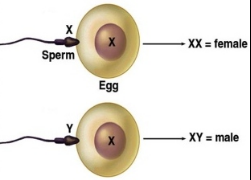
Sex is determined at the time of fertilization.
A human male has an $XY$ sex chromosome and produces two types of sperms, either with an $X$ chromosome or with a $Y$ chromosome.
A human female has a $XX$ chromosome and produces ova of one type.
If the sperm containing the $X$ chromosome fuses with the ovum, the individual will be a girl, and the sperm containing the $Y$ chromosome fuses with the ovum, the individual will be a boy.
View full question & answer
MCQ 141 Mark
Scientists believe that all life originated in :
  • The sea.
  • B
    The soil.
  • C
    The ground.
  • D
    The air.
Answer
Correct option: A.
The sea.
Scientists believe that all life originated in sea water.
View full question & answer
MCQ 151 Mark
The laws put forward by Mendel are :
  • A
    Laws of germplasm
  • B
    Laws of origin of species
  • C
    Laws of recapitulation
  • Laws of inheritance
Answer
Correct option: D.
Laws of inheritance
Mendel proposed some Laws of Inheritance.They are three in number.
Law of Dominance
Law of Segregation
Law of independent assortment.
View full question & answer
MCQ 161 Mark
A gradual change, over a long period, in a form of life is known as :
  • A
    Erosion.
  • Evolution.
  • C
    Revolution.
  • D
    Evaluation.
Answer
Correct option: B.
Evolution.
Evolution is the sequence of gradual changes, which take place in primitive organisms over millions of years, due to which new species are formed.
View full question & answer
MCQ 171 Mark
A cross between a tall plant $(TT)$ and short plant $(tt)$ resulted in progeny that were all tall plants because:
  • Tallness is the dominant trait.
  • B
    Shortness is the dominant trait.
  • C
    Tallness is the recessive trait.
  • D
    Height of plant is not governed by gene $T$ or $t.$
Answer
Correct option: A.
Tallness is the dominant trait.
In progeny, all plants obtained will be tall because tallness is the dominant trait, while dwarfism is the recessive trait.
View full question & answer
MCQ 181 Mark
If you are asked to select a group of two vegetables, out of the following, having homologous structures which one would you select?
  • Carrot and radish.
  • B
    Potato and sweet potato.
  • C
    Potato and tomato.
  • D
    Lady finger and potato.
Answer
Correct option: A.
Carrot and radish.
Homologous organs are defined as the organs which have same structure but different functions. Radish and carrot is a pair of homologues organs as they are modified roots.
View full question & answer
MCQ 191 Mark
A couple will have a male child if :
  • A
    Father is healthier than mother
  • B
    Genetic chromosomal constitution of child is $XX$
  • C
    Mother is fed well during the pregnancy
  • Genetic chromosomal constitution of a child is $XY$
Answer
Correct option: D.
Genetic chromosomal constitution of a child is $XY$
In human males, there will be $22$ pairs of autosomes and one last pair of sex chromosomes.
The sex chromosome will be $XY$. Human females will have $22$ pairs of autosomes and $XX$ as sex chromosome.
View full question & answer
MCQ 201 Mark
What is a result of natural selection?
  • A
    Dogs that are friendly to humans.
  • B
    Grapes that contain no seeds.
  • Mosquitoes that are resistant to insecticides.
  • D
    Onion crops that have a pleasant taste.
Answer
Correct option: C.
Mosquitoes that are resistant to insecticides.
View full question & answer
MCQ 211 Mark
The number of chromosomes in parents and offsprings of a particular species remains constant due to :
  • A
    Doubling of chromosomes after zygote formation
  • Halving of chromosomes during gamete formation
  • C
    Doubling of chromosomes after gamete formation
  • D
    Halving of chromosomes after gamete formation
Answer
Correct option: B.
Halving of chromosomes during gamete formation
During gamete formation, there is meiosis in which mother cell divides into $4$ cells having a half number of chromosomes.
In fertilization, male and female gametes fuse to form a zygote having the same number of chromosomes as parents.
View full question & answer
MCQ 221 Mark
Which of the following statement is incorrect ?
  • A
    For every hormone there is a gene.
  • B
    For every protein there is a gene.
  • C
    For production of every enzyme there is a gene.
  • For every molecule of fat there is a gene.
Answer
Correct option: D.
For every molecule of fat there is a gene.
Hormone and enzymes are made up of proteins and formation of any particular protein is also controlled by a particular gene. But fat formation does not depends on gene. Hence, all other options are correct.
View full question & answer
MCQ 231 Mark
Four student $\ce{P, Q, R}$ and $s$ differently reported the following set of organs to be analogous:
  1. Forelimb of a frog and forelimb of a lizard.
  2. Forelimb of a bird and forelimb of a human.
  3. Wings of a parrot and wings of a butterfly.
  4. Wings of a bird and wings of a bat.
The two student who have reported correctly are :
  • A
    $P$ and $Q$
  • B
    $Q$ and $R$
  • $R$ and $S$
  • D
    $P$ and $S$
Answer
Correct option: C.
$R$ and $S$
Analogous organs are that which are different in origin but similar in function.
View full question & answer
MCQ 241 Mark
If a round, green seeded pea plant $\ce{(RRyy)}$ is crossed with wrinkled, yellow seeded pea plant, $\ce{(rrYY)}$ the seeds produced in $F_1$ generation are :
  • Round and yellow.
  • B
    Round and green.
  • C
    Wrinkled and green.
  • D
    Wrinkled and yellow.
Answer
Correct option: A.
Round and yellow.
The cross between $\ce{RRyy}$ and $\ce{rrYY}$ seeds will obtain $\ce{RrYy}$ offspring which will exhibit round and yellow phenotype as these traits are dominant one.
View full question & answer
MCQ 251 Mark
The fossil trilobite was originally :
  • An arthropod.
  • B
    An invertebrate.
  • C
    A reptile.
  • D
    An ave
Answer
Correct option: A.
An arthropod.
Trilobites were marine arthropods which were common $400\ – 600$ millions years ago.
View full question & answer
MCQ 261 Mark
Which of the following set of chromosomes is present in human male :
  • A
    $XX$
  • B
    $YY$
  • $XY$
  • D
    $OX$
Answer
Correct option: C.
$XY$
Human females have two $XX$ chromosomes and males have $XY$ chromosomes.
The sperm may contain either the $X$ or $Y$ chromosome.
View full question & answer
MCQ 271 Mark
Which of the following term was used by Mendel for genes :
  • Factors
  • B
    $\text{DNA}$
  • C
    Traits
  • D
    None of the above
Answer
Correct option: A.
Factors
Gregor Mendel is the father of genetics. When he explained about heredity for the first time ever, the term "Gene" which is now being used, was not given.
According to his explanations, he called them 'Factors' which are otherwise known as Genes.
View full question & answer
MCQ 281 Mark
For his experiments on heredity, Mendel used :
  • A
    papaya plants
  • B
    potato plants
  • pea plants
  • D
    pear plants
Answer
Correct option: C.
pea plants
Mendel used pea plants for his experiments on heredity.
View full question & answer
MCQ 291 Mark
Two pink colored flowers on crossing resulted in $1$ red $, 2$ pink and $1$ white flower progeny. The nature of the cross will be :
  • A
    Double fertilization.
  • B
    Self $-$ pollination.
  • Cross fertilization.
  • D
    No fertilization.
Answer
Correct option: C.
Cross fertilization.
The term ‘cross’ in the question indicate towards cross fertilization.
View full question & answer
MCQ 301 Mark
Which of the following statement is incorrect ?
  • A
    For every hormone there is a gene.
  • B
    For every protein there is a gene.
  • C
    For production of every enzyme there is a gene.
  • For every type of fat there is a gene.
Answer
Correct option: D.
For every type of fat there is a gene.
Fats are not synthesised by genes present on chromosomes.
View full question & answer
MCQ 311 Mark
The maleness of a child is determined by :
  • A
    The $X$ chromosome in the zygote
  • The $Y$ chromosome in zygote
  • C
    The cytoplasm of germ cell which determines the sex
  • D
    Sex is determined by chance
Answer
Correct option: B.
The $Y$ chromosome in zygote
A male has sex chromosomes $X$ and $Y,$ while a female has $XX$ as sex chromosomes.
During fertilization, the mother always contributes an $X$ chromosome while the father either contributes an $X$ or a $Y$ chromosome.
Hence, the maleness of the child is determined by the presence of the $Y$ chromosome in the zygote contributed by the sperm.
View full question & answer
MCQ 321 Mark
Which statement describes an example of artificial selection ?
  • A
    It has been found that some strains of bacteria produce antibiotics.
  • It is common practice to mate bulls with cows that produce the most milk.
  • C
    It is possible to control caterpillars on food crops by releasing small wasps which lay their eggs on caterpillars and kill them.
  • D
    Mosquitoes have developed strains that are resistant to insecticides.
Answer
Correct option: B.
It is common practice to mate bulls with cows that produce the most milk.
View full question & answer
MCQ 331 Mark
Mendel's laws of inheritance are applicable only for :
  • A
    Asexual reproduction
  • Sexual reproduction
  • C
    Vegetative propagation
  • D
    All of the above
Answer
Correct option: B.
Sexual reproduction
View full question & answer
MCQ 341 Mark
When a gene exists in more than one form, the different forms are called :
  • A
    Heterozygous
  • B
    Complementary genes
  • C
    Genotypes
  • Alleles
Answer
Correct option: D.
Alleles
Alleles are the two forms of a gene that attribute to contrasting traits.
The two alleles express two different phenotypes.
The allele which shows its effect even in the heterozygous condition is known as the dominant allele and the allele which is unable to express itself in the heterozygous condition $($in presence of the dominant allele$)$ is known as the recessive allele.
View full question & answer
MCQ 351 Mark
One of the following has not been produced from wild cabbage by the process of artificial selection. This one is :
  • A
    Kohlrabi.
  • B
    Cabbage.
  • Spinach.
  • D
    Kale.
Answer
Correct option: C.
Spinach.
Spinach has not been produced from wild cabbage by the process of artificial selection.
View full question & answer
MCQ 361 Mark
Which statement about the genotypes of organisms is correct?
  • A
    Dominant alleles are only found in homozygotes.
  • B
    One recessive allele always causes a recessive phenotype.
  • Recessive phenotypes must be homozygous.
  • D
    The dominant phenotype must be heterozygous.
Answer
Correct option: C.
Recessive phenotypes must be homozygous.
View full question & answer
MCQ 371 Mark
The organs which perform similar functions but have different basic structure are called :
  • A
    Asymmetric organs.
  • Analogous organs.
  • C
    Homologous organs.
  • D
    Homophonic organs.
Answer
Correct option: B.
Analogous organs.
The organs which perform a similar function, but have different basic structures are called analogous organs.
For example : wings of insects and birds are analogous.
View full question & answer
MCQ 381 Mark
Mendelism is related with :
  • Heredity in living beings
  • B
    Meiosis during sexual reproduction
  • C
    Mutation in living organisms
  • D
    None of the above
Answer
Correct option: A.
Heredity in living beings
Mendelism is related to heredity.
The prominent law given by Mendel proved its relationship with inheritance.
The law of segregation states that each character is regulated by a gene which exists in two forms for a particular character known as allele which segregates into different gametes.
The law of independent assortment states that alleles for separate traits are passed independently of one another from parents to offspring.
View full question & answer
MCQ 391 Mark
Study the different conclusions drawn by students of a class on the basis of observations of preserved/available specimens of plants and animals.
  1. Potato and sweet potato are analogous organs in plants.
  2. Wings of insects and wings of birds are homologous organs in animals.
  3. Wings of insects and wings of bats are analogous organs in animals.
  4. Thorns of citrus and tendrils of cucurbita are analogous organs in plants.
The correct conclusions are :
  • A
    $\ce{I},$ and $\ce{II}$
  • B
    $\ce{II}$ and $\ce{IV}$
  • $\ce{I}$ and $\ce{III}$
  • D
    $\ce{II}$ and $\ce{IV}$
Answer
Correct option: C.
$\ce{I}$ and $\ce{III}$
Analogous organs are those which do not share a common ancestor but perform common function. Wings of insects and bats both perform the same function of flight but are not common in origin. Hence, wings of insects and wings of bats are analogous organs in animals.
Hence, Potato and sweet potato have different origin but similar function so are analogous organs in plants.
View full question & answer
MCQ 401 Mark
The wings of a housefly and the wings of a pigeon are examples of :
  • Analogous organs
  • B
    Vestigial organs
  • C
    Respiratory organs
  • D
    Homologous organs
Answer
Correct option: A.
Analogous organs
Analogous organs are organs that have a different origin but have the same functions.
In birds, the wings are modified forelimbs, while in insects they are made of the cuticle.
But the wings of a housefly and the wings of a pigeon have the same function of flying.
View full question & answer
MCQ 411 Mark
An example of homologous organs is :
  • A
    Our arm and a dog’s fore $-$ leg.
  • Our teeth and an elephant’s tusks.
  • C
    Potato and runners of grass.
  • D
    All of the above.
Answer
Correct option: B.
Our teeth and an elephant’s tusks.
View full question & answer
MCQ 421 Mark
A basket of vegetables contains carrot, potato, radish and tomato. Which of them represent the correct homologous structures?
  • A
    Carrot and potato.
  • B
    Carrot and tomato.
  • Radish and carrot.
  • D
    Radish and potato.
Answer
Correct option: C.
Radish and carrot.
They have similar design and origin.
View full question & answer
MCQ 431 Mark
Genetic identity of a human male is determined by :
  • A
    Autosomes
  • B
    Nucleolus
  • Sex chromosomes
  • D
    Cell organelles
Answer
Correct option: C.
Sex chromosomes
View full question & answer
MCQ 441 Mark
Evolution is a/an :
  • A
    Outcome of asexual reproduction.
  • Long term phenomenon.
  • C
    Mutation in an individual organism.
  • D
    All of the above.
Answer
Correct option: B.
Long term phenomenon.
The theory of evolution by natural selection, first formulated in Darwin's book "On the Origin of Species" in $1859,$ is the process by which organisms change over time as a result of changes in heritable physical or behavioral traits.
View full question & answer
MCQ 451 Mark
Which of the following gas was not present in early earth atmosphere ?
  • A
    Ammonia.
  • Oxygen.
  • C
    Hydrogen sulphide.
  • D
    Methane.
Answer
Correct option: B.
Oxygen.
Oxygen was absent in early earth atmosphere.
View full question & answer
MCQ 461 Mark
According to Darwin, evolution is :
  • A
    A sudden but discontinuous process.
  • A slow, gradual and continuous process.
  • C
    A sudden but continuous process.
  • D
    A slow and discontinuous process.
Answer
Correct option: B.
A slow, gradual and continuous process.
Darwin believed that certain variations are better adapted to environmental conditions.
These adaptations got accumulated over a period of time in each generation, and ultimately gave rise to new species.
Thus, time was the most important requirement in speciation.
Further evolution is a continuous process in the sense that intermediate forms between ancestors and present-day modern species did exist in past but later on got extinct.
View full question & answer
MCQ 471 Mark
The traits which are acquired by an organism during its lifetime are called :
  • Acquired traits
  • B
    Inherited traits
  • C
    Skilled traits
  • D
    All of the above
Answer
Correct option: A.
Acquired traits
Acquired characters are characteristics that are gained by an organism after birth as a result of external influences or its own activities, that change its structure or function.
These characters cannot be inherited.
For example, If we breed a group of mice whose tails are removed by surgery, then these tailless mice will not have tailless progeny because removal of the tail cannot change the genes of the germ cells of the mice.
View full question & answer
MCQ 481 Mark
In peas, a pure tall plant $(TT)$ is crossed with a short plant $(tt).$ The ratio of pure tall plants to short plants in $F_2$ is :
  • A
    $1 : 3$
  • $3 : 1$
  • C
    $1 : 1$
  • D
    $2 : 1$
Answer
Correct option: B.
$3 : 1$
The monohybrid $F_2$ generation phenotypic ratio is $3 : 1.$
View full question & answer
MCQ 491 Mark
What is the number of chromosomes in a normal human :
  • A
    $42$
  • B
    $44$
  • $46$
  • D
    $48$
Answer
Correct option: C.
$46$
Human beings contain $23$ pairs of chromosomes, which means $46$ chromosomes.
Out of $23, 22$ pairs are autosomes and $1$ pair is of sex chromosomes.
View full question & answer
MCQ 501 Mark
Genetic constitution of an organism is known as :
  • Genotype
  • B
    Phenotype
  • C
    Trait
  • D
    Allele
Answer
Correct option: A.
Genotype
A genotype is the genetic makeup/constitution of a cell of an organism.
A phenotype is an external appearance caused by the presence of a particular genotype.
A trait indicates the specific characteristic of an individual.
An allele is a variant form of a gene.
View full question & answer
M.C.Q - Science STD 10 Questions - Vidyadip