Questions · Page 2 of 4

M.C.Q

MCQ 511 Mark
Wing of an insect and forelimb of a bird are :
  • Analogous organs.
  • B
    Analeptic organs.
  • C
    Homologous.
  • D
    Homophobic organs.
Answer
Correct option: A.
Analogous organs.
Wings of an insect and forelimbs of a bird are analogous organs, as they have different structures but perform the same function of flying.
View full question & answer
MCQ 521 Mark
An inherited character which is normally inherited and has detectable variant is :
  • Trait.
  • B
    Character.
  • C
    Gene.
  • D
    Allele.
Answer
Correct option: A.
Trait.
Phenylketonuria $($commonly known as $\text{PKU})$ is an inherited disorder that increases the levels of a substance called phenylalanine in the blood.
View full question & answer
MCQ 531 Mark
In order to ensure that he had pure $-$ breeding plants for his experiments, Mendel :
  • A
    Cross $-$ fertilised each variety with each other.
  • Let each variety self fertilise for several generations.
  • C
    Removed the female parts of the plants.
  • D
    Removed the male parts of the plants.
Answer
Correct option: B.
Let each variety self fertilise for several generations.
Mendel ensured that he used pure breeding plants for his experiments by letting each variety self $-$ pollinate for several generations.
View full question & answer
MCQ 541 Mark
You have a basket of vegetables which contains carrot, potato, tomato, ginger, radish, sweet potato. Select two vegetables to represent the correct homologous structures.
  • A
    Potato and sweet potato.
  • Carrot and radish.
  • C
    Potato and carrot.
  • D
    Carrot and tomato.
Answer
Correct option: B.
Carrot and radish.
View full question & answer
MCQ 551 Mark
Wings of a bird and forelimbs of a horse are :
  • A
    Analogous organs
  • Homologous organs
  • C
    Vestigial organs
  • D
    Both $A$ and $C$
Answer
Correct option: B.
Homologous organs
Homologous organs are those organs that have originated from the same basic structure but perform different functions.
The wings of birds and forelimbs of the horse originated from a similar structure but use them differently.
Thus, these structures are homologous structures.
View full question & answer
MCQ 561 Mark
Four students $\ce{P, Q, R}$ and $S$ differently reported the following set of organs to be analogous:
  1. Forelimb of a frog and forelimb of a lizard.
  2. Forelimb of a bird and forelimb of a human.
  3. Wings of a parrot and wings of a butterfly.
  4. Wings of a bird and wings of a bat.
The two student who have reported correctly are :
  • A
    $P$ and $Q$
  • B
    $Q$ and $R$
  • $R$ and $S$
  • D
    $P$ and $S$
Answer
Correct option: C.
$R$ and $S$
Analogous organs are that which are different in origin but similar in function.
View full question & answer
MCQ 571 Mark
Which one of the following sets includes all homologous organs :
  • Hind legs of pig, duck and kangaroo
  • B
    Wings of bats, butterfly and bird
  • C
    Sting of honey bee, scorpion and snake
  • D
    Tail of rat, peacock and cockroach
Answer
Correct option: A.
Hind legs of pig, duck and kangaroo
Homologous structures means that they had come from a common ancestor, e.g., hind legs of pig, duck and kangaroo.
View full question & answer
MCQ 581 Mark
The science of heredity is known as :
  • A
    Biology.
  • B
    Embryology.
  • Genetics.
  • D
    Biochemistry.
Answer
Correct option: C.
Genetics.
The science of heredity is known as genetics.
View full question & answer
MCQ 591 Mark
The theory of evolution of species by natural selection was given by :
  • A
    Mendel.
  • Darwin.
  • C
    Dalton.
  • D
    Lamarck.
Answer
Correct option: B.
Darwin.
The theory of evolution of species by natural selection was given by Charles Darwin in his book The Origin of Species.
View full question & answer
MCQ 601 Mark
Which of the following may be used to obtain an $F_2$ generation?
  • Allowing flowers on a parent plant to be self $-$ pollinated.
  • B
    Allowing flowers on an $F_1$ plant to be self $-$ pollinated.
  • C
    Cross-pollinating an $F_1$ plant with a parent plant.
  • D
    Cross-pollinating two parent plants.
Answer
Correct option: A.
Allowing flowers on a parent plant to be self $-$ pollinated.
$F_2$ generation can be obtained by allowing flowers on the plants of $F_1$ generation to be self $-$ pollinated.
View full question & answer
MCQ 611 Mark
Name the island $($continent$),$ where largest number of human fossils have been discovered :
  • A
    Europe
  • Africa
  • C
    America
  • D
    Asia
Answer
Correct option: B.
Africa
A Large number of human fossils have been discovered from Africa.
This led to the "Out of Africa hypothesis" according to which modern humans evolved only in Africa and then traveled to Asia, Europe, and other places to replace the indigenous populations.
Most probably, Homo erectus was the first hominid to move out of Africa, and colonize Asia, Europe, and other parts of the earth.
View full question & answer
MCQ 621 Mark
For green coloured pod and rounded seed, which is the functional unit of inheritance :
  • A
    Reproduction
  • Gene
  • C
    Chromosome
  • D
    Generation
Answer
Correct option: B.
Gene
Genes are the functional hereditary units.
Gene is also defined as the functional unit of $\ce{DNA}$ which codes for a character.
Genes are located on chromosomes, which are then carried to the next generation and thus plays a great role in heredity.
View full question & answer
MCQ 631 Mark
The law of dominance states that :
  • A dominant trait always supresses the recessive trait.
  • B
    The recessive trait is always expressed.
  • C
    The dominant trait is always suppressed.
  • D
    The recessive trait dominates over dominant trait.
Answer
Correct option: A.
A dominant trait always supresses the recessive trait.
Mendel's third law $($also called the law of dominance$)$ states that one of the factors for a pair of inherited traits will be dominant and the other recessive, unless both factors are recessive.
View full question & answer
MCQ 641 Mark
One pair of organs in the following animals are not homologous. This is :
  • A
    Forelimbs in humans and lizard.
  • B
    Forelimbs in lizard and frog.
  • Wings in butterfly and bat.
  • D
    Wings in bat and bird.
Answer
Correct option: C.
Wings in butterfly and bat.
Butterfly and bat wings cannot be considered homologous organs as they have different basic designs.
View full question & answer
MCQ 651 Mark
When two parents are crossed, the offspring are referred to as :
  • A
    Recessives.
  • B
    Test cross.
  • $F_1$ generation.
  • D
    $F_2$ generation.
Answer
Correct option: C.
$F_1$ generation.
When two parents cross to produce progeny, their progeny is called first filial generation $($or $F_1$ generation$).$
View full question & answer
MCQ 661 Mark
The basis of differentiating two groups of more or less similar organisms as separate species is :
  • A
    Genetic drift.
  • B
    Natural selection.
  • Reproductive isolation.
  • D
    Geographical barrier.
Answer
Correct option: C.
Reproductive isolation.
The mechanisms of reproductive isolation are a collection of evolutionary mechanisms, behaviors and physiological processes critical for speciation.
View full question & answer
MCQ 671 Mark
The resemblance of individuals to their progenitors is called :
  • Heredity
  • B
    Genetics
  • C
    Evolution
  • D
    Allele
Answer
Correct option: A.
Heredity
Heredity can be defined as the transmission of various genetic characteristics from the parents to their offspring.
These characteristics include the colour of the eyes, the hairstyle, the shape of the face, nose, etc.
The similarity between parents’ physical features and their children’s physical features is marked by heredity inherent traits.
View full question & answer
MCQ 681 Mark
A basket of vegetables contains Carrot, Potato, Sweet potato, Radish, Tomato and Brinjal. Which of them represent the homologous structures?
  • A
    Carrot, sweet potato and potato.
  • Radish and carrot.
  • C
    Carrot, potato and tomato.
  • D
    Brinjal and radish.
Answer
Correct option: B.
Radish and carrot.
Homologous structures have a same basic structural design but different function. Here radish and carrot are homologous structures.
View full question & answer
MCQ 691 Mark
The following results were obtained by a scientist who crossed the $F_1$ generation of pure-breeding parents for round and wrinkled seeds.
Dominant trait Recessive trait No. of $F_2$ offspring
Round seeds Wrinkled seeds $7524$
From these results, it can be concluded that the actual number of round seeds he obtained was:
  • A
    $1881.$
  • B
    $22572.$
  • C
    $2508.$
  • $5643.$
Answer
Correct option: D.
$5643.$
The round and wrinkled seeds will be obtained in the ratio $3 : 1.$
Number of round seeds obtained will be $\frac{7524\times3}{4}=5643$
View full question & answer
MCQ 701 Mark
Only one of the following characteristic of the parents can be inherited by their children. This one is :
  • A
    Deep scar on chin.
  • Snub nose.
  • C
    Technique of swimming.
  • D
    Cut nose.
Answer
Correct option: B.
Snub nose.
Snub nose is an inherited trait, and can be can be passed on to the progeny.
View full question & answer
MCQ 711 Mark
Four students $\ce{P, Q, R}$ and $S$ differently reported the following set of organs to be analogous :
  1. Forelimb of a frog and forelimb of a lizard.
  2. Forelimb of a bird and forelimb of a human.
  3. Wings of a parrot and wings of a butterfly.
  4. Wings of a bird and wings of a bat.
The two student who have reported correctly are :
  • A
    $P$ and $Q$
  • B
    $Q$ and $R$
  • $R$ and $S$
  • D
    $P$ and $S$
Answer
Correct option: C.
$R$ and $S$
Wings of birds and wings of bat, Wings of a parrot and wings of a butterfly; these are analogous organs as they have different structures but perform same function.
View full question & answer
MCQ 721 Mark
In evolutionary terms, we have more in common with :
  • A Chinese school $-$ boy.
  • B
    A chimpanzee.
  • C
    A spider.
  • D
    A bacterium.
Answer
Correct option: A.
A Chinese school $-$ boy.
View full question & answer
MCQ 731 Mark
In human males all the chromosomes are paired perfectly except one. This/ these unpaired chromosome is/ are :
  1. Large chromosome.
  2. Small chromosome.
  3. $Y-$ chromosome.
  4. $X-$ chromosome.
  • A
    $(i)$ and $(ii).$
  • B
    $(iii)$ only.
  • $(iii)$ and $(iv).$
  • D
    $(ii)$ and $(iv).$
Answer
Correct option: C.
$(iii)$ and $(iv).$
These are sex chromosomes determining the gender of the offspring.
View full question & answer
MCQ 741 Mark
The origin of new species from pre $-$ existing species is :
  • A
    Isolation
  • Speciation
  • C
    Genetic variation
  • D
    Reproductive isolation
Answer
Correct option: B.
Speciation
The evolutionary process by which new biological species arise is called speciation.
The speciation not only brings phenotypic changes but also genotypic changes which causes a variation in the gene pool.
Isolation is the segregation of different populations into smaller units by a certain mechanism so as to prevent interbreeding among them.
Genetic variation is the difference in $\text{DNA}$ among individuals or the differences between populations.
View full question & answer
MCQ 751 Mark
The organs which perform different functions but have the same basic structure are known as :
  • Homologous organs.
  • B
    Analogous organs.
  • C
    Homolytic organs.
  • D
    Analytic organs.
Answer
Correct option: A.
Homologous organs.
The organs that perform different functions but have the same basic structure are known as homologous organs.
For example : forelimbs of humans and lizards are homologous.
View full question & answer
MCQ 761 Mark
There is more competition for survival between :
  • Similar species occupying same niche
  • B
    Different species occupying same niche
  • C
    Similar species occupying different niche
  • D
    Different species occupying different niche
Answer
Correct option: A.
Similar species occupying same niche
imilar species occupying the same niche will have similar requirements, hence, there will be more competition.
If organisms have different requirements or they occupy different niches, then competition will be less.
View full question & answer
MCQ 771 Mark
Which of the following statement is incorrect with respect to variations?
  • All variations in a species have equal chance of survival.
  • B
    Change in genetic composition results in variations.
  • C
    Selection of variations by environmental factors forms the basis of evolutionary process.
  • D
    Variations are the minimum in asexual reproduction.
Answer
Correct option: A.
All variations in a species have equal chance of survival.
All variations in a species do not have an equal chance of survival. Variations may either be beneficial or harmful to the species.
View full question & answer
MCQ 781 Mark
The human species has genetic roots in :
  • A
    America.
  • Africa.
  • C
    Australia.
  • D
    Antarctica
Answer
Correct option: B.
Africa.
Earliest members of the human species came from Africa.
View full question & answer
MCQ 791 Mark
One of the following traits of the parents cannot be passed on to their future generations. This trait is :
  • A
    Cleft chin.
  • B
    Pointed chin.
  • Scarred chin.
  • D
    Broad chin.
Answer
Correct option: C.
Scarred chin.
Scarred chin is an acquired trait, which an individual gets due to an accident. It cannot be passed on to the progeny.
View full question & answer
MCQ 801 Mark
Which of the following is incorrect :
  • A
    Flippers of penguins and dolphins are analogous organs.
  • B
    Wings of insects and bats are analogous organs.
  • Wings of insects and birds are homologous organs.
  • D
    Wings of bat and pigeon are analogous organs.
Answer
Correct option: C.
Wings of insects and birds are homologous organs.
The wings of an insect are analogous to the wings of a bird and bat.
It is because the structure of the wings of the insect is different from the wings of birds and bats.However, their function is similar.
Flippers of penguins and dolphins have a similar function $($helps in swimming$)$ but different origins so, they are analogous organs.
The wings of bat and pigeon are analogous organs, as both use wings for flying.
View full question & answer
MCQ 811 Mark
In evolutionary terms, we have more in common with :
  • A
    A chinese school boy.
  • A chimpanzee.
  • C
    A spider.
  • D
    Aa bacterium.
Answer
Correct option: B.
A chimpanzee.
In evolutionary terms, we have more in common with a chimpanzee because both human beings and chimpanzees had a common ancestor, long time ago.
View full question & answer
MCQ 821 Mark
Which one of the following is not a living fossil :
  • A
    Lopholithodes
  • B
    Sphenodon
  • Archaeopteryx
  • D
    Peripatus
Answer
Correct option: C.
Archaeopteryx
Archaeoptery $x$ is not a living fossil in fact it is a connecting link between the birds and the reptiles while King crab, Sphenodon, and Peripatus are the living fossils.
Archaeoptery $x$ is basically known to be the connecting link between birds and reptiles as it looks like a bird and possesses bird wings.
View full question & answer
MCQ 831 Mark
Mendelian factors or genes as well as chromosomes are present in $............. ?$
  • Pairs
  • B
    Singles
  • C
    May be paired may be not
  • D
    All of the above
Answer
Correct option: A.
Pairs
Mendelian factors or genes, as well as chromosomes, are present in pairs.
According to this Mendelian concept, inheritance of a trait depends on the passing $-$ on of units.
For any given trait, an individual inherits one gene from each parent so that the individual has a pairing of two genes.
View full question & answer
MCQ 841 Mark
When a breed of cattle with red coats is crossed with the same breed with coats, the offspring all have coats with a mixture of red and white hairs, a condition called roan. If roan cows were crossed with a red $-$ coated bull, the theoretical ratio of the offspring would be :
  • A
    All red.
  • All roan.
  • C
    $1-$ red : $1$ roan.
  • D
    $3 $ red: $1$ roan.
Answer
Correct option: B.
All roan.
Let red coat be $RR \ ($dominant$) $ and white coat be $rr\ ($recessive$).$ , In $F_1$ generation $: RR \times rr = Rr\ ($roan$)$ In $F_2$ generation : when roan $(Rr) $ is mated with red $(RR), Rr \times RR$
$RR$ $RR$
$Rr$ $Rr$
Therefore the ratio will be $- RR : Rr \ ($Red : roan$) = 1 : 1$
View full question & answer
MCQ 851 Mark
An allele is said to be dominant if :
  • A
    It is expressed only in heterozygous condition.
  • B
    It is expressed only in homozygous condition.
  • It is expressed in both homozygous and heterozygous conditions.
  • D
    It is expressed only in second generation.
Answer
Correct option: C.
It is expressed in both homozygous and heterozygous conditions.
Alleles are the two individual genes in a particular gene pair that occupy the same locus or position on a homologous pair of chromosomes.
An allele may be dominant or recessive.
If the allele is expressed in both homozygous $(TT$ or $tt)$ and heterozygous $(Tt)$ conditions, then it is a dominant allele.
Recessive alleles express in only homozygous conditions.
View full question & answer
MCQ 861 Mark
Deviation of homologous organs are caused by :
  • A
    Time consequence along
  • Gradual changes in structure
  • C
    Drastic changes in structure
  • D
    No changes in basic structure
Answer
Correct option: B.
Gradual changes in structure
Starting from a common ancestor, homologues show gradual changes, retaining the overall basic structure and not deviating drastically.
View full question & answer
MCQ 871 Mark
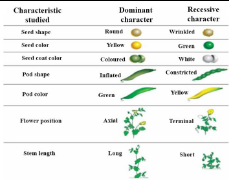
The number of characteristics of pea plants that Mendel considered for his experiments were :
  • A
    $2$
  • B
    $3$
  • C
    $4$
  • $7$
Answer
Correct option: D.
$7$
Seven characters found in garden pea plants were selected by Mendel for his experiment.
They were seed shape, seed colour, flower colour, pod shape, pod colour, flower position, and stem height.
For the experiments, Mendel selected a set of two contrasting traits for each of these characters.
View full question & answer
MCQ 881 Mark
According to scientists, aves have evolved from :
  • A
    Mammals.
  • B
    Amphibians.
  • Reptiles.
  • D
    Arthropods.
Answer
Correct option: C.
Reptiles.
According to scientists, aves have evolved from reptiles.
View full question & answer
MCQ 891 Mark
What determines the sex of a child?
  • A
    Chromosome content of the ovum.
  • Chromosome content of the sperm.
  • C
    Number of days between ovulation and fertilization.
  • D
    Number of days between fertilization and implantation.
Answer
Correct option: B.
Chromosome content of the sperm.
Men determine the sex of a baby depending on whether their sperm is carrying an $X$ or $Y$ chromosome. An $X$ chromosome combines with the mother's $X$ chromosome to make a baby girl $(XX)$ and a $Y$ chromosome will combine with the mother's to make a boy $(XY).$
View full question & answer
MCQ 901 Mark
A zygote which has an $X$ chromosome inherited from the father will develop into a
  • A
    Boy
  • Girl
  • C
    $X$ chromosome does not determine the sex of a child
  • D
    Either boy or girl
Answer
Correct option: B.
Girl
View full question & answer
MCQ 911 Mark
Homologous organs are :
  • A
    Leg of man, leg of horse, wing of bat.
  • B
    Hand of man, tail of horse, wing of bat.
  • Hand of man, forelimb of horse, wing of bat.
  • D
    Hand of man, leg of horse, wing of bat.
Answer
Correct option: C.
Hand of man, forelimb of horse, wing of bat.
Homologous organs are those that have similar structures and share common ancestors but have different functions e.g., the wings of a bat for flight, the lateral fin of a whale for swimming, and the human arm to hold or lift any object.
View full question & answer
MCQ 921 Mark
Which genotype represents a true dihybrid condition :
  • $\ce{TtRr}$
  • B
    $\ce{ttrr}$
  • C
    $\ce{Ttrr}$
  • D
    $\ce{TrRR}$
Answer
Correct option: A.
$\ce{TtRr}$
A dihybrid cross considers two pairs of contrasting characters.
$\ce{TtRr}$ genotype is obtained from the dihybrid cross of $\ce{TTRR}$ and ttrr which are true $-$ breeding homozygous dominant and homozygous recessive breeding lines.
TtRr genotype consists of both dominant and recessive alleles for two different traits.
Hence, it's a dihybrid genotype.
On the other hand, other genotypes given in the questions contain heterozygous alleles for either one of the two traits or none at all.
View full question & answer
MCQ 931 Mark
Select the incorrect statement :
  • A
    Frequency of certain genes in a population change over several generations resulting in evolution.
  • Reduction in weight of the organism due to starvation is genetically controlled.
  • C
    Low weight parents can have heavy weight progeny.
  • D
    Traits which are not inherited over generations do not cause evolution.
Answer
Correct option: B.
Reduction in weight of the organism due to starvation is genetically controlled.
The weight reduction due to starvation is environmentally determined factor.
View full question & answer
MCQ 941 Mark
The visible characteristic in an organism is known as :
  • A
    Prototype.
  • B
    Stereotype.
  • Phenotype.
  • D
    Genotype
Answer
Correct option: C.
Phenotype.
The characteristic $($or trait$)$ in an organism that is visible is called its phenotype.
View full question & answer
MCQ 951 Mark
When two individuals are similar in external appearance but differ in their genetic make $-$ up, they are said to have the same :
  • Phenotype
  • B
    Genotype
  • C
    Homozygous
  • D
    Both $A$ and $C$
Answer
Correct option: A.
Phenotype
The characters of an organism that are visible are known as phenotypes and a genotype is defined as the unique genetic constitution of a living organism.
Now, the same phenotype may or may not belong to the same genotype.
As an example, the genotype of a tall plant can be $\ce{(TT)}$ or $\ce{(Tt)},$ but phenotypically both the genotypes will produce tall plants.
A homozygous genotype may include two normal alleles or two alleles that have the same variant.
View full question & answer
MCQ 961 Mark
Study the different conclusions drawn by students on the basis of their observations of fresh available specimens of plants and animals :
  • Potato and sweet potato are homologous organs.
  • Wings of insects and wings of bird are analogous organs.
  • Wings of insects and wings of bats are homologous organs.
  • Thoms of citrus arid tendrils of cucurbita are homologous organs.
The correct conclusions are:
  • A
    $\ce{I}$ and $\ce{II}$
  • $\ce{II}$ and $\ce{IV}$
  • C
    $\ce{I}$ and $\ce{III}$
  • D
    $\ce{III}$ and $\ce{IV}$
Answer
Correct option: B.
$\ce{II}$ and $\ce{IV}$
View full question & answer
MCQ 971 Mark
Select the statements that describe characteristics of genes:
  1. Genes are specific sequence of bases in a $\text{DNA}$ molecule.
  2. A gene does not code for proteins.
  3. In individuals of a given species, a specific gene is located on a particular chromosome.
  4. Each chromosome has only one gene
  • A
    $(i)$ and $(ii).$
  • $(i)$ and $(iii).$
  • C
    $(i)$ and $(iv).$
  • D
    $(ii)$ and $(iv).$
Answer
Correct option: B.
$(i)$ and $(iii).$
A gene is the section in a $\text{DNA}$ on a chromosome that codes for the formation of a protein, controlling a specific characteristic of the organism. The two genes which are responsible for a particular characteristic are always present on the corresponding position of the pair of chromosomes. There are thousands of genes on a chromosome, which control various characteristics of an organism.
View full question & answer
MCQ 981 Mark
Heterozygous purple $-$ flowered plant was crossed with homozygous recessive white $-$ flowered plant.The observed phenotype is :
  • A
    All purple
  • B
    All white
  • $50\% $ purple $,50\%$ white
  • D
    $75\%$
Answer
Correct option: C.
$50\% $ purple $,50\%$ white
Heterozygous Purple flower $- Pp$
Gametes $: P$ and $p$
Recessive white flower $: pp$
Gametes $: p$
Fusion thus yields $: Pp \ ($Purple$)$ and $pp \ ($white$)$
The ratio is $1:1$
View full question & answer
MCQ 991 Mark
You have potato, carrot, radish, sweet potato, tomato and ginger bought from the market in your jute bag. Identify two vegetables to represent the correct homologous structures.
  • A
    Potato and tomato.
  • B
    Carrot and tomato.
  • C
    Potato and sweet potato.
  • Carrot and radish.
Answer
Correct option: D.
Carrot and radish.
Homologous structures are similar in origin but perform different functions. Carrot and radish are underground roots. So, they represent the correct homologous structures.
View full question & answer
MCQ 1001 Mark
Some dinosaurs had feathers although they could not fly but birds have feathers that help them to fly. In the context of evolution this means that :
  • A
    Reptiles have evolved from birds.
  • B
    There is no evolutionary connection between reptiles and birds.
  • C
    Feathers are homologous structures in both the organisms.
  • Birds have evolved from reptiles.
Answer
Correct option: D.
Birds have evolved from reptiles.
Development of flight feathers in reptilian ancestors of birds lead to evolution of birds $($Aves$).$
View full question & answer