50 questions · timed · auto-graded
$\frac{1}{\text{v}}-\frac{1}{\text{u}}=\frac{1}{\text{f}}$
$-\frac{1}{80}-\frac{1}{\infty}=\frac{1}{\text{f}}$
$\frac{1}{\text{f}}=-\frac{1}{80}$
$\text{f} = -80 \text{ cm} = -0.8\text{ cm}$
We know, Power, $\text{P}=\frac{1}{\text{f(in metres)}}$$\text{P}=\frac{1}{-0.8}=-1.25 \ \text{D}$
A concave lens of power -1.25 D is required by the person to correct his defect.Using the relation
$\text{P}=\frac{1}{\text{f}} \ \text{or} \ \text{f}=\frac{1}{\text{P}}$
or $\text{f}=\frac{100}{-5.5} =-18.2 \ \text{cm}$
P = +1.5 D
Using the relation
$\text{P}=\frac{1}{\text{f}} \ \text{or} \ \text{f}=\frac{1}{\text{P}}$
or $\text{f}=\frac{100}{1.5} =66.7 \ \text{cm}$

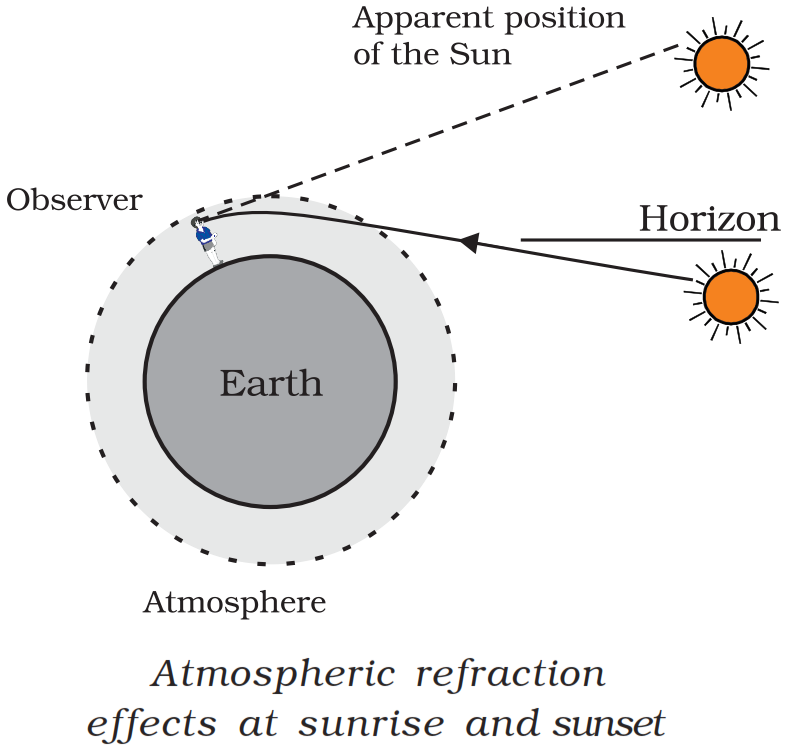
Sunrise can be observed two minutes before the sun actually gets above the horizon because of the phenomenon of bending of light as a result of atmospheric refraction. The rays coming from the sun get refracted because of the difference in the density of the atmospheric layers and then reach the observer. Thus, the light coming is perceived as coming from the sun and hence, the sunrise is seen two minutes before it actually rises.


Non - metallic/ poor conductor of electricity.

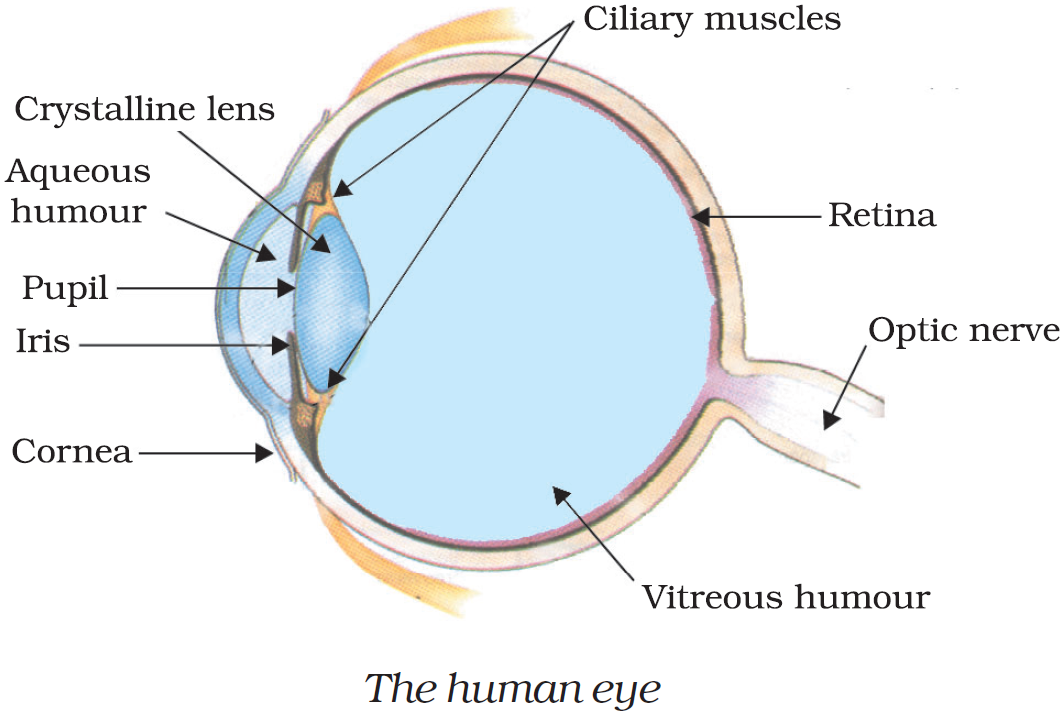
Cornea: focuses light rays and permits the light to enter the eye.
Iris: Controls amount of light entering the eye and controls the size of pupil.
Crystalline Lens: Converges light rays onto retina.
Cilliary Muscles: Adjusts focal length of eye lens by contraction and relaxation so that sharp image can be obtained on the retina. It helps in accommodation.
OR
Why does sun appear reddish at sunrise? Give reason.Alternate Answer
Sun appears red at sunrise as the rays have to travel a larger part of the atmosphere because they are very close to the horizon. Therefore, light other than red is mostly scattered away. Most of the red light, which is the least scattered, enters our eyes. Hence, the sun during sunrise appear red.