Questions · Page 1 of 5

M.C.Q

🎯

Test yourself on this topic

50 questions · timed · auto-graded

MCQ 11 Mark
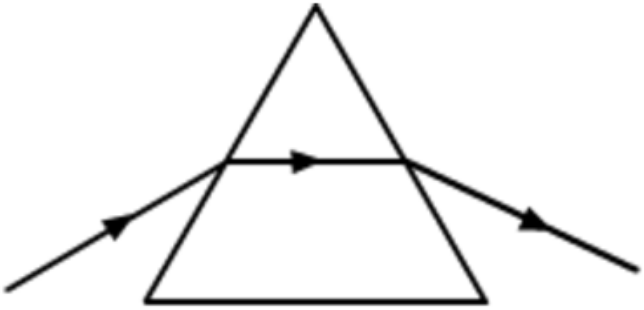
In the following diagram, the path of a ray of light passing through a glass prism is shown :
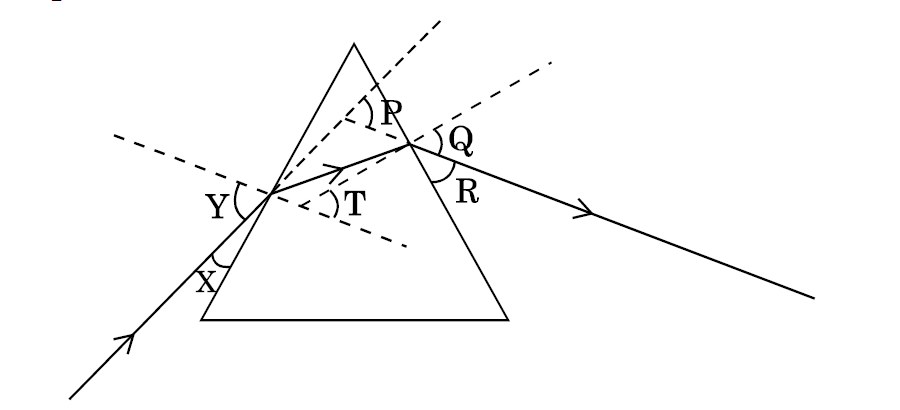
In this diagram the angle of incidence, the angle of emergence and the angle of deviation respectively are $($select the correct option$) :$
  • A
    $X, R$ and $T.$
  • B
    $Y, Q$ and $T.$
  • C
    $X, Q$ and $P.$
  • $Y, Q$ and $P.$
Answer
Correct option: D.
$Y, Q$ and $P.$
The angle made by the incident ray with the normal to the first face of the prism is called incident angle, which is angle $Y$ here.
The angle made by the emergent ray with the normal to the surface when it comes out from the prism after refraction is called emergent angle, which is angle $Q$ here.
The angle between the incident ray and the emergent ray is called angle of deviation, which is angle $P$ here.
Hence, the correct option is $D.$
View full question & answer
MCQ 21 Mark
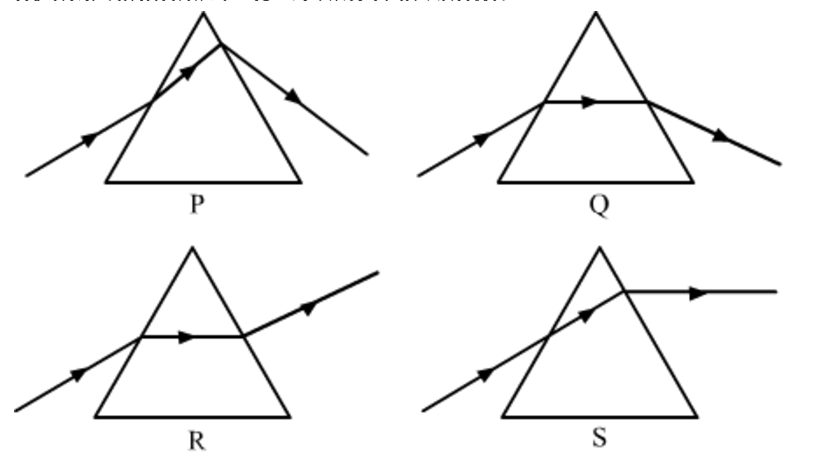
Study the following diagrams in which the path of a ray of light passing through a glass prism as traced by four students $\ce{P, Q, R}$ and $S$ is shown :

The student who has traced the path correctly is
  • A
    $P$
  • $Q$
  • C
    $R$
  • D
    $S$
Answer
Correct option: B.
$Q$
Student $Q$ has traced the path correctly.

When light is travelling from a rarer medium to a denser medium, it bends towards the normal to the surface, while the light from a denser medium to a rarer medium bends away from the normal to the surface.
Hence, the correct option is $B.$
View full question & answer
MCQ 31 Mark
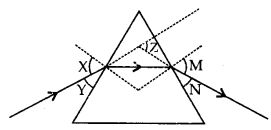
For the refraction of a ray of light through a glass prism, the path of a ray of light is shown below :
The angle of incidence, the angle of emergence and the angle of deviation respectively have been represented by
  • A
    $\ce{Y, N, Z}.$
  • B
    $\ce{X, Z, M}.$
  • C
    $\ce{X, N, Z}.$
  • $\ce{X, M, Z}.$
Answer
Correct option: D.
$\ce{X, M, Z}.$
View full question & answer
MCQ 41 Mark
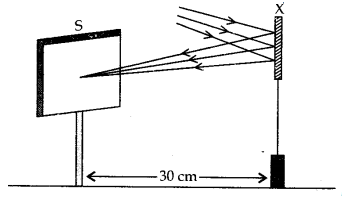
A student focussed the image of a distant object using a device $X$ on a white screen S as shown in the figure. If the distance of the screen from the device is $30 \ cm,$ select the correct statement about the device $X.$​​​​​​​
  • A
    The device $X$ is a concave mirror of focal length $15 \ cm$
  • The device $X$ is a concave mirror of focal length $30 \ cm.$
  • C
    The device $X$ is a concave mirror of radius of curvature $30 \ cm.$
  • D
    The device $X$ is a convex mirror of focal length $30 \ cm.$
Answer
Correct option: B.
The device $X$ is a concave mirror of focal length $30 \ cm.$
View full question & answer
MCQ 51 Mark
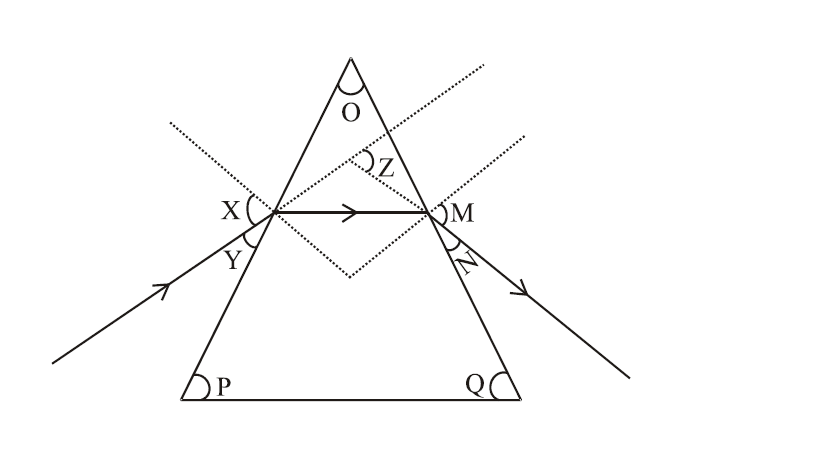
The path of a ray of light passing through a glass prism is shown below : In this diagram the angle of prism, angle of incidence, angle of emergence and angle of deviation respectively have been represented by
  • A
    $\ce{O, Y, Z}$ and $\ce{N}.$
  • B
    $\ce{P, Y, M}$ and $\ce{Z.}$
  • $\ce{O, X, M}$ and $\ce{Z.}$
  • D
    $\ce{P, X, Z}$ and $\ce{N}.$
Answer
Correct option: C.
$\ce{O, X, M}$ and $\ce{Z.}$
$O$ is the angle of prism.
Angle of incidence is the angle made by the incident ray with the normal to the surface of the prism. Here, $X$ represents the angle of incidence.
Angle of emergence is the angle made by the emerging ray with the normal to the surface of the prism. Here, $M$ represents the angle of emergence.
Angle of deviation is the angle made by the emerging ray with the incident ray. Here, $Z$ represents the angle of deviation.
Hence, the correct option is $C.$
View full question & answer
MCQ 61 Mark
A student is observing the diagram showing the path of a ray of light passing through a glass prism. He would find that for all angles of incidence the ray of light bends :
  • Towards the normal while entering into the prism and away from the normal while emerging out of the prism.
  • B
    Away from the normal while entering into the prism and towards the normal while emerging out of the prism.
  • C
    Away from the normal while entering as well as while emerging out of the prism.
  • D
    Towards the normal while entering as well as while emerging out of the prism.
Answer
Correct option: A.
Towards the normal while entering into the prism and away from the normal while emerging out of the prism.
When a ray of light enters a glass prism, it travels from a rarer medium to a denser medium. So, the ray of light bends towards the normal.
When the ray of light emerges from the glass prism, it travels from a denser medium to a rarer medium. So, the ray of light bends away from the normal.
Hence, the correct option is $A$.
View full question & answer
MCQ 71 Mark
Study the following ray diagrams :
  • A
    $\ce{II}$ and $\ce{III}$ only
  • B
    $\ce{I}$ and $\ce{II}$ only
  • $\ce{I, II}$ and $\ce{III}$
  • D
    $\ce{I, II}$ and $\ce{IV}$
Answer
Correct option: C.
$\ce{I, II}$ and $\ce{III}$
View full question & answer
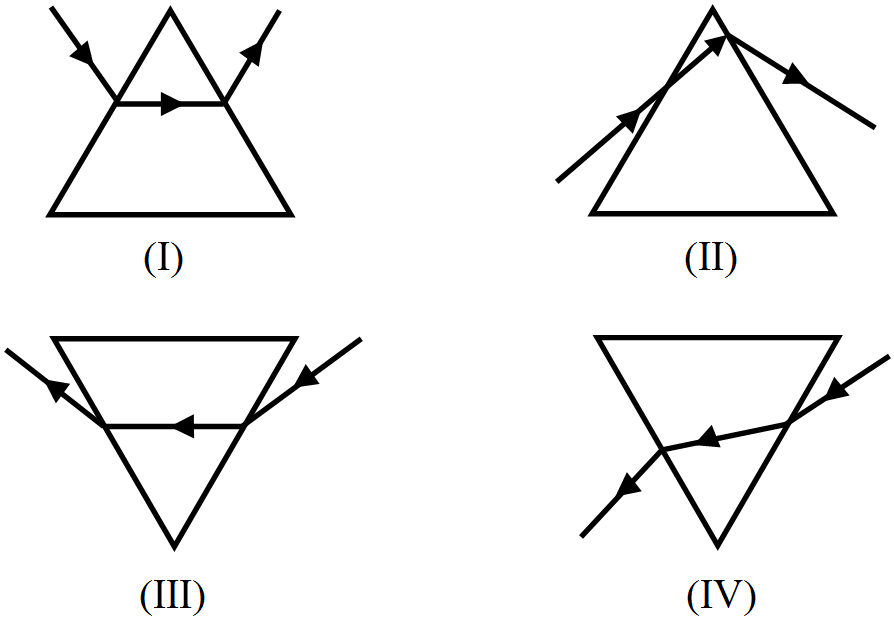
MCQ 81 Mark
While performing the experiment to trace the path of a ray of light passing through a glass prism, four students marked the incident ray and the emergent ray in their diagrams in the manner shown below :
  • A
    $\ce{I}$
  • B
    $\ce{II}$
  • $\ce{III}$
  • D
    $\ce{IV}$
Answer
Correct option: C.
$\ce{III}$
When light goes from rarer medium to denser medium it bends towards the normal. The light bends away from the normal when it goes from a denser medium to rarer medium.
This condition is fulfilled in figure $\ce{III.}$
View full question & answer
MCQ 91 Mark
Consider the following properties of virtual images :
  1. Cannot be projected on the screen.
  2. Are formed by both concave and convex lens.
  3. Are always erect.
  4. Are always inverted.
The correct properties are :
  • A
    $(A)$ and $(D).$
  • $(A)$ and $(B).$
  • C
    $(A), (B)$ and $(C).$
  • D
    $(A), (B)$ and $(D).$
Answer
Correct option: B.
$(A)$ and $(B).$
Virtual Images are images which can only be seen in a mirror but cannot be obtained on the screen. They are formed when light rays after getting reflected from a mirror appear to meet at a point. A virtual image is erect with respect to the object.
View full question & answer
MCQ 101 Mark
A real image is formed by the light rays after reflection or refraction when they :
  1. Actually meet or intersect with each other.
  2. Actually converge at a point.
  3. Appear to meet when they are produced in the backward direction.
  4. Appear to diverge from a point. Which of the above statements are correct?z
Which of the above statements are correct?
  • A
    $(A)$ and $(D).$
  • B
    $(B)$ and $(D).$
  • $(A)$ and $(B).$
  • D
    $(B)$ and $(C).$
Answer
Correct option: C.
$(A)$ and $(B).$
Real Images are images which can be obtained on the screen. They are formed when light rays after getting reflected from a mirror actually meet at a point. A real image is inverted with respect to the object.
View full question & answer
MCQ 111 Mark
Which of the following statement is correct?
  • A
    A person with myopia can see distant objects clearly.
  • B
    A person with hypermetropia can see nearby objects clearly.
  • A person with myopia can see nearby objects minutes before act clearly.
  • D
    A person with hypermetropia cannot see distant objects clearly.
Answer
Correct option: C.
A person with myopia can see nearby objects minutes before act clearly.
Nearsightedness, or myopia is inability to see the far located objects clearly.
View full question & answer
MCQ 121 Mark
A series of fast $-$ moving still pictures can create an illusion of movement because :
  • A
    The eye can focus on very rapidly changing pictures
  • B
    The eye is quicker than the brain
  • The eye can separate two images only when the interval of separation between them is one-sixteenth of a second
  • D
    The optical cortex can see through the rapidly moving images
Answer
Correct option: C.
The eye can separate two images only when the interval of separation between them is one-sixteenth of a second
The impression of an image does not vanish immediately from the retina.
It persists there for about one-sixteenth of a second.
So, if still images of a moving object are flashed on the eye at a rate faster than $16$ per second, then the eye perceives this object as moving.
View full question & answer
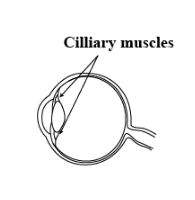
MCQ 131 Mark
The change in focal length of an eye $-$ lens is caused by the action of the :
  • A
    Pupil.
  • B
    Retina.
  • Ciliary muscles.
  • D
    Iris.
Answer
Correct option: C.
Ciliary muscles.
The ciliary muscles change the focal length of the eye lens by changing its shape.
View full question & answer
MCQ 141 Mark
The ability of the eye lens to adjust its focal length is called :
  • Accommodation
  • B
    Accomplish
  • C
    Composition
  • D
    None of the above
Answer
Correct option: A.
Accommodation
View full question & answer
MCQ 151 Mark
The human eye forms the image of an object at its :
  • A
    Cornea.
  • B
    Iris.
  • C
    Pupil.
  • Retina.
Answer
Correct option: D.
Retina.
The human eye forms the image of an object on its retina.
View full question & answer
MCQ 161 Mark
Twinkling of stars is due to atmospheric :
  • A
    Dispersion of light by water droplets.
  • Refraction of light by different layers of varying refractive indices.
  • C
    Scattering of light by dust particles.
  • D
    Internal reflection of light by clouds.
Answer
Correct option: B.
Refraction of light by different layers of varying refractive indices.
The twinkling of a star is due to atmospheric refraction of light of stars.
View full question & answer
MCQ 171 Mark
$1.54$ is combined with another prism $p_2$ made from glass of refractive index $1.92$ to produce dispersion without deviation. Then the angle of prism $p_2$ is
  • A
    $2.3^\circ$
  • $4.3^\circ $
  • C
    $3.2^\circ$
  • D
    $2.0^\circ$
Answer
Correct option: B.
$4.3^\circ $
The angle of deviation for a prism the is given by
$\Delta=(\text{n}-1)\times\text{A}$
Where $, n =$ refractive index of prism
$A =$ angle of prism
Given : The two prisms when combined produce dispersion without deviation. Conclusion : For no deviation for the two prism the deviation caused by two prism should be opposite to each other.
$(\text{n1}-1)\times\text{A}_{1}=(\text{n}_{2}-1)\times\text{A}_{2}$
$\text{A}_{2}=\frac{(\text{n1}-1)\times\text{A}_{1}}{\text{A}}$
$\text{A}_{2}=\frac{(1.54-1)\times4}{(\text{n2}-1)}$
$\text{A2}=4.3^\circ$
View full question & answer
MCQ 181 Mark
The danger signals installed at the top of tall buildings are red in colour. These can be easily seen from a distance because among all other colours, the red light :
  • A
    is scattered the most by smoke or fog.
  • is scattered the least by smoke or fog.
  • C
    is absorbed the most by smoke or fog.
  • D
    moves fastest in air.
Answer
Correct option: B.
is scattered the least by smoke or fog.
View full question & answer
MCQ 191 Mark
A parallel beam of light falling on the eye gets focused on the retina because of refraction at :
  • The cornea
  • B
    The crystalline lens
  • C
    The vitreous humor
  • D
    Various surfaces in the eye
Answer
Correct option: A.
The cornea
Most of the refraction for the light rays entering the eye occurs at the outer surface of the cornea.
View full question & answer
MCQ 201 Mark
Advanced sunrise and delayed sunset is due to $............$ of sunlight :
  • Atmospheric refraction.
  • B
    Atmospheric dispersion.
  • C
    Internal reflection.
  • D
    Scattering.
Answer
Correct option: A.
Atmospheric refraction.
Advanced sunrise and delayed sunset. The sunrise is advanced due to atmospheric refraction of sunlight. An observer on the earth sees the sun two minutes before the sun reaches the horizon.
View full question & answer
MCQ 211 Mark
When light rays enter the eye, most of the refraction occurs at the :
  • A
    Crystalline lens
  • Outer surface of the cornea
  • C
    Iris
  • D
    Pupil
Answer
Correct option: B.
Outer surface of the cornea
Cornea is the transparent spherical part of the eye covering the iris and pupil.
When an object appears in front of the eye, the rays from the object enter through this transparent cornea and refraction occurs at the outer
View full question & answer
MCQ 221 Mark
Which of the following colour of white light has the least wavelength?
  • A
    Red.
  • B
    Orange.
  • Violet.
  • D
    Blue.
Answer
Correct option: C.
Violet.
Violet is the colour of white light that has the least wavelength.
View full question & answer
MCQ 231 Mark
The animal which does not have eyes that look sideways is :
  • A
    Horse.
  • B
    Chicken.
  • Lion.
  • D
    Fish.
Answer
Correct option: C.
Lion.
A lion does not have eyes that face sideways.
View full question & answer
MCQ 241 Mark
The splitting up of white light into seven colours on passing through a glass prism is called :
  • A
    Refraction.
  • B
    Deflection.
  • Dispersion.
  • D
    Scattering.
Answer
Correct option: C.
Dispersion.
The splitting of white light into seven colours on passing through a glass prism is called dispersion.
View full question & answer
MCQ 251 Mark
A man driving a car can read a distant road sign clearly but finds difficulty in reading the odometer on the dashboard of the car. Which of the following statement is correct about this man.
  • The near point of his eyes has receded away.
  • B
    The near point of his eyes has come closer to him.
  • C
    The far point of his eyes has receded away.
  • D
    The far point of his eyes has come closer to him.
Answer
Correct option: A.
The near point of his eyes has receded away.
If a man driving a car can see a distant road sign distinctly but cannot read the odometer on the dashboard of the car clearly, it suggests that the near point of his eyes has receded.
View full question & answer
MCQ 261 Mark
The animals of prey have :
  • A
    Two eyes at the front.
  • B
    Two eyes at the back.
  • Two eyes on the sides.
  • D
    One eye at the front and one on the side.
Answer
Correct option: C.
Two eyes on the sides.
Animals of prey have two eyes on the sides of their head. This gives them a wide field of view and allows them to see the approach of potential predators.
View full question & answer
MCQ 271 Mark
The defect of vision in which the person is able to see distant object distinctly but cannot see nearby objects clearly is called :
  • Far $-$ sightedness
  • B
    Near $-$ sightedness
  • C
    Presbyopia
  • D
    All of above
Answer
Correct option: A.
Far $-$ sightedness
View full question & answer
MCQ 281 Mark
In the case of hypermetropia :
  • The image of a near object is formed behind the retina
  • B
    The image of a distant object is formed in front of the retina
  • C
    A concave lens should be used for correction
  • D
    Abifocal lens should be used for correction
Answer
Correct option: A.
The image of a near object is formed behind the retina
In hypermetropia image of a distance object is formed on the retina and image of a near object is formed behind the retina.
For correction of hypermetropia , convex lens is used.
View full question & answer
MCQ 291 Mark
A hollow glass prism gives :
  • A
    A dim spectrum
  • B
    Bright spectrum
  • No spectrum
  • D
    Only continuous spectrum
Answer
Correct option: C.
No spectrum
A hollow glass prism does not give any spectrum because it does not have any medium inside it is hollow from inside so white light can not split in vacuum because in vacuum all colors light travel with same speed hence they do not split and no spectrum is observed.
View full question & answer
MCQ 301 Mark
The clear sky appears blue because :
  • A
    Blue light gets absorbed in the atmosphere.
  • B
    Ultraviolet radiations are absorbed in the atmosphere.
  • Violet and blue lights get scattered more than lights of all other colours by the atmosphere.
  • D
    Light of all other colours is scattered more than the violet and blue colour lights by the atmosphere.
Answer
Correct option: C.
Violet and blue lights get scattered more than lights of all other colours by the atmosphere.
View full question & answer
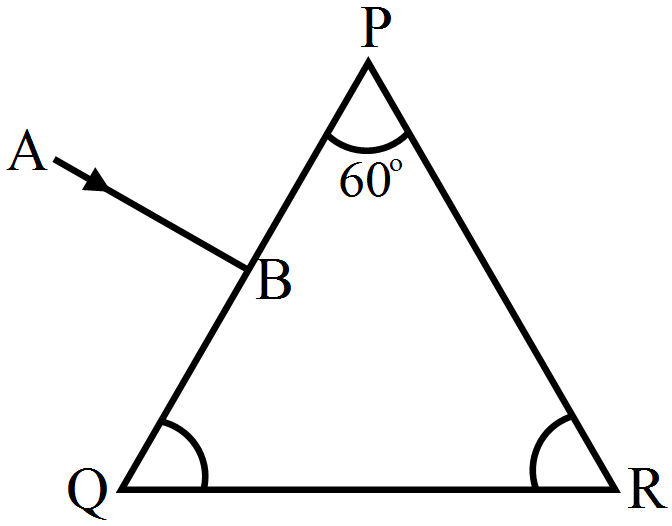
MCQ 311 Mark
In given figure, a light ray $AB$ is incident normally on one face $PQ$ of an equilateral glass prism. Find out the angles at faces $PQ$ and $PR$. Find out the angles at faces $PQ$ and $PR.$​​​​​​​
  • $60^\circ $
  • B
    $30^\circ$
  • C
    $45^\circ$
  • D
    $90^\circ$
Answer
Correct option: A.
$60^\circ $
Angle of incidence, $i=0^{\circ}$
Angle of refraction, $r=\sin (i) \times n$
Where $n=$ refractive index
So, $r_1=0^{\circ}$ Where,
$r_1=$ angle of refraction at
$PQ \ \ r_2=$ angle of incidence from inside on side
$PR \ \ A =$ angle of prism
We know that $A=r_1+r_2$
$r_2=A-r_1$
$=60^{\circ}-0^{\circ}$
$=60^{\circ}$
 
View full question & answer
MCQ 321 Mark
Change in focal length of an eye $-$ lens to focus the image of the object at varying distances is done by the action of :
  • A
    Pupil
  • Ciliary muscles
  • C
    Retina
  • D
    Blind spot
Answer
Correct option: B.
Ciliary muscles
The ciliary muscles change the focal length of the eye lens to focus objects at variable distances.
View full question & answer
MCQ 331 Mark
A myopic person cannot see distinctly, objects that are :
  • A
    near
  • far
  • C
    Neither
  • D
    horizontal and vertical signs
Answer
Correct option: B.
far
Myopia is a vision defect in which a person can see nearby objects clearly but is not able to see distinct objects clearly. In this defect, the rays coming from distant objects, focus in front of retina, instead of on retina.
View full question & answer
MCQ 341 Mark
At noon, the Sun appears white as :
  • A
    Blue colour is scattered the most.
  • B
    Red colour is scattered the most.
  • Light is least scattered.
  • D
    All the colours of the white light are scattered away.
Answer
Correct option: C.
Light is least scattered.
View full question & answer
MCQ 351 Mark
The speed of light will be minimum while passing through :
  • Glass
  • B
    Air
  • C
    Water
  • D
    Vacuum
Answer
Correct option: A.
Glass
View full question & answer
MCQ 361 Mark
The muscular diaphragm that controls the size of the pupil is :
  • A
    Cornea
  • B
    Ciliary muscles
  • Iris
  • D
    Retina
Answer
Correct option: C.
Iris
View full question & answer
MCQ 371 Mark
One cannot see through the fog, because :
  • A
    Refractive index of the fog is very high.
  • B
    Light suffers total reflection at droplets.
  • C
    Fog absorbs light.
  • Light is scattered by the droplets.
Answer
Correct option: D.
Light is scattered by the droplets.
View full question & answer
MCQ 381 Mark
The defect of vision in which a person cannot see the distant objects clearly but can see nearby objects clearly is called :
  • Myopia
  • B
    Hypermetropia
  • C
    Presbyopia
  • D
    Bifocal eye
Answer
Correct option: A.
Myopia
View full question & answer
MCQ 391 Mark
The danger signals installed at the top of tall buildings are red in colour. These can be easily seen from a distance because among all other colours, the red light :
  • A
    Is scattered the most by smoke or fog.
  • Is scattered the least by smoke or fog.
  • C
    Is absorbed the most by smoke or fog.
  • D
    Moves fastest in air.
Answer
Correct option: B.
Is scattered the least by smoke or fog.
Red colour is scattered the least by smoke or fog due to its largest wavelength.
View full question & answer
MCQ 401 Mark
It is very difficult to see through fog because :
  • Of scattering of light
  • B
    Of total internal reflection
  • C
    Fog is good absorber of light
  • D
    Refractive index offog is very large
Answer
Correct option: A.
Of scattering of light
View full question & answer
MCQ 411 Mark
When white light enters a prism, it gets split into its constituent colours. This is due to :
  • Different refractive index for different wavelength of each colour
  • B
    Each colours has same velocity in the prism.
  • C
    Prism material have high density.
  • D
    Scattering of light.
Answer
Correct option: A.
Different refractive index for different wavelength of each colour
View full question & answer
MCQ 421 Mark
A near sighted person wears eye glass of power $5.5D$ for distant vision. His doctor prescribes a correction of $+\ ID$ in near vision part of his bifocals, which is measured relative to the main part of the lens. Then, the focal length of his near vision part of the lens is.
  • A
    $-18.18\ cm$
  • B
    $-20\ cm$
  • $-22.22\ cm$
  • D
    $+\ 20.22\ cm$
Answer
Correct option: C.
$-22.22\ cm$
It is given that Power of Lens $, P = 5.5 D$
Now, since this lens is used for Myopic Eye,
so it will be concave lens and hence the sign will be negative.
So
$P = - 5.5 D$
Now, for near vision power is to be increased by $+\ 1 D.$
Therefore,
Power $= -5.5 D + 1 D = -4.5 D$
Now, we know,$\text{P}=\frac{1}{\text{f}}$
$=\frac{1}{\text{p}}$
$=\frac{1}{\text{4.5}}$
$=-22.22\text{ cm}$
Hence, Option $C$ is correct.
View full question & answer
MCQ 431 Mark
A person cannot see distinctly objects kept beyond 2m. This defect can be corrected by using a lens of power :
  • A
    $+\ 0.5D$
  • $-\ 0.5D$
  • C
    $+\ 0.2D$
  • D
    $-\ 0.2D$
Answer
Correct option: B.
$-\ 0.5D$
This person is suffering from myopia. He needs a concave lens and hence power would be in negative.
$\text{P}=\frac{1}{\text{f}}=\frac{1}{2\text{m}}=0.5\text{D}$
View full question & answer
MCQ 441 Mark
The defect of vision which cannot be corrected by using spectacles is :
  • A
    Myopia.
  • B
    Presbyopia.
  • Cataract.
  • D
    Hypermetropia.
Answer
Correct option: C.
Cataract.
Cataract is the defect of vision that cannot be corrected by using spectacles. It requires surgical intervention.
View full question & answer
MCQ 451 Mark
The person who is suffering from the following disease cannot donate eyes.
  • A
    Diabetes
  • B
    Asthma
  • C
    Hypertension
  • Tetanus
Answer
Correct option: D.
Tetanus
View full question & answer
MCQ 461 Mark
The size of the pupil of the eye is adjusted by :
  • A
    Cornea.
  • B
    Ciliary muscles.
  • C
    Optic nerve.
  • Iris.
Answer
Correct option: D.
Iris.
The iris controls the size of the pupil.
View full question & answer
MCQ 471 Mark
Image forming light sensitive screen of the eye is known as $...........$ and it contains $............. ?$
  • A
    iris, blind spot
  • B
    cornea, blind spot
  • retina, photoreceptors
  • D
    cornea, photoreceptors
Answer
Correct option: C.
retina, photoreceptors
Aqueous humour is present between cornea and eye lens.It keeps the cornea moist and maintains the shape of eye ball.
View full question & answer
MCQ 481 Mark
After testing the eyes of a child, the optician has prescribed the following lenses for his spectacles:
Left eye : $+\ 2.00D$
Right eye : $+\ 2.25D$
The child is suffering from the defect of vision called:
  • A
    Short $-$ sightedness.
  • Long $-$ sightedness.
  • C
    Cataract.
  • D
    Presbyopia.
Answer
Correct option: B.
Long $-$ sightedness.
The optician has prescribed convex lenses for the child's spectacles, because a convex lens is used to increase the converging power of the eye lens. This shows that the child is suffering from the defect of vision called long $-$ sightedness.
View full question & answer
MCQ 491 Mark
For a myopic $($short $-$ sighted$)$ eye, rays from far distant objects are brought to focus at a point :
  • A
    On the retina
  • B
    Behind the retina
  • In between eye lens and retina
  • D
    At any position
Answer
Correct option: C.
In between eye lens and retina
In a myopic eye, rays from distant objects are brought to focus at a point in between eye lens and retina.
A myopic person can not see distance objects clearly, but is able to see nearby objects clearly.
View full question & answer
MCQ 501 Mark
A person cannot see distant objects clearly. His vision can be corrected by using the spectacles containing :
  • A
    Concave lenses.
  • B
    Plane lenses.
  • Contact lenses.
  • D
    Convex lenses.
Answer
Correct option: C.
Contact lenses.
Concave lenses are used to correct the defect of vision and enable the person to see distant objects clearly.
View full question & answer
M.C.Q - Science STD 10 Questions - Vidyadip