Questions

M.C.Q

🎯

Test yourself on this topic

14 questions · timed · auto-graded

MCQ 11 Mark
Twinkling of stars is due to atmospheric:
  • A
    Dispersion of light by water droplets.
  • Refraction of light by different layers of varying refractive indices.
  • C
    Scattering of light by dust particles.
  • D
    Internal reflection of light by clouds.
Answer
Correct option: B.
Refraction of light by different layers of varying refractive indices.
The twinkling of a star is due to atmospheric refraction of light of stars.
View full question & answer
MCQ 21 Mark
The danger signals installed at the top of tall buildings are red in colour. These can be easily seen from a distance because among all other colours, the red light:
  • A
    Is scattered the most by smoke or fog.
  • Is scattered the least by smoke or fog.
  • C
    Is absorbed the most by smoke or fog.
  • D
    Moves fastest in air.
Answer
Correct option: B.
Is scattered the least by smoke or fog.
Red colour is scattered the least by smoke or fog due to its largest wavelength.
View full question & answer
MCQ 31 Mark
A person cannot see distinctly objects kept beyond 2m. This defect can be corrected by using a lens of power:
  • A
    +0.5D
  • -0.5D
  • C
    +0.2D
  • D
    -0.2D
Answer
Correct option: B.
-0.5D
This person is suffering from myopia. He needs a concave lens and hence power would be in negative.
$\text{P}=\frac{1}{\text{f}}=\frac{1}{2\text{m}}=0.5\text{D}$
View full question & answer
MCQ 41 Mark
Which of the following phenomena of light are involved in the formation of a rainbow?
  • A
    Reflection, refraction and dispersion.
  • B
    Refraction, dispersion and total internal reflection.
  • Refraction, dispersion and internal reflection.
  • D
    Dispersion, scattering and total internal reflection.
Answer
Correct option: C.
Refraction, dispersion and internal reflection.
Dispersion results in white light getting segregated into its component colours. Refraction bends the incident light to an angle that is causes internal reflection; and finally rainbow is formed.
View full question & answer
MCQ 51 Mark
The focal length of the eye lens increases when eye muscles:
  • Are relaxed and lens becomes thinner.
  • B
    Contract and lens becomes thicker.
  • C
    Are relaxed and lens becomes thicker.
  • D
    Contract and lens becomes thinner.
Answer
Correct option: A.
Are relaxed and lens becomes thinner.
Focal length of thin lens is greater than the focal length of thick glass.
View full question & answer
MCQ 61 Mark
A student sitting on the last bench can read the letters written on the blackboard but is not able to read the letters written in his text book. Which of the following statements is correct?
  • The near point of his eyes has receded away.
  • B
    The near point of his eyes has come closer to him.
  • C
    The far point of his eyes has come closer to him.
  • D
    The far point of his eyes has receded away.
Answer
Correct option: A.
The near point of his eyes has receded away.
Student suffers from hypermetropia. In this case, the near point of the eye recedes away.
View full question & answer
MCQ 71 Mark
Which of the following statements is correct regarding the propagation of light of different colours of white light in air?
  • A
    Red light moves fastest.
  • B
    Blue light moves faster than green light.
  • All the colours of the white light move with the same speed.
  • D
    Yellow light moves with the mean speed as that of the red and the violet light.
Answer
Correct option: C.
All the colours of the white light move with the same speed.
Speed of light is a constant value regardless of its colour.
View full question & answer
MCQ 81 Mark
Which of the following statement is correct?
  • A
    A person with myopia can see distant objects clearly.
  • B
    A person with hypermetropia can see nearby objects clearly.
  • A person with myopia can see nearby objects clearly.
  • D
    A person with hypermetropia cannot see distant objects clearly.
Answer
Correct option: C.
A person with myopia can see nearby objects clearly.
Hypermetropia: A person suffering from this defect can see far off objects clearly but cannot see nearby objects clearly.

Myopia: A person suffering from th is defect can see nearby objects clearly but cannot see far off objects clearly.
View full question & answer
MCQ 91 Mark
At noon the sun appears white as:
  • Light is least scattered.
  • B
    All the colours of the white light are scattered away.
  • C
    Blue colour is scattered the most.
  • D
    Red colour is scattered the most.
Answer
Correct option: A.
Light is least scattered.
Sun is directly over head and sunlight travel relatively shorter distance causing only little of the blue and violet colours to be scattered.
View full question & answer
MCQ 101 Mark
When light rays enter the eye, most of the refraction occurs at the:
  • A
    Crystalline lens.
  • Outer surface of the cornea.
  • C
    Iris.
  • D
    Pupil.
Answer
Correct option: B.
Outer surface of the cornea.
The transparent, anterior portion of outer layer of eyeball is termed as cornea which causes most of the bending of incident light rays, i.e. refraction, to make them converge which in turn causes image formation on retina.
View full question & answer
MCQ 111 Mark
The clear sky appears blue because:
  • A
    Blue light gets absorbed in the atmosphere.
  • B
    Ultraviolet radiations are absorbed in the atmosphere.
  • Violet and blue lights get scattered more than lights of all other colours by the atmosphere.
  • D
    Light of all other colours is scattered more than the violet and blue colour lights by the atmosphere.
Answer
Correct option: C.
Violet and blue lights get scattered more than lights of all other colours by the atmosphere.
Intensity of scattered light, $1\propto\frac{1}{\lambda^4}.$ The wavelength of blue and violet light is smaller than the wavelengths of other colours.
View full question & answer
MCQ 121 Mark
The bluish colour of water in deep sea is due to:
  • A
    The presence of algae and other plants found in water.
  • Reflection of sky in water.
  • C
    Scattering of light.
  • D
    Absorption of light by the sea.
Answer
Correct option: B.
Reflection of sky in water.
Water is colourless. Its colour appears to be same as the object reflected by it.
View full question & answer
MCQ 131 Mark
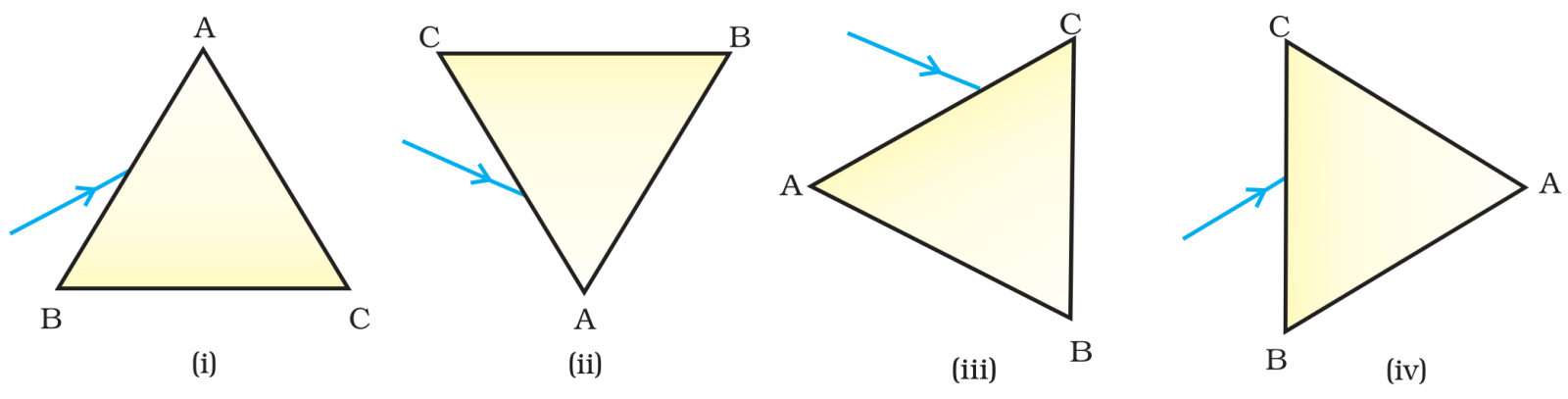
A prism ABC (with BC as base) is placed in different orientations. A narrow beam of white light is incident on the prism as shown in Figure. In which of the following cases, after dispersion, the third colour from the top corresponds to the colour of the sky?
  • A
    (i)
  • (ii)
  • C
    (iii)
  • D
    (iv)
Answer
Correct option: B.
(ii)
Colour of sky is blue.
View full question & answer
MCQ 141 Mark
Which of the following phenomena contributes significantly to the reddish appearance of the sun at sunrise or sunset?
  • A
    Dispersion of light.
  • Scattering of light.
  • C
    Total internal reflection of light.
  • D
    Reflection of light from the earth.
Answer
Correct option: B.
Scattering of light.
Red colour scatters the least and hence travels the farthest. During sunset or sunrise, light has to travel a longer distance to reach us. Hence, only red light reaches to us and the sky appears reddish.
View full question & answer
M.C.Q - Science STD 10 Questions - Vidyadip