Questions · Page 1 of 4

[1 Mark Questions]

🎯

Test yourself on this topic

50 questions · timed · auto-graded

Question 11 Mark
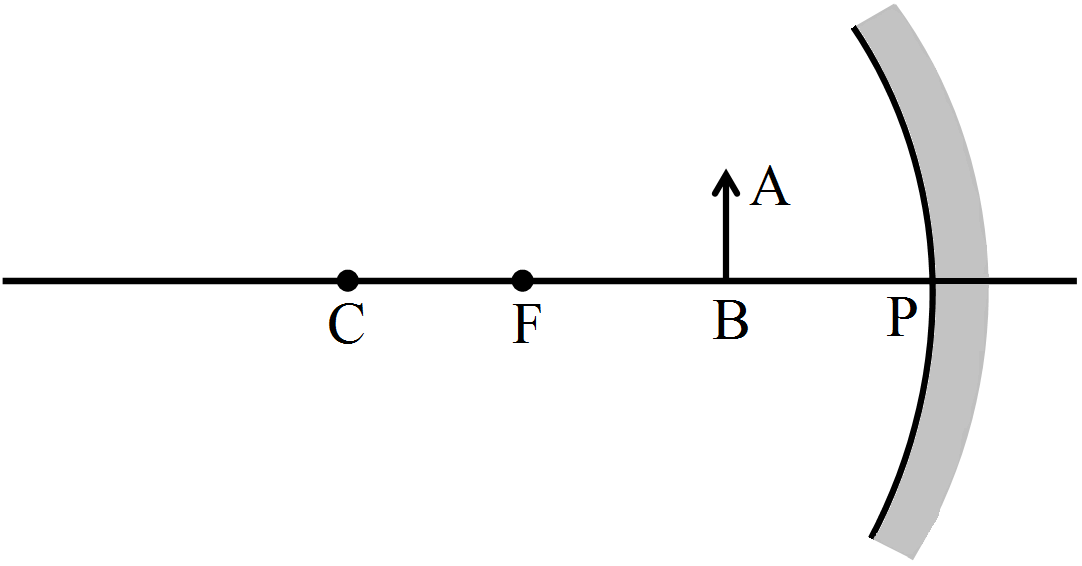
Draw the following diagram in your answer-book and show the formation of image of the object AB with the help of suitable rays.
View full question & answer
Question 21 Mark
What is the magnification of the images formed by plane mirrors and why?
Answer
The magnification of the image formed by a plane mirror is 1. This is because the size of the image formed is equal to the size of the object.
Magnification, $m = \frac{H_{i}}{H_{o}} = 1 \ \ \ \ \ \ \ (H = H_{o})$
Here, $H_{i}$ is the height of the image and $H_{o}$ is the height of the object.
View full question & answer
Question 31 Mark
What is meant by power of a lens?
Answer
Power of a lens- The degree of convergence or divergence of light rays achieved by a lens/Reciprocal of focal length of a lens.
View full question & answer
Question 41 Mark
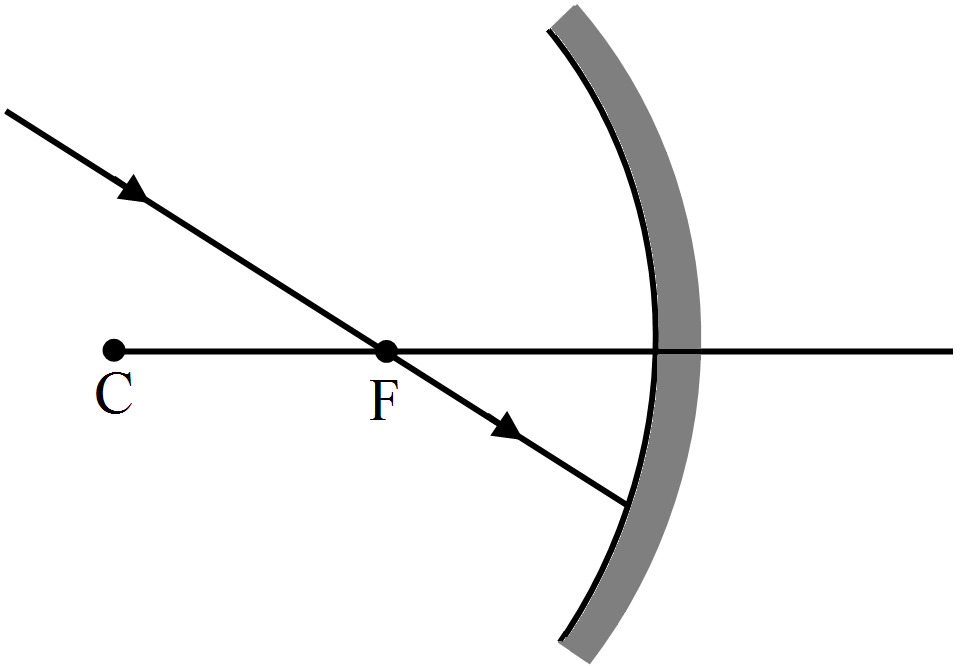
Explain why a ray of light passing through the centre of curvature of a concave mirror gets reflected along the same path.
Answer
This is because the angle of incidence is $0^0$ that is the ray passing through the centre of curvature is incident normally to the mirror. The angle of reflection should also be $0^0$.
View full question & answer
Question 51 Mark
What is the nature of the image formed by a concave mirror if the magnification produced by the mirror is + 3?
Answer
The magnification has a plus sign then the image is virtual and erect. Here the magnification is greater than 1 therefore the image will be formed is larger than the object.
View full question & answer
Question 61 Mark
Why does a ray of light bend when it travels from one medium into another?
Answer
The refraction of light (bending of light ray) depends upon the change in speed of light. If speed of light changes so it will bend when travelling from one medium to another.
View full question & answer
Question 71 Mark
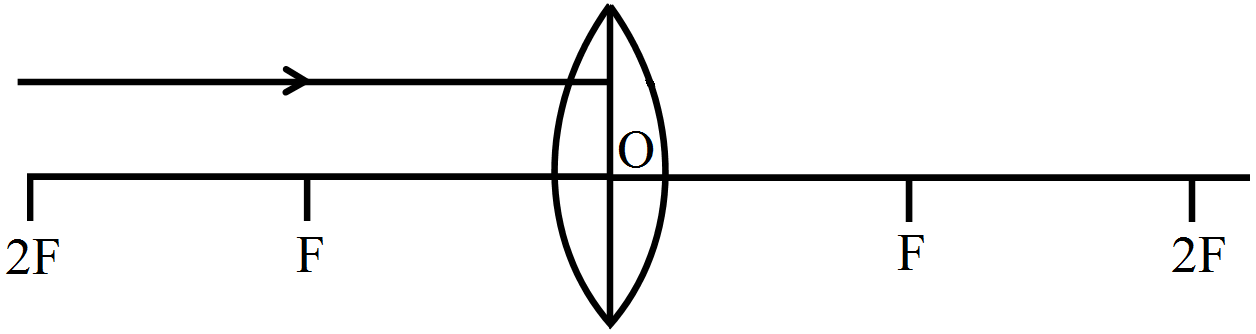
Draw the given diagram in your answer book and complete it for the path of ray of light beyond the lens.
View full question & answer
Question 81 Mark
The refractive index of diamond is 2.42. What is the meaning of this statement in relation to speed of light?
Answer
The refractive index of diamond is 2.42. This means that the speed of light in diamond will reduce by a factor of 2.42 as compared to its speed in air.
View full question & answer
Question 101 Mark
The magnification produced by a plane mirror is +1. What does this mean?
Answer
$\text{m}=\frac{\text{h}_\text{i}}{\text{h}_\text{0}} = \frac{\text{v}}{\text{u}}$Magnification produced by a plane mirror is +1 which means that size of image formed is exactly equal to size of object behind the mirror.
View full question & answer
Question 111 Mark
Draw a labelled ray diagram to show the formation of image in a convex mirror when the object is at infinity. Mark clearly the pole and focus of the mirror in the diagram.
Answer
Coming Soon
View full question & answer
Question 121 Mark
The image seen in a plane mirror cannot be formed on a screen. What name is given to this type of image?
Answer
Virtual image.
View full question & answer
Question 131 Mark
What sign (+ve or -ve) has been given to the following on the basis of Cartesian Sign Convention?
  1. Height of a real image.
  2. Height of a virtual image.
Answer
  1. Negative.
  2. Positive.
View full question & answer
Question 141 Mark
What kind of mirrors are used in big shopping centres to watch the activities of the customers?
Answer
Convex mirrors.
View full question & answer
Question 151 Mark
State one use of concave mirror based on the formation of image as in case (z) above.
Answer
one use of concave mirror based on the formation of image as in case (i) above: As a shaving mirror.
View full question & answer
Question 161 Mark
Define:principal axis.
Answer
Principal axis: The straight line passing through the centre of curvature and pole of a spherical mirror is called its principal axis.
View full question & answer
Question 171 Mark
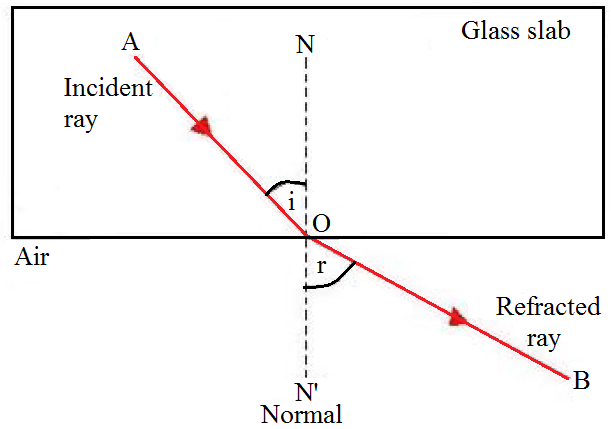
A beam of light travelling in a rectangular glass slab emerges into air. Draw a ray-diagram indicating the change in its path.
Answer
A ray of light travelling from the glass slabs and emerges into the air.
View full question & answer
Question 181 Mark
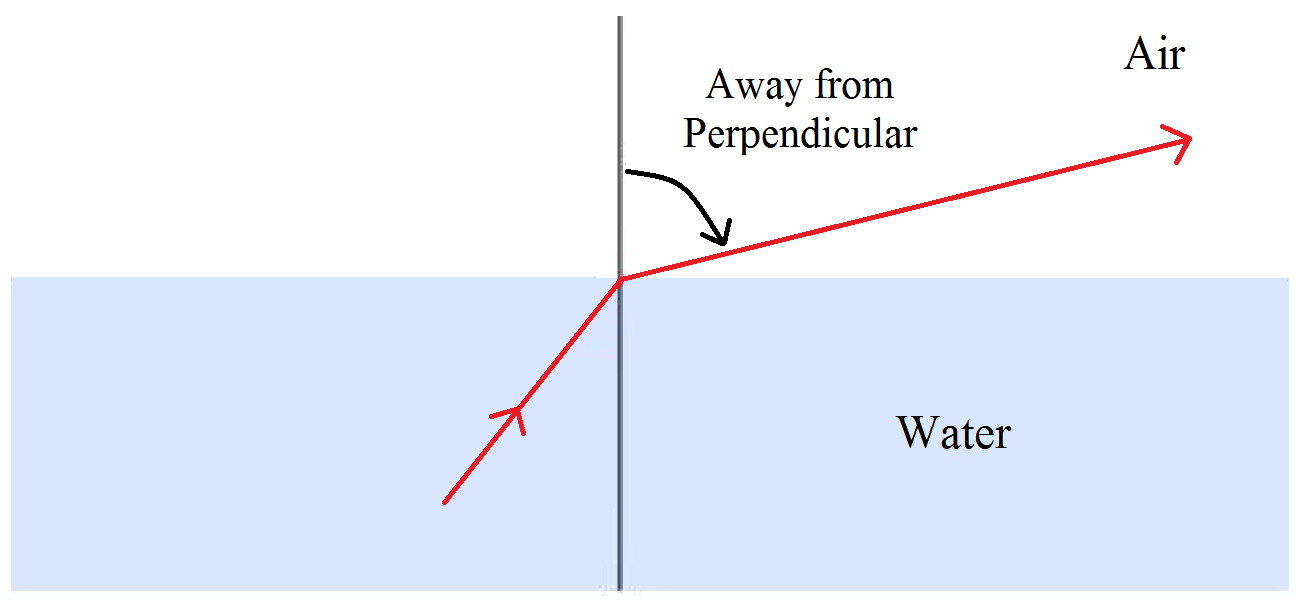
A ray of light goes from water into air. Will it bend towards the normal or away from the normal?
Answer
It will bend away from the normal.
View full question & answer
Question 191 Mark
Which of the two has a greater power:
A lens of short focal length or a lens of large focal length?
Answer
Lens of short focal length.
View full question & answer
Question 201 Mark
What is inverted image?
Answer
An image in which up and down, as well as left and right, are interchanged, that is, an image that results from rotating the object 180° about a line from the object to the observer, such images are formed by most astronomical telescopes. Also known as reversed image.
View full question & answer
Question 211 Mark
What type of image/ images are formed by:
  1. A convex mirror?
  2. A concave mirror?
Answer
  1. Virtual and erect.
  2. Virtual and erect; real and inverted.
View full question & answer
Question 221 Mark
Where should an object be placed in front of a convex lens so as to obtain its real, inverted and magnified image?
Answer
Object should be placed between f and 2f.
View full question & answer
Question 231 Mark
If you want to see an enlarged image of your face, state whether you will use a concave mirror or a convex mirror?
Answer
Concave mirror.
View full question & answer
Question 241 Mark
Which type of mirror has:
  1. Positive focal length?
  2. Negative focal length?
Answer
  1. Convex mirror.
  2. Concave mirror.
View full question & answer
Question 251 Mark
According to the “New Cartesian Sign Convention” for mirrors, what sign has been given to the focal length of:
  1. A concave mirror?
  2. A convex mirror ?
Answer
  1. Negative.
  2. Positive.
View full question & answer
Question 261 Mark
Which one of these circumstances enables a concave mirror to be used as a shaving mirror?
Answer
A concave mirror can be used as a shaving mirror when the object is placed between the pole and focus of a concav mirror.
View full question & answer
Question 271 Mark
What is meant by the refractive index of a substance?
Answer
Refractive index of substance: The ratio of speed of light in vacuum to the speed of light in a medium, is calles the refractive index of that medium.
View full question & answer
Question 281 Mark
For what position of an object, a real and diminished image is formed by a concave mirror?
Answer
Beyond the centre of curvature.
View full question & answer
Question 291 Mark
What name is given to the ratio of sine of angle of incidence to the sine of angle of refraction?
Answer
Refractive index.
View full question & answer
Question 311 Mark
A 50cm tall object is at a very large distance from a diverging lens. A virtual, erect and diminished image of the object is formed at a distance of 20cm in front of the lens. How much is the focal length of the lens?
Answer
When an object is placed at a very large distance from a diverging lens, then image is formed at the focus of the lens. Therefore, the focal length of the lens is 20cm.
View full question & answer
Question 331 Mark
Write the relation between the angle of incidence and the angle of refraction for a medium.
Answer
$\text{Refractive index} = \frac{\text{sine of the angle of incidence}}{\text{sine of the angle of refraction}}$
View full question & answer
Question 341 Mark
What kind of mirror can have a focal length of, – 20cm?
Answer
Concave mirror (since focal length is negative).
View full question & answer
Question 361 Mark
The focal length of a convex lens is 25cm. What is its power?
Answer
$\text{f}=25\text{cm}=0.25\text{cm}$$\text{p}=\frac{1}{\text{f}}=\frac{1}{0.25}=+4\text{D}$
View full question & answer
Question 371 Mark
Where should an object be placed in front of a convex lens so as to obtain its virtual, erect and magnified image?
Answer
The object should be placed within focus.
View full question & answer
Question 381 Mark
An object is placed at a long distance in front of a convex mirror of radius of curvature 30cm. State the position of its image.
Answer
Image is formed at the focus.$\text{focus}=\frac{30}{2}=15\text{cm}$
Exmpale: 15cm behind the convex mirror.
View full question & answer
Question 391 Mark
What type of image is formed:
  1. In a plane mirror?
  2. On a cinema screen?
Answer
  1. Virtual image.
  2. Real image.
View full question & answer
Question 401 Mark
What is the ratio of the height of an image to the height of an object known as?
Answer
The ratio of the height of an image to the height of an object known as magnifincation.
View full question & answer
Question 411 Mark
If an object is placed at the focus of a convex lens, where is the image formed?
Answer
The image is formed at infinity (at very large distance).
View full question & answer
Question 421 Mark
Name the mirror which can give:
  1. An erect and enlarged image of an object.
  2. An erect and diminished image of an object.
Answer
  1. Concave mirror.
  2. Convex mirror.
View full question & answer
Question 431 Mark
A 1cm high object is placed at a distance of 2f from a convex lens. What is the height of the image formed?
Answer
1cm (same as the height of the object).
View full question & answer
Question 441 Mark
A ray of light travelling in water emerges into air. Draw a ray-diagram indicating the change in its path.
Answer
A ray of light travelling through water to air.
View full question & answer
Question 451 Mark
Describe the nature of image formed when an object is placed at a distance of 30cm from a convex lens of focal length 15cm.
Answer
Since the object is placed at a distance greater than the focal length of the convex lens, so the image formed is real and inverted.
View full question & answer
Question 461 Mark
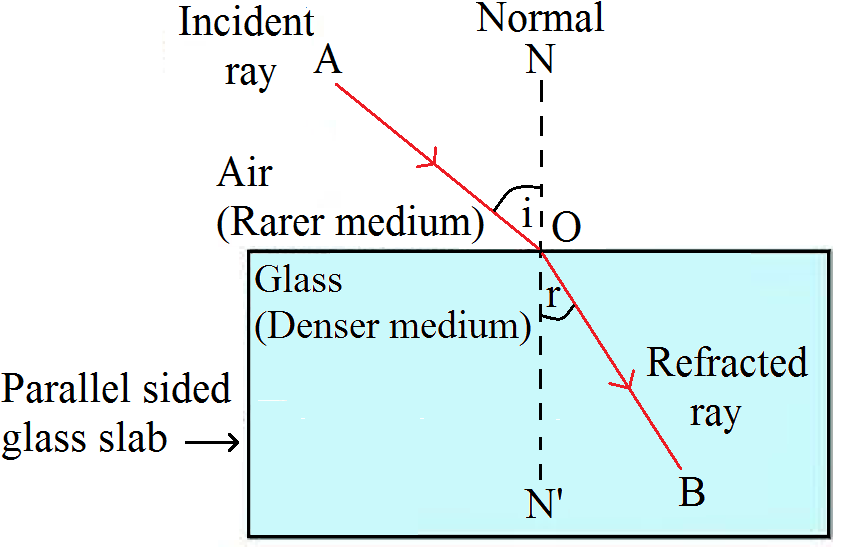
A ray of light travelling in air is incident on a parallel-sided glass slab (or rectangular glass slab). Draw a ray-diagram indicating the change in its path in glass.
Answer
A ray of light incidence on parallel sided glass slab.
View full question & answer
Question 471 Mark
Name the spherical mirror which can produce a real and diminished image of an object.
Answer
Concave mirror.
View full question & answer
Question 481 Mark
If the image formed by a convex lens is of the same size as that of the object, what is the position of the image with respect to the lens?
Answer
At 2F (At twice the focal length).
View full question & answer
Question 491 Mark
Name a mirror that can give an erect and enlarged image of an object.
Answer
Only a concave mirror can give a erect and enlarged image of an object.
View full question & answer
Question 501 Mark
What is the power of a convex lens whose focal length is 80cm?
Answer
$\text{f}=80\text{cm}=0.08\text{m}$$\text{p}=\frac{1}{\text{f}}=\frac{1}{0.08}=+1.25\text{D}$
View full question & answer
[1 Mark Questions] - Science STD 10 Questions - Vidyadip