Questions · Page 1 of 2

[5 marks Questions]

🎯

Test yourself on this topic

50 questions · timed · auto-graded

Question 15 Marks
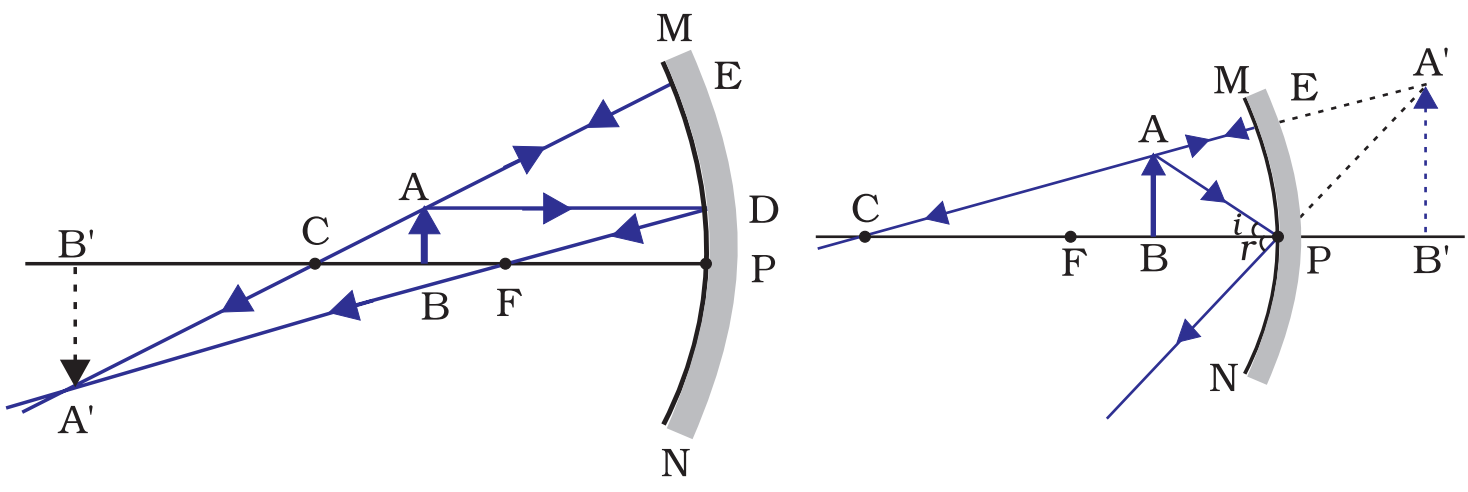
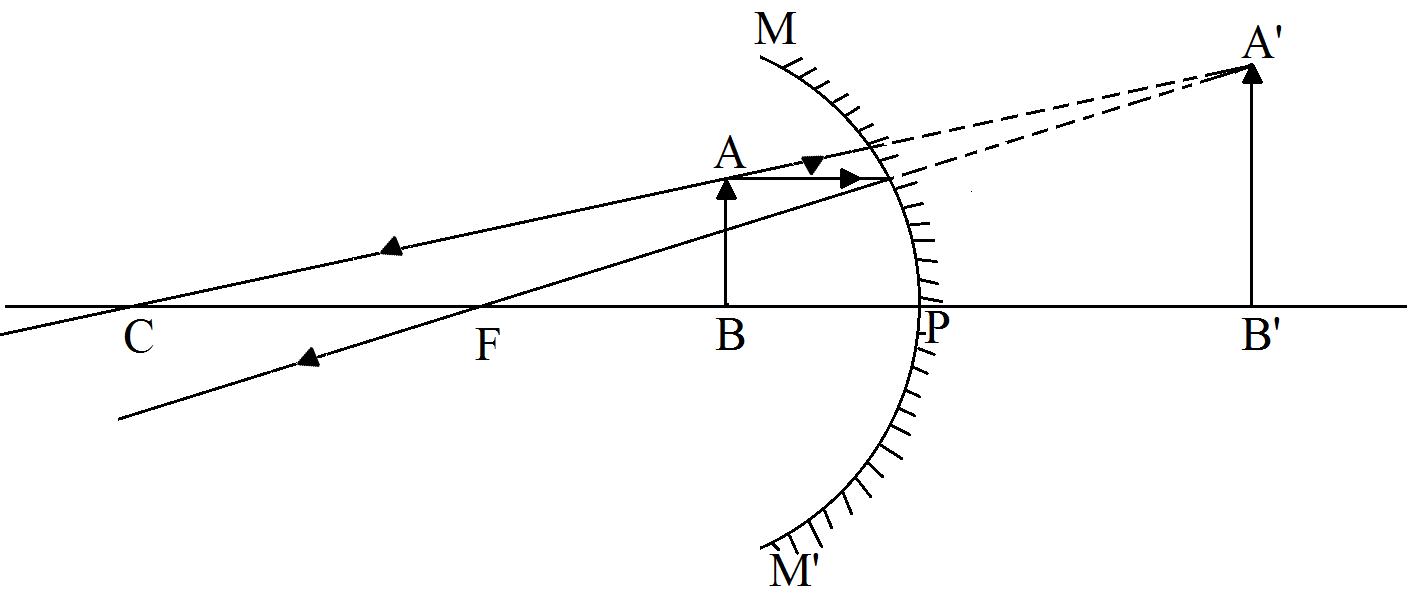
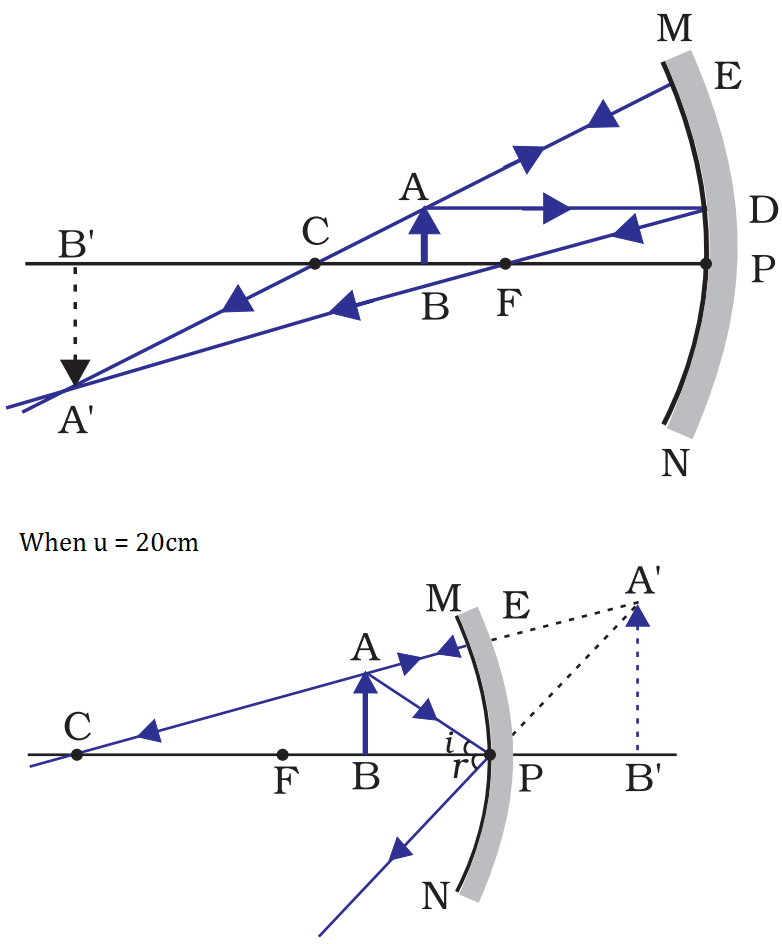
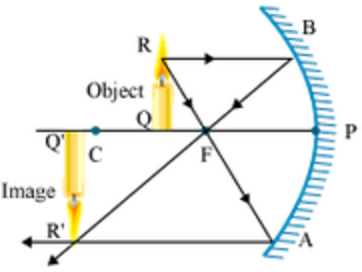
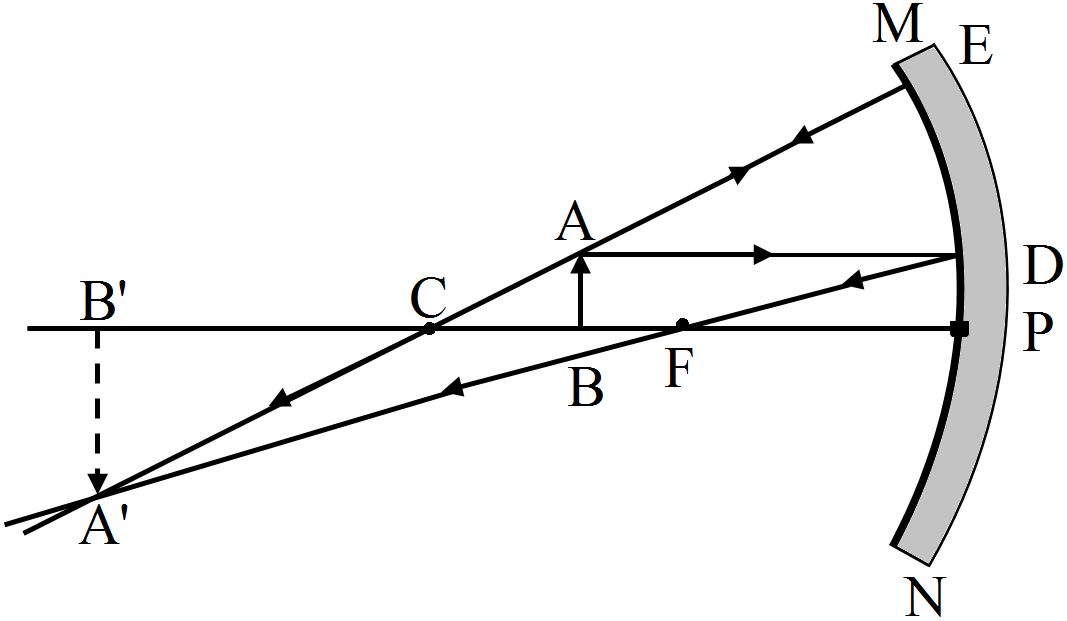
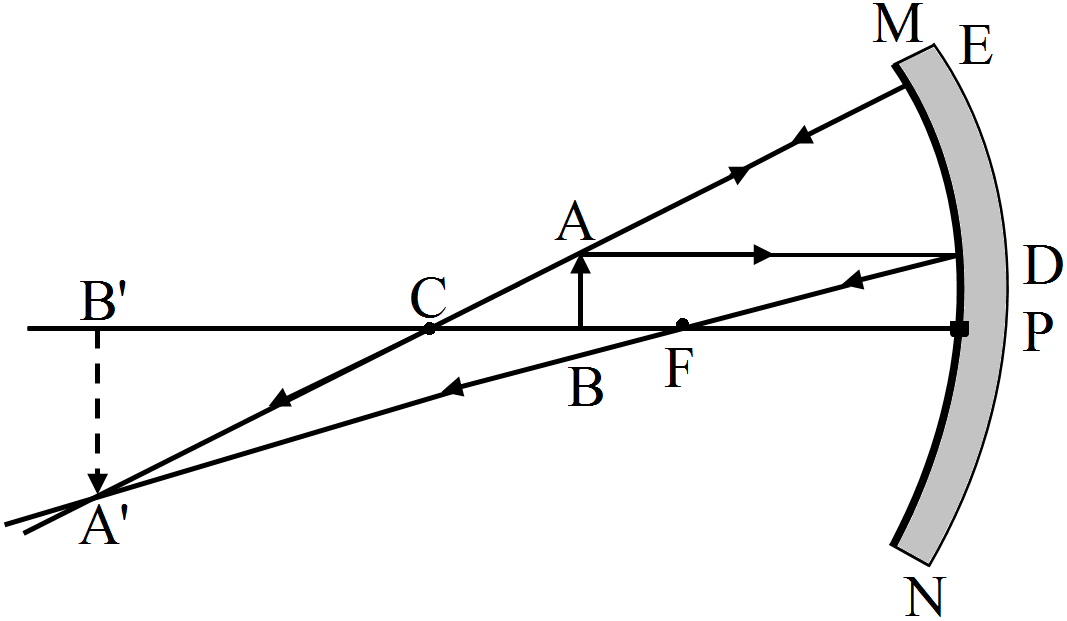
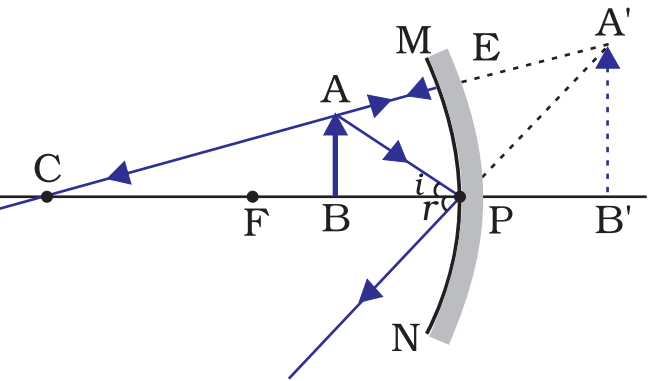
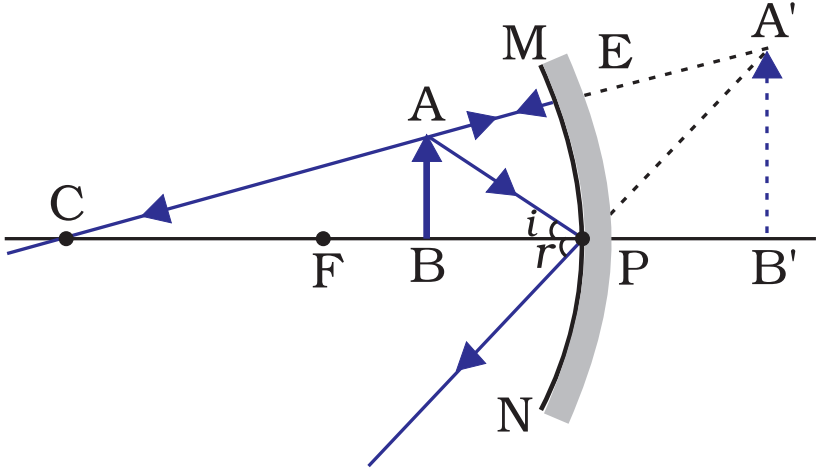
A $10 cm$ long pencil is placed $5 cm$ in front of a concave mirror having a radius of curvature of $40 cm$.
(i) Determine the position of the image formed by this mirror.
(ii) What is the size of the image?
(iii) Draw a ray diagram to show the formation of the image as mentioned in the part (i).
Answer
(i) $\frac{1}{f}=\frac{1}{v}+\frac{1}{u}$
$ \text { where } u=-5 cm , f=\frac{r}{2}=-20 cm$
$-\frac{1}{20}=\frac{1}{v}-\frac{1}{5}$
$ \frac{1}{v}=-\frac{1}{20}+\frac{1}{5}=\frac{-1+4}{20}=\frac{3}{20}$
$v=\frac{20}{3}=6.67 cm $
The image is obtained at $6.67 m$ behind the mirror.
(ii) $m =\frac{h_2}{h_1}=-\frac{v}{u}=\frac{\frac{20}{3}}{5}=\frac{4}{3}$
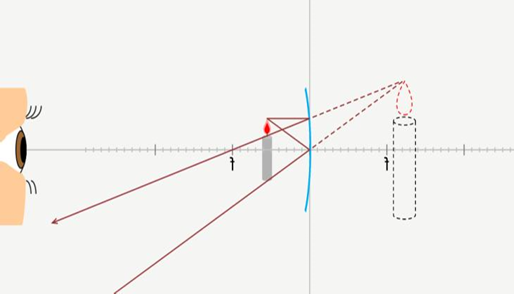
Image
View full question & answer
Question 25 Marks

Image
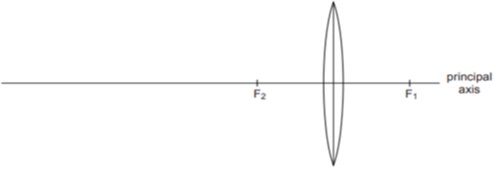
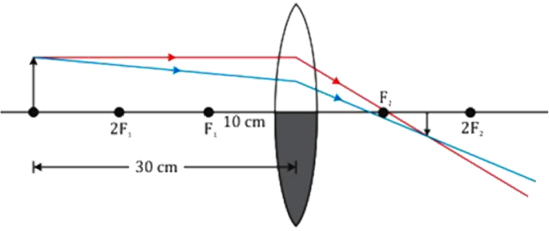
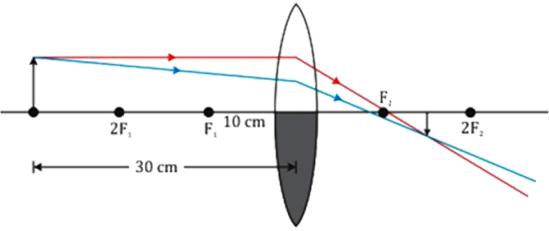
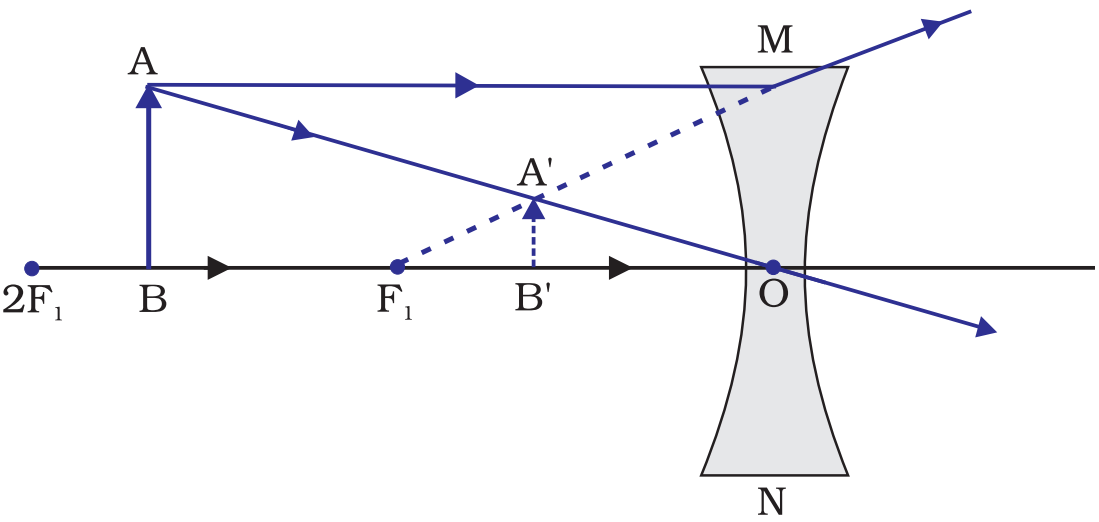
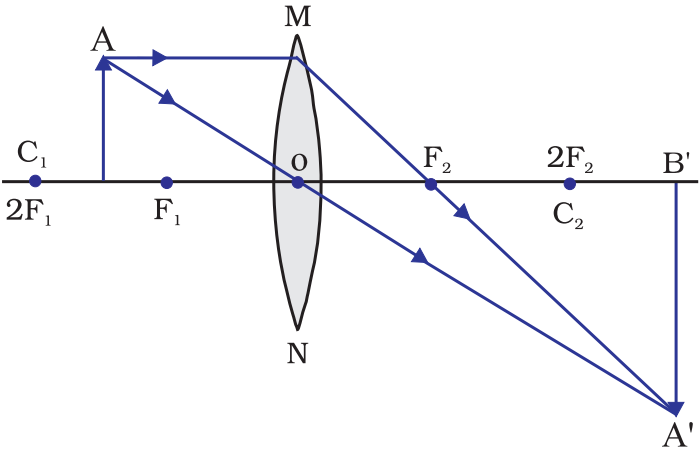
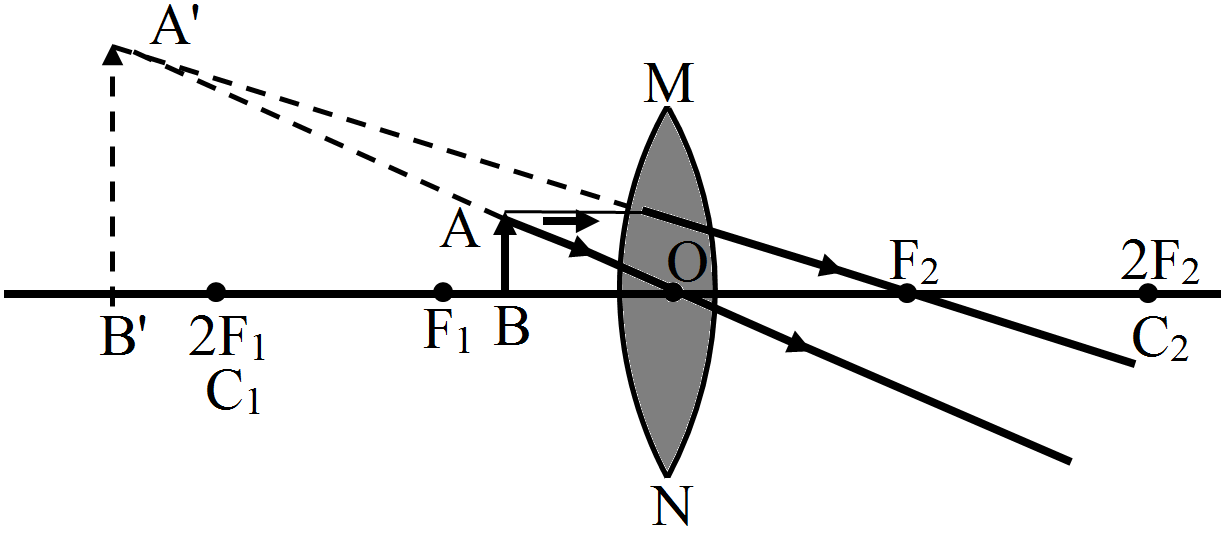
The above image shows a thin lens of focal length $5 m$.
(i) What is the kind of lens shown in the above figure?
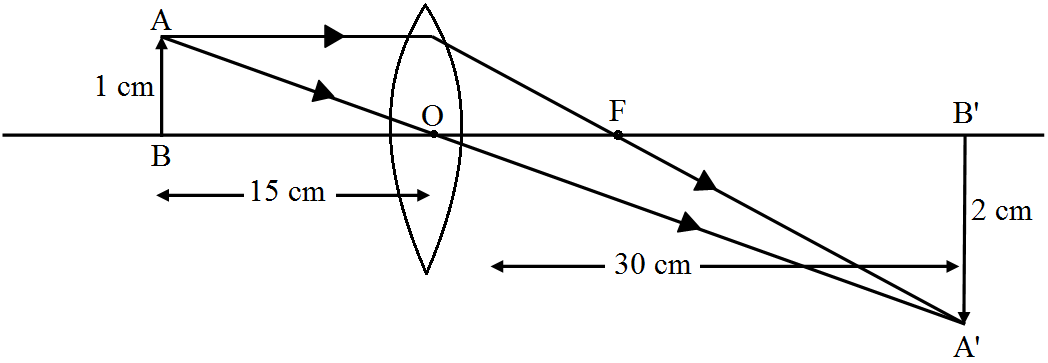
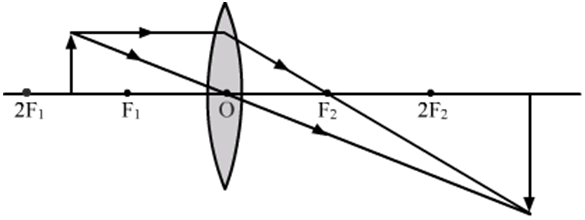
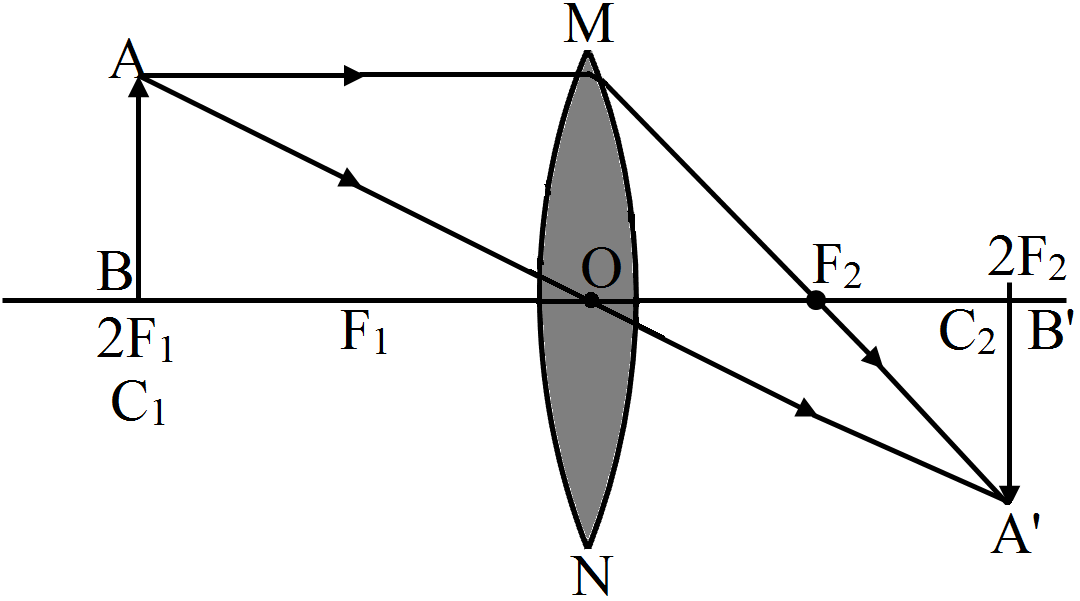
(ii) If a real inverted image is to be formed by this lens at a distance of $7 m$ from the pole, then show with calculation where should the object be placed?
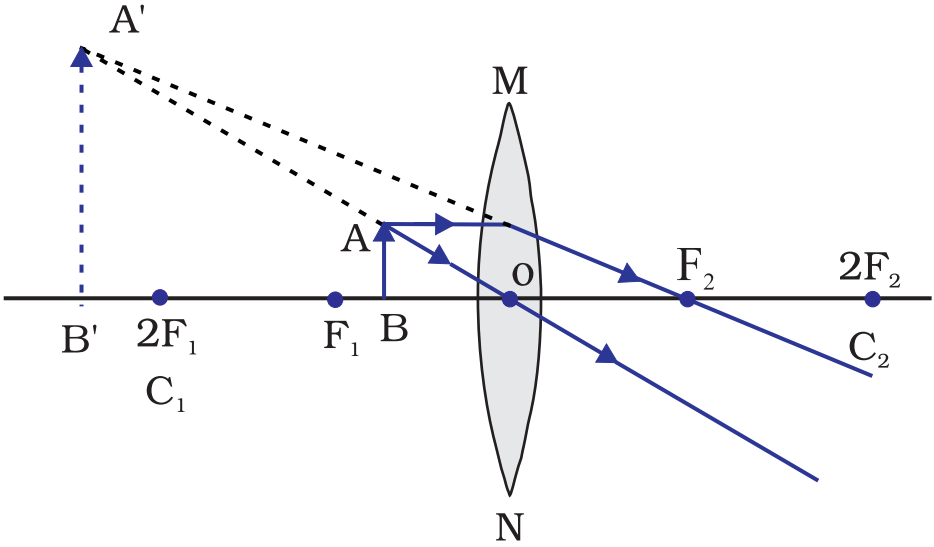
(iii) Draw a neatly labelled diagram of the image formation mentioned in (ii)

Answer
(i) Convex lens
(ii) $\frac{1}{f}=\frac{1}{v}-\frac{1}{u}$
In this case, $v=7 m$ and $f =5 m$.
Putting the values in the equation we get -
$
\begin{array}{c}
\frac{1}{5}=\frac{1}{7}-\frac{1}{u} \\
\frac{1}{u}=\frac{1}{7}-\frac{1}{5}=\frac{5-7}{35}=\frac{-2}{35} \\
u=-\frac{35}{2}=-17.5 m
\end{array}
$
The object will be placed $17.5 m$ on the left of the convex lens.
(iii) Image

View full question & answer
Question 35 Marks
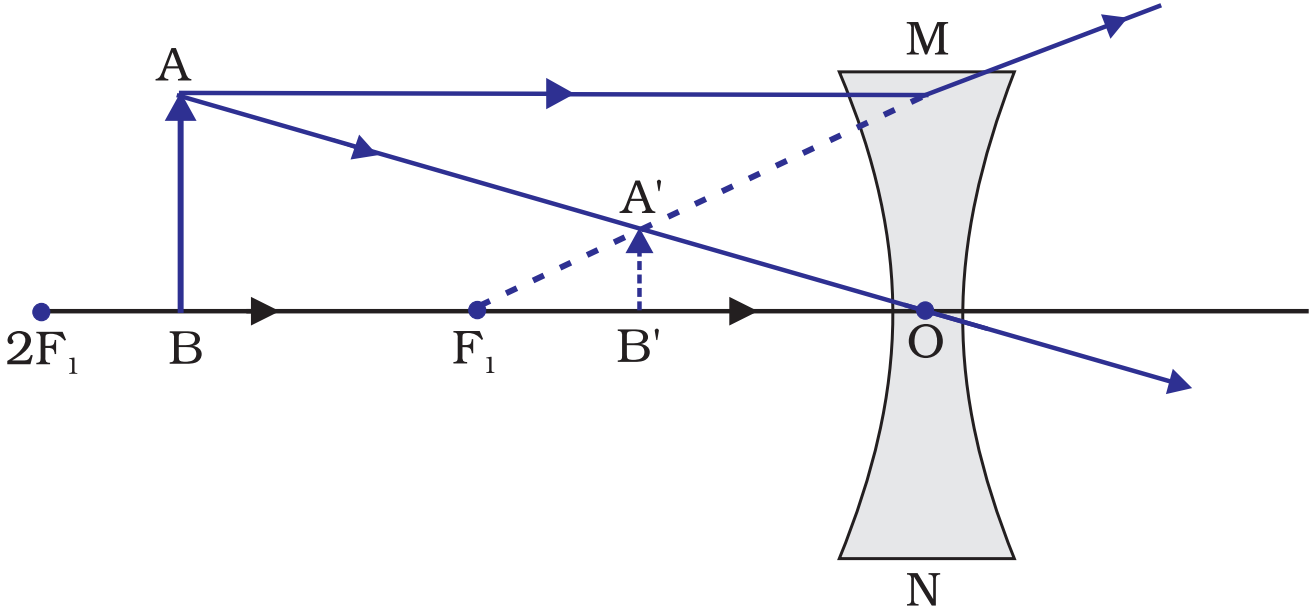
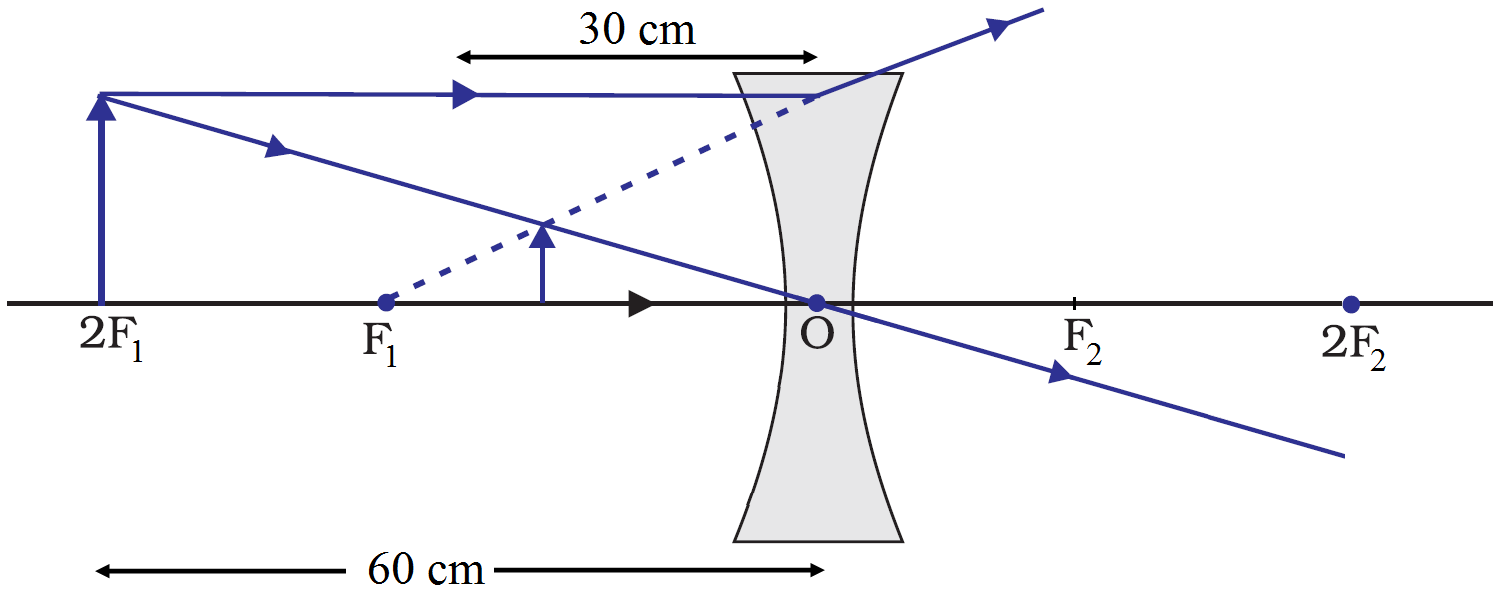
  1. Define focal length of a divergent lens.
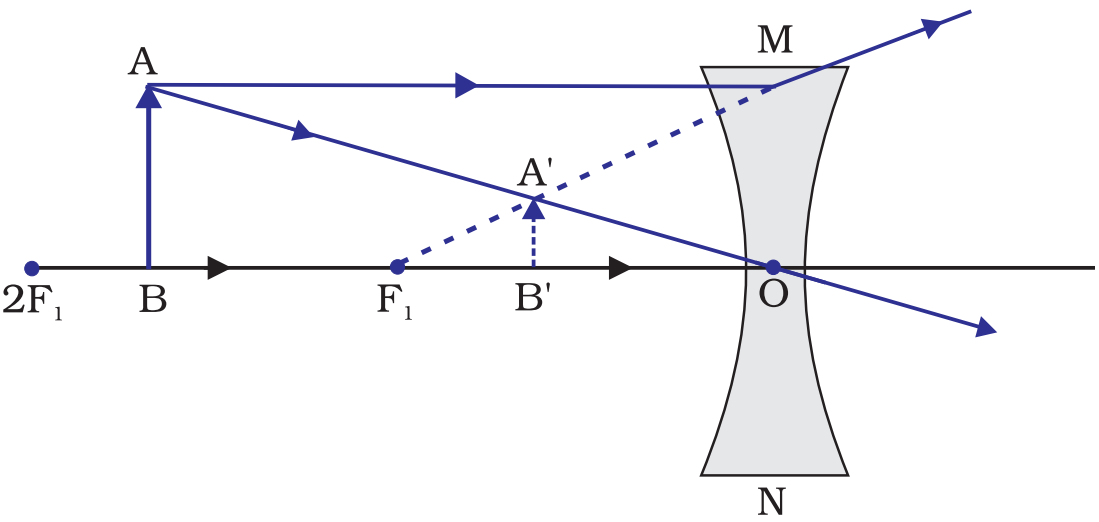
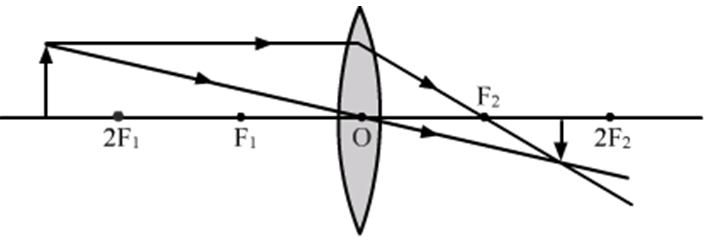
  2. A divergent lens of focal length 30 cm forms the image of an object of size 6 cm on the same side as the object at a distance of 15 cm from its optical centre. Use lens formula to determine the distance of the object from the lens and the size of the image formed.
  3. Draw a ray diagram to show the formation of image in the above situation.
Answer
  1. Optical center of the lens is defined as the point which lies on the principal axis through the rays of light passes without any deflection.
  2. Given: focal length of convex lens = 20 cm Height of object = 4cm Applying the lens formula:
$\frac{1}{\text{f}}=\frac{1}{\text{v}}-\frac{1}{\text{u}}$

$\frac{1}{-20}=-\frac{1}{10}-\frac{1}{\text{u}}$

$\frac{1}{\text{u}}=-\frac{1}{10}+-\frac{1}{20}$

$\frac{1}{\text{u}}=-\frac{1}{20}$

Therefore u = -20 cm

Height of image can be calculated by using the formula:

$\frac{\text{h}_2}{\text{h}_1}=\frac{\text{v}}{\text{u}}$

$\text{h}_2=\frac{\text{v}}{\text{h}}\text{h}_1$

$=\frac{-10\text{cm}}{-20\text{cm}}\times4=2\text{cm}$

Therefore,

The ray diagram is as follows:

View full question & answer
Question 45 Marks
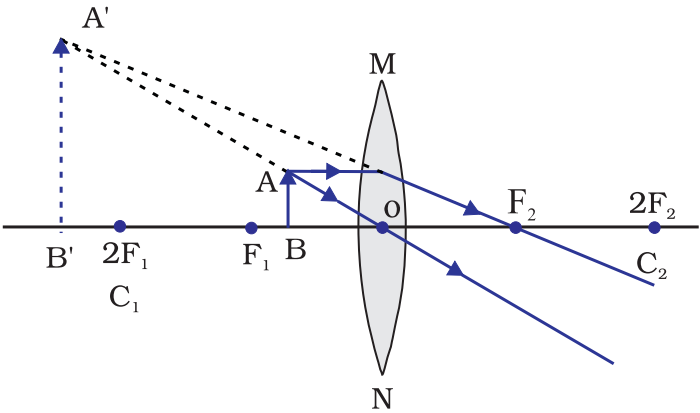
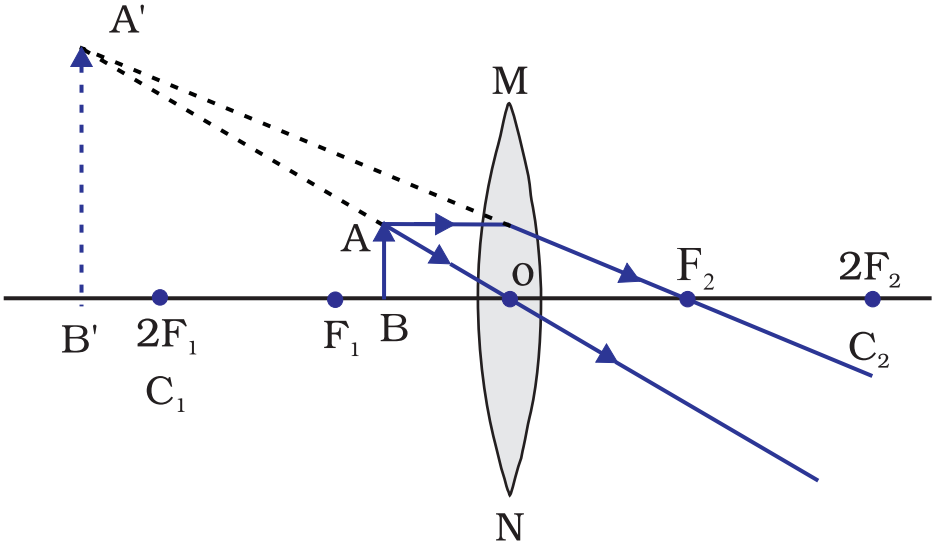
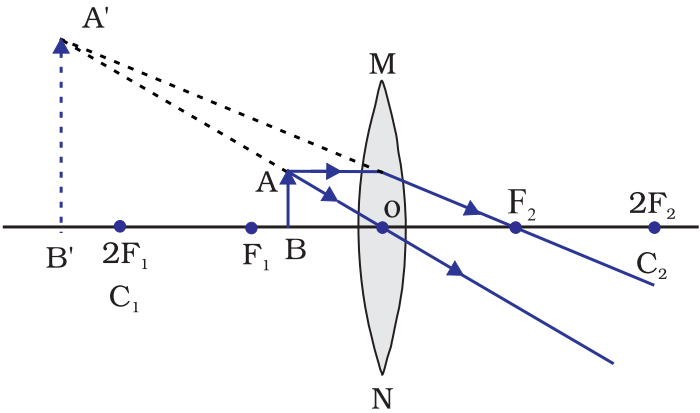
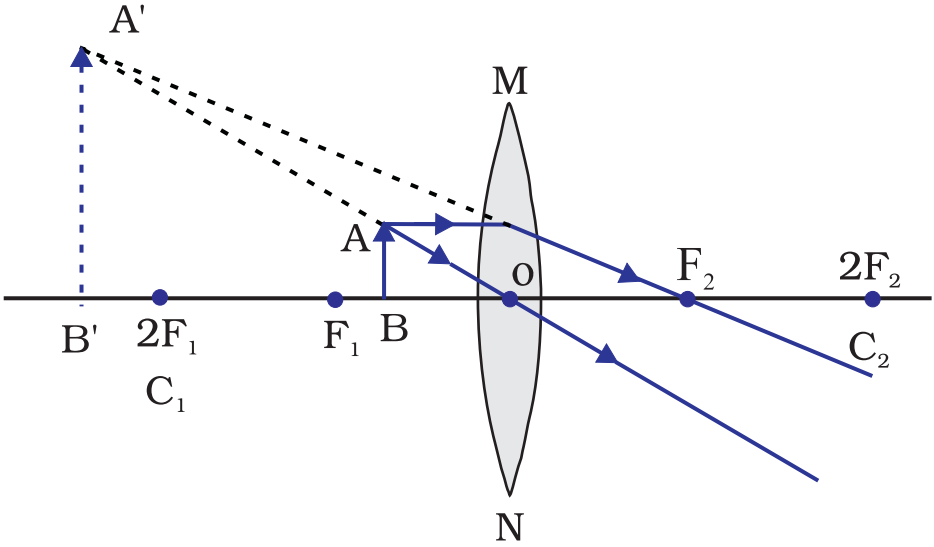
What is meant by power of a lens? Define its S.I. unit. You have two lenses A and B of focal lengths +10 cm and –10 cm respectively. State the nature and power of each lens. Which of the two lenses will form a virtual and magnified image of an object placed 8 cm from the lens? Draw a ray diagram to justify your answer.
Answer
The power of a lens is defined as the reciprocal of its focal length. It is denoted using the letter P. Mathematically,$\text{P}=\frac{1}{\text{f}}$
where f is the focal length of the lens. Given: Focal length of the lens A, F = +10 cm = +0.1 m Focal length of lens B, F = -10 cm = -0.1 m Power of lens A, $\text{P}=\frac{1}{+0.1}$ P = +10 D Since, power is positive, the lens is a converging lens or convex lens. Power of lens B, $\text{P}=\frac{1}{\text{F}_\text{B}(\text{in m})}$ i.e., $\text{P}=\frac{1}{-0.1}$ Therefore, P = -10 D since, power is negative; it is a diverging lens or concave lens. Given, that the object is placed 8 cm from the lens, which is at a distance less than 10 cm. In a convex lens, when the object is placed between the pole and focus, image formed is always virtual and diminished. Therefore, the lens will produce a virtual and magnified image of the object. Ray diagram is as shown below:
View full question & answer
Question 55 Marks
One half of a convex lens of focal length 10 cm is covered with a black paper. Can such a lens produce an image of a complete object placed at a distance of 30 cm from the lens? Draw a ray diagram to justify your answer.
A 4 cm tall object is placed perpendicular to the principal axis of a convex lens of focal length 20 cm. The distance of the object from the lens is 15 cm. Find the nature, position and size of the image.
Answer
The convex lens will produce the complete image of the object even though half of the lens is covered. This is because the other half of the lens can refract the light coming from the object. However, the intensity of the image will be reduced. Numerical: Given, Height of the object, h = 4cm Focal length of the convex lens, f = 20cm Object distance, u = -15cm Using the lens formula,$\frac{1}{\text{f}}=\frac{1}{\text{v}}-\frac{1}{\text{u}}$
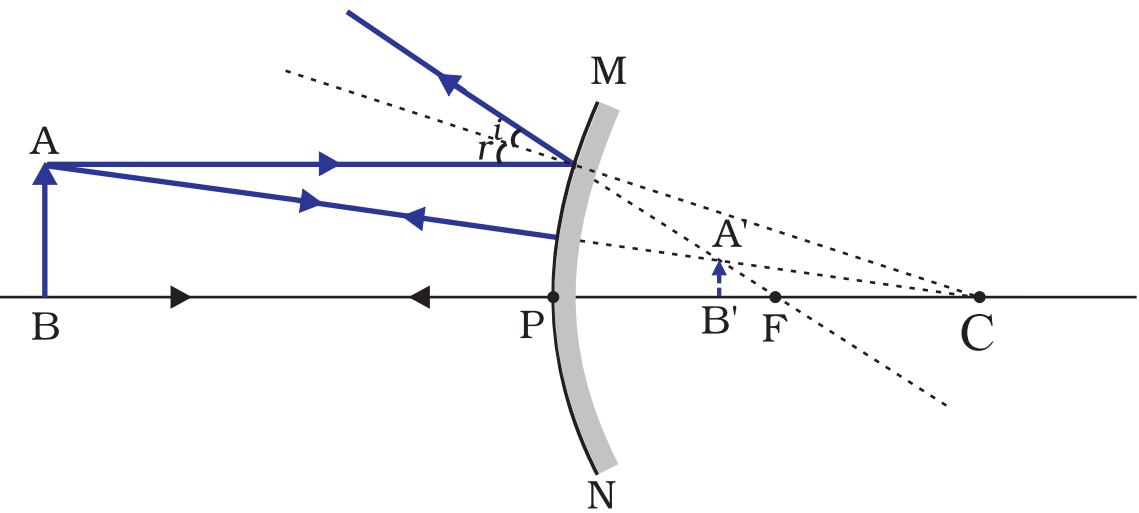
Therefore,$\frac{1}{\text{v}}=\frac{1}{\text{f}}+\frac{1}{\text{u}}$
$=\frac{1}{20}-\frac{1}{15}$
$=\frac{3-4}{60}$
$=\frac{-1}{60}$
$\text{v}=-60\text{ cm}$
Thus, the image is formed 60cm in front of the lens on the same side as that of the object. Since v is negative, the image formed is virtual. Using the formula for magnification of a lens,$\text{m}=\frac{\text{h}'}{\text{h}}=\frac{\text{v}}{\text{u}}$
That is,$\text{h}'=\frac{\text{vh}}{\text{u}}=\frac{-60\times4}{-15}=16\text{ cm}$
Since the height of the image is positive and greater than the height of the object, the image formed is erect and magnified. Therefore, the image is virtual, erect and magnified.
View full question & answer
Question 65 Marks
  1. Explain the following terms related to spherical lenses:
  1. Optical centre.
  2. Centres of curvature.
  3. Principal axis.
  4. Aperture.
  5. Principal focus.
  6. Focal length.
  1. A converging lens has focal length of 12 cm. Calculate at what distance should the object be placed from the lens so that it forms an image at 48 cm on the other side of the lens.
Answer
  1.  
  1. Optical center. It is a point within the lens that lies on the principal axis through which a ray of light passes undeflected.
  2. Center of curvature. The centre of curvature of the surface of a lens is the centre of the sphere of which it forms a part. A lens has two centres of curvature because it has two surfaces.
  3. Principal axis. It is a line trough the centres of curvature of the lens Aperture. The diameter of the circular boundary of the lens is called the aperture of the lens.
  4. Principal focus. A beam of light parallel to the principal axis either converges to a point or appears to diverge from a point on the principal axis after refraction through the lens, is called the principal focus. All lenses have two principal focuses.
  5. Focal length. The distance between the optical centre and the principal focus of the lens is called its focal length.
  1. A converging lens is a convex lens.
$f = \text{+ 12} \text{ cm}$

$\text{U} = ?$

$\text{V = + 48 cm}$ (+ve as it is formed on other side of the object)

According to lens formula,

$\frac{1}{f} = \frac{1}{v} = \frac{1}{u}$

$\frac{1}{12} = \frac{1}{48} - \frac{1}{u}$

$\frac{1}{u} = \frac{1}{48} - \frac{1}{12} = \frac{1 - 4}{48} = \frac{-3}{48} = \frac{1}{16}$

$\therefore u = -16 \text{ cm}$

$\therefore$ The object should be placed 16 cm away from the lens.
View full question & answer
Question 75 Marks
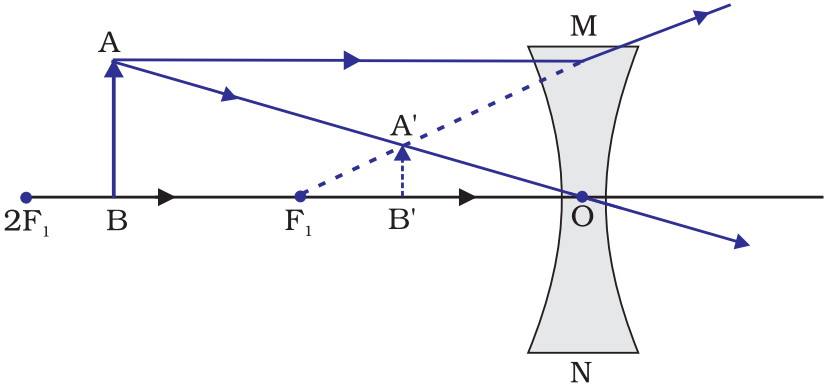
  1. If the image formed by a mirror for all positions of the object placed in front of it is always diminished, erect and virtual, state the type of the mirror and also draw a ray diagram to justify your answer. Write one use such mirrors are put to and why.
  2. Define the radius of curvature of spherical mirrors. Find the nature and focal length of a spherical mirror whose radius of curvature is + 24 cm.
Answer
The image formed by a convex mirror is always erect and diminished. Therefore, the given mirror is a convex mirror. Let, the object is placed between the pole (P) and infinity in front of a convex mirror. Convex mirrors is used as rear view mirrors in vehicles because it gives a wide field of view and the image formed is always virtual, erect and diminished image. Thus, it enables the driver to view a much larger area of the traffic behind. Focal lenght and radius of curvature are related as$\text{f}=\frac{\text{R}}{2}=\frac{+24}{2}=+12\text{cm}$
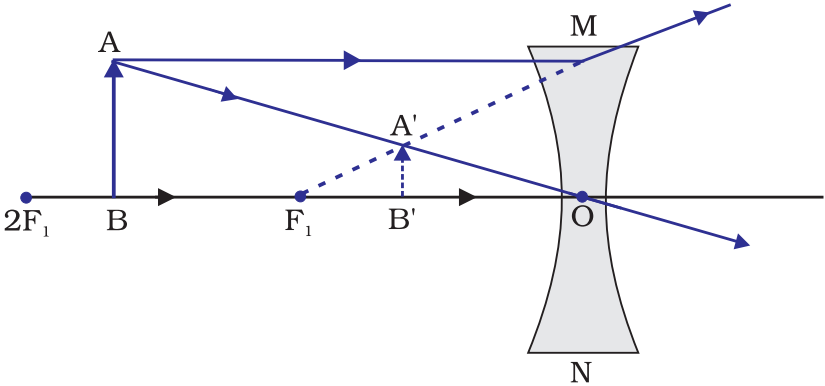
Since, the focal length of mirror is possitive it is a convex mirror.
View full question & answer
Question 85 Marks
  1. Define focal length of a spherical lens.
  2. A divergent lens has a focal length of 30 cm. At what distance should an object of height 5 cm from the optical centre of the lens be placed so that its image is formed 15 cm away from the lens? Find the size of the image also.
  3. Draw a ray diagram to show the formation of image in the above situation.
Answer
  1. Optical center of the lens is defined as the point which lies on the principal axis through the rays of light passes without any deflection.
  2. Given: focal length of convex lens = 20 cm Height of object = 4cm Applying the lens formula:
$\frac{1}{\text{f}}=\frac{1}{\text{v}}-\frac{1}{\text{u}}$

$\frac{1}{-20}=-\frac{1}{10}-\frac{1}{\text{u}}$

$\frac{1}{\text{u}}=-\frac{1}{10}+-\frac{1}{20}$

$\frac{1}{\text{u}}=-\frac{1}{20}$

Therefore u = -20cm

Height of image can be caliculated by using the formula:

$\frac{\text{h}_2}{\text{h}_1}=\frac{\text{v}}{\text{u}}$

${\text{h}_2}=\frac{\text{v}}{\text{u}}{\text{h}_1}$

$=\frac{-10\text{cm}}{-20\text{cm}}\times4=2\text{cm}$

Therefore,

The ray diagram is as follows:

View full question & answer
Question 95 Marks
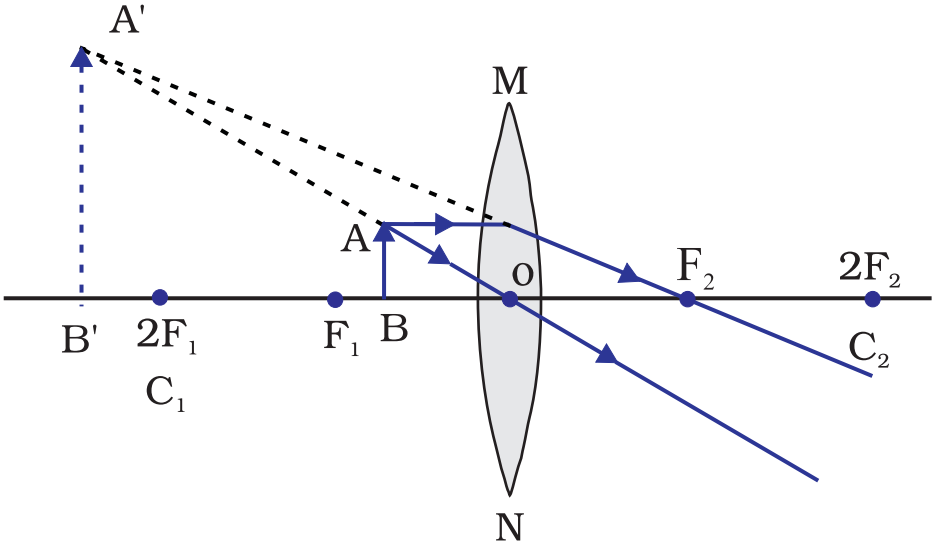
What is meant by power of a lens? Define its S.I. unit. You have two lenses A and B of focal lengths +10cm and -10cm respectively. State the nature and power of each lens. Which of the two lenses will form a virtual and magnified image of an object placed 8cm from the lens? Draw a ray diagram to justify your answer.
Answer
The power of a lens is defined as the reciprocal of its focal length. It is denoted using the letter P. Mathematically,$\text{P}=\frac{1}{\text{f}}$
where f is the focal length of the lens. Given: Focal length of the lens A, FA = +10cm = +0.1m Focal length of lens B, FB = -10cm = -0.1m Power of lens A, $\text{P}=\frac{1}{+0.1}$ P = +10 D Since, power is positive, the lens is a converging lens or convex lens. Power of lens B, $\text{P}=\frac{1}{\text{F}_\text{B}(\text{in m})}$ i.e., $\text{P}=\frac{1}{-0.1}$ Therefore, P = -10 D since, power is negative; it is a diverging lens or concave lens. Given, that the object is placed 8cm from the lens, which is at a distance less than 10cm. In a convex lens, when the object is placed between the pole and focus, image formed is always virtual and diminished. Therefore, the lens will produce a virtual and magnified image of the object. Ray diagram is as shown below:
View full question & answer
Question 105 Marks
One half of a convex lens of focal length 10cm is covered with a black paper. Can such a lens produce an image of a complete object placed at a distance of 30cm from the lens? Draw a ray diagram to justify your answer.
A 4cm tall object is placed perpendicular to the principal axis of a convex lens of focal length 20cm. The distance of the object from the lens is 15cm. Find the nature, position and size of the image.
Answer
The convex lens will produce the complete image of the object even though half of the lens is covered. This is because the other half of the lens can refract the light coming from the object. However, the intensity of the image will be reduced. Numerical: Given, Height of the object, h = 4cm Focal length of the convex lens, f = 20cm Object distance, u = -15cm Using the lens formula,$\frac{1}{\text{f}}=\frac{1}{\text{v}}-\frac{1}{\text{u}}$
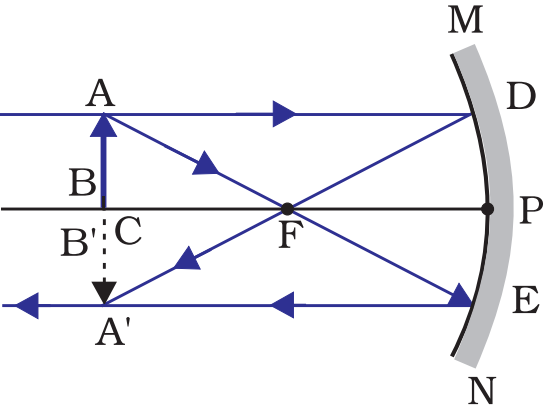
Therefore,$\frac{1}{\text{v}}=\frac{1}{\text{f}}+\frac{1}{\text{u}}$
$=\frac{1}{20}-\frac{1}{15}$
$=\frac{3-4}{60}$
$=\frac{-1}{40}$
$\text{v}=-60\text{ cm}$
Thus, the image is formed 60cm in front of the lens on the same side as that of the object. Since v is negative, the image formed is virtual. Using the formula for magnification of a lens,$\text{m}=\frac{\text{h}'}{\text{h}}=\frac{\text{v}}{\text{u}}$
That is,$\text{h}'=\frac{\text{vh}}{\text{u}}=\frac{-60\times4}{-15}=16\text{ cm}$
Since the height of the image is positive and greater than the height of the object, the image formed is erect and magnified. Therefore, the image is virtual, erect and magnified.
View full question & answer
Question 115 Marks
Explain the following terms related to spherical lenses:
  1. Centres of curvature.
  2. Principal axis.
  3. Optical centre.
  4. Principal focus.
At what distance from a concave lens of focal length 20 cm, should a 6 cm tall object be placed so that it forms an image at 15 cm from the lens? Also determine the size of the image formed.
Answer
  1. Centre of curvature: It is defined as the centre of the spheres of which the lens is originally a part of. Because the spherical lens consists of two spherical surfaces, the lens has two centres of curvature.
  2. Optical centre: The centre point of a lens is known as its optical centre. It always lies inside the the lens. A light beam passing through the optical centre immerges without any deviation.
  3. Principal axis: The line joining the centre of curvature and the optical centre is called the principal axis.
  4. Principal focus: A light ray parallel to the principal axis of the lens meets at a point on the principal axis. This point is called the principal focus.
Focal length of concave lens, f = −20 cm
Image distance, v = −15 cm (Negative sign is taken because of sign convention.)
Using the lens formula, we get:
$\frac{1}{f} = \frac{1}{v} - \frac{1}{u}$
$\Rightarrow \frac{1}{-20} = \frac{1}{-15} - \frac{1}{u}$
$\Rightarrow \frac{1}{u} = \frac{1}{-15} + \frac{1}{20}$
$\Rightarrow \frac{1}{u} = \frac{-4 + 3}{60}$
$\Rightarrow u = -60 \text{ cm}$
The distance of the object from the mirror is 60 cm.
$h_i$ is the size of the image formed.
$h_o$ is the size of the object; it is 6 cm.
We know that the image formed by the concave lens is virtual and erect.
The magnification is given as:
$m = \frac{v}{u} = \frac{h_{i}}{h_{o}}$
$\Rightarrow \frac{-15}{-60} = \frac{h_{i}}{6}$
$\Rightarrow h_{i} = 1.5 \text{ cm}$
Hence, the size of the image is 1.5 cm.
View full question & answer
Question 125 Marks
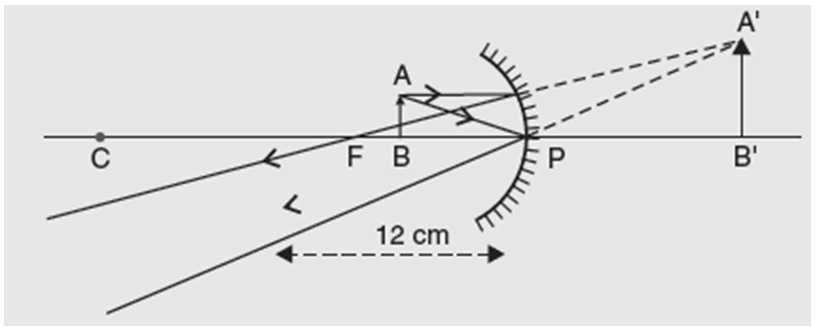
It is desired to obtain an erect image of an object, using concave mirror of focal length of 12 cm.
  1. What should be the range of distance of an object placed in front of the mirror?
  2. Will the image be smaller or larger than the object. Draw ray diagram to show the formation of image in this case.
  3. Where will the image of this object be, if it is placed 24 cm in front of the mirror? Draw ray diagram for this situation also to justify your answer.
Show the positions of pole, principal focus and the centre of curvature in the above ray diagrams.
Answer
  1. The range of the object distance when placed in front of the mirror is from 0 to 12cm i.e., when object is placed between pole and focus of the mirror. The nature of the Image formed will be magnified, i.e., larger than the size of the object.
  1. When the object is placed in front of the mirror i.e., at 2f position at center of curvature, the image will be formed at center of curvature of the mirror.
View full question & answer
Question 135 Marks
  1. Define optical centre of a spherical lens.
  2. A divergent lens has a focal length of 20cm. At what distance should an object of height 4cm from the optical centre of the lens be placed so that its image is formed 10cm away from the lens. Find the size of the image also.
  3. Draw a ray diagram to show the formation of image in above situation.
Answer
  1. Optical center of the lens is defined as the point which lies on the principal axis through the rays of light passes without any deflection.
  2. Given: focal length of convex lens = 20 cm Height of object = 4cm Applying the lens formula:
$\frac{1}{\text{f}}=\frac{1}{\text{v}}-\frac{1}{\text{u}}$
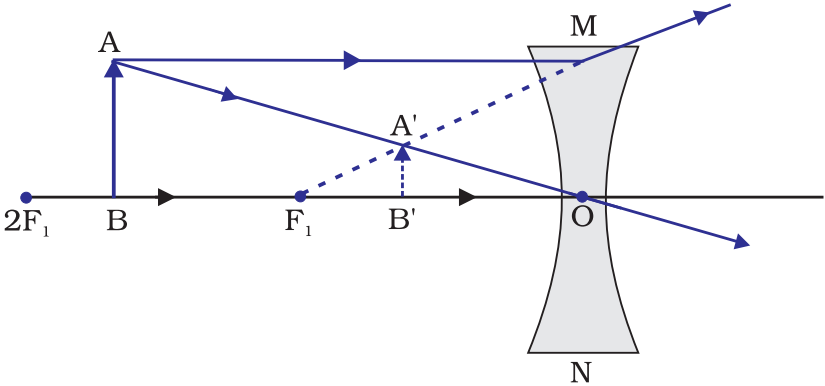
$=\frac{1}{-20}=-\frac{1}{10}-\frac{1}{\text{u}}$

$\frac{1}{\text{u}}=-\frac{1}{10}+-\frac{1}{20}$

$\frac{1}{\text{u}}=-\frac{1}{20}$

Therefore u = -20cm

Height of image can be calculate by using the formula:

$\frac{\text{h}_2}{\text{h}_1}=\frac{\text{v}}{\text{u}}$

$\text{h}_1=\frac{\text{v}}{\text{h}}\text{h}_1$

$=\frac{-10\text{cm}}{-20\text{cm}}\times4=2\text{cm}$

Therefore,

The ray diagram is as follows:

View full question & answer
Question 145 Marks
  1. To construct a ray diagram we use two light rays which are so chosen that it is easy to know their directions after reflection from the mirror. List these two rays and state the path of these rays after reflection. Use these two rays to locate the image of an object placed between infinity and the centre of curvature of a concave mirror.
  2. Draw a ray diagram to show the formation of image of an object placed between the pole and principal focus of a concave mirror. How will the nature and size of the image formed change, if the mirror is replaced by a converging lens of same focal length?
Answer
  1. The rays used for obtaining the image from the mirror after reflections are as follows:
  1. A ray which is parallel to the principal axis which on reflecting from the mirror, passes through the focus (when the mirror is concave) or appears to pass through the focus (in case of convex mirror).
  2. A ray which passes through the principal focus of the mirror is directed towards the principal focus , in case of convex mirror, it will emerge as parallel to the principal axis of the mirror.
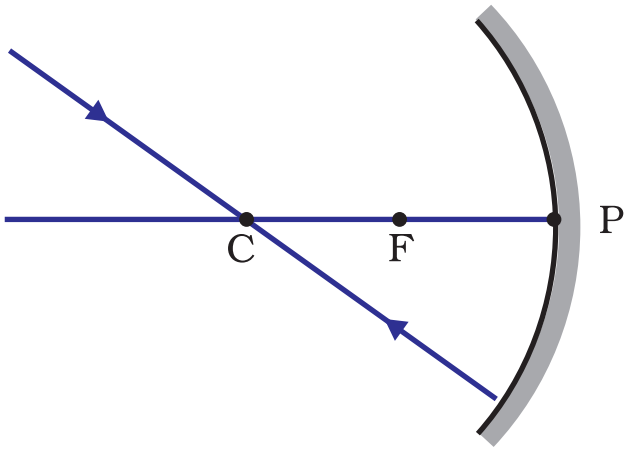
  3. The Ray which passes through the center of curvature of concave mirror or directed in the direction of center of curvature of convex mirror, reflects back along the same path.
  1. The ray diagrams are as follows:
  1. When object is placed between infinity and C:
  1. When the object is placed between pole and focus of a concave mirror:
  1. When the object is placed between pole and focus of convex lens:
View full question & answer
Question 155 Marks
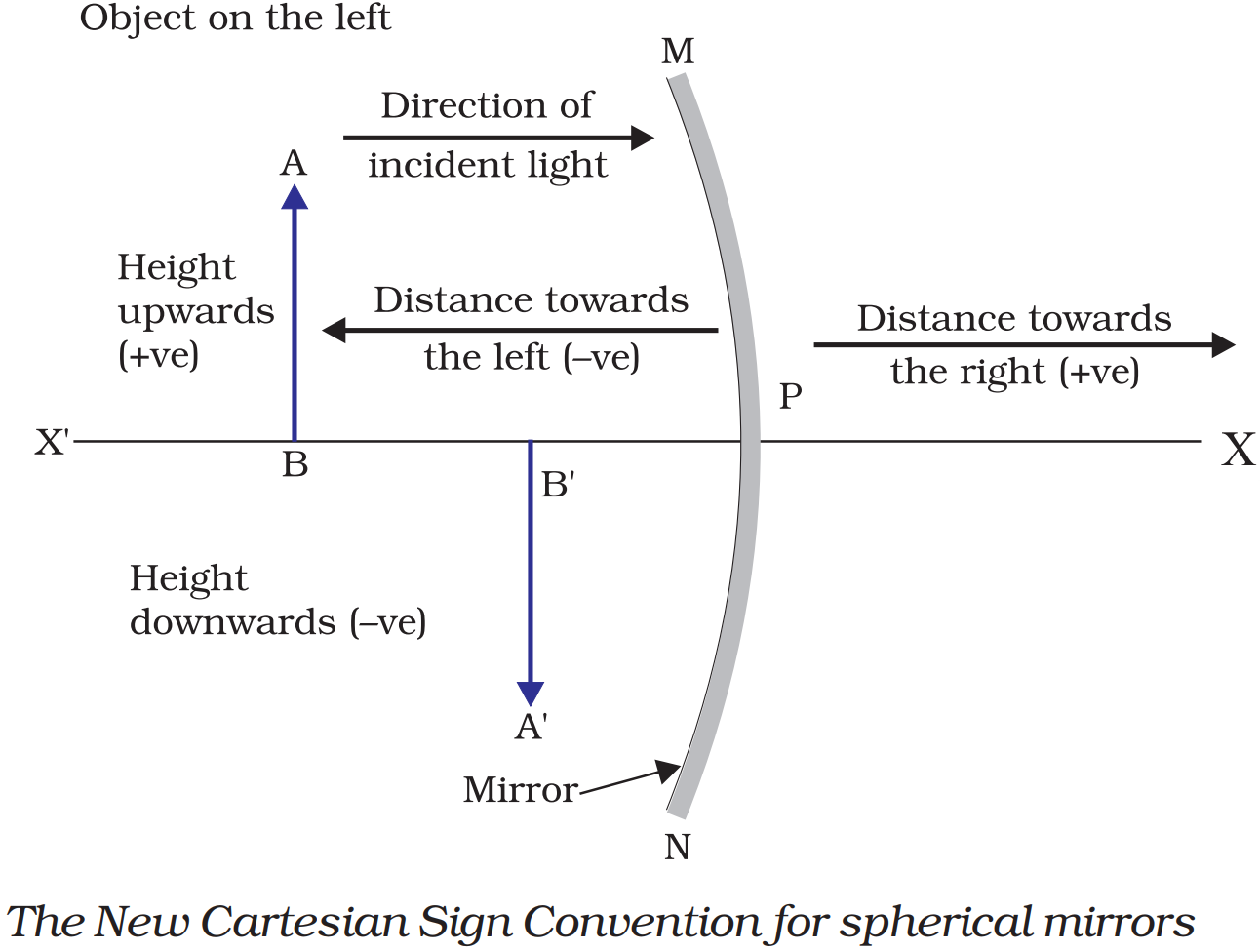
List the new Cartesian sign convention for reflection of light by spherical mirror. Draw a diagram and apply these conventions for calculating the focal length and nature of spherical mirror which forms a 1/3 times magnified virtualimage of an object placed 18 cm in front of it.
Answer

New Cartesian Sign Conventions for reflection of light by spherical mirrors are given below:
  1. The object is always placed to the left of the mirror. This implies that the light from the object falls on the mirror from the left-hand side.
  2. All distances parallel to the principal axis are measured from the pole of the mirror.
  3. All the distances measured to the right of the origin (along + x-axis) are taken as positive while those measured to the left of the origin (along − x-axis) are taken as negative.
  4. Distances measured perpendicular to and above the principal axis (along + y-axis) are taken as positive.
  5. Distances measured perpendicular to and below the principal axis (along − y-axis) are taken as negative.

$m = \frac{1}{3}$
$u = -18 \text{ cm}$
$f = ?$
$v=?$
$m = -\frac{v}{u} = \frac{1}{3}$
$\Rightarrow v = -\frac{u}{3} = -\frac{(-18)}{3} = 6 \text{ cm}$
Now, according to mirror formula
$\frac{1}{v}+\frac{1}{u} = \frac{1}{f}$
$\frac{1}{6}+\frac{1}{(-18)} = \frac{1}{f}$
$\frac{1}{f} = \frac{3-1}{18}$
$\frac{1}{f} = \frac{2}{18}$
$f = \text{9 cm}$
Since the focal length is positive so, it is a convex mirror.
Ray diagram:
View full question & answer
Question 165 Marks
With the help of a ray diagram, state what is meant by refraction of light. State Snell’s law for refraction of light and also express it mathematically.
The refractive index of air with respect to glass is 2/3 and the refractive index of water with respect to air is 4/3. If the speed of light in glass is $\text{2}\times 10^{8} \text{m/s,}$ find the speed of light in (a) air, (b) water.
Answer
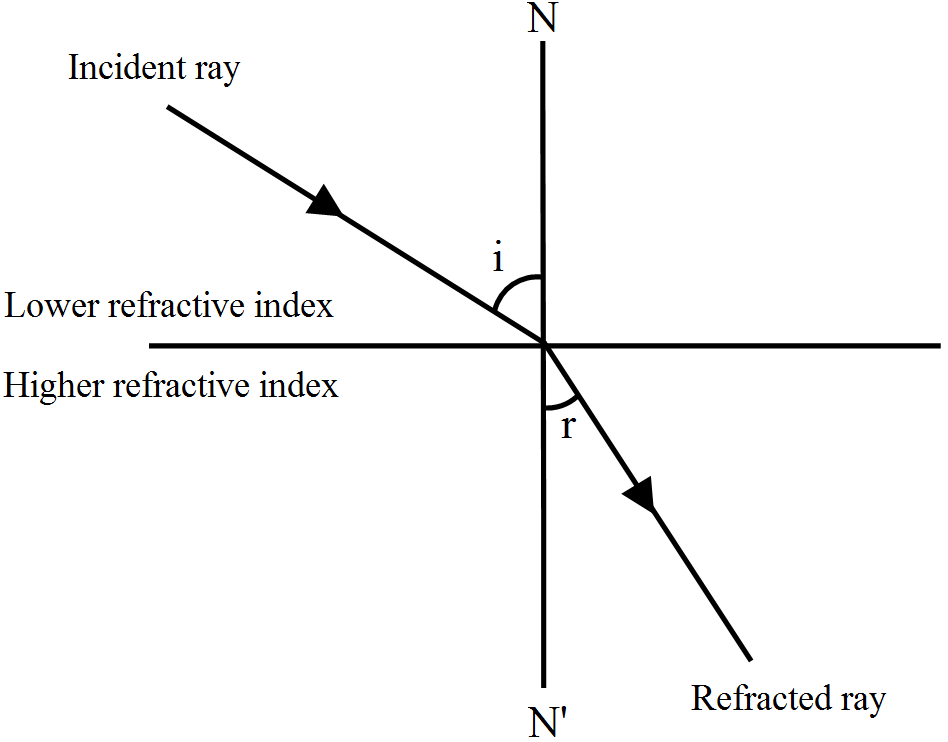
When a ray of light travels from one transparent medium to another, it bends at the surface. This happens because different media have different optical densities.The phenomenon of bending of light as it travels from one medium to another is known as refraction of light. As a ray of light moves from an optically rarer medium to an optically denser medium, it bends towards the normal at the point of incidence. Therefore, the angle of incidence (i) is greater than the angle of refraction (r). Hence, $\text{i} > \text{r}$
The first law of refraction is also known as Snell’s law. Snell’s law: The ratio of the sine of the angle of incidence to the sine of the angle of refraction is constant. This is known as Snell’s law. Mathematically, it can be given as follows:$\frac{\sin \text{i}}{\sin \text{r}} = \text{constant} = ^a{u}_{\text{ b}}$
$^g u _{\text{ a}} = \frac{2}{3} = \frac{u_{a}}{u_{g}}$
$^a{u}_{\text{ w}} = \frac{4}{3} = \frac{u_{\text{ w}}}{u_{\text{ a}}}$
$\text{V}_{g} = 2 \times 10^{8} \text{m/s}$
$\text{Now we know } u = \frac{\text{C}}{\text{V}}$
Where µ is absolute refractive index of a medium w.r.t. vacuum C is speed of light in vacuum V is speed of light in medium.
  1. $\text{Now } u_{a} = \frac{\text{C}}{\text{V}_{a}}$
$u_{\text{ g}} = \frac{\text{C}}{\text{V}}_{g}$
$\text{Dividing} \frac{u_{a}}{u_{g}} = \frac{\text{V}_{g}}{\text{V}_{a}} = \frac{2}{3}$
$\text{V}_{a} = \frac{3}{2}\times \text{V}_{g} = \frac{3}{2}\times 2\times10^{8} \text{ m/s}$
$= 3\times10^{8} \text{ m/s}$
  1. $\text{Again } u_{\text{ w}} = \frac{\text{C}}{\text{V}_{w}}$
$u_{\text{ a}} = \frac{\text{C}}{\text{V}_{a}}$
$\text{Dividing} \frac{u_{w}}{u_{a}} = \frac{\text{V}_{a}}{\text{V}_{w}} = \frac{4}{3}$
$\text{V}_{w} = \frac{3}{4}\times3\times10^{8}$
$=\frac{9}{4}\times10^{8}$
$=2.25\times10^{8}\text{ m/s}$
View full question & answer
Question 175 Marks
  1. Draw a ray diagram to show the formation of image of an object placed between infinity and the optical centre of a concave lens.
  2. A concave lens of focal length 15 cm forms an image10 cm from the lens. Calculate:
  1. The distance of the object from the lens.
  2. The magnification for the image formed.
  3. The nature of the image formed.
Answer
  1.  

Image fornmed by concave lens is always virtual and small in size.
  1.  
  1. Focal length, f = -15cm
    image distance, v = -10cm (as image formed by concave lens is always virtual i.e. at the side of the object)
    Using Lens formula,
$\frac{1}{\text{f}} = \frac{1}{\text{v}}-\frac{1}{\text{u}}$
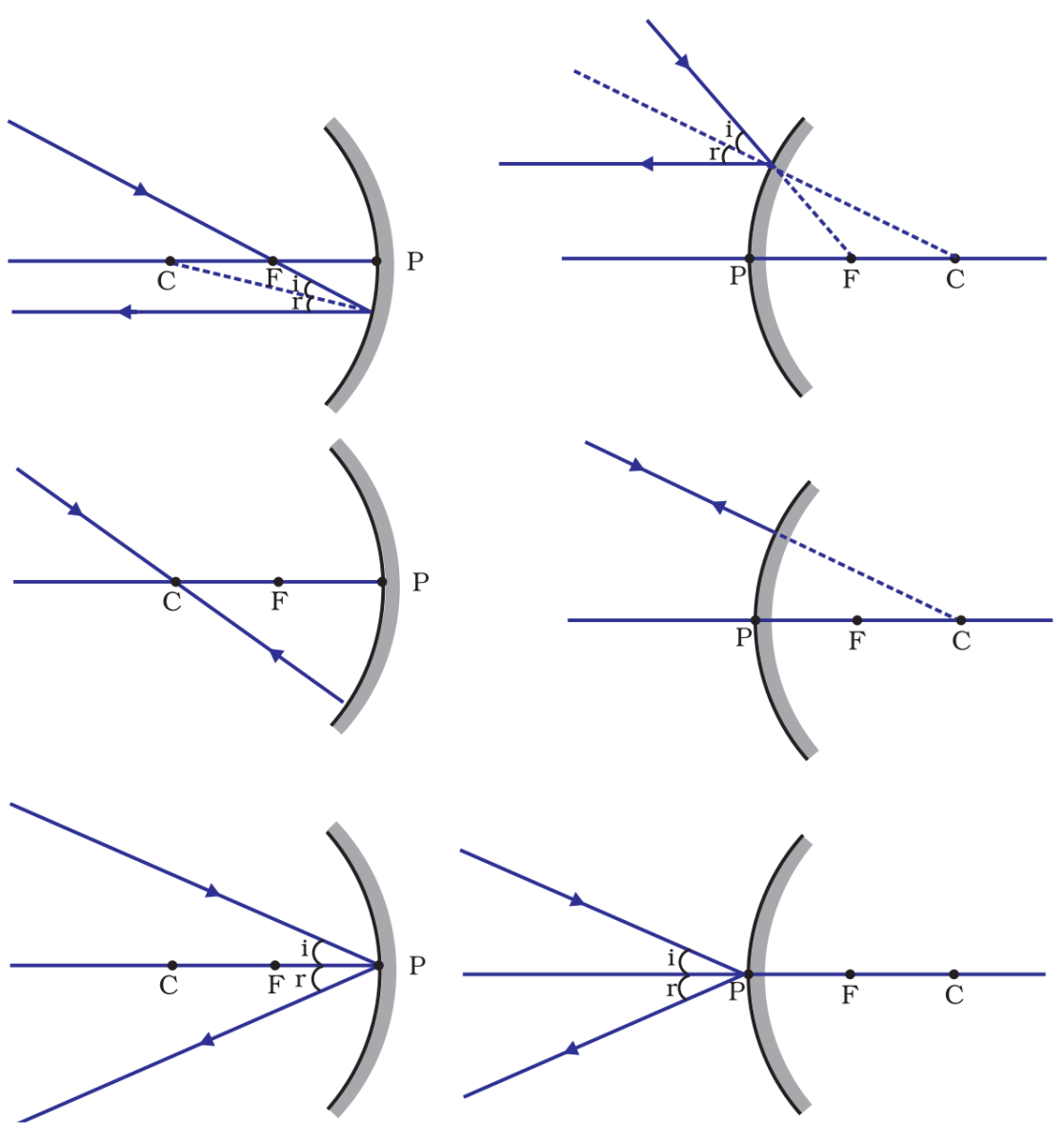
$\frac{1}{(-15)}=\frac{1}{-10}-\frac{1}{\text{u}}$
$\frac{1}{\text{u}}=-\frac{1}{10}+\frac{1}{15}=-\frac{1}{30}$
$\text{u}=-30\text{cm}$
  1. Magnification, $\text{m}=\frac{\text{v}}{\text{u}}= \frac{-10}{-30} = \frac{1}{3}$
  2. Nature of image is: virtual and small in size.
View full question & answer
Question 185 Marks
Suppose you have three concave mirrors A, B and C of focal lengths 10cm, 15cm and 20cm. For each concave mirror, you perform the experiment of image formation for three values of object distance of 10cm, 20cm and 30cm. Giving reason answer the following:
  1. For the three object distances, identify the mirror/mirrors which will form an image of magnification - 1.
  2. Out of the three mirrors identify the mirror which would be preferred to be used for shaving purposes/ makeup.
  3. For the mirror B draw, ray diagram for image formation for object distances 10 cm and 20 cm.
Answer
Given,
$f_a=10 cm ; f_b=15 cm ; f_c=20 cm$
$u_1=10 cm ; u_2=20 cm ; u_3=30 cm$
a. $m=-1$ means $u=2 f$. For $A$ it will be $u_2$ and for $B$ it will be $u_3$.
b. Mirror B or C can be used for shaving, makeup purposes because the distance should be less than focal length for erect and magnified image. The face is generally kept at a distance more than 10 cm from the mirror.
c. When $a =10 cm$. ​​​​​​
View full question & answer
Question 195 Marks
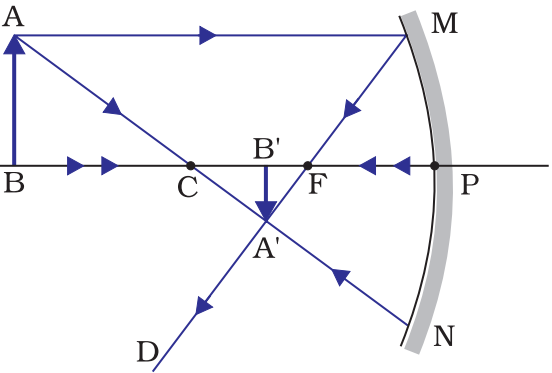
At what distance from a concave lens of focal length 20 cm a 6 cm tall object be placed so as to obtain its image at 15 cm from the lens? Also, calculate the size of the image formed.
Draw a ray diagram to justify your answer for the above situation and label it.
Answer
Given, f = -20 cm; h1 = 6 cm; v = -15 cm; u = ?$\text{Lens formula}; \frac{1}{\text{f}}=\frac{1}{\text{v}}-\frac{1}{\text{u}}$
$\Rightarrow\text{u}=\frac{\text{vf}}{\text{f}-\text{v}}=\frac{-15\text{cm}\times-20\text{cm}}{-20\text{cm}-(-15\text{cm})}$
= -60cm object ar 60 cm from the lens$\text{h}_2=\frac{\text{v}}{\text{u}}\times\text{h}_1=\frac{-15\text{cm}}{-60\text{cm}}\times6\text{cm}=+1.5\text{cm diminihed erect}$
View full question & answer
Question 205 Marks
  1. Define the following terms in the context of spherical mirrors:
  1. Pole.
  2. Centre of curvature.
  3. Radius of curvature.
  4. Principal axis.
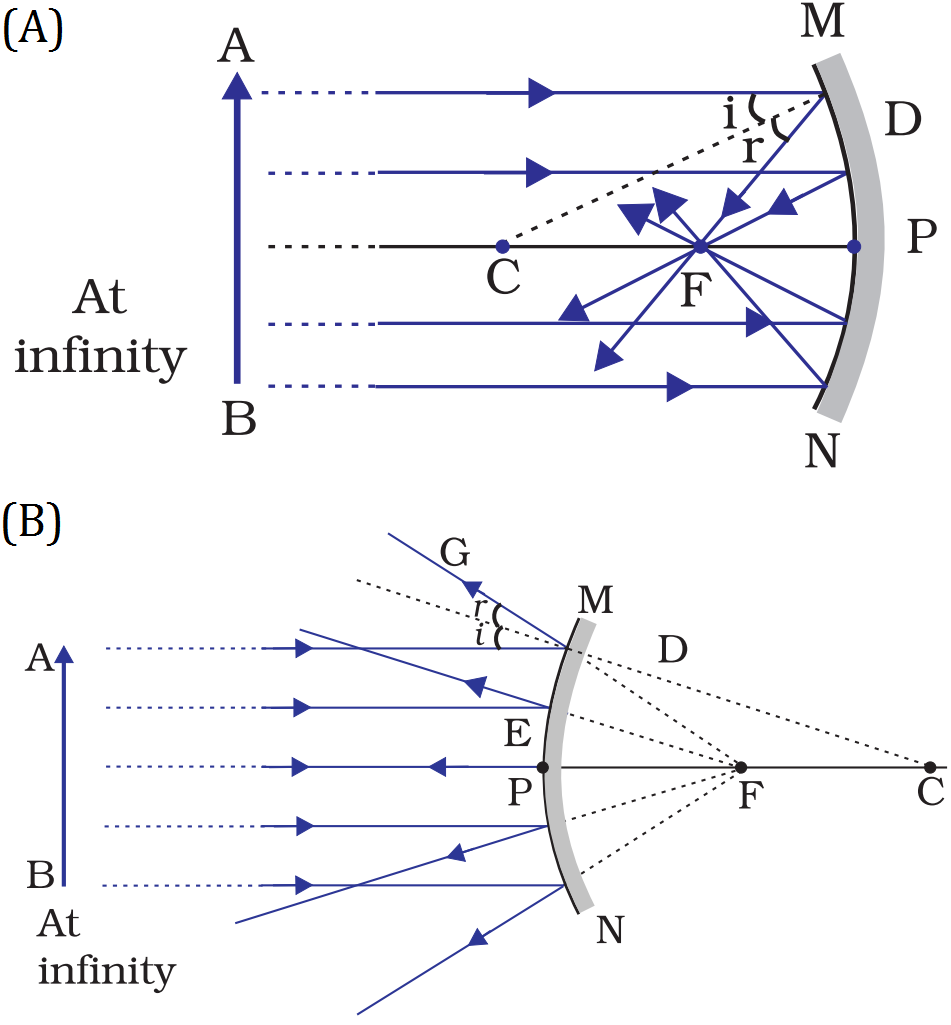
  1. Draw ray diagrams to show the principal focus of (i) a concave mirror, and (ii) a convex mirror.
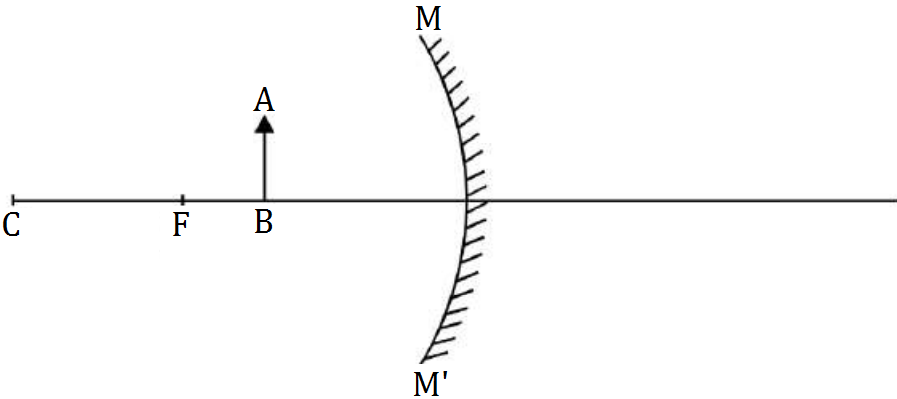
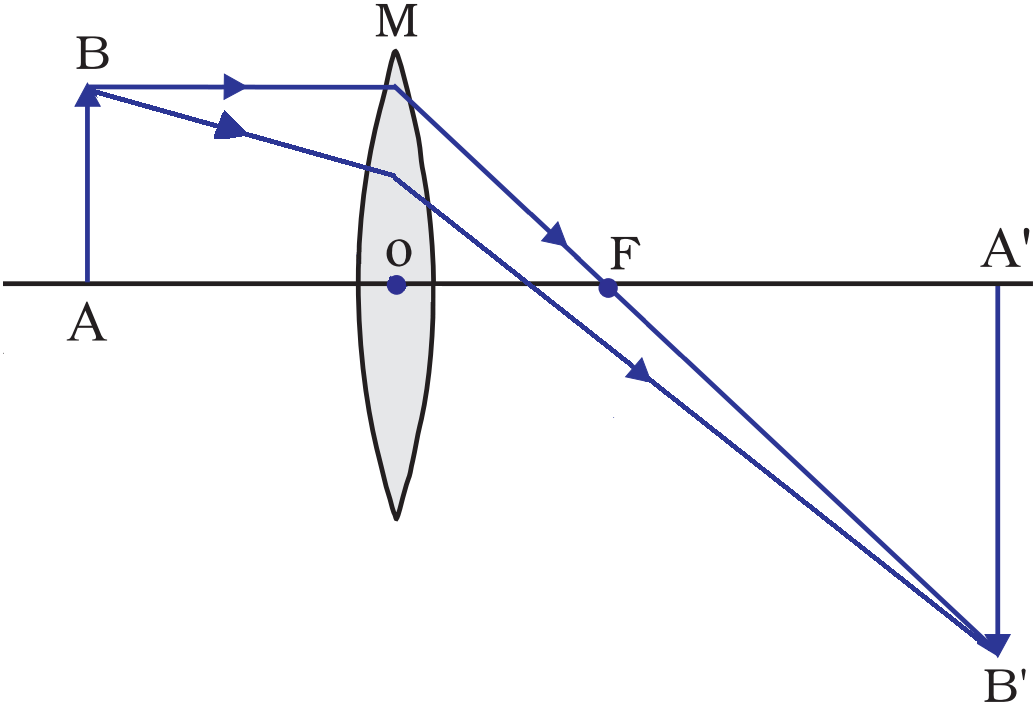
  2. In the following diagram, MM' is a concave mirror and AB is an object. Draw on your answer-sheet a ray diagram to show the formation of image of this object.
Answer
  1.  
  1. Pole: A pole is the central point of the reflecting surface of a spherical mirror. Pole lies on the mirror and is denoted by P.
  2. Centre of curvature: The centre of a sphere from which the given spherical mirror (convex or concave) is obtained is called as centre of curvature. It is denoted by the letter C.
  3. Principal axis: An imaginary straight line passing through the pole and centre of curvature is termed as the principal axis.
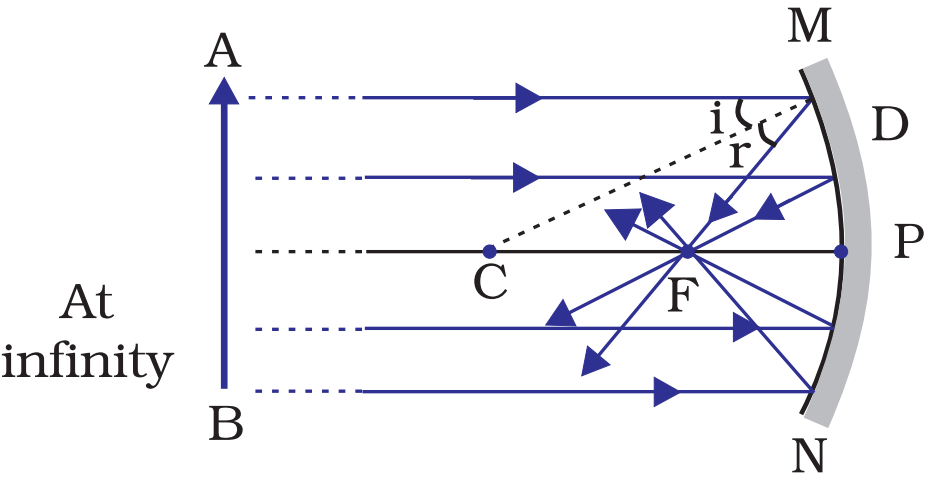
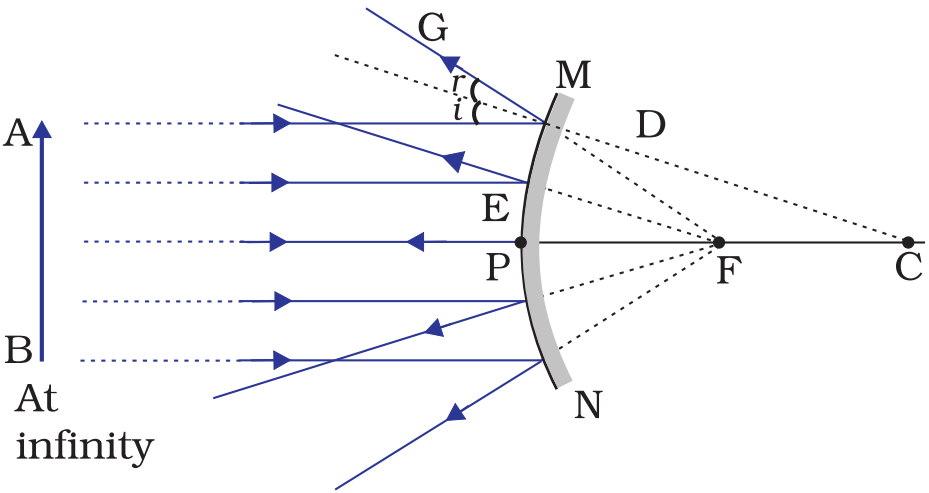
  4. Principal focus: The focus (F) is the point on the principal axis of a spherical mirror where all the incident rays parallel to the principal axis meet or appear to diverge from after reflection.
  1.  
Concave mirror: The focus lies on the same side of the reflecting surface.

Convex mirror: Focus is obtained on the opposite side of the reflecting surface by extending the rays reflected from the surface of the mirror.
  1.  

The given mirror M is a concave spherical mirror. The image formed is a virtual image and it is the characteristic property of the image.
View full question & answer
Question 215 Marks
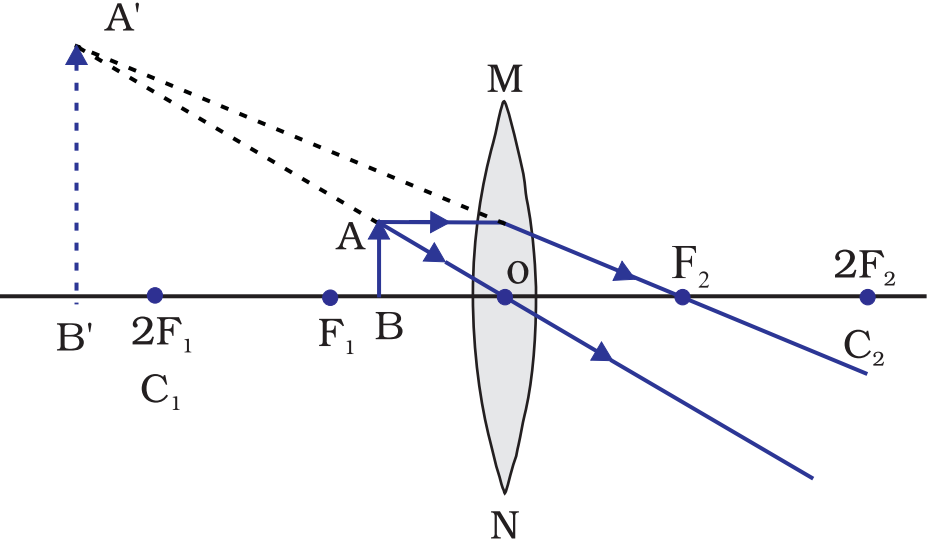
At what distance from a concave lens of focal length 25 cm a 10 cm tall object be placed so as to obtain its image at 20 cm from the lens. Also calculate the size of the image formed.
Draw a ray diagram to justify your answer for the above situation and label it.
Answer
$f=-25 cm ; h_1=6 cm ; v=-15 cm ; u=?$
$\text{Lens formula}:\frac{1}{\text{f}}=\frac{1}{\text{v}}-\frac{1}{\text{u}}$
$\Rightarrow\text{u}=\frac{\text{vf}}{\text{f}-\text{v}}=\frac{-15\text{cm}\times-20\text{cm}}{-20\text{cm}-(-15\text{cm})}$
= -60 cm object at 60 cm from the lens$\text{h}_2=\frac{\text{v}}{\text{u}}\times\text{h}_1=\frac{-15\text{cm}}{-60\text{cm}}\times6\text{cm}=+1.5\text{cm diminished erect.}$
View full question & answer
Question 225 Marks
Analyse the following observation table showing variation of image-distance (v) with object-distance (u) in case of a convex lens and answer the questions that follow without doing any calculations:
S. No. Object-Distance
u (cm)
Image-Distance
v (cm)
1. -60 +12
2. -30 +15
3. -20 +20
4. -15 +30
5. -12 +60
6. -9 +90
  1. What is the focal length of the convex lens? State reason for your answer.
  2. For what object-distance (u) is the corresponding image-distance (v) not correct? How did you arrive at this conclusion?
  3. Choose an appropriate scale to draw a ray diagram for the observation at S. No. 4 and find the approximate value of magnification.
Answer
  1. Observation no 3, indicates u = - 20 cm v = + 20 cm.
It suggests that object is at 2F.

Therefore f = + 10 cm.
  1. Observation no 6, because, here:
u = - 9 cm.

Thus object is between ‘O’ and ‘F’.

Hence image distance should be negative NOT positive.
  1.  


Magnification is approx = -2.
View full question & answer
Question 235 Marks
Suppose you have three concave mirrors A, B and C of focal lengths 10cm, 15cm and 20cm. For each concave mirror, you perform the experiment of image formation for three values of object distance of 10cm, 20cm and 30cm. Giving reason answer the following:
  1. For the three object distances, identify the mirror/ mirrors which will form an image of magnification - 1.
  2. Out of the three mirrors identify the mirror which would be preferred to be used for shaving purposes/ makeup.
  3. For the mirror B draw, ray diagram for image formation for object distances 10cm and 20cm.
Answer
Given, $f_a=10 cm ; f_b=15 cm ; f_c=20 cm$
$u_1=10 cm ; u_2=20 cm ; u_3=30 cm$
i. $m=-1$ means $u=2 f$. For $A$ it will be $u_2$ and for $B$ it will be $u_3$.
ii. Mirror B or C can be used for shaving, makeup purposes because the distance should be less than focal length for erect and magnified image. The face is generally kept at a distance more than 10 cm from the mirror.
iii. When $a =10 cm$
View full question & answer
Question 245 Marks
  1. To construct a ray diagram we use two rays which are so chosen that it is easy to know their directions after reflection from the mirror. List two such rays and state the path of these rays after reflection in case of concave mirrors. Use these two rays and draw ray diagram to locate the image of an object placed between pole and focus of a concave mirror.
  2. A concave mirror produces three times magnified image on a screen. If the object is placed 20 cm in front of the mirror, how far is the screen from the object?
Answer
  1. Two light rays whose path of reflection is priorly known are:
  1. The incident ray passes through the centre of curvature: In this case, light ray after reflecting from the concave mirror moves back in the same path. This happens because the light ray is incident perpendicularly on the mirror surface.
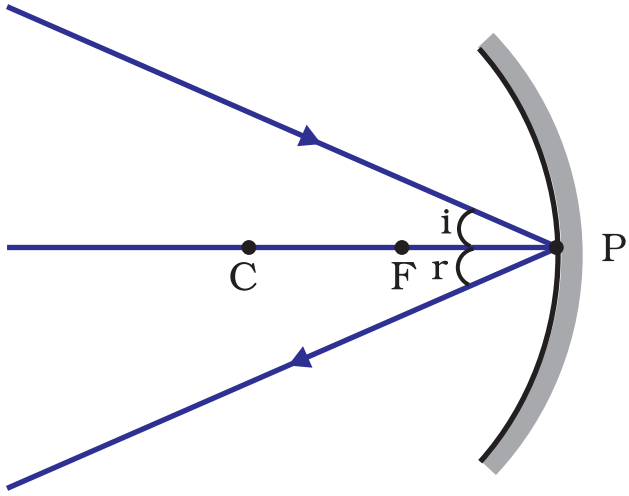
  1. The ray incident obliquely to the principal axis: In this case, the incident ray will be reflected back by the reflecting surface of the concave mirror obliquely and making equal angles with the principal axis.


Let an object "a candle" is placed between the focus and pole of the concave mirror. Then using above two rays, image of the candle can be located as shown below:

  1. Given,
u = -20 cm

m = -3

$\text{m}=\frac{\text{v}}{(-\text{u})}$

$\therefore \text{v}= -\text{m u}$

= -(-3)(-20 cm) = -60

Distance between the object and the screen is 40cm

= -60 cm - (-20 cm)= -40cm
View full question & answer
Question 255 Marks
  1. State the laws of refraction of light. Explain the term absolute refractive index of a medium and write an expression to relate it with the speed of light in vacuum.
  2. The absolute refractive indices of two media 'A' and 'B' are 2.0 and 1.5 respectively. If the speed of light in medium 'B' is 2 × $10^8$ m/ s, calculate the speed of light in:
  1. Vacuum,
  2. Medium 'A'.
Answer
Laws of refraction states that:
  1. The incident ray, the refracted ray and the normal to the interface of two media at the point of incidence all lie in the same plane.
  2. For the light of a given color and for given pair of media, the ratio of the sine of the angle of incidence to the sine of the angle of refraction is constant.
This is also known as Snell's Law.
Mathematically it can be written as:
  1. Here, is the refractive index of medium B with respect to medium A.
Refractive index of a medium with respect to the vacuum is known as the absolute refractive index.

$\mu_\text{B}=\frac{\text{C}}{\text{V}}$ c is the speed of light in vacuum and c is the speed of light in medium B.
  1. Absolute refractive of medium A, $\mu_\text{A}=2$
Absolute refractive index of medium B, $\mu_\text{B} = 1.5$
  1. For medium B,
$1.5=\frac{\text{c}}{2\times10^8}$

$\Rightarrow\text{C}=2\times1.5\times10^8$

$\Rightarrow\text{C}=3\times10^8$

Speed of light in vaccum is 3 × 10$^8$
  1. For medium A,
$\mu_\text{A}=\frac{\text{c}}{\text{v}}$

$\Rightarrow\text{v}=\frac{\text{c}}{\mu\text{A}}$

$\text{V}=\frac{3\times10^8}{2}$

$=1.5 \times 10^8$ is the required speed of light in medium A .
View full question & answer
Question 265 Marks
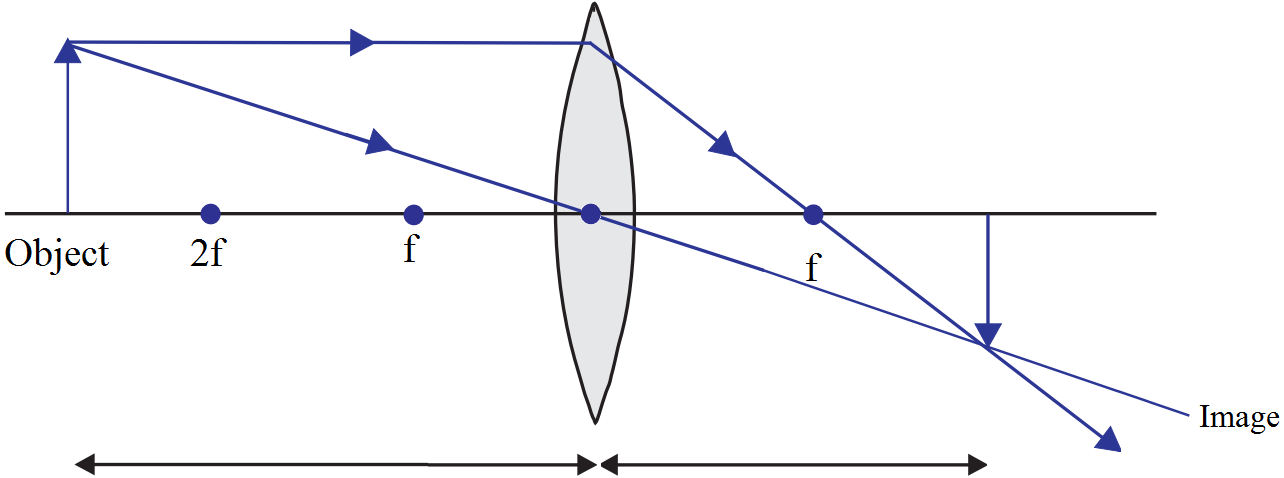
  1. Draw a ray diagram to show the formation of image by a convex lens when an object is placed in front of the lens between its optical centre and principal focus.
  2. In the above ray diagram mark the object-distance (u) and the image-distance (v) with their proper signs (+ve or – ve as per the new Cartesian sign convention) and state how these distances are related to the focal length (f) of the convex lens in this case.
  3. Find the power of a convex lens which forms a real, and inverted image of magnification –1 of an object placed at a distance of 20 cm from its optical centre.
Answer
  1. When an object is placed in front of the lens between its optical centre and principal focus, the image is formed beyond $2F_1$ (on the same side of the object), and the ray diagram is obtained is as follows:
  1. The object distance (u) and the image distance (v) are as shown below. Since both the image and the object lie in a direction opposite to the direction of incoming rays, the magnitude will be negative for both.


The relation between u, v and f is given by the lens formula,

$\frac{1}{\text{f}}=\frac{1}{\text{v}}-\frac{1}{\text{u}}$
Since both u and v are negative,

$\frac{1}{\text{f}}=\frac{1}{(-\text{v})}-\frac{1}{(-\text{u)}}$

$\frac{1}{\text{f}}=-\frac{1}{\text{v}}+\frac{1}{\text{u}}$

$\frac{1}{\text{f}}=\frac{1}{\text{u}}-\frac{1}{\text{v}}$
  1. Given
u = -20cm

m = -1

Since magnification is given as,

$\text{m}=\frac{\text{v}}{\text{u}}$

$\Rightarrow\text{v}=\text{mu}$

$=(-1)\times(-20)$

$=20\text{ cm}$

Focal length (f) can be calculated as:

$\frac{1}{\text{f}}=\frac{1}{\text{v}}-\frac{1}{\text{u}}=\frac{1}{20}-\Big(\frac{1}{-20}\Big)=\frac{1}{10}$

$\Rightarrow\text{f}=10\text{ cm}$

Thus, the power of the convex lens,

$\text{P}=\frac{1}{\text{f}(\text{m})}=\frac{100}{10}=10\text{D}$
View full question & answer
Question 275 Marks
The image of a candle flame placed at a distance of 30cm from a spherical lens is formed on a screen placed on the other side of the lens at a distance of 60cm from the optical centre of the lens. Identify the type of lens and calculate its focal length. If the height of the flame is 3cm, find the height of its image.
Answer
Since the image is formed on the screen, the image is real. A concave lens cannot form a real image. Therefore, the lens is convex. Object distance, u = -30 cm Image distance, v= +60 cm According to lens formula:$\frac{1}{\text{f}}=\frac{1}{\text{v}}-\frac{1}{\text{u}}$
$\frac{1}{\text{f}}=\frac{1}{+60}-\frac{1}{-30}=\frac{1}{60}+\frac{1}{30}=\frac{1+2}{60}=\frac{3}{30}$
Magnification of convex lens, $\text{m}=\frac{\text{v}}{\text{u}}$$\frac{\text{h}_2}{\text{h}_1}=\frac{\text{v}}{\text{u}}\Rightarrow\frac{\text{h}_2}{+3}=\frac{+60}{-30}$
$=\text{h}_2=\frac{+60}{-30}\times3$
$\therefore\text{h}_2=-6\text{ cm}$
Thus the image of the candle flame is 6cm high and inverted.
View full question & answer
Question 285 Marks
A student wants to project the image of a candle flame on the walls of the school laboratory by using a mirror.
  1. Which type of mirror should he use and why?
  2. At what distance, in terms of focal length 'f' of the mirror, should he place the candle flame to get the magnified image on the wall?
  3. Draw a ray diagram to show the formation of the image in this case.
  4. Can he use this mirror to project a diminished image of the candle flame on the same wall? State 'how' if your answer is 'yes' and 'why not' if your answer is 'no.'
Answer
  1. He should use a concave mirror as it forms real images.
  2. He should place the candle flame between the focus and centre of curvature of the mirror to get the magnified image on the wall.
  3. The ray diagram for the formation of the image is shown below:
  1. Yes, he can get a diminished image of the candle flame when the object is located at infinity.
View full question & answer
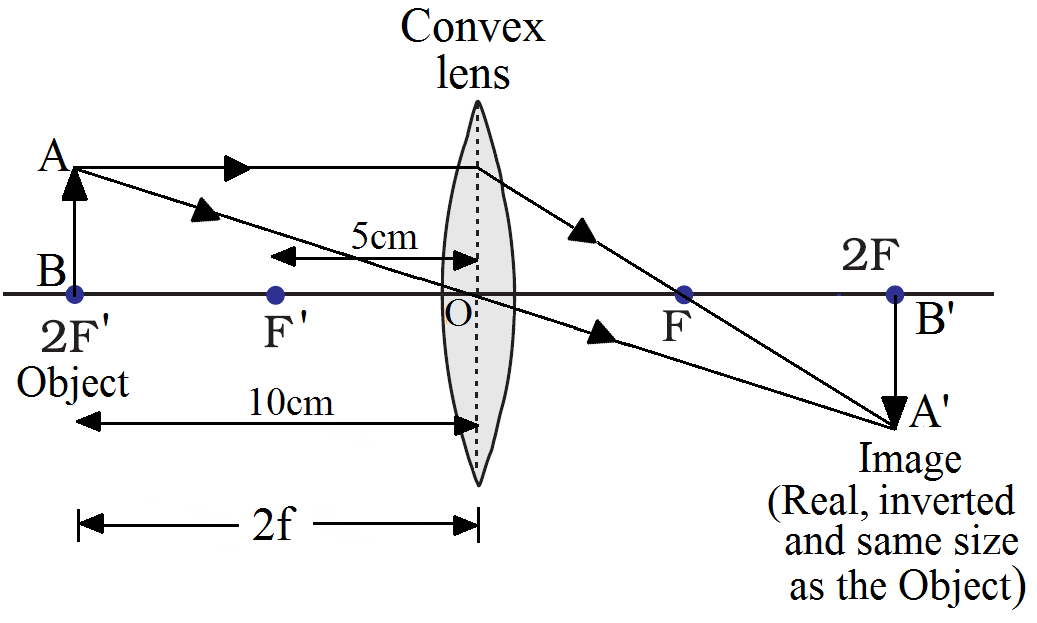
Question 295 Marks
  1. Draw a ray diagram to show the formation of image by a convex lens when an object is placed in front of the lens between its optical centre and principal focus.
  2. In the above ray diagram mark the object-distance (u) and the image-distance (v) with their proper signs (+ve or – ve as per the new Cartesian sign convention) and state how these distances are related to the focal length (f) of the convex lens in this case.
  3. Find the power of a convex lens which forms a real, and inverted image of magnification -1 of an object placed at a distance of 20cm from its optical centre.
Answer
  1. When an object is placed in front of the lens between its optical centre and principal focus, the image is formed beyond $2F_1$ (on the same side of the object), and the ray diagram is obtained is as follows:
  1. The object distance (u) and the image distance (v) are as shown below. Since both the image and the object lie in a direction opposite to the direction of incoming rays, the magnitude will be negative for both.


The relation betweem u, v and f is given by the lens formula,

$\frac{1}{\text{f}}=\frac{1}{\text{v}}-\frac{1}{\text{u}}$
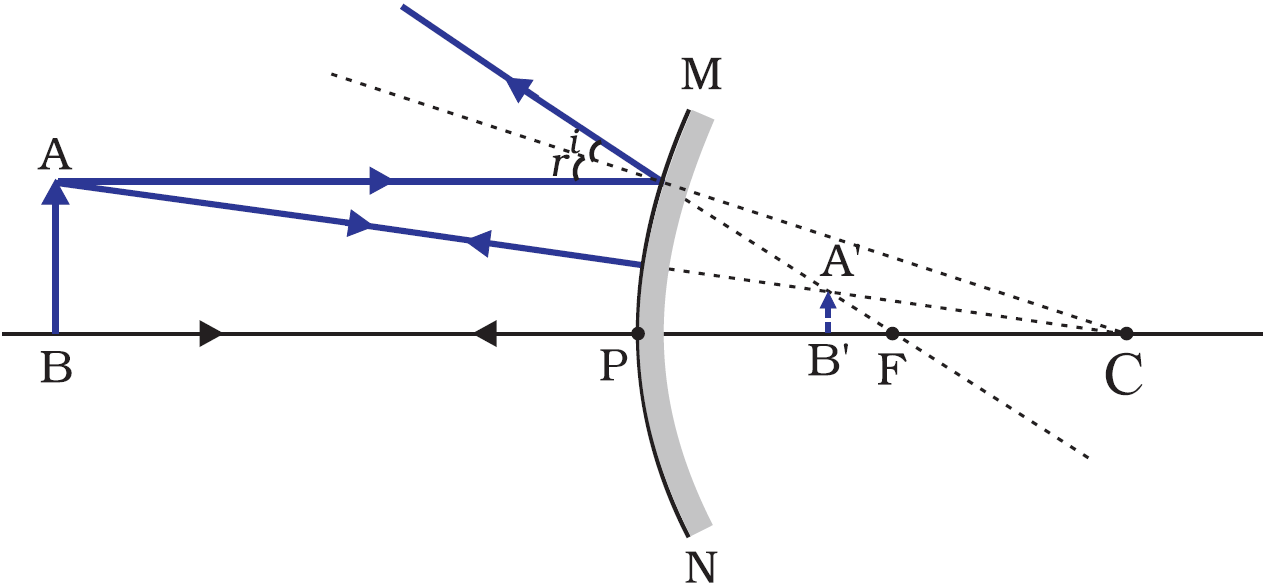
Since both u and v are negative,

$\frac{1}{\text{f}}=\frac{1}{\text{(-v)}}-\frac{1}{\text{(-u)}}$

$\frac{1}{\text{f}}=-\frac{1}{\text{v}}+\frac{1}{\text{u}}$

$\frac{1}{\text{f}}=\frac{1}{\text{u}}-\frac{1}{\text{v}}$
  1. Given
u = -20cm

m = -1

Since magnification is given as,

$\text{m}=\frac{\text{v}}{\text{u}}$

$\Rightarrow\text{v}=\text{nu}$

$=(-1)\times(-20)$

$=20\text{ cm}$

Focal length (f) cab be calculated as:

$\frac{1}{\text{f}}=\frac{1}{\text{v}}-\frac{1}{\text{u}}=\frac{1}{20}-\Big(\frac{1}{-20}\Big)=\frac{1}{10}$

$\Rightarrow\text{f}=10\text{ cm}$

Thus, the power of the convex lens,

$\text{P}=\frac{1}{\text{f}(\text{m})}=\frac{100}{10}=10\text{D}$
View full question & answer
Question 305 Marks
  1. Define the following terms in the context of spherical mirrors:
  1. Pole.
  2. Centre of curvature.
  3. Principal axis.
  4. Principal focus.
  1. Draw ray diagrams to show the principal focus of a:
  1. Concave mirror.
  2. Convex mirror.
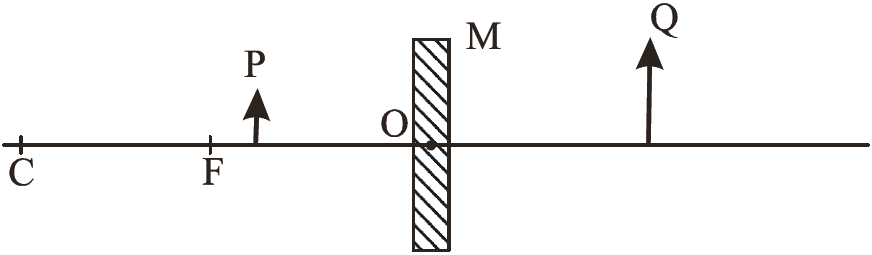
  1. Consider the following diagram in which M is a mirror and P is an object and Q is its magnified image formed by the mirror.


State the type of the mirror M and one characteristic property of the image Q.
Answer
  1.  
  1. Pole: Centre of the reflecting surface of the mirror.
  2. Centre of curvature: The centre of the hollow sphere of which the reflecting surface of mirror is a part.
  3. Principal axis: Straight-line passing through the pole and the centre of curvature of a spherical mirror.
  4. Principal focus: Incident rays parallel to principal axis, after reflection, either converge to or appear to diverge from a fixed point on the principal axis called principal focus of the spherical mirror.
  1.  
  1. Concave mirror Image formed is virtual.
View full question & answer
Question 315 Marks
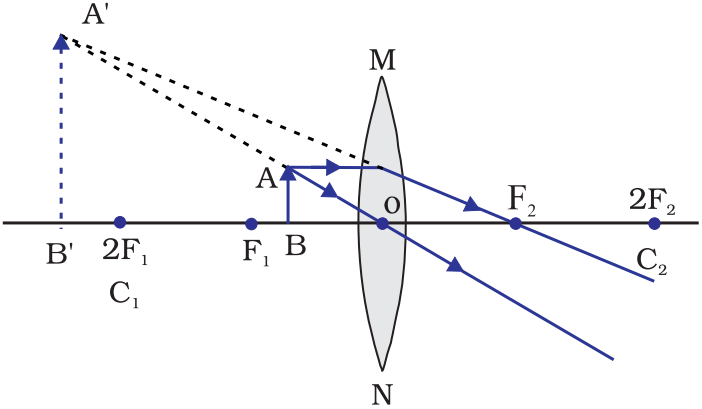
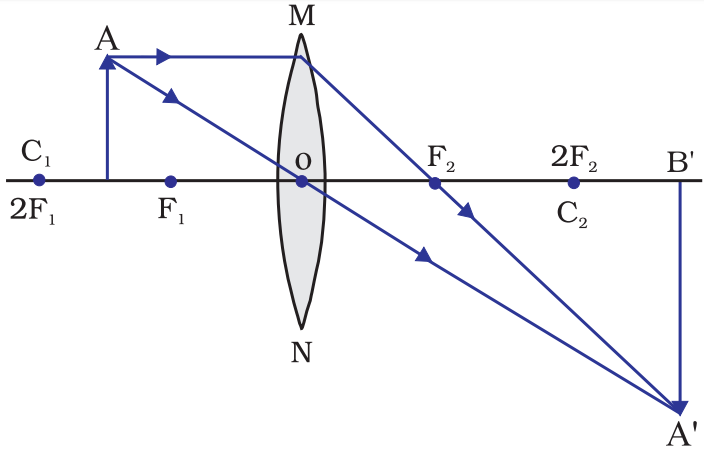
"A convex lens can form a magnified erect as well as magnified inverted image of an object placed in front of it." Draw ray diagram to justify this statement stating the position of the object with respect to the lens in each case.
An object of height 4 cm is placed at a distance of 20 cm from a concave lens of focal length 10 cm. Use lens formula to determine the position of the image formed.
Answer
For magnified erect image: Object is between the optical center and principal focus of a convex lens. For magnified inverted image: Object is between F and 2F of a convex lens. Lens formula$\frac{1}{\text{v}}-\frac{1}{\text{u}}=\frac{1}{\text{f}}$
$\text{f}=10\text{ cm}$
$\text{u}=-20\text{ cm}$
Applying above formula$\frac{1}{\text{v}}-\frac{1}{-20}=\frac{1}{10}$
$\frac{1}{\text{v}}=\frac{1}{10}-\frac{1}{20}=\frac{1}{20}$
$\text{v}=20\text{ cm}$
View full question & answer
Question 325 Marks
A student wants to project the image of a candle flame on the walls of school laboratory by using a lens:
  1. Which type of lens should he use and why?
  2. At what distance in terms of focal length ‘f’ of the lens should he place the candle flame so as to get.
  1. A magnified.
  2. A diminished image respectively on the wall?
  1. Draw ray diagram to show the formation of the image each case.
Answer
  1. The student should use a convex lens as it can form a real image (on a screen).
  2.  
  1. To get a magnified image on the wall, the candle flame should be placed between F and 2F from the lens.
  2. To get a diminished image on the wall the candle flame should be placed at a distance greater than 2F from the lens.
  1.  
  1.  
  1.  
View full question & answer
Question 335 Marks
  1. State the laws of refraction of light. Give an expression to relate the absolute refractive index of a medium with speed of light in vacuum.
  2. The refractive indices of water and glass with respect to air are 4/3 and 3/2 respectively. If the speed of light in glass is $2\times 10^8 \text{ ms}^{-1},$ find the speed of light in (i) air, (ii) water.
Answer
  1. Laws of refraction:
There are two laws of refraction.

First law of refraction:

The ratio of the sine of the angle of incidence to the sine of the angle of refraction is constant. This is known as Snell’s law. Mathematically, it can be given as follows:

$\frac{\sin{\text{i}}}{\sin{\text{r}}} = \text{n}_{\text{ab}}$

Here, $\text{n}_\text{ab}$ is the relative refractive index of medium a with respect to medium b.

Second law of refraction:

The incident ray, the refracted ray, and the normal to the interface of two media at the point of incidence – all lie in the same plane.

If the light ray goes from medium 1 to 2 then the refractive index of medium 1 with respect to medium 2 is,

$\text{n}_{12} = \frac{\text{speed of light in medium 2}}{\text{speed of light in medium 1}} = \frac{\text{v}_{2}}{\text{v}_{1}} $ where, $\text{v}_{1} \text{ and} \text{ v}_{2} $ are the speeds of light in medium 1 and 2 respectively.
  1. Given: Refractive index of water, $\text{n}_{\text{w}}$ = 4/3 and Refractive index of glass, $\text{n}_\text{g}$ = 3/2
Speed of light in glass, $\text{V}_{\text{g}} = 2 \times 10^{8} \text{ m/s}$
  1.  
$\frac{\text{n}_{\text{g}}}{\text{n}_{\text{a}}} = \frac{\text{V}_\text{a}}{\text{V}\text{g}}$ refractive index of air = 1

$\text{V}_{\text{a}}$ = speed of light in air

$\therefore \text{V}_{\text{a}} = \frac{\text{n}_{\text{g}}}{\text{n}_{\text{a}}}\times \text{V}_{\text{g}} = \frac{\frac{3}{2}}{1} \times (2\times10^{8}) = 3\times10^{8} \text{ m/s}$
  1. $\frac{\text{n}_{\text{g}}}{\text{n}_{\text{a}}} = \frac{\text{V}_\text{w}}{\text{V}\text{g}}$, where, $\text{V}_{\text{a}}$ = speed of light in water
$\therefore \text{V}_\text{w} = \frac{\text{n}_\text{g}}{\text{n}_\text{w}} \times \text{V}_{\text{g}} = \frac{\frac{3}{2}}{\frac{4}{3}} \times (2 \times 10^{8}) = 2.25 \times10^{8} \text{ m/s}$
View full question & answer
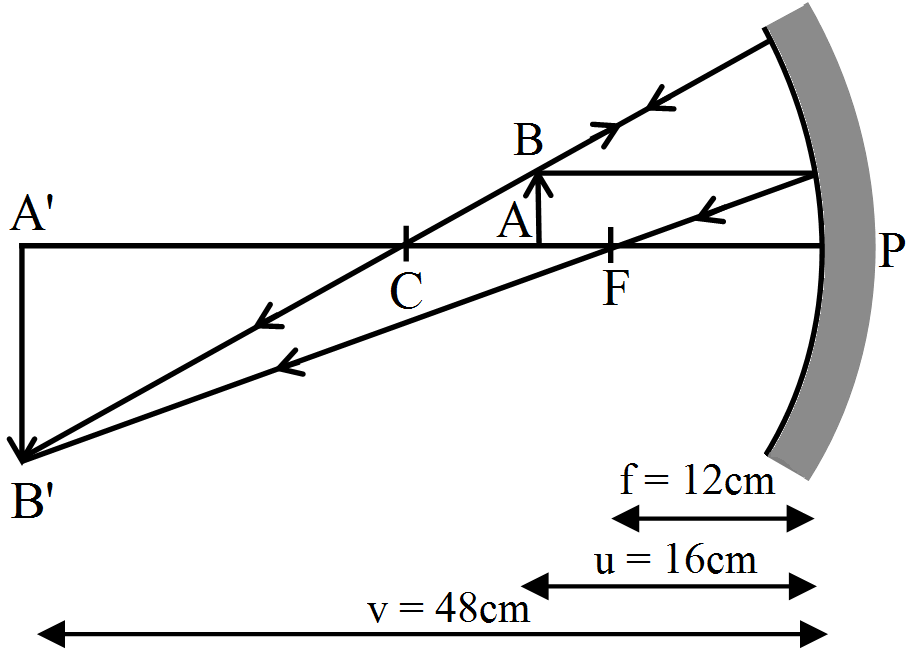
Question 345 Marks
List the sign conventions for reflection flight by spherical mirrors. Draw a diagram and apply these conventions in the determination of focal length of spherical mirror which forms a three times magnified real image of an object placed 16 cm infront of it.
Answer
Sign conventions for reflection of light by spherical mirror are:
  1. The object is always placed to the left of the mirror.
  2. All the distances parallel to the principal axis are always measured from the pole of the spherical mirror.
  3. All the distances measured along the direction of incident light (along +ve x-axis), are considered to be positive.
  4. Those distances measured opposite to the direction of incidence light (i.e. along -ve x-axis), are taken as negative.
  5. The distances measured in upward direction, i.e. perpendicular to and above the principal axis (along +ve y-axis), are taken as positive.
  6. The distances measured in the downward direction, (along -ve y-axis), i.e. perpendicular to and below the principal axis are taken as negative.
From the question

u = -16cm, m = -3 for real


But $\text{m}=-\frac{\text{v}}{\text{u}}=-3$

$\Rightarrow\text{v}=3\text{u}=3(-16)=-48\text{cm}.$

Using mirror fornula

$\frac{1}{\text{f}}=\frac{1}{\text{v}}+\frac{1}{\text{u}}$

We get, $=\frac{1}{\text{f}}=\frac{1}{-48}+\frac{1}{-16}$

$=\frac{1}{-48}+\frac{1}{-16}=\frac{-1-3}{48}=\frac{-4}{48}=\frac{-1}{12}$

$\text{f}=-12\text{cm}$

So, focal lenght of spherical mirror is 12cm. Negative sign of focal length indicates that mirror is concave in nature.
View full question & answer
Question 355 Marks
State the law of refraction of light that defines the refractive index of a medium with respect to the other. Express it mathematically. How is refractive index of any medium 'A' with respect to a medium 'B' related to the speed of propagation of light in two media A and B? State the name of this constant when one medium is vacuum or air.
The refractive indices of glass and water with respect to vacuum are $\frac{3}{2}$ and $\frac{4}{3}$ respectively. If the speed of light in glass is $2\times 10^{8} \text{ m/s}$ find the speed of light in,
  1. Vacuum.
  2. Water.
Answer
First law of refraction also known as Snell’s law defines the refractive index of a medium with respect to the other medium. First law of refraction states that, the ratio of the sine of the angle of incidence to the sine of the angle of refraction is constant. This is known as Snell’s law. Mathematically, it can be given as follows:$\frac{\sin\text{i}}{\sin\text{r}}=\text{constant}=\ ^{\text{a}}\mu_{\text{b}}$
Here, $^\text{a}\mu_\text{b}$ is the relative refractive index of medium b with respect to medium a. Consider a ray of light travelling from medium B into medium A. Let $v_1$ be the speed of light in medium A and $v_2$ be the speed of light in medium B. Then, Refractive index of medium A with respect to medium B is given by$\text{n}_{\text{AB}}=\frac{\text{v}_2}{\text{v}_1}$
If one medium is vacuum or air then the constant is known as absolute refractive index of the medium. Let, absolute refractive index of glass, $\text{n}_\text{g}=\frac{3}{2}$ Absolute refractive index of Water $\text{n}_\text{w}=\frac{4}{3}$ Speed of light in glass, $\text{v}_\text{g}=2\times10^{8}\text{m/s}$
  1. Speed of light inn cacuum
$\text{n}_\text{g}=\frac{\text{c}}{\text{v}_\text{g}}$
$\text{c}=\text{n}_\text{g}\times\text{v}_\text{g}=\frac{3}{2}\times2\times10^8\text{m/s}$
  1. Speed of light in water,
$\text{n}_\text{w}=\frac{\text{c}}{\text{v}_\text{w}}$
$\text{v}_\text{w}=\frac{\text{c}}{\text{n}_\text{w}}=\frac{3\times10^8}{\frac{4}{3}}=2.25\times10^8\text{m/s}$
View full question & answer
Question 365 Marks
  1. One-half of a convex lens is covered with a black paper. Will such a lens produce an image of the complete object? Support your answer with a ray diagram.
  2. An object 5 cm high is held 25 cm away from a converging lens of focal length 10 cm.
  1. Draw the ray diagram.
  2. Calculate the position and size of the image formed.
  3. What is the nature of the image?
Answer
  1. Image is formed by a large number of rays from the object. If one part of the lens is blackened, image will be formed. But, intensity of the image will be reduced.
  1.  
  1.  

Object distance, u = -25cm
Focal length, f = 10cm
Height of the image, h = 5cm
  1. Now, using the lens formula,
$\frac{1}{\text{f}} = \frac{1}{\text{v}} - \frac{1}{\text{u}}$
We have,
$\frac{1}{\text{v}} = \frac{1}{\text{f}} + \frac{1}{\text{u}}$
$\text{v}=\frac{\text{u}\times\text{f}}{\text{u}+\text{f}}$
$\text{v}=\frac{-25\times10}{10-25}=16.67\text{cm}$
Now, magnification
$\text{m}=-\frac{\text{v}}{\text{u}}=-\frac{\text{h}_\text{i}}{\text{h}_0}$
$=\text{h}_\text{i}=\frac{\text{v}\times\text{h}_0}{\text{u}}=\frac{6.67\times3}{(-25)}=-3.34\text{cm}$
  1. Negative sign indicates that the imae is real & inverted.
View full question & answer
Question 375 Marks
  1. If the image formed by a lens is diminished in size and erect, for all positions of the object, what type of lens is it?
  2. Name the point on the lens through which a ray of light passes undeviated.
  3. An object is placed perpendicular to the principal axis of a convex lens of focal length 20cm. The distance of the object from the lens is 30cm. Find,
  1. The position.
  2. The magnification.
  3. The nature of the image formed.
Answer
  1. If the image formed by a lens is diminished in size and erect, for all positions of the object, then the type of lens is a concave lens.
  2. The point on the lens through which a ray of light passes undeviating is known as Optical centre.
  3. Given,
Object distance, u = -30cm

Focal length, f = 20cm
  1. Now, using the len’s formula,
$\frac{1}{\text{f}}=\frac{1}{\text{v}}-\frac{1}{\text{u}}$
$\frac{1}{\text{v}}=\frac{1}{\text{f}}+\frac{1}{\text{u}}$
$\text{v}=\frac{\text{u}\times\text{f}}{\text{u}+\text{f}}$

The image is formed at a distance of 60cm of the other side of the optical centre.
  1. Magnification, $\text{m}=\text{m}=-\frac{\text{v}}{\text{u}}=-\frac{60}{-30}=2$
  2. Image formed is Real & inverted.
View full question & answer
Question 385 Marks
An object 4.0cm in size, is placed 25.0cm in front of a concave mirror of focal length 15.0cm.
  1. At what distance from the mirror should a screen be placed in order to obtain a sharp image?
  2. Find the size of the image.
  3. Draw a ray diagram to show the formation of image in this case.
Answer
Given h = +4.0cm, u = -25.0cm, f = -15.0cm
  1. Image distance v = ?, mirror formula: $\frac{1}{\text{v}}+\frac{1}{\text{u}}=\frac{1}{\text{f}}$
Or $\frac{1}{\text{v}}=\frac{1}{\text{f}}-\frac{1}{\text{u}};=-\frac{1}{15}-(-\frac{1}{25})$

$=\frac{-1}{15}+\frac{1}{25}=\frac{-5+3}{75}$

$=\frac{-2}{75}$

$\text{v}=-37.5\text{cm}.$

The screen should be placed 37.5cm in front of the mirror.
  1. $\text{m}=\frac{\text{h}^1}{\text{h}}=-\frac{\text{v}}{\text{u}}$
$\text{h}^1=-\frac{\text{v}}{\text{u}}\cdot\text{h}$

$=-\frac{(-37.5\times4)}{-25}$

$h^1=-6.0 cm$ (size of the image).
  1.  


Note: Deduct half mark for not showing arrows in ray diagrams.
View full question & answer
Question 395 Marks
Draw a ray diagram in each of the following cases to show the formation of image, when the object is placed:
  1. Between optical centre and principal focus of a convex lens.
  2. Anywhere in front of a concave lens.
  3. At 2F of a convex lens. State the signs and values of magnifications in the above mentioned cases (i) and (ii).
Answer
  1.  
  1.  
  1.  
1
In case (i) sign is positive and m> 1 (ii) sign is positive and m < 1.
View full question & answer
Question 405 Marks
An object is placed at a distance of 60cm from a concave lens of focal length 30cm.
  1. Use lens formula to find the distance of the image from the lens.
  2. List four characteristics of the image (nature, position, size, erect/ inverted) formed by the lens in this case.
  3. Draw ray diagram to justify your answer of part (ii).
Answer
We have,
  1. Object distance, u = -60cm
Focal length of the concave lens, f = -30cm

Using lens formula,

$\frac{1}{\text{v}}-\frac{1}{\text{u}}=\frac{1}{\text{f}}$

$\frac{1}{\text{v}}-\frac{1}{(-60)}=\frac{1}{(-30)}$

$\frac{1}{\text{v}}=\frac{-1}{30}-\frac{1}{60}$

$\frac{1}{\text{v}}=\frac{-3}{60}$

$\text{v}=-20\text{cm}$

The image will be formed at a distance of 20cm in front of the lens.
  1. Nature of the image is virtual. The position of the image is between $F_1$ and optical center $O$.
Size of the image is diminished. The image is Erect.
  1.  
View full question & answer
Question 415 Marks
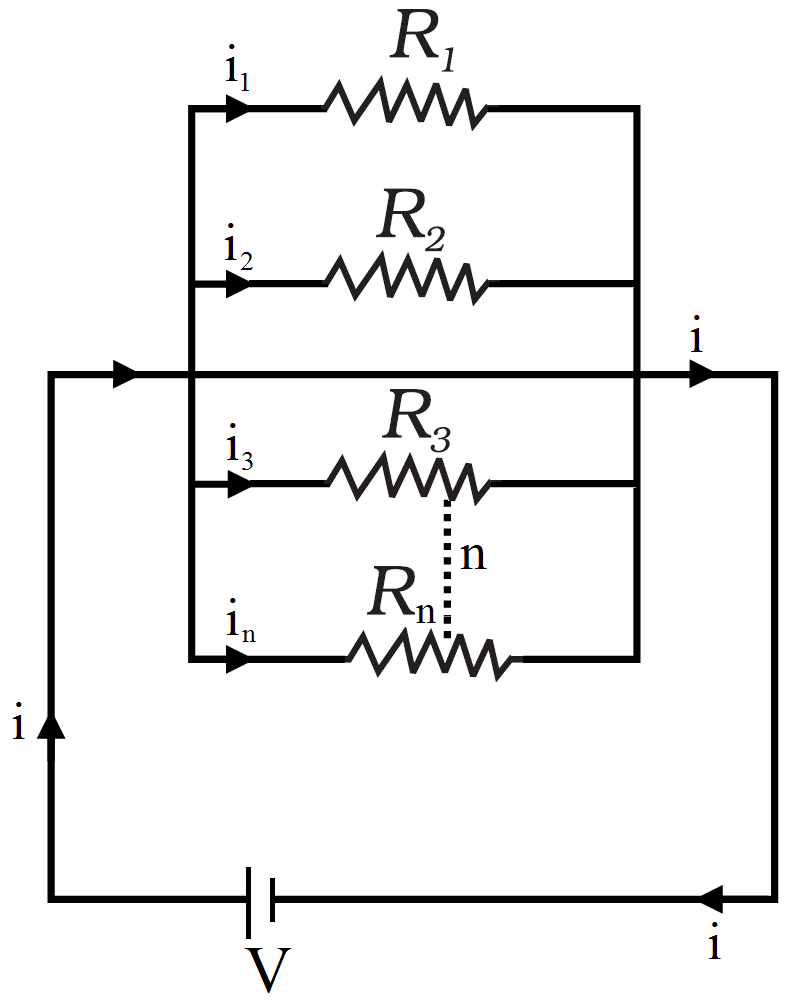
  1. With the help of a suitable circuit diagram prove that the reciprocal of the equivalent resistance of a group of resistances joined in parallel is equal to the sum of the reciprocals of the individual resistances.
  2. In an electric circuit, two resistors of $12\Omega$ each are joined in parallel to a 6V battery. Find the current drawn from the battery.
Answer
  1.  


Let there are $n$ resistances, each of value $R_1, R_2 \ldots \ldots . R_n$, respectively, are connected in parallel to a battery of voltage $V$. if the equivalent resistance of the circuit is $R_{\text {eq }}$, then current drawn from $i=\frac{V}{R(e q)}$ the battery is:
The total current i then divides into $i _1, i _2, i _3, \ldots i i _n$, respectively in the given resistors.
As all the resistances are connected in parallel, hence the voltage across each resistor is V volt.
Now we can write,
$i=i_1+i_2+i_3+\ldots+i_{eq}$
$\frac{v}{R(eq)}=\frac{v}{R_1}+\frac{v}{R_2}+\frac{v}{R_3}+\ldots+\frac{v}{R_{n}} \ldots(1)$
From equation 1 ,
$\frac{1}{R(eq)}=\frac{1}{R_1}+\frac{1}{R_2}+\frac{1}{R_3}+\ldots+\frac{1}{R_{n}}$
Hence, reciprocal of the equivalent resistance is equal to the sum of reciprocal of each resistor joined in parallel.
b. Let net resistance of the given parallel combination be $R _{\text {net }}$ Then,
$\frac{1}{R_{nct}}=\frac{1}{12}+\frac{1}{12}$
$\frac{1}{R_{nct}}=\frac{2}{12}=\frac{1}{6}$
$\Rightarrow R_{net}=6 \Omega$
Hence, current, $i =\frac{ V }{ R _{ nct }}=\frac{6 V}{6 \Omega}=1 A$
View full question & answer
Question 425 Marks
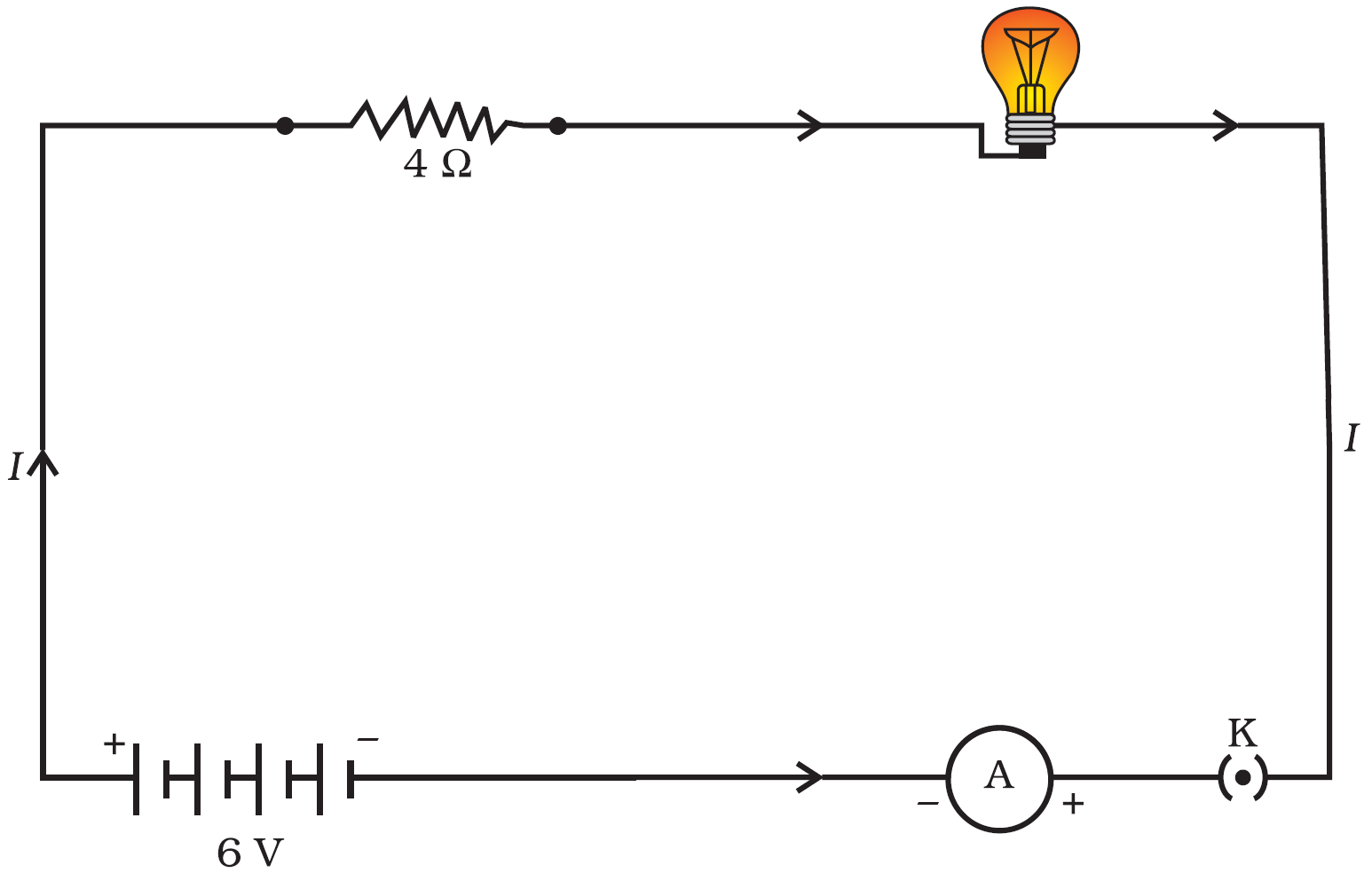
An electric lamp of resistance $20\Omega$ and a conductor of resistance $4\Omega$ are connected to a 6V battery as shown in the circuit. Calculate:
  1. The total resistance of the circuit,
  2. The current through the circuit,
  3. The potential difference across the (i) electric lamp and (ii) conductor, and
  4. Power of the lamp.
Answer

Resistance of electric lamp $=20\Omega$
Resistance of Conductor $=4\Omega$
Voltage of Battery = 6V
  1. The total resistance of the circuit $=20\Omega+4\Omega=24\Omega$
  2. Current in the circuit = I
Applying Ohm's law in the circuit,

$\text{V}=\text{IR}$

$6\text{V}=\text{I}\times24\Omega$

$\text{I}=\frac{6\text{V}}{24\Omega}=0.25\text{A}$

Hence current in the circuit is 0.25 Ampere.
  1. Potential difference across lamp,
$\text{V}_\text{lamp}=\text{IR}$

$\text{V}_\text{lamp}=0.25\text{A}\times20\Omega=5\text{V}$

$\therefore\ \text{V}_\text{lamp}=5\text{V}$

Potential difference across conductor,

$\text{V}_\text{Conductor}=\text{IR}$

$\text{V}_\text{Conductor}=0.25\text{A}\times4\Omega=1\text{V}$

$\therefore\ \text{V}_\text{Conductor}=1\text{V}$
  1. Power of Lamp $=\text{I}^2\text{R}=(0.25)^2\times20=1.25\text{W}$
View full question & answer
Question 435 Marks
An object is placed 15cm from (a) a converging mirror, and (b) a diverging mirror, of radius of curvature 20cm. Calculate the image position and magnification in each case.
Answer
Case 1: It is a converging mirror, i.e. concave mirror. Distance of the object 'u' = -15cm Radius of curvature of the mirror 'R' = -20cm Focal length of the mirror 'f' $=\frac{\text{R}}{2}=-10\text{cm}$ We have to find the position of the image 'v' and its magnification 'M'. Using the mirror formula, we get Distance of the object (u) = -5 m Magnification (m) = $\frac{1}{10}$ We have to find the position of the image (v), radius of curvature (R) and the focal length of the mirror (f). Using the magnification formula, we get$\frac{1}{\text{f}}=\frac{1}{\text{u}}+\frac{1}{\text{v}}$
$\Rightarrow\frac{1}{-10}=\frac{1}{-15}+\frac{1}{\text{v}}$
$\Rightarrow\frac{1}{\text{v}}=\frac{1}{-10}+\frac{1}{15}$
$\Rightarrow\frac{1}{\text{v}}=-\frac{1}{10}+\frac{1}{15}$
$\Rightarrow\frac{1}{\text{v}}=\frac{-15}{150}+\frac{10}{150}$
$\Rightarrow\frac{1}{\text{v}}=\frac{-5}{150}$
$\Rightarrow\frac{1}{\text{v}}=-30\text{cm}$
The image will be form ata distance of 30cm in front of converging mirror. Magnification$\frac{\text{-v}}{\text{u}}$$\text{m}=\frac{-(-30)}{-15}$
$\text{m}=-2$
magnifacation = -2 Thus the image is real, inverted and large in size.Case 2:
Mirror is converging mirror i.e. convex mirror. Distance of the object u = -15cm Radius of curvature of the mirror R = 20cm Focal length of the mirror f $=\frac{\text{R}}{2}=10\text{cm}$ We have to find the position of the image v = ? Magnification = ? Using the mirror formula, we get$\frac{1}{\text{f}}=\frac{1}{\text{u}}+\frac{1}{\text{v}}$
$\Rightarrow\frac{1}{\text{f}}=\frac{1}{-15}+\frac{1}{\text{v}}$
$\Rightarrow\frac{1}{10}=\frac{1}{-15}+\frac{1}{\text{v}}$
$\Rightarrow\frac{1}{\text{v}}=\frac{1}{10}+\frac{1}{15}$
$\Rightarrow\frac{1}{\text{v}}=\frac{15}{150}+\frac{10}{150}$
$\Rightarrow\frac{1}{\text{v}}=\frac{25}{150}$
$\Rightarrow\frac{1}{\text{v}}=\frac{1}{6}$
$\Rightarrow\text{v}=6\text{cm}$
Therefore, the image will form 6cm behind the mirror. Using the magnification formula, we get
$\text{m}=\frac{\text{-v}}{\text{u}}$
$\text{m}=\frac{-6}{-15}$
$\text{m}=0.4$
Thus, the image is virtual, erect and small in size.
View full question & answer
Question 445 Marks
The speed of light in vacuum and in two different glasses is given in the table below:
Medium
Speed of light
Vacuum
Flint glass
Crown glass
$3.00 \times 10^8 m / s$
$1.86 \times 10^8 m / s$
$1.97 \times 10^8 m / s$
  1. Calculate the absolute refractive indexes of flint glass and crown glass.
  2. Calculate the relative refractive index for light going from crown glass to flint glass.
Answer
  1. $\text{n}_{\text{flint}}=\frac{\text{Speed of light in vacuum}}{\text{Speed of light in flint glass}}$
$\text{n}_{\text{flint}}=\frac{3\times10^8}{1.86\times10^8}=1.61$

$\text{n}_{\text{crown}}=\frac{\text{Speed of light in vacuum}}{\text{Speed of light in crown glass}}$

$\text{n}_{\text{crown}}=\frac{3\times10^8}{1.97\times10^8}=1.52$
  1. $_{\text{crown}}\text{n}_\text{ flint}=\frac{\text{Speed of light in crown glass}}{\text{Speed of light in flint glass}}$
$_{\text{crown}}\text{n}_\text{ flint}=\frac{1.97\times10^8}{1.86\times10^8}=1.059$
View full question & answer
Question 455 Marks
If a concave mirror has a focal length of 10cm, find the two positions where an object can be placed to give, in each case, an image twice the height of the object.
Answer
$\text{f}=-10\text{cm}$Case 1: m = 2 (Image is virtual and erect)
$\text{m}=-\frac{\text{v}}{\text{u}}$
$2=-\frac{\text{v}}{\text{u}}$
$\Rightarrow{\text{v}}=2{\text{u}}$
$\frac{1}{\text{v}}+\frac{1}{\text{u}}=\frac{1}{\text{f}}$
$\frac{1}{-2\text{u}}+\frac{1}{\text{u}}=\frac{1}{10}$
$\frac{1}{\text{2u}}=\frac{-1}{10}$
$\text{u}=-5\text{cm}$
Case 2:
$\text{m}=-\frac{\text{v}}{\text{u}}$
$2=-\frac{\text{v}}{\text{u}}$
$\Rightarrow{\text{v}}=2{\text{u}}$
$\frac{1}{\text{v}}+\frac{1}{\text{u}}=\frac{1}{\text{f}}$
$\frac{1}{2\text{u}}+\frac{1}{\text{u}}=\frac{1}{-10}$
$\frac{3}{\text{3u}}=\frac{-1}{10}$
$\text{u}=-15\text{cm}$
View full question & answer
Question 465 Marks
An object is placed (a) 20cm, (b) 4cm, in front of a concave mirror of focal length 12cm. Find the nature and position of the image formed in each case.
Answer
  1. u = -20cm, f = -12cm
We know that

$\frac{1}{\text{v}}+\frac{1}{\text{u}}=\frac{1}{\text{f}}$

$\frac{1}{\text{v}}+\frac{1}{-20}=\frac{1}{-12}$

$\frac{1}{\text{v}}=\frac{-1}{20}+\frac{1}{20}=\frac{-20+12}{240}=\frac{-8}{240}$

$\text{v}=30\text{cm}$

The image is formed at a distance of 30cm in front of themirror.

The image is real and inverted.
  1. u = -4cm, f = -12cm
We know that

$\frac{1}{\text{v}}+\frac{1}{\text{u}}=\frac{1}{\text{f}}$

$\frac{1}{\text{v}}+\frac{1}{-4}=\frac{1}{-12}$

$\frac{1}{\text{v}}=\frac{-1}{12}+\frac{1}{4}=\frac{-1+3}{12}=\frac{-2}{12}$

$\text{v}=6\text{cm}$

The image is formed at a distance of 6cm in behind the mirror.

The image is virtual and erect.
View full question & answer
Question 475 Marks
At what distance from a concave mirror of focal length 10cm should an object be placed so that:
  1. Its real image is formed 20cm from the mirror?
  2. Its virtual image is formed 20cm from the mirror?
Answer
  1. Given,
It is a concave mirror.

F = −10cm

V = −20cm

the image is real and forms in front of the mirror, the equation will be

$\frac{1}{\text{f}}=\frac{1}{\text{v}}+\frac{1}{\text{u}}$
$\frac{1}{-10}=\frac{1}{-20}+\frac{1}{\text{u}}$
$\frac{1}{\text{u}}=\frac{1}{-10}+\frac{1}{20}$

$\frac{1}{\text{u}}=\frac{-20+10}{200}$

$\frac{1}{\text{u}}=\frac{-10}{200}$

$\frac{1}{\text{u}}=\frac{1}{-20}$

$\text{u}=-20\text{cm}$

Therefore, the object should be placed at a distance of 20cm from the mirror to form a real image
  1. Given,
F = −10cm

V = +20cm

Since the image is virtual and forms behind the mirror, the equation will be

$\frac{1}{\text{f}}=\frac{1}{\text{v}}+\frac{1}{\text{u}}$
$\frac{1}{-10}=\frac{1}{-20}+\frac{1}{\text{u}}$
$\frac{1}{\text{u}}=\frac{1}{-10}+\frac{1}{20}$

$\frac{1}{\text{u}}=\frac{-20-10}{200}$

$\frac{1}{\text{u}}=\frac{-3}{20}$

${\text{u}}=-\frac{20}{3}$

Therefore, the object must be placed at a distance of 20/3cm from the mirror to form the virtual image.
View full question & answer
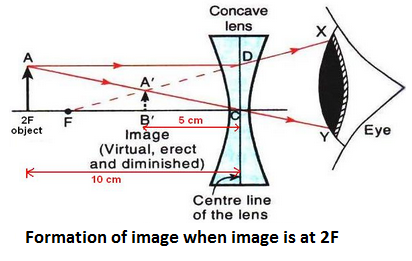
Question 485 Marks
An object is placed 10cm from a lens of focal length 5cm. Draw the ray diagrams to show the formation of image if the lens is:
  1. Converging, and
  2. Diverging.
Answer
  1.  
  1.  
View full question & answer
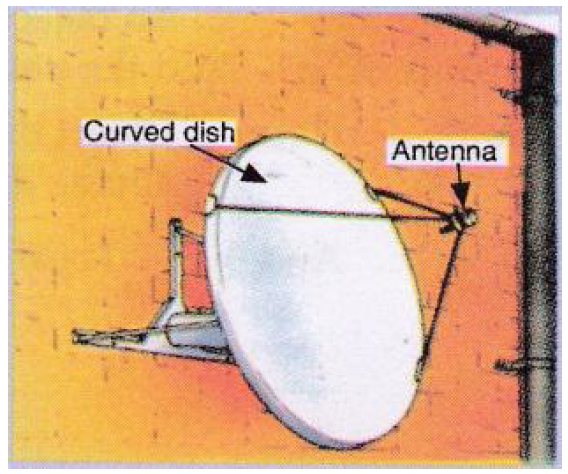
Question 495 Marks
The diagram shows a dish antenna which is used to receive television signals from a satellite. The antenna (signal detector) is fixed in front of the curved dish.
  1. What is the purpose of the dish?
  2. Should it be concave or convex?
  3. Where should the antenna be positioned to receive the strongest possible signals?
  4. Explain what change you would expect in the signals if a larger dish was used.
Answer
  1. The dish is collecting the large amount of signal from the satellite, and converging them to the antenna.
  2. The dish should be concave.
  3. The antenna should be positioned at the focus of the concave dish to receive the strongest possible signals.
  4. If a larger dish was used, the aperture of the concave mirror would have been bigger; therefore, the signals received by the antenna would have been stronger.
View full question & answer
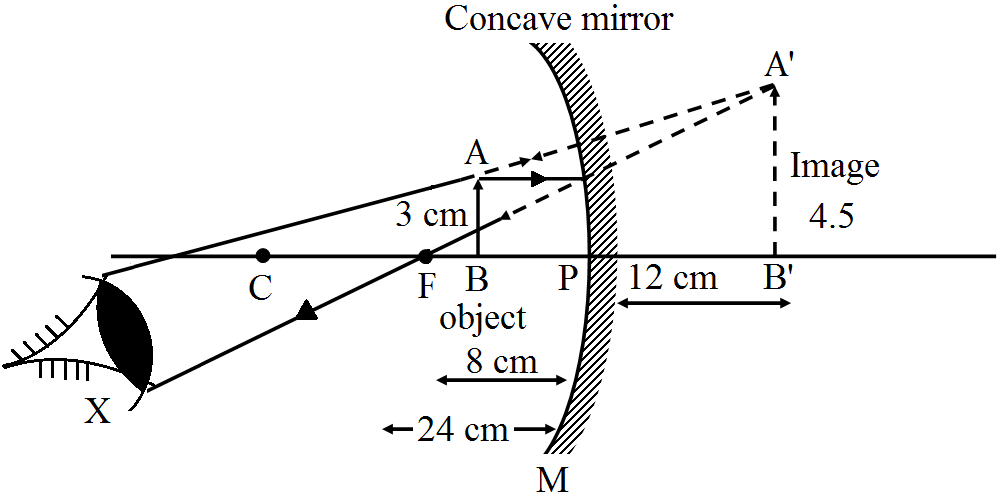
Question 505 Marks
An object 3cm high is placed at a distance of 8cm from a concave mirror which produces a virtual image 4.5cm high:
  1. What is the focal length of the mirror?
  2. What is the position of image?
  3. Draw a ray-diagram to show the formation of image.
Answer
$h_1=3 cm, u =-8 cm, h _2=4.5$ (virtual image)
  1. We know that
$\text{m}=\frac{\text{h}_2}{\text{h}_1}=\frac{4.5}{3}=1.5$

and

$\text{m}=-\frac{\text{v}}{\text{u}}$

$\Rightarrow1.5=\frac{\text{v}}{(-8)}$

$\Rightarrow\text{v}=1.5\times8=12\text{cm}$

We have

$\frac{1}{\text{v}}+\frac{1}{\text{u}}=\frac{1}{\text{f}}$
$\Rightarrow\frac{1}{12}+\frac{1}{(-8)}=\frac{1}{\text{f}}$

$\Rightarrow\frac{1}{\text{f}}=\frac{1}{12}-\frac{1}{8}=\frac{2-3}{24}=-\frac{1}{24}$

$\therefore\text{f}=-24\text{cm}$
  1. v = 12cm
So, the image is formed 12cm behind the concave mirror.
  1.  
View full question & answer
[5 marks Questions] - Science STD 10 Questions - Vidyadip