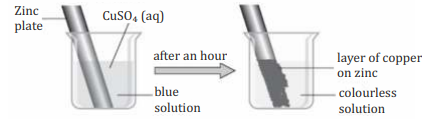
Ionic compound is a chemical compound in which ions are held together by ionic bonds. An ionic bond is the type of chemical bond in which two oppositely charged ions are held through electrostatic forces. We know that, metal atoms have loosely bound valence electrons in their valence shell and non-metal atoms need electrons in their valence shell to attain noble gas configuration. The metal atom loses the valence electrons while non-metal atom accepts these electrons. By losing electrons, metal atoms change to cations and by accepting electrons, non-metals form anions. Ionic compounds are generally solid and exist in the form of crystal. They have high melting and boiling points.
- Write two element which can change to a cation?
- Write two element which can change to an anion?
- Which Ionic compounds are soluble and how?
OR - What are Ionic compounds? Give two examples.
- (c) Potassium.
Explanation:
Potassium, being a metal, can change to cation by losing its valence electron.
- (a) Iodine.
Explanation:
Iodine, being a non-metal, can change to anion by gaining electron.
- (c) Water.
Explanation:
Ionic compounds are generally soluble in water and insoluble in kerosene and petrol.
- (d) II and III only.
Explanation:
Ionic compounds do not conduct electricity in solid state, as ions are very closely packed and are free to move.
- (c) Formation of ionic bonds involve sharing of electrons.
Explanation:
Formation of ionic bonds involve complete transfer of electrons from metal atom to non-metal atom.