MCQ 11 Mark
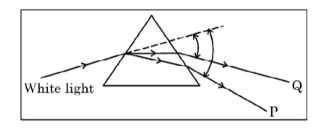
- ✓Violet and Red
- BOrange and Green
- CRed and Blue
- DRed and Violet
Answer
View full question & answer→Correct option: A.
Violet and Red
(A) Violet and Red
Explanation: The splitting of white light into its constituent colours is known as light dispersion. The spectrum is the band of seven colours produced by splitting white light. All of the constituent colours of white light have the same velocity in vacuum, but their velocity changes when they pass through a transparent 'medium' like a glass prism. Different colours are diverted by different angles on the prism's initial face. Violet's minimum speed is deviated by the maximum angle, whereas red's maximum speed is distorted by the minimum angle. As a result, the letters ' P ' and ' Q ' are violet and crimson, respectively.
Explanation: The splitting of white light into its constituent colours is known as light dispersion. The spectrum is the band of seven colours produced by splitting white light. All of the constituent colours of white light have the same velocity in vacuum, but their velocity changes when they pass through a transparent 'medium' like a glass prism. Different colours are diverted by different angles on the prism's initial face. Violet's minimum speed is deviated by the maximum angle, whereas red's maximum speed is distorted by the minimum angle. As a result, the letters ' P ' and ' Q ' are violet and crimson, respectively.