MCQ
Which of the following statements is true?
  • A
    A concave lens has 4 dioptre power having
  • B
    A concave lens has-8 dioptre power having a focal length 0.25 m a focal length of 0.25 m
  • C
    A convex lens has -4 dioptre power having a focal length 0.25 m
  • A convex lens has 4 dioptre power having a focal length 0.25 m

Answer

Correct option: D.
A convex lens has 4 dioptre power having a focal length 0.25 m
(D) A convex lens has 4 dioptre power having a focal length 0.25 m
Explanation: The power P of a lens of the focal length is given by $P=\frac{1}{f}$, where f is the focal length in meter and power in dioptre $P=\frac{1}{f}$ orf $=\frac{1}{P}=\frac{1}{4}=0.25 \mathrm{~m}$
The positive value for focal length indicates a convex lens.

Need a full question paper?

Generate a complete, print-ready paper with questions like this in minutes — across 16+ boards, with answer keys.

Start Generating Free

Similar questions

Electricity flows through a very long solenoid. Some statements are given below related to the magnitude of the magnetic field developed inside the coil. Find out the correct ones and write them down:
Which of the following phenomena contributes significantly to the reddish appearance of the sun at sunrise or sunset?
  1. Dispersion of light.
  2. Scattering of light.
  3. Total internal reflection of light.
  4. Reflection of light from the earth.
The focal length of a small concave mirror is 2.5cm. In order to use this concave mirror as a dentist's mirror, the distance of tooth from the mirror should be:
  1. 2.5cm
  2. 1.5cm
  3. 4.5cm
  4. 3.5cm
Our eye lens is held in position by:
An object is placed at the following distances from a concave mirror of focal length 15cm, turn by turn:
  1. 35cm
  2. 30cm
  3. 20cm
  4. 10cm
Which position of the object will produce:
  1. A magnified real image?
  2. A magnified virtual image?
  3. A diminished real image?
  4. An image of same size as the object?
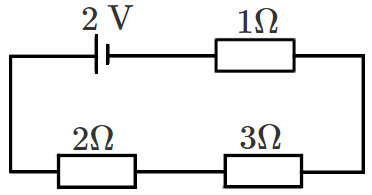
In the circuit shown below:

The potential difference across the $3 Ω$ resistor is:
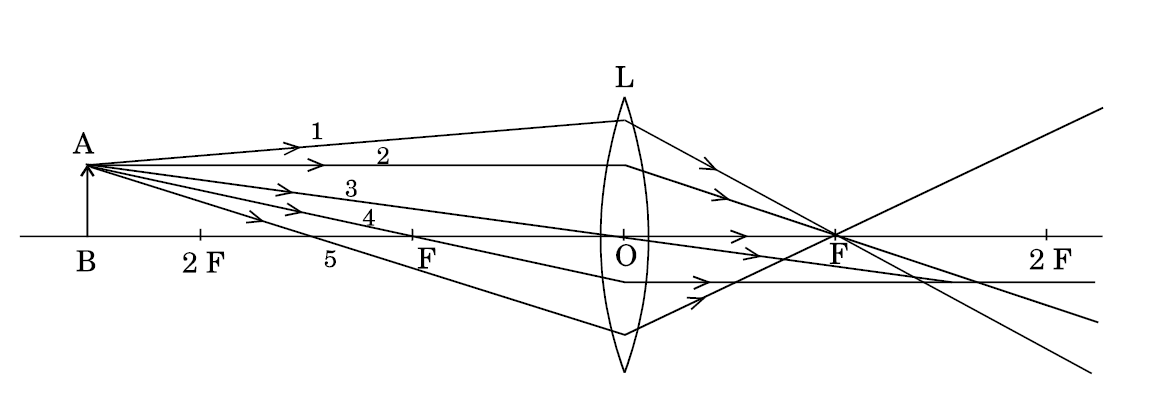
A student is using a convex lens of focal length 18 cm to study the image formation by it for the various positions of the object. He observes that when he places the object at 27 cm, the location of the image is at 54 cm on the other side of the lens. Identify from the following diagram the three rays that are obeying the laws of refraction and may be used to draw the corresponding ray diagram.
Which of the following can make a parallel beam of light when light from a point source is incident on it?
  1. Concave mirror as well as convex lens.
  2. Convex mirror as well as concave lens.
  3. Two plane mirrors placed at 90° to each other.
  4. Concave mirror as well as concave lens.
The angle of incidence for of light passing through the centre of curvature of a concave mirror is:
An electric refrigerator rated 400W operates 8 hours/ day. The cost of the energy to operate it for 30 days at Rs. 3 per kWh is: