Question 15 Marks
i. What is meant by power of a lens? Define its Sl unit.
ii. You have two lenses A and B of focal lengths +10 cm and - 10 cm, respectively. State the nature and power of each lens. Which of the two lenses will from a virtual and magnified image of an object placed 8 cm from the lens? Draw a ray diagram to justify your answer.
ii. You have two lenses A and B of focal lengths +10 cm and - 10 cm, respectively. State the nature and power of each lens. Which of the two lenses will from a virtual and magnified image of an object placed 8 cm from the lens? Draw a ray diagram to justify your answer.
Answer
View full question & answer→The ability of a lens to converge or diverge light rays is called power of the lens. It is defined as the reciprocal of focal length. It's Sl unit is dioptre (D). If focal length is expressed in metres, then power is expressed in dioptre. We can say, dioptre is the power of a lens whose focal length is one metre. For concave lens P and f are negative. For convex lens P and f are positive. Lens A of focal length + 10 cm is convex lens
and power $P =\frac{100}{f(i n con )}=\frac{100}{10}=+10 D$
Lens B of focal length - 10 cm is concave lens
and power, P $\frac{100}{f(i n a n)}=\frac{100}{-10}=-10 D$
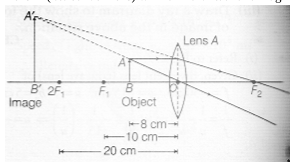
Lens A (i.e. convex lens) will form a virtual and magnified image of an object placed 8 cm from it, as shown.
and power $P =\frac{100}{f(i n con )}=\frac{100}{10}=+10 D$
Lens B of focal length - 10 cm is concave lens
and power, P $\frac{100}{f(i n a n)}=\frac{100}{-10}=-10 D$
Lens A (i.e. convex lens) will form a virtual and magnified image of an object placed 8 cm from it, as shown.